Buy Argor-Heraeus Gold Bars Online
Our catalog of Argor-Heraeus gold bars spans a wide range of weights, formats, and packaging configurations, giving buyers genuine flexibility when selecting the right product for their needs. From the compact 1 gram bar in an assay card to the substantial 1 kilo cast bar, each product in this lineup is refined to .9999 fine gold and manufactured at one of Switzerland's most respected private refineries. Whether you're looking at fractional sizes like the 1/10 oz, 1/4 oz, or 1/2 oz bars, or pursuing a full troy ounce in either standard assay or Kinebar format, this selection covers the most commonly traded Argor-Heraeus bar configurations available in the market today.
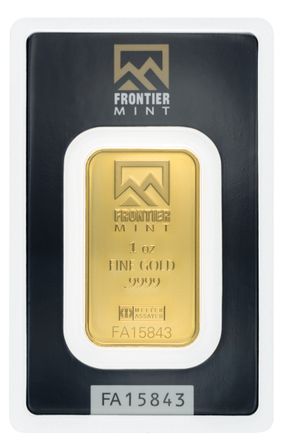
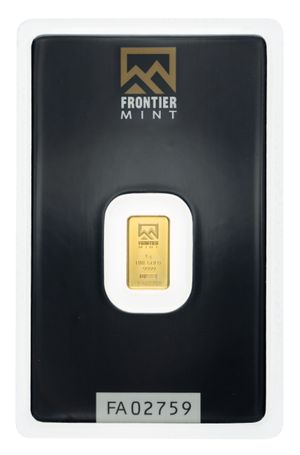
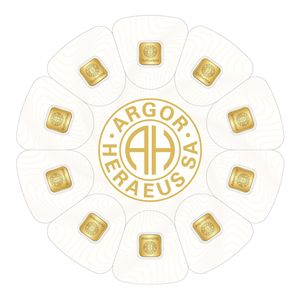
Alongside the flagship Argor-Heraeus branded bars, our catalog also includes Frontier Mint products that carry Argor-Heraeus refinery origin, maintaining the same Swiss purity standards under a different distribution label. Unique multi-bar formats like the 10 x 1 gram Goldseed product are also available for buyers who prefer divisibility without sacrificing the credibility of the underlying refinery. Bullion Standard presents these products with transparent pricing rooted in real-time market conditions, so you're working with current data rather than artificial markups.
Pricing on each product page reflects the live spot price relationship alongside the current premium, giving buyers a clear picture of what they're actually paying above market. Our two-way market structure means you can evaluate both the acquisition cost and the expected buyback value before committing to a purchase, which is the kind of pricing clarity that's often missing from traditional bullion retail environments.
What Are Argor-Heraeus Gold Bars?
Argor-Heraeus gold bars are privately refined bullion products produced at the Argor-Heraeus facility in Mendrisio, Switzerland. Unlike government-issued coins, these bars carry no face value or legal tender status. They are pure bullion products, priced by weight and purity rather than numismatic or collectible value. That distinction makes them straightforward to price, trade, and evaluate using standard market benchmarks.
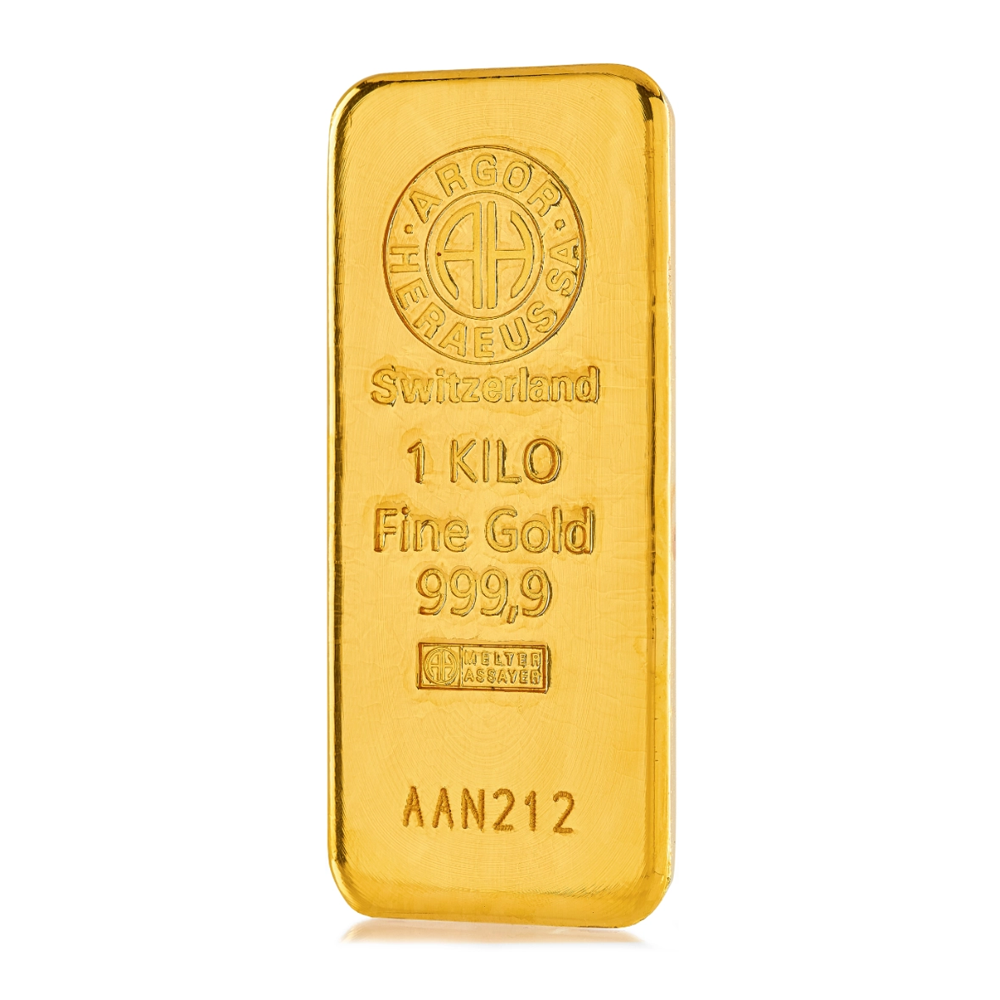
The bars in this catalog come in two primary formats: minted and cast. Minted bars, which represent the majority of Argor-Heraeus products sold at retail, are produced by cutting precisely sized blanks from rolled gold sheet and stamping them with design and certification details. Cast bars, like the 1 kilo option here, are formed by pouring molten gold into a mold, resulting in a more utilitarian finish that typically carries a lower fabrication premium. Both formats carry identical purity, but the surface appearance and premium structure differ meaningfully between the two.
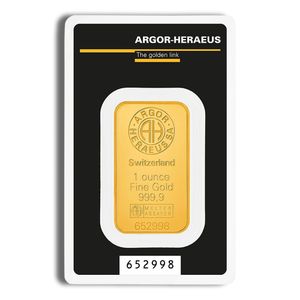
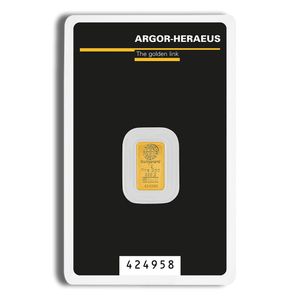
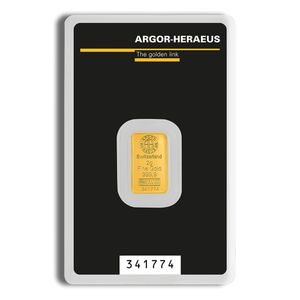
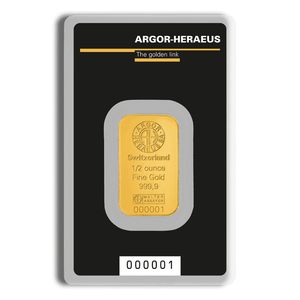
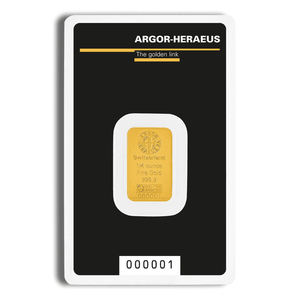
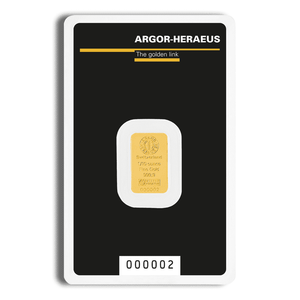
Most of the bars in this selection are packaged in individual assay cards, which are sealed presentation cards that include printed certification of weight, purity, and refinery origin. Assay packaging is standard for smaller minted bars because it provides tamper-evident protection and makes authentication straightforward at the point of resale. The Kinebar variant adds a holographic security strip as an additional anti-counterfeiting measure, which is a detail worth noting when comparing similar weight products side by side.
History and Background
Argor-Heraeus has roots going back to 1951, when it was founded in Chiasso, Switzerland, under the name Argor S.A. The company developed refining operations that aligned closely with Switzerland's long-established position as a global center for precious metals processing. Switzerland's geographic neutrality, stable legal framework, and concentration of banking and commodity infrastructure made it the natural home for some of the world's most consequential gold refining operations, and Argor grew alongside that ecosystem.
The Heraeus partnership came through a series of corporate developments that eventually produced the Argor-Heraeus name, linking the Swiss operation to Heraeus, the German precious metals and technology group with origins in the mid-19th century. The combination brought together two institutions with deep industrial roots in precious metals refining and fabrication. Today the Mendrisio facility is one of four Swiss refineries accredited by the London Bullion Market Association, a designation that reflects adherence to strict standards for gold purity, chain of custody, and responsible sourcing.
The broader market for privately refined gold bars expanded significantly through the latter half of the 20th century as institutional demand for standardized, verifiable gold products increased across banking, central reserve management, and retail bullion distribution. Argor-Heraeus benefited from that growth by establishing reliable production across a wide range of bar weights, from fractional gram sizes to Good Delivery kilobars, making their products accessible across multiple buyer segments and distribution channels.
Purity, Weight, and Specifications
Every Argor-Heraeus gold bar in this catalog is refined to a purity of .9999 fine gold, also expressed as 24 karat. This purity level represents four nines fineness, meaning the gold content is 99.99% pure with minimal trace elements from the refining process. It is the standard purity for most investment-grade gold bars sold through the wholesale and retail bullion market globally.
The weight range covered here moves from 1 gram at the smallest end through 2 grams, then into troy ounce denominations at 1/10 oz, 1/4 oz, 1/2 oz, 1 oz, and up to 1 kilogram. The 10 x 1 gram Goldseed multi-bar is a specialized format that packages ten individual 1 gram bars within a single assay card, with total gold content of 10 grams or approximately 0.3215 troy oz. Physical dimensions for the minted bars are stamped and consistent by product: for example, the 1 gram bar measures 15 mm by 8.7 mm with a 0.5 mm thickness, while the 1 oz minted bar runs 40.4 mm by 23.3 mm at 1.8 mm thick.
Each bar carries stamped information including the Argor-Heraeus logo, the weight designation, the purity mark, and the CHI ESSAYEUR FONDEUR certification hallmark. LBMA-accredited refineries like Argor-Heraeus are required to maintain documented production standards, and serial numbers appear on select larger bar formats as an additional traceability measure. For most fractional and 1 oz bars sold in assay cards, the card itself serves as the primary authentication document.
Available Brands, Mints, and Product Variations
The primary manufacturer across this catalog is Argor-Heraeus itself, with the majority of products bearing the refinery's own branding and certification. The Kinebar format represents one of Argor-Heraeus's most recognizable product distinctions, incorporating a kinegram holographic strip that runs along the surface of the bar. This feature was developed specifically to combat counterfeiting and is unique to Argor-Heraeus production, making the Kinebar one of the more identifiable minted bar formats in the global retail market.
Two products in this catalog are listed under Frontier Mint, a distribution label that sources bars refined at the Argor-Heraeus facility. The underlying gold content, purity, and Swiss origin are consistent with other Argor-Heraeus bars in the lineup, but the Frontier Mint name appears on the bar or assay card as the distributing brand. Buyers should understand that the refinery origin is the more meaningful credential in terms of market recognition and resale acceptance, and both products in this case originate from the same Mendrisio operation.
The Goldseed multi-bar format is worth separate attention because it serves a specific buyer need. By packaging ten individual 1 gram bars in a single card, it allows for physical divisibility at the gram level without requiring the buyer to open or break the assay seal until they choose to separate individual bars. This structure suits buyers who want fine-grained flexibility in how they store, distribute, or eventually sell portions of their holdings over time.
Pricing, Premiums, and Market Factors
Gold bar premiums above spot price are primarily driven by fabrication cost, packaging, brand recognition, weight, and current supply and demand conditions within the wholesale distribution network. Smaller bars carry higher premiums per troy ounce than larger ones because the fixed costs of minting, assay card production, and per-unit packaging are spread across less gold content. A 1 gram bar will always carry a higher percentage premium than a 1 oz bar from the same refinery, and the 1 oz bar will carry a higher premium than the 1 kilo cast bar.
Within the Argor-Heraeus lineup specifically, packaging format also influences pricing. Bars sold in assay cards carry a modest premium above equivalent loose bars because the card adds production cost and provides tamper-evident verification that supports resale. The Kinebar format commands a slight additional premium tied to the holographic security feature, which adds fabrication complexity. Cast bars like the 1 kilo option generally carry lower fabrication premiums because the minting process is less labor-intensive than producing smaller, individually packaged minted bars.
Bullion Standard prices all products based on real-time spot market data, with premiums reflecting current wholesale market conditions rather than static retail markups. The bid and ask spread displayed on each product page gives buyers a transparent view of both acquisition cost and expected buyback value at the time of purchase. As market conditions shift, those spreads adjust accordingly, which means the displayed pricing reflects the actual current state of the market rather than a fixed margin applied regardless of conditions.
Condition, Packaging, and What to Expect
Argor-Heraeus gold bars sold in assay cards arrive in the original manufacturer's sealed packaging. The assay card itself is a rigid or semi-rigid card with a clear window showing the bar, and the seal should remain intact through delivery. Buyers should inspect the seal upon receipt and retain the packaging, as an intact assay card materially affects resale value and buyer acceptance across most buyback channels.
For bars not sold in assay cards, such as the 1 kilo cast bar, some surface variation is entirely normal. Cast bars are produced by pouring molten metal into molds rather than through precision stamping processes, and minor surface irregularities, flow lines, or slight toning are characteristic of the format rather than defects. These cosmetic differences have no bearing on gold content or purity.
Product year is not always specified for bullion bars, and buyers should expect to receive current-production bars without a guaranteed vintage year unless the specific listing states otherwise. Production standards and specifications for Argor-Heraeus bars remain consistent regardless of production date, so year variation does not affect the bullion value or purity of the product delivered.
Authenticity and Verification
Argor-Heraeus maintains LBMA accreditation, which requires adherence to the Responsible Gold Guidance standards covering chain of custody, sourcing documentation, and production traceability. Bars produced at an LBMA-accredited refinery are recognized and accepted by institutional buyers, central banks, and professional trading firms globally. This accreditation provides an independent, industry-level validation of the refinery's production standards beyond the refinery's own certification markings.
The assay card itself is one of the most practical authentication tools for retail buyers. The sealed card contains the bar within a tamper-evident enclosure and includes printed details that match the bar's stamped information. If the card is intact and the stamped details match, that combination provides strong verification for standard retail transactions. For the Kinebar format, the holographic kinegram strip provides an additional visual authentication layer that is difficult to replicate outside of Argor-Heraeus production.
Bullion Standard verifies all products for authenticity, weight, and purity before they reach our customers. Every product sourced through our purchasing network goes through an intake process that confirms it meets the specifications listed on the product page. Buyers purchasing through our platform can transact with confidence that the product they receive has been verified against the standard it represents, backed by our relationships with reputable mints, refineries, wholesalers, and distributors.
Liquidity and Resale Considerations
Argor-Heraeus is one of the most widely recognized refinery names in the global gold bar market. Their products are accepted by institutional dealers, coin shops, private party buyers, and online precious metals platforms across most major markets. That breadth of recognition is practically significant at the point of resale, because a less familiar brand may require additional verification or negotiation that a well-known Swiss refinery name typically does not.
Bar size matters when evaluating resale practicality. The 1 oz minted bar is the most liquid format in terms of buyer demand depth, because it represents the standard unit most retail buyers and dealers are accustomed to transacting. Fractional bars are also liquid but carry slightly wider spreads at resale due to the per-unit processing involved. The 1 kilo bar has strong institutional and dealer demand but appeals to a narrower pool of individual retail buyers given the capital commitment involved.
Intact assay card packaging consistently supports better resale outcomes compared to bars removed from their original packaging. Most dealers and online buyback platforms assess condition and packaging as part of their pricing, and a sealed, undamaged assay card helps buyers transact at pricing closer to the standard market rate for the product rather than a discounted rate that accounts for unverified condition.
Storage and Security
Minted bars in assay cards are well-suited to home storage because the packaging provides physical protection and eliminates direct handling. A fireproof home safe rated for burglary resistance is a common and practical solution for buyers maintaining modest holdings. The assay card format is compact and stackable, which simplifies organization within a safe or secure drawer.
For larger positions or high-value items like the 1 kilo bar, professional vault storage offers security infrastructure that home safes typically cannot match. Many buyers use third-party vault services or bank safe deposit boxes for larger bar formats, particularly when the combined value of their holdings exceeds the coverage limits of standard homeowner's insurance policies. It's worth confirming with your insurer whether precious metals in home storage are covered and at what valuation method.
Environmental conditions matter more for long-term storage than many buyers initially consider. Gold itself is chemically stable and does not tarnish, corrode, or react with humidity the way silver does. That said, the assay card packaging should be kept away from sustained moisture exposure or extreme temperature fluctuations that could degrade the card material or seal over time. Protecting the packaging protects the ease of resale later.
Selling and Buyback Options
Selling gold bars back into the market involves presenting the product to a dealer, platform, or private buyer who then verifies the item and offers a price based on current spot pricing and their own bid structure. Argor-Heraeus bars are consistently accepted across professional buyback channels, which simplifies the process compared to less widely recognized products. Having the original assay card intact makes verification faster and typically results in a more favorable bid.
Buyback pricing is driven by current spot price, the dealer's wholesale bid levels, product type, size, condition, and current market demand. Fractional bars tend to trade at tighter buyback premiums than 1 oz bars, while the 1 kilo format may command a slightly different bid depending on the dealer's current inventory needs and institutional demand at the time. These dynamics shift with market conditions, which is why understanding the current bid side of a product's pricing matters before purchasing rather than only at the point of sale.
Bullion Standard operates a two-way market structure that allows customers to sell products back through the same platform where they purchased them. Our purchasing team evaluates incoming products using current wholesale bid pricing, and the bid value displayed on each product page gives sellers a transparent indication of what they can expect before initiating a sale. This streamlines the process and removes the uncertainty that often accompanies selling to an unfamiliar buyer or platform for the first time.
Why Buy Argor-Heraeus Gold Bars?
The practical appeal of Argor-Heraeus gold bars comes down to a combination of refinery credibility, purity standardization, and format diversity that is difficult to match within a single product family. The .9999 fine gold specification is the global benchmark for investment-grade bar purity, and the LBMA accreditation backing Argor-Heraeus production places these bars within the tier of product accepted by institutional buyers without additional qualification. That matters for buyers who may eventually sell through professional channels.
The weight range available from 1 gram through 1 kilogram means buyers at nearly every budget level can access the same underlying refinery standard. A buyer starting with a 1 gram or 2 gram bar and later scaling up to 1 oz or 1 kilo products is working with a consistent product family rather than navigating multiple brands or quality standards. The Goldseed multi-bar format adds an additional layer of flexibility for buyers who want divisibility built into their holdings from the point of purchase.
Premium efficiency is another genuine advantage, particularly for buyers purchasing the 1 oz and larger formats. Argor-Heraeus bars typically carry lower fabrication premiums compared to sovereign-minted coins of equivalent weight, reflecting the absence of government-issued coin programs, collector markets, and legal tender designation in the bar format. For buyers focused on acquiring gold content at a cost as close to spot as practical, bars from a recognized refinery like Argor-Heraeus represent a structurally efficient way to do that.
Why Buy from Bullion Standard?
Bullion Standard was founded in 2010 and has operated from San Diego, California, since the beginning. Our growth from a local operation into a nationally recognized online marketplace was built on straightforward principles: transparent pricing, verified products, and a customer-first approach that doesn't rely on high-pressure sales tactics or obscured costs. Our A Better Business Bureau rating and memberships in the American Numismatic Association and the National Coin and Bullion Association reflect the standards we hold ourselves to across every transaction.
Every product sold through our platform is sourced from reputable mints, refineries, wholesalers, and distributors, and verified for authenticity, weight, and purity before fulfillment. Our checkout process supports a wide range of payment methods including Visa, Mastercard, American Express, Discover, PayPal, bank-connected payments through Plaid, wire transfer, paper check, and cryptocurrency payments through BitPay, giving buyers genuine flexibility without compromising security.
Our product research tools allow buyers to evaluate Argor-Heraeus gold bars alongside comparable products using objective data including premiums, historical premiums, bid and ask spreads, and liquidity metrics. Rather than relying on marketing claims, buyers can sort and compare across the catalog using transparent information. Our goal is to give every customer the tools to make informed decisions independently, not to steer them toward a product that maximizes our margin.
Get Near-Spot Pricing with Bullion Standard Pro
Bullion Standard Pro is designed for buyers who want direct access to wholesale bid and ask pricing across the precious metals market. Rather than applying a fixed dealer markup over spot, the Pro platform gives members access to live, executable wholesale pricing that fluctuates naturally based on real-time supply, demand, and liquidity conditions. For buyers making repeat purchases or working with meaningful position sizes, the difference between retail pricing and near-wholesale pricing adds up quickly.
Pro members transact at executable wholesale market prices without additional dealer spreads layered on top, which means premiums and bid-ask spreads reflect actual current market conditions rather than a static retail pricing structure. For Argor-Heraeus gold bars specifically, where premium efficiency is already a core part of the format's appeal, accessing tighter spreads through Pro amplifies that efficiency further. Members can also view their portfolio valuations using live wholesale bid pricing rather than estimated retail values, providing a more realistic picture of current liquidation value at any point in time.
Beyond pricing, Bullion Standard Pro provides access to historical premium analysis, premium percentile rankings, spread analysis, liquidity metrics, and other proprietary market intelligence tools. These tools are built to help buyers understand not just what a product costs today but how its premium and spread have behaved over time relative to the broader market. For buyers who want to go beyond a basic spot price reference and actually understand the market dynamics behind what they're purchasing, Bullion Standard Pro offers a level of analytical depth that isn't available through conventional retail bullion platforms.

 (833) 278-4653