Buy Baseball Hall of Fame Commemorative Coins Online
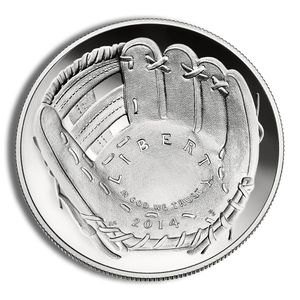
Our selection of the 2014 baseball hall of fame commemorative coin centers on the curved silver dollar the U.S. Mint struck at Philadelphia to mark the 75th anniversary of the National Baseball Hall of Fame in Cooperstown, New York. Every coin here contains 0.7734 troy ounces of silver in a .900 fine alloy, with a concave obverse shaped like a baseball glove and a convex reverse shaped like the ball itself.
The dollar is offered in both finishes the Mint produced. The uncirculated version appears raw and graded MS70 by PCGS, and the proof is listed raw and in PF70 holders from both PCGS and NGC. Each listing shows live pricing with the current bid/ask spread, which makes it simple to compare a raw coin with a perfect-graded example.
What Are Baseball Hall of Fame Commemorative Coins?
Baseball Hall of Fame commemorative coins are legal tender coins authorized by Congress and issued by the U.S. Mint in 2014, with surcharges from their sale paid to the National Baseball Hall of Fame. The program included a clad half dollar, this silver dollar and a $5 gold coin, and all three shared the same curved form, making them the first curved coins the U.S. Mint had ever produced.
The curve is what separates these coins from every other commemorative dollar. Rather than a flat strike, each coin was formed so that the glove side dishes inward and the ball side bulges outward, a shape that ties the design directly to the game. Buyers choose the silver dollar for that novelty, for its connection to baseball history and as a practical way to own the program in precious metal without the cost of the gold version.
Next to silver bullion, the Hall of Fame dollar is very much a collector issue. Its price rests on its design, finish and grade far more than on the silver it contains.
History and Background
The National Baseball Hall of Fame and Museum opened in Cooperstown in 1939, and Congress authorized the commemorative program in 2012 to honor the museum's 75th anniversary. The legislation called for curved coins, a format the Royal Australian Mint had used a few years earlier, so the U.S. Mint had to develop new tooling and striking methods before production could begin.
The program also changed how a commemorative design was chosen. The Mint held a public design competition for the shared obverse, and the winning entry by California artist Cassie McFarland shows a baseball glove on the concave side. The convex reverse, designed by U.S. Mint sculptor-engraver Don Everhart, renders a baseball with realistic stitching.
The coins went on sale in March 2014 and drew strong interest from both coin collectors and baseball fans. Their success helped make the curved format a recurring part of U.S. commemorative coinage, with later programs such as the 2019 Apollo 11 50th Anniversary and 2020 Basketball Hall of Fame coins using the same concave and convex design approach.
Purity, Weight, and Specifications
Despite its unusual shape, the 2014 silver dollar is made from the same 90% silver, 10% copper alloy as other modern U.S. commemorative dollars, and at 26.73 grams it holds 0.7734 troy ounces of pure silver. The curve doesn't change the metal content, and the uncirculated and proof versions are identical in weight and fineness.
Both versions were struck at the Philadelphia Mint and carry the P mint mark. The coin has a face value of one dollar and is legal tender, and its inscriptions follow the conventions of U.S. commemorative coinage rather than stating weight and purity the way a bullion coin would.
Available Brands, Mints, and Product Variations
Every coin on this page is a 2014-P silver dollar from the U.S. Mint, so the variations come down to finish and certification. The uncirculated coin has a soft, satin luster and is available as a raw Brilliant Uncirculated coin or in a PCGS MS70 holder. The proof shows mirror-like fields against frosted design elements, and it's offered raw or graded PF70 by either PCGS or NGC.
The curved shape makes certification especially useful here. A perfect MS70 or PF70 grade confirms that the strike came out cleanly across both the concave and convex surfaces, and a sealed holder protects a coin whose raised reverse is more exposed to contact than a flat coin's. For raw coins the decision is mostly about finish, and many collectors buy the proof and uncirculated versions as a matched pair.
Pricing, Premiums, and Market Factors
The silver in a Hall of Fame dollar is only the starting point for its price. These coins sell at collector premiums over their metal value, shaped by mintage, finish, grade, packaging and demand from both numismatists and baseball fans, and those premiums move independently of spot.
Proof and uncirculated versions are priced differently, reflecting how many of each were struck and how collectors value each finish. Grade adds a further premium, since MS70 and PF70 coins are scarcer than raw examples, and any difference between PCGS and NGC holders at the same grade usually reflects buyer preference. For raw coins, original government packaging with the Mint's box and certificate of authenticity supports stronger pricing than a loose coin.
We display the live ask and our bid on each product page, so the spread for each version is visible before you commit. That openness matters more with commemoratives than with bullion, because collector pricing is less standardized.
Condition, Packaging, and What to Expect
The convex reverse puts the highest points of the ball's stitching further forward than on a flat coin, so raw examples deserve careful handling. Uncirculated coins may show the minor contact marks typical of production, while proofs are the most prone to fingerprints, haze or spotting if they've been handled outside the capsule.
PCGS and NGC coins arrive in their original sealed holders at the grade named in the listing. For raw examples, whether the Mint's original box and certificate are included varies from listing to listing, so read the description before ordering if a complete presentation matters to you.
Authenticity and Verification
The curved strike is difficult to imitate well. Genuine coins show crisp detail in the glove's lacing and the ball's stitching, the correct P mint mark and a weight that matches the 26.73 gram standard, and a careful weight check with close inspection of the surfaces exposes most counterfeits.
Graded coins carry unique certification numbers that can be verified on the PCGS or NGC website, and both services authenticate a coin before grading it. We're authorized dealers for both, and every coin is inspected before shipment so it matches its listing.
Liquidity and Resale Considerations
As the first curved U.S. coin, the Hall of Fame dollar is among the most recognizable modern commemoratives, and dealers know it on sight. That familiarity helps when selling, especially for MS70 and PF70 coins that can be priced from the holder alone.
Its market still depends on collector demand rather than metal prices alone. Raw coins with complete original packaging sell more easily than loose ones, and comparing our bid with the ask shows how each version trades today.
Storage and Security
Keep raw coins in their Mint capsules, which hold the curved coin securely and keep its raised reverse from contact. Store them in a dry, temperature-stable place away from PVC and household chemicals, and avoid stacking boxes where pressure could bear on the capsule.
Slabbed coins should stay sealed and be stored upright in slab boxes. A home safe is adequate for a few coins, while a bank safe deposit box or depository suits a larger collection. Keep certification numbers on record for insurance and inventory tracking.
Selling and Buyback Options
Hall of Fame dollars can be sold back to us through the same marketplace where they're listed, with the current bid shown on each product page. Once you accept a price, the purchasing team checks the coin when it reaches us and sends payment.
Bids reflect the version, its grade or packaging and current collector interest, with silver prices supporting the floor. An undamaged slab, or a raw coin still in its full Mint presentation, makes the quote quicker and cleaner.
Why Buy Baseball Hall of Fame Commemorative Coins?
Few modern coins connect form and subject as directly as this one. The glove and ball shape makes the Hall of Fame dollar instantly recognizable, and its place as the Mint's first curved coin gives it significance in U.S. coinage history beyond the anniversary it marks.
Completing the issue is also well within reach. Two finishes from a single mint, each available raw or top-graded, make a complete set straightforward to assemble, and the dollar sits comfortably in a broader collection of baseball-themed or modern U.S. commemorative coins.
Why Buy from Bullion Standard?
Bullion Standard has served precious metals buyers from San Diego, California since 2010, and we've built a national marketplace around one idea: you only get one chance to earn trust. For a coin like the Hall of Fame dollar, where finish and grade decide the price, that means clear listings and visible bids.
Our credentials include authorized dealer status with PCGS and NGC, membership in the American Numismatic Association and the National Coin and Bullion Association, and an A+ rating from the Better Business Bureau. You can pay by Visa, Mastercard, American Express, Discover, PayPal, Plaid, wire transfer, paper check or BitPay cryptocurrency, and sell back through our two-way market when the time comes.
Get Near-Spot Pricing with Bullion Standard Pro
Pro membership replaces retail list prices with the wholesale market itself. Members see live, executable bids and offers on a wide range of coins and bullion, we layer no dealer markup or dealer spread onto those quotes, and each product's pricing shifts with real wholesale supply and demand.
Members also see their holdings valued at live wholesale bid prices and can use market intelligence such as historical premium analysis and spread comparisons to understand how products trade over time. For buyers who purchase regularly, Pro offers the most transparent view of pricing at the wholesale level.


 (833) 278-4653