Buy Benjamin Franklin Commemorative Coins Online
Our Benjamin Franklin commemorative coin selection is built around the two silver dollars the U.S. Mint struck in 2006 to mark the 300th anniversary of Franklin's birth. One design honors Franklin the Founding Father and the other Franklin the Scientist, and both appear here in several forms: Brilliant Uncirculated, raw proof, and NGC certified examples at the very top of the grading scale.
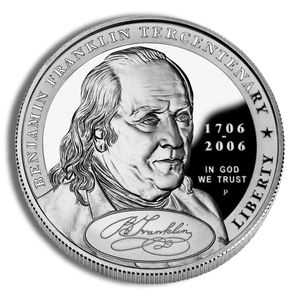
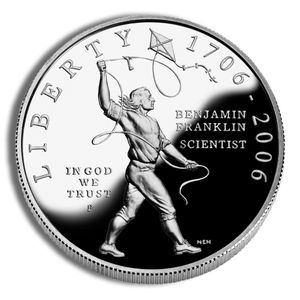
Every coin on this page is a 2006-P silver dollar from the Philadelphia Mint, fittingly the city where Franklin built his printing business and spent most of his public life. The Founding Father design is offered as an uncirculated coin, an ungraded proof and an NGC PF70, while the Scientist design comes as an uncirculated coin, an ungraded proof, an NGC MS70 and an NGC PF70. That spread makes it easy to pair the two designs by finish or by grade.
Each product page shows live pricing alongside the current bid/ask spread. With collector coins like these, seeing what we pay next to what we charge is the clearest way to understand the real cost of a given finish or grade.
What Are Benjamin Franklin Commemorative Coins?
They're one-dollar silver coins authorized by Congress and produced by the U.S. Mint under its modern commemorative coin program, which issues limited, single-year coins honoring specific people, places and events. Unlike bullion coins that are struck year after year, the Franklin dollars were sold directly by the Mint for a limited window in 2006, at prices that included a surcharge set by law, and they haven't been restruck since.
What sets this program apart is that it produced two different silver dollars rather than one. Each design was struck in an uncirculated finish, with soft satin surfaces, and a proof finish, with mirrored fields and frosted devices, so the full program consists of four basic coins.
Don't confuse these with the Franklin half dollar, the circulating 90% silver coin struck from 1948 to 1963, which isn't part of our catalog here. The 2006 dollars are collector issues from the start, and most buyers choose them to own both portraits of Franklin's career, to fill a year in a modern commemorative set, or to hold a top-graded example of a subject they care about.
History and Background
Benjamin Franklin was born in Boston on January 17, 1706, and the tercentenary of his birth brought a year of national observances in 2006. Congress authorized a pair of commemorative silver dollars for the occasion, and the U.S. Mint released them that year as part of its ongoing commemorative program, which Congress revived in 1982 after a long pause.
The two designs split Franklin's life into its best-known roles. The Scientist dollar shows a young Franklin flying a kite in a thunderstorm, a reference to the electrical experiment traditionally dated to 1752, and its reverse reproduces his "Join, or Die" cartoon of a segmented snake, first printed in his Pennsylvania Gazette in 1754 to urge the colonies toward unity. The Founding Father dollar presents Franklin in later life alongside his signature, and its reverse is adapted from the Continental Currency coinage of 1776, whose imagery is traditionally linked to Franklin.
That second design points to a record few Americans can match. Franklin signed the Declaration of Independence, the 1783 Treaty of Paris that ended the Revolutionary War, and the Constitution, and he served as the new nation's minister to France. Pairing the statesman with the experimenter gave collectors a two-coin portrait of one of the most versatile figures in American history.
Purity, Weight, and Specifications
Both Franklin dollars follow the standard specification for modern U.S. commemorative silver dollars: 90% silver and 10% copper, a gross weight of 26.73 grams, and a silver content of 0.7734 troy ounces. That .900 fineness is the same alloy used in classic Morgan and Peace dollars, rather than the .999 fine silver found in most modern bullion.
The coins carry a face value of one dollar and are legal tender, though their price is set by silver content and collector demand rather than denomination. Like most U.S. commemoratives, they don't carry a fineness or weight stamp in the design. Instead you'll find the standard inscriptions LIBERTY, IN GOD WE TRUST, E PLURIBUS UNUM, UNITED STATES OF AMERICA and ONE DOLLAR, with the P mint mark identifying Philadelphia.
Proof and uncirculated coins share the same metal content and weight. The difference lies in the striking process: proofs are struck on specially prepared planchets with polished dies and multiple strikes, while uncirculated coins receive a single strike that leaves a uniform, matte-like surface.
Available Brands, Mints, and Product Variations
All seven listings come from the U.S. Mint's Philadelphia facility, so the choices come down to design, finish and certification. For the Founding Father dollar, you can choose a Brilliant Uncirculated coin, an ungraded proof, or an NGC PF70 proof. For the Scientist dollar, the options are a Brilliant Uncirculated coin, an ungraded proof, an NGC MS70 uncirculated coin and an NGC PF70 proof.
A note on listing names: the raw proofs carry "Proof - BU" in their titles, but they are proof strikes, not Brilliant Uncirculated coins. The proof surface is a distinct finish, and it's what you'll receive with those listings. Uncirculated coins, by contrast, are listed simply as BU.
The NGC certified coins sit at the top of the scale. MS70 applies to uncirculated strikes and PF70 to proofs, and both mean NGC's graders found no post-production imperfections under five times magnification. Buyers building a registry set or a matched pair often start with these, while raw coins suit collectors who want the designs without the added cost of certification.
Pricing, Premiums, and Market Factors
Franklin dollars sell at collector premiums over their silver content, not near spot. The 0.7734 oz of silver sets a baseline that moves with the silver market, but the larger share of the price usually comes from numismatic factors. Mintage is one: the uncirculated versions were made in noticeably smaller numbers than the proofs, which buyers weigh when comparing finishes.
Condition and grade come next. A PF70 or MS70 coin commands a meaningful premium over a raw example of the same design, since a perfect grade is the narrowest slice of surviving coins. Proof versus uncirculated finish, collector demand for one design over the other, and whether a raw coin still has its original government packaging, the Mint's box and certificate of authenticity, all shift prices independently of silver.
Because premiums on commemoratives aren't as standardized as bullion pricing, we show the live ask and bid for every listing. Comparing the spread on a raw proof against an NGC PF70 of the same design tells you how much of the price is grade premium and how efficiently each version trades.
Condition, Packaging, and What to Expect
The U.S. Mint originally sold each Franklin dollar in a protective capsule inside a presentation case with a certificate of authenticity. Raw coins can trade with or without that original government packaging, and its presence affects value, so if the box and COA matter to you, review the listing or ask our team before you order.
Raw proofs show their mirrored fields and frosted portraits best when handled as little as possible, and minor capsule haze or light toning can appear on coins that have spent nearly two decades in storage. Uncirculated coins have a softer, more even luster, and small contact marks from production are normal at that level.
NGC certified coins arrive sealed in NGC's tamper-evident holder, with a label showing the date, mint mark, design, grade and certification number. The grade on the label is the grade you receive, and light scuffs on the outside of the plastic don't affect the coin inside.
Authenticity and Verification
Modern commemorative silver dollars are counterfeited less often than classic coins, but fakes do exist. A genuine Franklin dollar weighs 26.73 grams, shows crisp detail in the kite string, the snake's segments and the lettering of Franklin's signature, and has a reeded edge. Soft details, an off weight or a greasy look to the surfaces are signs to look closer.
For certified coins, NGC's verification process does most of the work. Every holder carries a unique certification number, and entering it into NGC's online lookup confirms the coin's date, design, finish and grade. Matching that record against the coin and label in hand takes less than a minute.
We're an authorized NGC dealer and a member of the American Numismatic Association, and every Franklin dollar we sell is checked against its listing before it ships. That inspection covers the design, finish, mint mark and, for slabbed coins, the condition of the holder and label.
Liquidity and Resale Considerations
As official U.S. Mint issues, Franklin dollars are recognized by dealers and collectors across the country, and their standard silver content gives every coin a clear metal component. They trade in a narrower market than American Silver Eagles, though, because demand comes mostly from collectors rather than bullion buyers.
Within that market, liquidity varies by version. Raw coins with their original box and COA are generally easier to place than loose coins, and NGC certified 70 grade examples appeal to registry collectors who want a specific design and finish. Selling both designs together as a matched pair can also make a set more attractive than either coin alone.
Storage and Security
Keep raw Franklin dollars in their original Mint capsules, which protect the surfaces from fingerprints and air, and store the cases in a cool, dry place. Avoid soft plastic flips that may contain PVC, which can leave a green residue on silver over time, and don't attempt to clean any coin, since cleaning permanently lowers its value.
NGC holders should be stored upright in slab boxes rather than stacked loosely. A fire-rated home safe works well for a small set, while a bank safe deposit box or professional vault suits larger holdings. Keep the Mint boxes and certificates together with the coins, and record each NGC certification number separately for insurance purposes.
Selling and Buyback Options
You can sell Franklin dollars back to us through the same two-way market where you buy them. The current bid is posted on each product page, and our purchasing team handles the process from price confirmation through inspection and payment.
Buyback pricing depends on the design, finish and grade, along with current collector demand and the silver price. Coins with original government packaging and intact NGC holders are the simplest to value, while raw coins that have been cleaned, damaged or separated from their box and certificate will typically bring less than complete examples.
Why Buy Benjamin Franklin Commemorative Coins?
The subject is the first draw. Few commemorative programs capture a historical figure as fully as this one, and owning both the Scientist and Founding Father dollars puts Franklin's work in electricity and his role in founding the republic side by side.
The program is also unusually collectible. Two designs in two finishes, plus graded options, give collectors room to build anything from a simple uncirculated pair to a set of NGC 70 grade coins. Each piece is a U.S. Mint issue with full legal tender status and a known silver content, which adds clarity to what you're buying.
Why Buy from Bullion Standard?
Bullion Standard has operated since 2010 from San Diego, California, and grew from a local shop into a national online marketplace on a simple idea: you only get one chance to earn a customer's trust. That principle drives how we source commemoratives, how we price them and how we handle every order after checkout.
We're an authorized dealer for both NGC and PCGS, members of the American Numismatic Association and the National Coin and Bullion Association, and we hold an A+ rating with the Better Business Bureau. Every Franklin dollar is verified for design, finish and condition before it ships, so the coin you receive matches the listing you chose.
Checkout accepts Visa, Mastercard, American Express, Discover, PayPal, bank-connected payments through Plaid, wire transfer, paper check and cryptocurrency through BitPay. Because we also buy what we sell, the bid shown beside each listing reflects a working two-way market, and our research tools let you compare premiums and spreads with objective data.
Get Near-Spot Pricing with Bullion Standard Pro
Bullion Standard Pro gives members live, executable wholesale bid and ask pricing across a broad range of precious metals products, with no added dealer markup or dealer spread on member pricing. Prices move with real wholesale supply and demand instead of a fixed retail schedule, which brings bullion purchases close to spot and makes the cost of collector coins easier to read.
For commemoratives, the value of Pro lies in transparency rather than spot pricing. Members can see their holdings valued at live wholesale bid prices, along with tools such as historical premium analysis, spread analysis and liquidity metrics that show how individual products trade over time. If you buy regularly or care closely about cost, Pro is the most direct view of how the wholesale market prices each Benjamin Franklin commemorative coin you own.


 (833) 278-4653