Buy Bicentennial Commemorative Coins Online
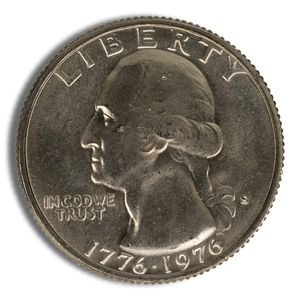
The dual-dated 1776-1976 quarter is the most familiar coin from the nation's 200th birthday, and our bicentennial commemorative coin listing features its scarcer 40% silver version from the San Francisco Mint. These silver-clad quarters were never released for circulation. The U.S. Mint sold them only to collectors, in uncirculated and proof sets, which is why the S-mint silver strike stands apart from the copper-nickel quarters that turned up in pocket change.
The listing is filled with either a Brilliant Uncirculated or a proof coin, so the finish you receive may differ from the photo. Both carry the same design, mint mark and silver content, and the product page shows the live ask next to our current bid so the full cost of ownership is visible before you buy.
What Are Bicentennial Commemorative Coins?
Bicentennial coins are the quarters, half dollars and dollars the U.S. Mint struck with the special 1776-1976 date and new reverse designs to mark 200 years of American independence. Most were ordinary circulating coins, but Congress also authorized a 40% silver version for collectors, struck only at San Francisco and sold in three-coin sets. The quarter on this page is one of those silver pieces, sold individually rather than as part of a set.
That makes it a hybrid between a circulating commemorative and a collector issue. It shares its design with billions of everyday quarters, yet its silver content and limited distribution give it a distinct place in the market. Many buyers pick it up as an affordable piece of bicentennial history, while others use it to complete a silver set or a run of proof and uncirculated quarters.
History and Background
As the bicentennial approached, Congress authorized new reverse designs for the quarter, half dollar and dollar in 1973, and the Treasury held an open design competition to choose them. Jack L. Ahr's colonial drummer boy won for the quarter, Seth G. Huntington's Independence Hall for the half dollar, and Dennis R. Williams's Liberty Bell superimposed on the moon for the dollar. The obverses kept their existing portraits but replaced the single date with 1776-1976.
Production began in 1975, and the Mint struck no quarters dated 1975 at all, using the dual date throughout 1975 and 1976 instead. Circulating coins came from Philadelphia and Denver in copper-nickel clad, while San Francisco struck clad proofs for the annual proof sets and the 40% silver coins for the special collector sets. The silver sets, offered in both uncirculated and proof form, were produced in the millions and sold by the Mint for years after the anniversary itself.
The half dollar and Eisenhower dollar from those silver sets aren't part of our catalog on this page, but they help explain why the silver quarter exists. It was one third of a set designed so collectors could own the entire bicentennial lineup in silver.
Purity, Weight, and Specifications
The silver bicentennial quarter is built in layers. Its outer surfaces are 80% silver and 20% copper, bonded to a core of roughly 21% silver and 79% copper, for an overall composition of 40% silver. A genuine coin weighs 5.75 grams and contains a little under 0.074 troy ounces of pure silver, compared with 5.67 grams and no silver at all in a standard clad quarter.
The obverse carries John Flanagan's portrait of George Washington with the dual date 1776-1976, and the S mint mark appears to the right of Washington's ponytail. The reverse shows the drummer boy with a victory torch encircled by 13 stars. Like other U.S. coins of its era, it bears no fineness stamp, so weight and edge are the practical ways to confirm the metal.
Available Brands, Mints, and Product Variations
Our listing covers one coin from one mint: the 40% silver 1776-1976-S Washington quarter from the U.S. Mint's San Francisco facility. Whether you receive the Brilliant Uncirculated or proof version, the composition and design are identical. Uncirculated coins show soft, even luster from a single strike, while proofs have mirrored fields and frosted relief from multiple strikes on polished dies.
It's worth knowing the variations that aren't silver, since they're common in the market. Philadelphia quarters with no mint mark and Denver quarters with a D are copper-nickel clad circulation strikes, and S-mint clad proofs came from the regular 1975 and 1976 proof sets. Only the silver collector sets produced 40% silver quarters, and those are what we offer here.
Pricing, Premiums, and Market Factors
With well under a tenth of an ounce of silver, this quarter's metal value is small, so the premium makes up a large share of its price. That premium reflects the work of breaking out and handling individual coins, the finish you're buying, the coin's condition, and steady collector demand for bicentennial material. It's a collector piece first, not a near-spot silver product.
Mintage plays a part as well. Silver quarters were produced in the millions, so they're widely available compared with many commemoratives, which keeps prices accessible. Coins in original government packaging, such as complete Mint sets with their certificates, are priced differently from individual coins like this one. Our product page shows the current bid and ask, so you can see exactly where the spread sits.
Condition, Packaging, and What to Expect
Expect a single silver quarter in Brilliant Uncirculated or proof condition, removed from its original set. Because coins from the 1970s have had decades to age, light toning, faint haze on proof surfaces or minor contact marks on uncirculated coins are normal and part of their character. Every coin will be free of circulation wear, and it will carry the S mint mark and dual date shown in the listing.
Authenticity and Verification
The simplest test is the edge. A copper-nickel clad quarter shows a distinct copper stripe, while a 40% silver quarter's edge has no copper band and looks silvery gray all the way around. A scale accurate to a hundredth of a gram confirms it, since the silver coin's 5.75 grams outweighs a clad quarter's 5.67 grams.
As a member of the American Numismatic Association and an authorized dealer for PCGS and NGC, we source U.S. Mint coins through established channels and check each piece for composition, mint mark and finish before it ships.
Liquidity and Resale Considerations
Silver bicentennial quarters are among the most recognized U.S. collector coins of the 20th century, and almost any coin dealer can identify one quickly. That familiarity makes them easy to buy and sell, though the market is driven by collectors and the coin's small silver content means prices respond only modestly to moves in spot. Uncirculated and proof examples in clean condition are the easiest to place.
Storage and Security
Store each quarter in an inert holder, such as a hard plastic capsule or an archival-quality flip free of PVC, and keep it in a dry, stable environment. Proof surfaces show fingerprints permanently, so handle the coin by its edges if you need to handle it at all. Small coins are easy to misplace, so a labeled box in a home safe or safe deposit box is a practical way to keep them together.
Selling and Buyback Options
Because we run a two-way market, you can sell silver bicentennial quarters back to us at the bid shown on the product page. Our purchasing team confirms pricing, checks each coin for composition and condition on arrival, and processes payment once verification is complete.
Bids depend on finish, condition, current silver prices and collector demand. Clean, unimpaired coins bring the strongest bids, while cleaned, scratched or circulated examples are priced lower.
Why Buy Bicentennial Commemorative Coins?
The 1776-1976 quarter captures a moment Americans still connect with, and the drummer boy design is instantly recognizable to anyone who handled pocket change in the 1970s. The silver version adds something its circulating cousins lack: real precious metal content and a collector-only pedigree from the San Francisco Mint.
A silver bicentennial commemorative coin is also one of the most approachable ways into U.S. commemoratives. The small size and modest price make it practical as a gift, a teaching piece or a starting point for a broader collection of bicentennial coinage.
Why Buy from Bullion Standard?
Bullion Standard was founded in 2010 in San Diego, California, and has grown into a national online marketplace by treating trust as something earned one order at a time. We're members of the American Numismatic Association and the National Coin and Bullion Association, hold an A+ rating with the Better Business Bureau, and verify every coin before it reaches a customer.
Even on a single quarter, you'll see both sides of the market, with the bid displayed next to the ask. Pay by credit card, PayPal, Plaid bank connection, wire, check or cryptocurrency through BitPay, and use our research tools to compare premiums and spreads across the products you're considering.
Get Near-Spot Pricing with Bullion Standard Pro
Bullion Standard Pro gives members access to live, executable wholesale bid and ask pricing without added dealer markups or spreads. For bullion, that means execution near spot; for collector issues like the silver bicentennial quarter, it means seeing how the wholesale market actually prices a coin rather than relying on a retail list.
Members can value their holdings at live wholesale bids and review historical premiums, spread analysis and liquidity metrics product by product. If you buy often or watch costs closely, Pro is the most transparent way to do it.


 (833) 278-4653