Buy Canadian Commemorative Coins Online
Canadian commemorative coins tell the country's story in gold and silver, and every coin in our catalog was struck by the Royal Canadian Mint. The selection spans more than four decades of Canadian minting, from the 1967 $20 gold coin issued for the centennial of Confederation to 2012 War of 1812 bicentennial coins and a group of issues honoring the First Special Service Force, the joint Canadian and American unit known as the Devil's Brigade.
You'll find gold in three different standards: the .900 fine 1967 $20, 22 karat and 14 karat $100 gold coins offered as random year listings, and modern .9999 fine quarter-ounce pieces. Silver is represented by .9999 fine 3/4 oz War of 1812 and Devil's Brigade coins and a random year 1/2 oz Devil's Brigade coin.
Each product page lists a live ask and our current bid. With coins this varied in age, purity and finish, seeing both numbers side by side is the quickest way to understand what you're paying for and how the market values it.
What Are Canadian Commemorative Coins?
A Canadian commemorative coin is a legal tender coin produced by the Royal Canadian Mint to mark a specific anniversary, person or event, with a design that typically appears for a single year or a short run. That separates them from the Mint's flagship bullion coin, the Gold or Silver Maple Leaf, whose design and specifications stay constant so it can trade almost entirely on metal value.
The coins in our catalog fall into two groups. The first is classic collector gold, including the 1967 $20 and the $100 gold series, which the Mint sold primarily to collectors in proof or specimen quality. The second is modern fractional bullion-style commemoratives from 2012 onward, struck in .9999 fine gold or silver with themed designs and released in limited quantities.
Buyers are drawn to these coins for Canadian history, military history and the Royal Canadian Mint's design work, and the fractional sizes make it practical to own several subjects without a large outlay on any single coin.
History and Background
The Royal Canadian Mint began in 1908 as the Ottawa branch of Britain's Royal Mint and became a Canadian institution in 1931. Its commemorative program took a major step forward in 1967, when Canada celebrated 100 years of Confederation. That year's circulating coins carried special reverses by artist Alex Colville, and the Mint issued a $20 gold coin in cased presentation sets, recording a mintage of 337,688.
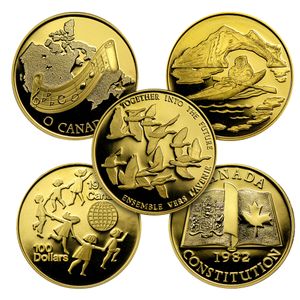
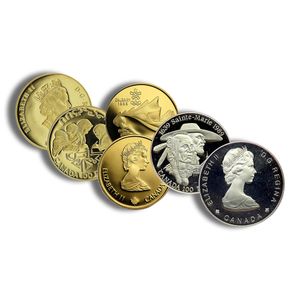
Gold commemoratives became a regular feature after the 1976 Montreal Olympics. From 1977 to 1986, the Mint struck half-ounce $100 coins in 22 karat gold, each with its own theme, beginning with Queen Elizabeth II's Silver Jubilee and continuing through subjects such as the International Year of the Child, the adoption of O Canada as the national anthem and the centennial of Canada's national parks. From 1987, the $100 coin moved to a 14 karat format containing a quarter ounce of gold, and the series continued with themes such as the 130th anniversary of the Supreme Court of Canada in 2005.
The modern coins in our catalog trace two military anniversaries. In 2012, the Mint launched a multi-year program for the War of 1812 bicentennial that included circulating quarters honoring figures such as Sir Isaac Brock and Tecumseh. In the following years, it honored the First Special Service Force, a unit formed in 1942 that trained in Montana, fought at Monte la Difensa and Anzio in Italy, and is regarded as a forerunner of modern special operations forces in both countries.
Purity, Weight, and Specifications
Purity varies more here than in most collections, so it pays to look at fine metal content rather than gross weight. The 1967 $20 weighs 18.27 grams in .900 fine gold, which gives it 0.5288 troy ounces of pure gold. The 1977 to 1986 $100 coins are 22 karat, or .9167 fine, and contain exactly one-half troy ounce of gold, while the 1987 to 2005 $100 coins are 14 karat, roughly .583 fine, and contain one-quarter troy ounce.
The modern pieces follow the Royal Canadian Mint's high-purity bullion standard. The 2012 War of 1812 gold coin and the Devil's Brigade gold coin each contain one-quarter troy ounce of .9999 fine gold, and the 2012 War of 1812 silver, 2013 Devil's Brigade silver and random year 1/2 oz Devil's Brigade silver coins are struck in .9999 fine silver. Purity and weight are struck into the design of the modern bullion-style coins, as they are on the Maple Leaf.
Available Brands, Mints, and Product Variations
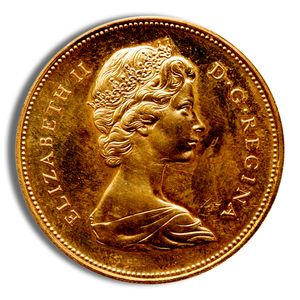
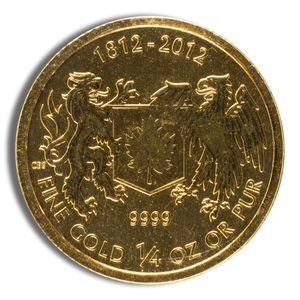
Every coin here comes from the Royal Canadian Mint, and all carry a portrait of Queen Elizabeth II, as Canadian coinage did throughout her reign. The 1967 $20 shows Canada's coat of arms on its reverse. The 2012 War of 1812 quarter-ounce gold coin has a heraldic design of a lion and an eagle facing each other across a maple leaf shield, and the Mint's records list a mintage of 2,000 for that gold issue.
The Devil's Brigade pieces come in three formats: a quarter-ounce .9999 gold coin, a 2013 3/4 oz silver coin with a $2 face value and a 1/2 oz silver coin. Their designs center on the unit's history and its shared Canadian and American identity. The 2013 3/4 oz silver coin was packed in Mint tubes of 20, a common format for the Mint's bullion-style silver.
Three listings are random year products. The 1977 to 1986 22 karat $100, the 1987 to 2005 14 karat $100 and the 1/2 oz silver Devil's Brigade coin are filled from available inventory, so the date and design you receive are selected by us.
Pricing, Premiums, and Market Factors
Canadian commemoratives sell at collector premiums over their metal content, and those premiums are driven by mintage, condition and grade, proof or uncirculated finish, whether the coin comes in original government packaging with its box and certificate of authenticity, and how much demand there is for the subject. The gold and silver content sets a baseline that follows spot prices, but it's rarely the whole story.
The older gold shows how these factors interact. The 1967 $20 had a large mintage for a gold coin but remains closely tied to the centennial, which keeps collector interest steady, while the $100 coins were sold as proofs in Mint cases and are often valued differently once separated from that packaging. The modern quarter-ounce gold coins were struck in small numbers, yet the bullion-style finish of the modern pieces means their pricing usually leans more on metal content than the older proof gold does.
Fractional coins also carry higher premiums per ounce than larger formats, because the cost of striking and distributing a coin doesn't shrink with its size. Comparing the bid and ask on each product page is the clearest way to see how those premiums look in practice.
Condition, Packaging, and What to Expect
Expectations vary by coin. The 1967 $20 was struck for presentation sets with a higher-quality finish than circulating coins, and after more than half a century, light toning or fine hairlines are typical. The $100 gold coins were issued as proofs, so their mirrored fields can show minor handling marks, especially on examples that have spent time outside their original cases.
The modern .9999 silver coins should arrive with full mint luster, though high-purity silver from the Royal Canadian Mint can develop white haze, often called milk spots, which is a known trait of the metal rather than damage. Random year coins may differ in date and design from the photo, and unless a listing names original packaging, expect the coin itself rather than a Mint box or certificate.
Authenticity and Verification
Because purity varies so widely among these coins, verification depends on knowing the right specification for each one. A 14 karat $100 coin will test very differently from a .9999 gold coin, so an electronic analyzer reading is only useful when it's compared with the correct standard. Weight, design detail and edge quality are the other basic checks.
We buy Royal Canadian Mint coins from established wholesalers and distributors, and every piece is checked for authenticity, weight and purity before it reaches you. Our memberships in the ANA and NCBA and our status as an authorized PCGS and NGC dealer reflect the standards we apply to world coins as well as U.S. issues.
Liquidity and Resale Considerations
The Royal Canadian Mint is one of the most familiar names in precious metals, which helps all of these coins when it's time to sell. The .9999 fine modern pieces are the easiest for dealers to price, since their metal content is stated on the coin and matches the Mint's well-known bullion standard.
The older gold is well known among collectors but can take a little more explanation in the U.S. market. Dealers price the 1967 $20 and the $100 coins on their fine gold content plus a premium for the issue, so knowing the correct figures for each coin makes resale smoother.
Storage and Security
Keep proofs in their capsules or original cases and handle them only by the edges, since fingerprints on mirrored fields can become permanent. For .9999 silver, a dry environment with a desiccant pack and airtight capsules or tubes helps limit toning and haze. Gold doesn't tarnish, but 24 karat coins are soft and scratch easily, so they need the same protection.
A home safe is suitable for a modest collection, while a bank safe deposit box or depository makes more sense as holdings grow. A simple record of each coin's year, purity and fine metal content is useful for insurance and makes selling easier later.
Selling and Buyback Options
Every coin in our catalog can be sold back to us through our two-way market. Our purchasing team confirms the bid shown on the product page, receives and verifies the coin, and sends payment once the process is complete.
Pricing reflects spot prices, the coin's fine metal content, its condition and current demand. Proofs in original cases with certificates, coins with clean surfaces and modern silver that's free of heavy spotting are the most straightforward to value.
Why Buy Canadian Commemorative Coins?
These coins offer a way to collect Canadian history through government-issued gold and silver. Each one marks a specific chapter, from Confederation to the War of 1812 to the Devil's Brigade, and comes from a mint known for its design and striking quality.
They also provide range. You can choose between classic proof gold and modern high-purity bullion-style issues, and between full half-ounce coins and smaller fractional pieces. That flexibility makes it easier to build a collection around subjects that matter to you.
Why Buy from Bullion Standard?
Bullion Standard has operated from San Diego since 2010, and our model is built on transparency: the price we sell at and the price we'd pay are both visible on every product page. We believe customers deserve to understand the full cost of a purchase before they make it.
We hold an A+ rating with the Better Business Bureau and source every product through established channels, verifying it before it ships. Checkout accepts Visa, Mastercard, American Express, Discover, PayPal, Plaid bank payments, wire transfers, paper checks and BitPay cryptocurrency.
Get Near-Spot Pricing with Bullion Standard Pro
Bullion Standard Pro gives members direct access to live, executable wholesale bid and ask pricing, with no dealer markup or dealer spread added. Premiums and spreads respond to wholesale supply and demand, giving members a clear look at how individual products trade.
Pro also includes portfolio valuation at live wholesale bid prices, along with tools for comparing premiums, spreads, liquidity and volatility across products. For buyers who add to their holdings regularly, it's a more efficient way to see how the market is actually pricing each coin.


 (833) 278-4653