Buy Commemorative Half Dollars Online
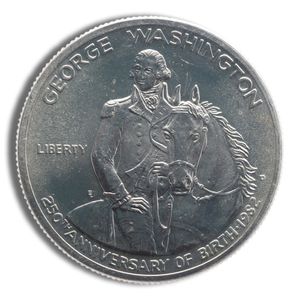
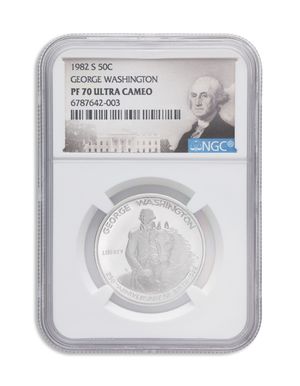
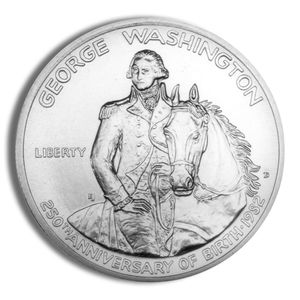
The half dollar is the oldest commemorative denomination in American coinage, and our half dollar commemorative coins cover three modern milestones in silver and gold. The 1982 George Washington half dollar, the coin that restarted the U.S. commemorative program, is offered as a 1982-D uncirculated coin and as a 1982-S proof, both raw and certified NGC PF70.
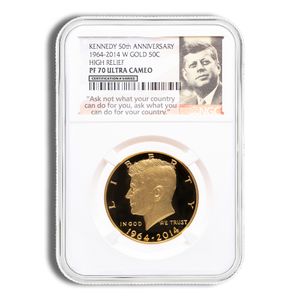
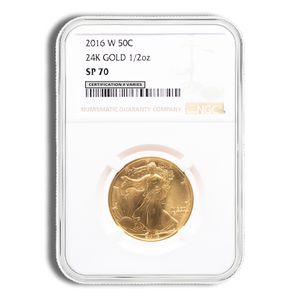
Two gold pieces carry the denomination into the 21st century. The 2014-W 3/4 oz JFK half dollar marks the 50th anniversary of the Kennedy half, and the 2016-W 1/2 oz Walking Liberty half dollar marks the centennial of Adolph Weinman's 1916 design. Both are offered in original U.S. Mint packaging with box and certificate of authenticity and in NGC or PCGS holders, with the JFK coin graded PF69 and PF70 and the Walking Liberty graded SP69 and SP70.
Every listing shows the live ask beside our current bid, so you can weigh a 90% silver Washington half against a 24 karat gold Kennedy or Walking Liberty with full visibility into both sides of the market. That matters with commemoratives, where premiums vary from coin to coin far more than they do with bullion.
What Are Commemorative Half Dollars?
A commemorative half dollar is a fifty-cent coin issued in limited numbers to honor a person, event or anniversary rather than for everyday circulation. The face value is legally real but practically symbolic, since the silver or gold inside is worth far more, and the coins are sold to collectors directly by the Mint for a set period.
The coins in our catalog show how broad the format has become. The 1982 Washington half follows the traditional pattern, a 90% silver coin of the same weight as a pre-1965 circulating half dollar. The 2014 and 2016 gold pieces keep the half dollar denomination and the original designs but are struck in .9999 fine gold, so they function as tributes to famous coins as much as commemoratives of a person or event.
Buyers choose commemorative halves for several reasons. Some collect the denomination itself, following it from the classic era into modern silver and gold, while others are drawn to Washington, Kennedy or Weinman's Walking Liberty, one of the most admired designs in American coinage.
History and Background
American commemoratives began with a half dollar. The World's Columbian Exposition half of 1892 and 1893 was the first U.S. commemorative coin, and over the next six decades the half dollar became the standard format for honoring state anniversaries, expositions, historical figures and local celebrations. Those classic issues, which ended in 1954 with the Carver and Washington half dollars, are background here rather than coins in our current selection.
The classic program ended amid criticism. By the mid-1930s some issues were struck in multiple mint marks each year or produced for small local events, and 1936 alone brought a wave of new designs, leaving collectors and the Treasury wary. After 1954 the Mint struck no commemoratives at all for nearly three decades.
That changed in 1982, when Congress authorized a half dollar for the 250th anniversary of George Washington's birth, struck in 90% silver for the first time since 1964 and designed by Chief Engraver Elizabeth Jones with Washington on horseback. Later modern programs mostly used copper-nickel clad halves, while the Mint marked the Kennedy half's 50th anniversary in 2014 with a .9999 fine gold version, dual-dated 1964-2014, and honored the Walking Liberty design's centennial in 2016 with a gold half alongside gold versions of the Mercury dime and Standing Liberty quarter.
Purity, Weight, and Specifications
The 1982 George Washington half dollar follows the traditional silver half dollar standard: 12.5 grams of .900 fine silver, with the rest copper, containing 0.3617 troy ounces of silver. That's the same composition and weight as the Franklin and 1964 Kennedy half dollars, which makes the Washington half a familiar coin to anyone who has handled pre-1965 silver.
The gold halves depart entirely from the old standard. The 2014-W JFK half dollar contains 3/4 troy ounce of 24 karat .9999 fine gold, and the 2016-W Walking Liberty half dollar contains 1/2 troy ounce of .9999 gold. Both carry a face value of fifty cents and a W mint mark for West Point, and their gold content is many times their face value.
Mint marks distinguish the Washington halves. Uncirculated coins were struck at Denver with a D mint mark, and proofs at San Francisco with an S, so a 1982-D is always an uncirculated strike and a 1982-S is always a proof. Like other U.S. commemoratives, none of these coins states its weight or fineness on its surface, so the specifications on each product page are the reference for metal content.
Available Brands, Mints, and Product Variations
All the coins on this page come from the U.S. Mint, struck at three of its facilities. The 1982 Washington half is offered as a 1982-D uncirculated coin, a raw 1982-S proof and a 1982-S proof certified NGC PF70. Because the Washington half was struck in the millions, PF70 certification is what sets a top-grade proof apart from the many examples that remain in original packaging.
The 2014-W JFK gold half dollar is available in more forms than any other coin here. You can choose a raw example with its original Mint box and certificate, or a certified coin graded PF69 or PF70 by NGC, or PR69 or PR70 by PCGS, which uses the PR abbreviation for proof. The certified listings ship with a random label, meaning the label design depends on when and how the coin was submitted.
The 2016-W Walking Liberty gold half follows a similar pattern, offered raw with box and certificate or certified SP69 and SP70 by both NGC and PCGS. The SP designation stands for specimen, which the grading services use for the centennial gold coins because their finish differs from both a standard proof and a business strike. Its design reproduces Weinman's striding Liberty with the rising sun on the obverse and the eagle on the reverse.
Pricing, Premiums, and Market Factors
Half dollar commemoratives sell at collector premiums over their metal value, but the size of that premium differs sharply between the silver and gold coins. A raw 1982 Washington half costs more than its 0.3617 ounces of silver, though its large mintage keeps that premium modest. The gold halves start from a much larger base of gold content, and their premiums reflect smaller mintages and strong collector interest in Kennedy and Walking Liberty.
Grade is the next driver. The difference between a PF69 and a PF70 JFK gold half, or an SP69 and an SP70 Walking Liberty, reflects how rarely coins earn the perfect grade and how much collectors will pay for it. On the Washington half, a PF70 certification turns a common proof into a scarcer, higher-priced coin.
Finish and packaging also matter. Proofs and specimen coins are priced differently from uncirculated strikes, and raw coins with the original U.S. Mint box and certificate of authenticity are worth more than loose ones. Spot prices for silver and gold still move the baseline, and our product pages show both the ask and our bid so you can see how each coin is priced today.
Condition, Packaging, and What to Expect
Raw 1982 Washington halves are uncertified coins, and each product page describes the packaging that comes with that listing. The 1982-S proofs show the mirrored fields and frosted portrait of a proof strike, while the 1982-D coins have the satin luster of an uncirculated strike. After four decades, light toning on these 90% silver coins is common and is a normal sign of age rather than mishandling.
Raw gold halves come in their original U.S. Mint capsules and presentation cases with the certificate of authenticity. The 2014-W JFK gold half dollar was struck only as a proof, so every raw example we sell is a proof coin with mirrored fields and frosted devices, and the Walking Liberty raw coins show the soft specimen finish of the 2016 centennial issues.
Certified coins come sealed in NGC or PCGS holders at the grade shown, and random label listings may arrive in any label style the grading service has used for that coin. The grade, coin and certification are the same either way.
Authenticity and Verification
Every commemorative half dollar we sell was issued by the U.S. Mint and comes to us through established wholesale channels. Before shipping, we check each coin's weight, mint mark, finish and packaging against its listing, and confirm that certified coins match their holder labels.
Known specifications make these coins straightforward to check. A 1982 Washington half should weigh 12.5 grams, and the gold halves should match the published weights for 3/4 oz and 1/2 oz of .9999 gold. For NGC and PCGS coins, the certification number on the label can be entered on the grading service's website to confirm the date, mint mark and grade.
As an authorized NGC and PCGS dealer and a member of the American Numismatic Association, we source certified half dollars through proper channels, and gold coins in particular receive careful inspection before they leave us. That inspection covers the holder and label as well as the coin itself.
Liquidity and Resale Considerations
The 1982 Washington half is one of the most widely held modern commemoratives, and dealers buy it readily. Its resale tends to track silver plus a modest premium, with PF70 certified examples priced separately on their grade.
The gold halves have a strong base of liquidity in their metal content, and their famous designs give them recognition well beyond commemorative specialists. Their collector premiums depend on demand for that coin and grade, and certified PF70 and SP70 examples are the easiest to price precisely. Comparing the bid and ask on each product page before buying gives a realistic sense of how each coin trades.
Storage and Security
Commemorative halves are compact, but their packaging is not. Keep raw coins in their original capsules and cases with certificates, and store certified coins upright in slab boxes where the plastic won't scratch or crack.
Silver Washington halves benefit most from a dry environment, since humidity speeds toning and spotting, so a desiccant inside your safe or storage box is a worthwhile precaution. Never clean these coins or remove them from their capsules or holders.
The gold halves concentrate significant value in a small space, which makes a fire-rated home safe the minimum, with a bank safe deposit box or professional depository a sensible option for larger holdings. Keep a written record of each coin and certification number for insurance purposes.
Selling and Buyback Options
When it's time to sell, you can sell commemorative half dollars back to us through the same two-way market where you bought them. The bid on each product page shows our current price, and our purchasing team walks you through confirmation, shipping, verification and payment.
Bids on raw 1982 Washington halves follow silver closely, while the gold halves are priced on their gold content plus the premium the market currently supports for that coin, finish and grade. Coins in sealed capsules with the original box and certificate, or in intact NGC and PCGS holders, are the simplest to value and bring the strongest bids.
Why Buy Commemorative Half Dollars?
Commemorative half dollars connect directly to the beginnings of American commemorative coinage, and the modern issues carry that tradition forward in silver and gold. Each is legal tender from the U.S. Mint, with a recognizable design and documented specifications.
They also span a useful range of price points. The 1982 Washington half is an accessible way to own a 90% silver commemorative with real historical significance, while the gold JFK and Walking Liberty halves offer 24 karat gold in fractional sizes with designs that collectors already know.
Finally, half dollar commemorative coins reward focused collecting. A small set of Washington, Kennedy and Walking Liberty pieces tells a clear story about the denomination, and certified examples let you build that story at the grade you prefer.
Why Buy from Bullion Standard?
Since opening in San Diego in 2010, Bullion Standard has grown into a national precious metals marketplace on a single principle: trust has to be earned on the first transaction. For half dollars, that means clear descriptions of finish, mint mark and certification, and a buyback bid shown right next to our selling price.
We hold an A+ rating with the Better Business Bureau, belong to the American Numismatic Association and the National Coin and Bullion Association, and are an authorized PCGS and NGC dealer. Every coin is verified before it ships, and our comparison tools let you review premiums and spreads across products using objective data.
You can pay with Visa, Mastercard, American Express, Discover, PayPal, bank-connected payments through Plaid, wire transfer, paper check or cryptocurrency through BitPay. Orders are packed with care for reliable delivery, and because we also buy, the relationship continues after the sale.
Get Near-Spot Pricing with Bullion Standard Pro
Bullion Standard Pro is built for buyers who want to see the wholesale market directly. Members receive live, executable wholesale bid and ask prices across a broad range of precious metals products, free of any added dealer markup or dealer spread.
Commemorative half dollars keep their collector premiums at wholesale, especially the certified gold coins, so Pro isn't about buying them at spot. It's about seeing those premiums clearly. Members can track holdings at live wholesale bid, review historical premiums and spreads for specific products, and use liquidity metrics to understand how actively a coin trades.
For collectors adding Kennedy or Walking Liberty gold, or buying silver halves alongside other metals, that transparency makes each purchase easier to judge on market data rather than list price. It's the clearest view we offer of where these coins actually trade.


 (833) 278-4653