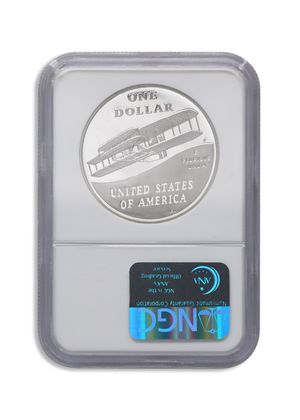
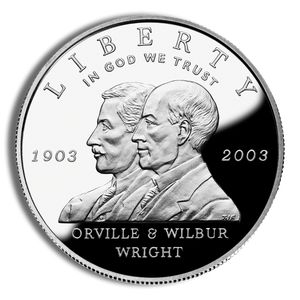
Buy First Flight Commemorative Coins Online
On December 17, 1903, Orville Wright lifted the Wright Flyer off the sand at Kill Devil Hills, North Carolina, for a 12-second flight that opened the age of powered aviation. A century later the U.S. Mint marked the moment with the First Flight Centennial program, and our catalog brings together its 90% silver dollar in three forms: a raw proof, a raw brilliant uncirculated coin, and a proof certified PF70 by NGC.
All three are 2003-P coins from the Philadelphia Mint, so choosing among them comes down to finish and certification rather than date or design. Each product page lists the live ask next to the current bid, which tells you what a 2003 First Flight Centennial commemorative coin costs and what we'd pay to buy it back.
What Are First Flight Commemorative Coins?
First flight commemorative coins are the congressionally authorized U.S. Mint issues struck for the centennial of the Wright brothers' achievement. The 2003 program included a $10 gold coin, a clad half dollar and the silver dollar offered here, each sold by the Mint for a limited period at a price that included a surcharge tied to the centennial.
The silver dollar is legal tender, but it's a collector coin rather than a bullion product. It holds the same silver as many older commemorative dollars, yet it was struck for one year only under a mintage limit, and its price reflects that history rather than the spot market alone. Buyers are typically aviation enthusiasts, collectors assembling modern commemorative dollars year by year, and set builders looking for a top-graded proof.
History and Background
Wilbur and Orville Wright ran a bicycle business in Dayton, Ohio, and spent several seasons testing gliders on the Outer Banks before returning in 1903 with a powered machine. Orville flew first that December morning, covering about 120 feet, and the brothers made four flights that day, the longest with Wilbur at the controls for 59 seconds. The original 1903 Flyer is preserved at the Smithsonian's National Air and Space Museum.
Both states connected to the story have honored it on coinage. North Carolina's 2001 state quarter shows the Flyer under the words First Flight, and Ohio's 2002 quarter credits the state as the birthplace of aviation pioneers. The 2003 centennial program went further, with the silver dollar pairing portraits of Orville and Wilbur on the obverse with the Wright Flyer in flight on the reverse.
The gold and half dollar coins from the same program carried their own designs, with the half dollar featuring the Wright Brothers Monument at Kill Devil Hills. Those coins, like the state quarters, are background here rather than part of our First Flight selection.
Purity, Weight, and Specifications
The 2003-P First Flight silver dollar follows the traditional U.S. commemorative standard of 26.73 grams in an alloy of 90% silver and 10% copper. That gives each coin 0.7734 troy ounces of pure silver, the same content as a Morgan or Peace dollar, with the copper adding hardness to resist wear.
The proof and uncirculated coins share those specifications but differ in how they were made. Proofs were struck more than once with polished dies on specially prepared blanks, producing reflective fields and frosted portraits, while the uncirculated version has a uniform satin finish. Both carry the P mint mark of Philadelphia, and on the NGC certified coin the label adds the grade, the date and denomination, and a unique certification number.
Available Brands, Mints, and Product Variations
Every coin here is a U.S. Mint product, and all three listings come from the same Philadelphia production. The NGC PF70 proof sits at the top, graded as having no visible imperfections under magnification and sealed in an NGC holder. The raw proof offers the same mirrored finish without third-party certification, and the brilliant uncirculated coin gives you the satin version of the design.
When sold by the Mint, the raw coins came in a capsule inside a presentation box with a certificate of authenticity, and each product page notes what packaging comes with that listing. There are no random year options, since the program was a single-year issue dated 2003.
Pricing, Premiums, and Market Factors
A First Flight silver dollar is priced well above its silver value, and that's normal for a commemorative. Silver content sets a baseline that moves with spot, but the premium above it comes from the coin's mintage, its condition and grade, whether it's a proof or uncirculated strike, whether it retains its original government packaging with box and COA, and how much collectors want this particular subject.
Those factors don't all pull in the same direction. As with many commemoratives of its era, the uncirculated version was produced in smaller numbers than the proof, which can narrow the price gap between them. Certification adds its own layer, since a PF70 grade sits at the very top of the scale and typically carries a premium over raw proofs that may grade lower if submitted.
Our product pages show both the bid and the ask for each version, so you can see how the market values a raw proof against the NGC PF70 example before you choose. Because we run a two-way market, that bid is a real buyback price.
Condition, Packaging, and What to Expect
The NGC PF70 coin arrives sealed in its holder with the grade shown on the label, and the slab should stay sealed, since opening it ends the certification. Light scuffs on the outside of the plastic are cosmetic and don't touch the coin.
The raw proof and BU coins are more than two decades old, so expect natural variation. Some silver commemoratives from this period show light toning or small spots, and presentation boxes may show age even when the capsule and coin are clean. Each coin is described by its finish and packaging on the product page, and that's what you'll receive.
Authenticity and Verification
For the NGC certified proof, verification is straightforward: the certification number on the label can be entered into NGC's online lookup to confirm the coin, its grade and its details. NGC holders also include security features designed to make altered or counterfeit slabs easier to spot.
For raw coins, verification relies on inspection. We check weight, surfaces, design detail and packaging against U.S. Mint specifications before shipping, and we source through established wholesale channels as an authorized PCGS and NGC dealer. A Mint certificate of authenticity is part of the original presentation, but it's the coin itself that has to pass inspection.
Liquidity and Resale Considerations
The First Flight silver dollar is a known modern commemorative, and dealers who handle U.S. Mint issues can price it without difficulty. It still trades in the collector market rather than the bullion market, so demand depends on people who want the coin rather than on silver buyers in general.
Certified coins are often the easiest version to sell remotely, because the grade is already settled by a recognized service. Raw coins with complete Mint packaging come next, while loose coins or those with spotting need closer evaluation. Checking our bid against the ask before buying is the most practical way to see where each version stands today.
Storage and Security
Store the NGC slab upright in a slab box, out of direct sunlight and away from heat, so the holder and label stay clean. For raw coins, keep the original capsule and box together and avoid soft plastic flips, which can contain PVC that damages silver over time.
A modest collection fits comfortably in a home safe, while a bank safe deposit box offers more protection for higher-priced pieces. Low humidity matters with 90% silver, so a desiccant pack in the storage space is a simple precaution, and a written record of each coin's finish, packaging and certification number helps with insurance.
Selling and Buyback Options
We buy First Flight silver dollars as well as sell them, and our purchasing team handles the process from quote to payment. Start with the bid on the product page, confirm a price with the team, and ship the coin for verification on arrival.
Offers depend on which version you have, its condition, its packaging or certification, collector demand at the time and the silver price. A sealed PF70 holder or a raw coin with an intact box and COA is the simplest to evaluate, and any coin that's been cleaned or removed from its packaging will be priced on its individual merits.
Why Buy First Flight Commemorative Coins?
The Wright brothers' flight is a turning point that touches nearly every part of modern life, and the 2003 First Flight Centennial commemorative coin is the official U.S. Mint tribute to it. For pilots, engineers, aviation historians or anyone with family in the field, it's a meaningful piece with a clear story.
It's also a practical collector coin. The silver dollar contains 0.7734 troy ounces of silver, it's government-issued legal tender with a single-year date, and it comes in proof, uncirculated and certified forms that let you choose the presentation and price level that suit you.
Why Buy from Bullion Standard?
Since 2010, Bullion Standard has grown from a local operation in San Diego, California, into a national online precious metals marketplace, guided by a simple rule: there's only one chance to earn a customer's trust. That shows up in how we describe commemoratives, listing finish, certification and packaging plainly so there are no surprises when the box arrives.
We're authorized by both PCGS and NGC, we belong to the American Numismatic Association and the National Coin and Bullion Association, and the Better Business Bureau rates us A+. Orders can be paid with major credit cards, PayPal, Plaid-connected bank payments, wire, check or BitPay cryptocurrency, and every coin is inspected before it ships.
Get Near-Spot Pricing with Bullion Standard Pro
Pro members trade at live, executable wholesale prices instead of retail ones. There's no added dealer markup or dealer spread on member pricing, so the premiums and spreads you see come straight from wholesale supply and demand, which keeps bullion purchases close to spot and makes collector premiums easy to read.
The platform also shows members' holdings at current wholesale bid value and includes tools for historical premiums, spread analysis and buy/sell activity. For collectors who buy often or want to measure a First Flight dollar's premium against its silver content, Pro offers a clearer view of the market than retail pricing can.


 (833) 278-4653