Buy Gold Commemorative Coins Online
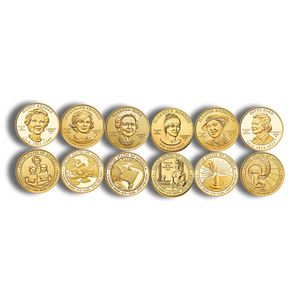
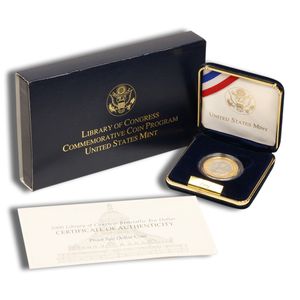
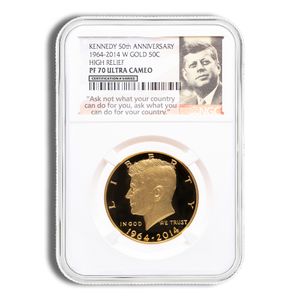
Our commemorative gold coins run from tenth-ounce pieces to multi-ounce anniversary sets, and they come from the U.S. Mint and from government mints in Canada, Mexico, Great Britain, Australia and beyond. On the U.S. side you'll find random year $5 and $10 modern gold commemoratives, the 2000-W Library of Congress bimetallic $10, the 2014-W 3/4 oz JFK half dollar, the 2016-W gold centennial coins, half-ounce First Spouse coins and 1 oz and 1/2 oz American Arts gold medallions.
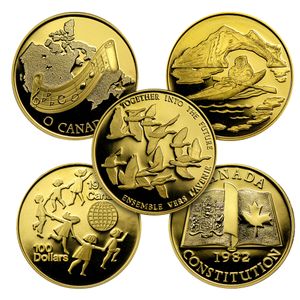
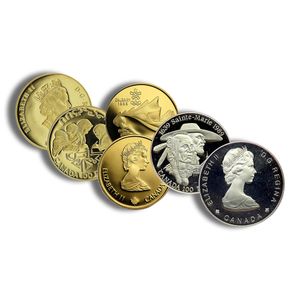
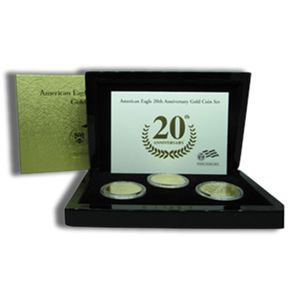
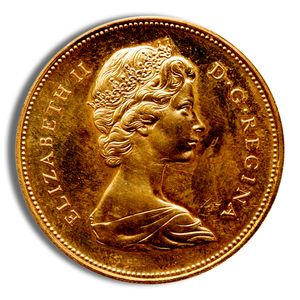
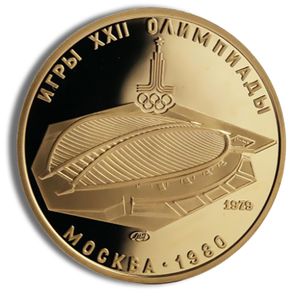
Anniversary sets of American Gold Eagles add another layer, including the 1993 Philadelphia set, the 1995-W 10th Anniversary set and the 2006 20th Anniversary three-coin set. World gold includes Canada's 1967 $20 Confederation coin and its $100 gold series, Mexico's 1957 gold 10 pesos, the Soviet Union's 1980 Moscow Olympics 100 roubles and recent .9999 fine issues from The Royal Mint and the Perth Mint.
Many of the U.S. coins are offered both in original government packaging and in NGC or PCGS holders graded up to PF70 and SP70. Each product page shows the live ask with our current bid, so the cost of a gold commemorative and its resale value are visible side by side.
What Are Gold Commemorative Coins?
A gold commemorative is a limited-issue coin struck in gold to honor a subject, an anniversary or an institution, usually carrying a face value and legal tender status but sold to collectors rather than circulated. In the U.S., the standard formats are the $5 half eagle and the $10 eagle, sold in proof and uncirculated versions as the gold companions to a program's silver dollar and clad half dollar.
Gold commemoratives differ from gold bullion in purpose and pricing. An American Gold Eagle or Buffalo is struck in large numbers every year and priced close to its gold content, while a gold commemorative is produced once, in a limited quantity, and priced on its mintage and condition as well as its metal. Compared with silver commemoratives, gold issues concentrate far more metal value into each coin, which means the gold content is a larger and steadier part of the price.
A few pieces here are gold medals rather than coins. The American Arts gold medallions and the 2026 1916 Standing Liberty gold and silver medal set carry no face value, and we identify them as medals so you know exactly what you're buying.
History and Background
Gold coinage stopped in the United States in 1933, when private gold ownership was restricted and the Mint ceased striking gold coins. For half a century the Mint produced no gold coinage at all, until the Los Angeles Olympic program's 1984 $10 eagle became the first U.S. gold coin since 1933 and the first coin to carry the W mint mark of West Point.
Before that, Congress had already tested a government gold product. From 1980 through 1984 the Mint sold American Arts gold medallions in 1 oz and 1/2 oz sizes, honoring figures such as Marian Anderson, Mark Twain, Louis Armstrong, Frank Lloyd Wright and John Steinbeck. They were sold by gold content rather than face value, and their modest sales are often cited as one reason Congress went on to authorize the American Gold Eagle, first issued in 1986.
The modern commemorative program kept gold in steady use after 1984. The $5 half eagle became the standard gold format from 1986 onward, $10 issues appeared for special programs, and the Mint began experimenting with new formats, from the 2000-W Library of Congress coin, the first U.S. bimetallic issue, to the 24 karat First Spouse coins launched in 2007 and the .9999 fine 2014 and 2016 tributes to classic designs. Abroad, Canada's centennial $20 of 1967 and its $100 gold series beginning in the 1970s, Mexico's mid-century gold, and the Soviet Union's Olympic gold of the late 1970s and 1980 are among the best-known world gold commemoratives.
Purity, Weight, and Specifications
Two standards cover most U.S. gold commemoratives. The $5 half eagle weighs 8.359 grams of .900 fine gold, alloyed mostly with copper, and contains 0.2419 troy ounces of gold, while the $10 eagle weighs 16.718 grams at the same fineness and contains 0.4838 ounces. These specifications match the classic pre-1933 half eagle and eagle, which is why the modern pieces are sometimes called gold half eagles and eagles.
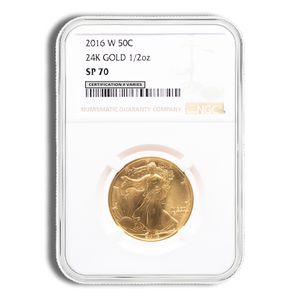
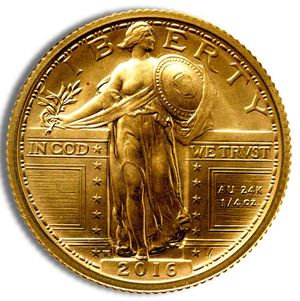
Newer and special issues use other standards. The First Spouse coins are 1/2 oz of 24 karat .9999 gold with a $10 face value, the 2014-W JFK half dollar is 3/4 oz of .9999 gold, and the 2016-W centennial coins are .9999 gold at 1/10 oz for the Mercury dime, 1/4 oz for the Standing Liberty quarter and 1/2 oz for the Walking Liberty half. American Gold Eagles in the anniversary sets are 22 karat at .9167 fine, and the Library of Congress $10 combines a gold outer ring with a platinum core, with roughly a quarter ounce of each metal.
World gold spans the full range of karats. Canada's 1967 $20 and the 1980 Soviet 100 roubles are .900 fine, Canada's $100 coins dated 1977 to 1986 are 22 karat with a half ounce of gold, those from 1987 to 2005 are 14 karat with a quarter ounce, and recent Royal Canadian Mint, Perth Mint and Royal Mint issues are 24 karat .9999 fine. The specifications on each product page list the actual gold weight, which is the number to compare across these different alloys.
Available Brands, Mints, and Product Variations
The 2016-W gold centennial coins are among the most varied listings we carry. Each of the three designs, Adolph Weinman's Mercury dime and Walking Liberty half and Hermon MacNeil's Standing Liberty quarter, is available in original Mint packaging and in NGC and PCGS holders graded SP69 and SP70. The 2014-W JFK gold half dollar is offered the same way, raw with its box and certificate or certified PF69 and PF70 by NGC and PCGS with a random label.
The 2000-W Library of Congress bimetallic $10 is listed in both its proof and uncirculated versions with original box and certificate. Random year listings cover the U.S. $10 and $5 modern gold commemoratives, the latter without box and certificate, along with First Spouse coins in either proof or uncirculated finish and the 1 oz and 1/2 oz Arts medallions. Gold Eagle sets include the 1993 Philadelphia set of three fractional proof Gold Eagles with a proof Silver Eagle, the 1995-W 10th Anniversary set with four proof Gold Eagles and the 1995-W proof Silver Eagle, and the 2006 20th Anniversary set of proof, reverse proof and uncirculated 1 oz Gold Eagles.
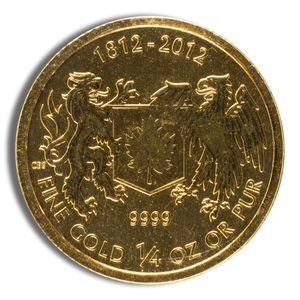
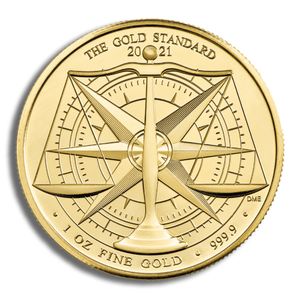
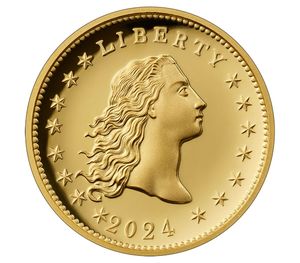
From other mints, the Royal Canadian Mint is represented by the 1967 $20, its 22 karat and 14 karat $100 coins, and quarter-ounce pieces for the War of 1812 bicentennial and the Devil's Brigade. You'll also find Mexico's 1957 gold 10 pesos, the 1980 Moscow Olympics 100 roubles, The Royal Mint's 2021 Gold Standard 1 oz coin, a random year 1/10 oz Perth Mint Battle of the Coral Sea coin, a 1/8 oz Solomon Islands coin marking the 20th anniversary of September 11, a 2024 high relief 1 oz proof for the 230th anniversary of the Flowing Hair design, and a 2026 NGC SP70 Early Release medal set based on the 1916 Standing Liberty quarter.
Pricing, Premiums, and Market Factors
Gold commemoratives are priced above their metal value, and the size of that premium varies widely from one coin to the next. Random year $5 and $10 gold coins typically sit closest to their gold content because buyers accept whatever program we supply, while a specific low-mintage issue or a perfect-grade certified coin can carry a premium many times larger.
Mintage is the starting point. The uncirculated 2000-W Library of Congress bimetallic $10 was struck in very small numbers, and many First Spouse coins had mintages in the low thousands, while the 2016-W centennial and 2014-W JFK gold issues were larger but still limited. Grade adds the next layer, since SP70 and PF70 coins command clear premiums over SP69 and PF69, and proof versus uncirculated matters program by program. Original government packaging with the box and certificate of authenticity supports a higher price, and subject appeal, from the Kennedy half dollar to the 1916 designs, shapes collector demand.
Gold's spot price sets the baseline beneath all of it. The gold market reflects demand from jewelry, central banks, technology and bar and coin buyers against a mine supply that changes slowly from year to year, and those conditions move the metal value inside every coin. Showing both our ask and our bid on each listing helps you see how much of a price is gold and how much is premium.
Condition, Packaging, and What to Expect
Raw U.S. gold commemoratives sold with box and COA come in the Mint's capsule and presentation case with the certificate. Proofs have deeply mirrored fields and frosted devices, uncirculated coins have a satin finish, and the 2016-W centennial coins have a specimen finish that grading services designate SP rather than MS or PF.
The 2014-W JFK gold half dollar was struck only as a proof, so every example we sell is a proof coin regardless of how its packaging is described. Certified coins arrive in sealed NGC or PCGS holders at the stated grade, and random label listings may show any label style the service used for that issue.
Gold resists toning far better than silver, but proof surfaces are delicate and show fingerprints and hairlines easily, so original capsules should stay sealed. For random year and finish listings, including the $5 and $10 coins, First Spouse coins and Arts medallions, we choose the piece from available inventory, and the date or design you receive can differ from the photo.
Authenticity and Verification
Every gold commemorative we offer is a government mint product sourced through established wholesale channels, and each one is verified before it ships. That includes checking weight and appearance against the known specifications and confirming that coins, cases, certificates and holder labels match the listing.
Gold's high value makes it the metal most targeted by counterfeiters, so known specifications are an important safeguard. A $5 gold commemorative should weigh 8.359 grams and a $10 should weigh 16.718 grams, and the .9999 issues have published weights as well. NGC and PCGS holders add independent authentication, with certification numbers that can be checked on each service's website.
We're an authorized dealer for both grading services and a member of the American Numismatic Association and the National Coin and Bullion Association, and our sourcing reflects those standards. When you buy a certified gold coin from us, the holder, the label and the coin inside have all been checked against each other.
Liquidity and Resale Considerations
Because gold commemoratives hold substantial metal, there's always a market for their gold content, and common $5 and $10 coins are bought by dealers routinely. Their numismatic premium is a different matter, and on common issues the bid often reflects mostly the gold, with a smaller premium than you paid.
Scarce issues and certified coins depend on collector demand. A PF70 JFK gold half dollar or an SP70 Walking Liberty centennial is easy to price from its grade, but finding a buyer who will pay the full collector premium can take longer than selling bullion. World gold commemoratives are recognized mostly for their metal outside their home markets, so their resale tends to track gold more closely.
Storage and Security
Gold commemoratives pack a lot of value into a small space, which makes secure storage the priority. A fire-rated, bolted home safe works for modest holdings, while a bank safe deposit box or an insured professional depository is a better fit as values grow.
Keep proofs and specimen coins in their original capsules or holders and handle them only by the case, since fingerprints can permanently mark gold proof surfaces. Store Mint boxes and certificates with their coins, and keep slabs upright in purpose-made storage boxes.
Gold doesn't tarnish easily, but the plastics, fabrics and paper around it can still be affected by humidity and heat, so a dry, stable environment protects packaging as well as coins. A record of each coin, its grade and certification number makes insurance and eventual sales easier.
Selling and Buyback Options
Gold commemoratives can be sold back to us within the same marketplace where you buy them. The bid on each product page shows what we're paying now, and our purchasing team takes a sale from quoted price through receipt, verification and payment.
Our bid reflects the gold price first, then the coin's issue, finish, grade, packaging and current collector demand. Random year $5 and $10 coins are priced mostly on their gold content, while certified coins, complete Gold Eagle sets and scarcer issues are priced from recent trading for that specific item. Keeping coins sealed and sets complete with their original boxes and certificates gives you the strongest result.
Why Buy Gold Commemorative Coins?
Gold commemoratives combine the recognizability of a government-issued gold coin with the limited production of a collectible. Each U.S. piece is legal tender from the U.S. Mint, made in a fixed quantity and documented by its specifications, and much of its value rests on the gold it contains.
They also offer variety that standard gold bullion doesn't. You can choose between 22 karat and 24 karat gold, proof and uncirculated finishes, fractional sizes from a tenth of an ounce to a full ounce, and subjects that run from the Library of Congress to the classic coin designs of 1916.
For collectors who already own silver commemoratives, commemorative gold coins are the natural next step, completing programs that were issued in both metals and adding pieces like the First Spouse and centennial coins that exist only in gold. World issues from Canada, Mexico and Great Britain then widen a collection beyond U.S. programs.
Why Buy from Bullion Standard?
Bullion Standard was founded in 2010 in San Diego, California, and our growth into a national online marketplace has rested on one idea: trust is earned once. For gold commemoratives, where premiums and packaging vary so much, that means accurate descriptions and prices you can compare against our own buyback bid.
We're rated A+ by the Better Business Bureau, belong to the ANA and NCBA, and carry PCGS and NGC certified gold as an authorized dealer for both. Every piece is verified before shipping and packed securely, and our research tools let you compare premiums, spreads and liquidity across gold products using objective data.
Payment options include Visa, Mastercard, American Express, Discover, PayPal, bank-connected payments through Plaid, wire transfer, paper check and cryptocurrency through BitPay. Because we buy back the same coins we sell, the bid you see on a gold commemorative today is a real price, not an estimate.
Get Near-Spot Pricing with Bullion Standard Pro
Gold buyers who want to see the wholesale market directly can do so through Bullion Standard Pro. Members get live, executable wholesale bid and ask pricing across a broad range of products, with no additional dealer markup or dealer spread applied.
Gold commemoratives still carry collector premiums at the wholesale level, but Pro shows where those premiums actually trade rather than leaving them hidden in a retail price. Portfolio valuation at live wholesale bid, historical premium analysis, spread analysis and liquidity metrics help members judge a coin's cost against its market.
For anyone buying gold regularly or in larger amounts, that combination of executable pricing and data is the most efficient way we offer to buy and sell. It also gives a clearer view of what a gold commemorative collection would bring at wholesale on any given day.


 (833) 278-4653