Buy Jackie Robinson Commemorative Coins Online
Our jackie robinson commemorative coin listings feature the 1997 silver dollar the U.S. Mint issued for the 50th anniversary of Robinson breaking Major League Baseball's color barrier. Both coins come from the San Francisco Mint and contain 0.7734 troy ounces of .900 fine silver, one in uncirculated finish and one in proof, which together make up the complete silver dollar issue for the program.
Each product page shows our live ask next to our bid, so you can see what each version costs and what it would bring if sold back. With only two versions to choose from, comparing them side by side takes a moment.
What Are Jackie Robinson Commemorative Coins?
Jackie Robinson commemorative coins are legal tender U.S. coins authorized by Congress and issued in 1997, with surcharges from their sale directed to the Jackie Robinson Foundation. The program had two denominations, this silver dollar and a $5 gold coin, each produced in uncirculated and proof versions.
The silver dollar is the more accessible of the two. Collectors buy it to honor Robinson's legacy, to fill a spot in a run of modern U.S. commemorative silver dollars or as a baseball piece with genuine historical weight. It's priced as a collector coin, so its value reflects finish, condition and demand more than silver content.
History and Background
Brooklyn Dodgers executive Branch Rickey signed Robinson in 1945, and after a season with the Montreal Royals he took the field for Brooklyn on April 15, 1947, becoming the first Black player in the modern major leagues. He won the first Rookie of the Year award that season, the National League MVP in 1949 and a World Series title with Brooklyn in 1955, and he was elected to the Hall of Fame in 1962. Fifty years after his debut, Major League Baseball retired his number 42 across every team, and the U.S. Mint marked the same anniversary with this coin program.
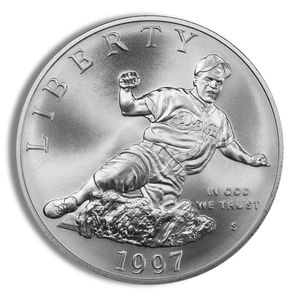
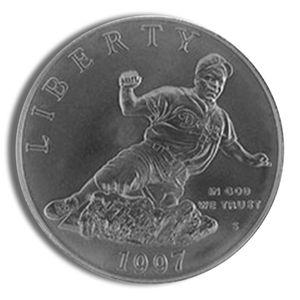
The silver dollar's obverse shows Robinson sliding into home, recalling his steal of home in the 1955 World Series. Sales at release were modest, a common outcome for commemoratives in the late 1990s. The uncirculated silver dollar was struck in far smaller numbers than the proof, and the program's uncirculated $5 gold coin, which isn't part of our catalog, finished with a mintage of just over 5,000, among the lowest of any modern U.S. commemorative.
Purity, Weight, and Specifications
Both dollars use the standard U.S. commemorative silver dollar composition: 26.73 grams of 90% silver and 10% copper, holding 0.7734 troy ounces of pure silver. Each carries a one dollar face value and the S mint mark of San Francisco, and weight and fineness are identical across the two finishes.
The difference is in how each was struck. The uncirculated version has a satin finish, while the proof was struck more than once on specially prepared planchets with polished dies, producing mirrored fields and frosted relief.
Available Brands, Mints, and Product Variations
Both coins here are U.S. Mint issues from San Francisco: the 1997-S uncirculated dollar and the 1997-S proof dollar. Because they share the same design and mint mark, the choice comes down to finish. The uncirculated coin presents the sliding Robinson with even, subdued luster, while the proof's contrast between mirrored fields and frosted devices makes the figure stand out sharply. Many collectors simply buy both as a pair.
Pricing, Premiums, and Market Factors
The silver in these dollars sets a floor, but they sell at collector premiums above their metal value. Mintage plays a large part: the uncirculated dollar was produced in much smaller numbers than the proof, and that scarcity shows in its price. Condition, original government packaging with the Mint's box and certificate of authenticity, and collector interest in Robinson's story all influence where each version trades.
Because those premiums don't track spot, a Robinson dollar can be priced very differently from a bullion silver coin of similar weight. We show the live ask and our bid on each listing, so the spread on each version is clear before you buy.
Condition, Packaging, and What to Expect
Both coins are raw, ungraded examples. The uncirculated dollar should show full luster with only the minor marks typical of production, while the proof should present reflective fields, although light toning or haze can develop on proofs of this age, especially if they've spent time outside the capsule. If the Mint's box and certificate matter to you, check the individual listing for packaging details.
Authenticity and Verification
Genuine 1997 Robinson dollars weigh 26.73 grams and carry the S mint mark, with sharp detail in the sliding figure and the lettering. A precise weight check and comparison with known genuine examples reveal most problems, and every coin is inspected before it ships. We buy our inventory from established wholesalers and distributors, the same channels we rely on as an authorized PCGS and NGC dealer and ANA member.
Liquidity and Resale Considerations
Robinson's dollar is a well-known modern commemorative with fixed specifications, which makes it easy for dealers to identify and price. Because it's a collector issue, pricing depends on demand for the coin itself, and the scarcer uncirculated version can take longer to match with a buyer at a specific price. Comparing our bid with the ask gives a realistic sense of how each version trades today.
Storage and Security
Keep both coins in their original capsules and store them somewhere cool and dry, away from PVC and household chemicals. Proof surfaces are especially sensitive to fingerprints and moisture, so avoid opening the capsule. A home safe works for a small collection, a bank safe deposit box or depository suits larger holdings, and keeping the Mint's certificate with each coin helps when it's time to sell.
Selling and Buyback Options
You can sell a Robinson dollar back to us through the same marketplace, with the current bid posted on each product page. After you lock in a price, we inspect the coin when it arrives and send payment once it's verified. The bid reflects the version, its condition and packaging and current collector demand, with silver prices supporting the floor.
Why Buy Jackie Robinson Commemorative Coins?
Few coins tie precious metal to a story as significant as Robinson's. The 1997 dollar marks a turning point for both baseball and civil rights, and it does so in government-issued silver from the U.S. Mint.
It's also one of the simplest modern commemoratives to own completely. With just two versions, both from the same mint, a collector can hold the entire silver issue, and the coin fits naturally beside other baseball-themed or 1990s U.S. commemoratives.
Why Buy from Bullion Standard?
Founded in 2010 and based in San Diego, California, Bullion Standard has grown into a national precious metals marketplace on a plain principle: there's only one chance to earn a customer's trust. We hold an A+ rating with the Better Business Bureau, belong to the National Coin and Bullion Association, and accept Visa, Mastercard, American Express, Discover, PayPal, Plaid, wire transfer, paper check and BitPay. Because we also buy coins back, our posted bid reflects a working two-way market.
Get Near-Spot Pricing with Bullion Standard Pro
Pro members deal directly at live, executable wholesale quotes, both bid and ask, and Bullion Standard puts no dealer markup or dealer spread on top of them. Their holdings are valued at the current wholesale bid, and research tools such as premium history and spread comparisons show how individual products trade, which gives anyone building a commemorative collection over time a clearer picture of cost and resale.


 (833) 278-4653