Buy Johnson Matthey Silver Bars Online
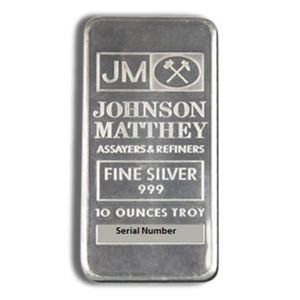
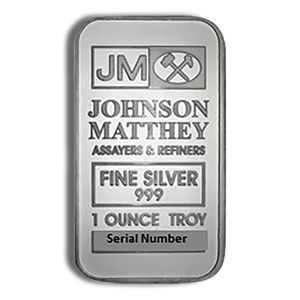
Our catalog features Johnson Matthey silver bars in three weights: the compact 1 oz silver bar, the mid-range 10 oz silver bar, and the substantial 100 oz silver bar. Each bar is produced to 0.999 fine silver purity and carries the unmistakable JM hallmark, one of the most widely recognized stamps in the wholesale bullion market. Whether you're looking for a manageable entry-level bar or a larger format suited to more concentrated silver ownership, this lineup covers the most commonly traded sizes in the secondary market.
Bullion Standard operates as a transparent two-way marketplace, meaning the same platform where you purchase these bars is also where you can sell them back at competitive wholesale bid prices. Pricing reflects real-time market conditions, and the bid/ask spread for each product is displayed directly on the product page so you can evaluate the complete cost of ownership before committing to a purchase.
Every Johnson Matthey bar in our catalog has been verified for authenticity, weight, and purity prior to listing. Our sourcing team works with reputable wholesalers and distributors to maintain product integrity at every stage of the supply chain.
What Are Johnson Matthey Silver Bars?
Johnson Matthey silver bars are privately minted silver bars produced by one of the world's most established precious metals refineries. Unlike government-issued coins or rounds, these bars carry no face value and derive their worth entirely from their silver content and the premium that the secondary market places on the Johnson Matthey name. That distinction matters in practice because JM bars have historically commanded strong recognition among dealers and private buyers alike.
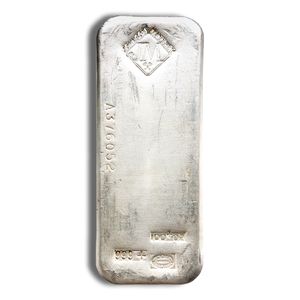
The 1 oz and 10 oz versions are minted bars, meaning they're produced using a stamping or pressing process that yields cleaner edges, smoother surfaces, and crisper detail. The 100 oz bar is a cast bar, formed by pouring molten silver into a mold, which gives it a more industrial appearance with slight surface texture variations that are entirely normal for the format. Both production methods meet the same purity standard of 0.999 fine silver.
Buyers who gravitate toward silver bars over coins generally do so because bars tend to carry lower premiums over spot, making them a more cost-efficient way to accumulate silver by weight. The Johnson Matthey name adds a layer of market recognition that makes these bars relatively straightforward to trade in both dealer and private channels.
History and Background
Johnson Matthey traces its origins to London in 1817, founded by Percival Norton Johnson as an assay office and precious metals dealer. The firm built its reputation over more than two centuries through refining, assaying, and chemicals manufacturing, eventually becoming one of the four original members of the London Gold Fix established in 1919. That institutional pedigree gave Johnson Matthey bars a credibility in global bullion markets that few private refiners have ever matched.
During the silver market boom of the late 1970s and early 1980s, Johnson Matthey expanded its North American refining operations significantly, producing large volumes of silver bars for the wholesale and retail markets. Their Brampton, Ontario and Salt Lake City facilities became well known sources of standardized silver bars that met the good delivery requirements of major commodity exchanges. The 100 oz cast bar in particular became a standard product for institutional and high-volume buyers during that era.
Johnson Matthey's refining division was eventually acquired and restructured over time, which means new production of JM-branded bullion bars is no longer ongoing. The bars available today in the secondary market represent production from the company's active refinery years, giving them a degree of scarcity compared to currently produced mint products. That history doesn't inflate their price in a speculative sense, but it does contribute to their strong name recognition and consistent resale demand among dealers familiar with the brand.
Purity, Weight, and Specifications
All three Johnson Matthey silver bars in our catalog carry a purity of 0.999 fine silver, which means 99.9% silver content by weight. This is the standard purity for investment-grade silver bars and meets the specifications required by major commodity exchanges for good delivery silver. Each bar is stamped with the JM hallmark, the stated weight, and the purity designation, providing the basic assay information a buyer or dealer needs to verify the product.
The 1 oz bar measures approximately 50.4mm x 29.7mm with a thickness of 2.7mm, while the 10 oz bar scales up to 76mm x 51mm at 7mm thick. The 100 oz cast bar is considerably larger at 163mm x 65.1mm with a 33mm thickness, reflecting the volume of silver involved. Weights are measured in troy ounces, the standard unit for precious metals, where one troy ounce equals approximately 31.1 grams.
Because these bars were produced during active refinery operations, most carry serial numbers stamped or engraved directly into the bar surface, particularly on the 100 oz format. Serial numbers are not universal across all JM products but are common enough that their presence is an important authentication feature when encountered. The absence of a serial number on smaller bars is not unusual and doesn't affect the bar's authenticity or market acceptance.
Available Brands, Mints, and Product Variations
The bars listed here are exclusively Johnson Matthey products, covering the three most commonly traded sizes in the JM secondary market. The 1 oz minted bar is the entry-level format, suited for buyers who prefer flexibility and ease of handling. Its compact dimensions make it easy to store in quantity and straightforward to sell in single-unit increments when needed.
The 10 oz minted bar occupies the middle ground, offering a balance between per-ounce premium efficiency and practical handling. It's a popular choice among buyers who want more silver per transaction without committing to the heavier 100 oz format. The minted finish on both the 1 oz and 10 oz bars gives them a cleaner, more uniform appearance compared to cast products, though the silver content and purity are identical regardless of production method.
The 100 oz cast bar is the largest format we carry and is produced as an American-origin product. Cast bars of this size typically show more surface variation than minted bars, including minor flow lines, crystallization patterns, and surface texture that develops naturally during the cooling process. These characteristics are expected and do not indicate any defect. For buyers focused purely on silver content at a lower per-ounce premium, the 100 oz cast bar represents the most cost-efficient option in this lineup.
Pricing, Premiums, and Market Factors
Silver bar prices are derived from the spot price of silver, a real-time benchmark traded on global commodity markets, plus a premium that reflects production costs, dealer margins, packaging, and product-specific market demand. Johnson Matthey bars typically carry premiums that sit above generic or lesser-known refinery bars, reflecting the brand's strong secondary market recognition. However, premiums on JM bars tend to be more moderate than those on government-issued coins such as American Silver Eagles or Canadian Maple Leafs.
The size of the bar also affects the per-ounce premium paid. Larger bars generally carry lower per-ounce premiums because the fixed costs of production and handling are spread across more silver content. The 100 oz bar will typically have the tightest premium per ounce, while the 1 oz bar carries the highest proportional cost. This is a consistent dynamic across the silver bar market and is worth factoring into any purchase decision.
At Bullion Standard, pricing is updated in real time to reflect current market conditions, and the bid/ask spread for each product is displayed transparently on the product page. Rather than burying the cost of ownership in unclear pricing structures, we believe buyers deserve to see both the acquisition price and the expected resale value before making a decision. That spread reflects genuine market conditions for that specific product, including liquidity, demand, and current wholesale pricing activity.
Condition, Packaging, and What to Expect
Johnson Matthey silver bars acquired through the secondary market may arrive in varying conditions depending on their age, prior handling, and storage history. Minor surface hairlines, handling marks, and light toning are common on bars that have circulated through the wholesale market over the years and are considered normal for bullion-grade products. These cosmetic variations have no meaningful impact on the bar's silver content or market value.
Smaller JM bars, particularly the 1 oz format, may occasionally come in original assay packaging, which typically consists of a sealed card or sleeve that provides additional authenticity verification. Assay-packaged bars often retain a slight premium over loose bars in the secondary market due to the added verification they provide. However, many bars in circulation are sold loose, and this is entirely standard for the bullion bar market.
The 100 oz cast bar is typically stored and shipped without additional packaging beyond protective wrapping to prevent surface contact during transit. Given its size and weight, it is not a product that typically comes in assay form. Buyers should expect the bar to arrive securely packaged for safe delivery but should not anticipate a presentation box or collector-style packaging for a product of this type.
Authenticity and Verification
Every Johnson Matthey bar in our catalog is verified for authenticity, weight, and purity before being listed for sale. Bullion Standard sources products from reputable wholesalers and distributors and applies a verification process at intake to confirm that each product meets the specifications stated on the listing. We maintain an A rating with the Better Business Bureau and are members of the American Numismatic Association and the National Coin and Bullion Association, organizations that hold member dealers to established ethical and professional standards.
Johnson Matthey bars carry several features that aid in authentication. The JM hallmark, purity stamp, and weight designation are pressed or engraved directly into the bar surface during production. On larger bars, serial numbers provide an additional layer of traceability. Buyers with access to precision scales can verify the stated weight against published troy ounce specifications, and professional-grade XRF analysis can confirm silver purity without damaging the bar.
Counterfeit silver bars do exist in the broader market, which is why sourcing from verified dealers matters. Purchasing through established channels with documented product intake processes significantly reduces exposure to fraudulent products. Bars with intact assay packaging provide an additional layer of assurance, though the absence of assay packaging alone is not an indicator of inauthenticity when the bar is purchased through a reputable dealer.
Liquidity and Resale Considerations
Johnson Matthey is one of the most recognizable names in the global bullion market, and that recognition translates directly into resale accessibility. Dealers across the United States and internationally are familiar with JM bars and will readily price them for purchase. The widespread familiarity with the brand reduces friction during the resale process compared to bars from less established or regionally limited refiners.
Bar size affects resale dynamics in practical ways. The 1 oz and 10 oz bars are easy to sell in smaller increments, which gives holders flexibility when partially liquidating a position. The 100 oz bar, while carrying the tightest per-ounce premium at purchase, is better suited for buyers who anticipate selling the full bar at once. Splitting a 100 oz bar into smaller units is not practical, so buyers considering partial liquidation over time may find the smaller formats more accommodating.
Condition and packaging also factor into resale pricing. Bars in original assay packaging typically receive slightly stronger bids than equivalent loose bars, particularly for the smaller formats where assay cards are more common. The 100 oz cast bar is generally evaluated on weight and purity alone regardless of its surface condition, as minor casting characteristics are expected and do not affect dealer bids meaningfully.
Storage and Security
Silver bars require protection from moisture, environmental contaminants, and physical contact that can cause toning or surface deterioration over time. For smaller bars like the 1 oz and 10 oz formats, individual protective holders or acid-free sleeves provide a practical and inexpensive layer of protection. Storing multiple bars in a hard-sided case with a moisture-absorbing desiccant pack helps maintain surface quality in humid environments.
The 100 oz cast bar presents different storage considerations due to its weight and size. At roughly 6.86 pounds per bar, a small accumulation of 100 oz bars adds up quickly in both weight and volume. A quality home safe with adequate weight capacity and fire resistance is a common storage solution, though buyers holding substantial quantities of silver in this format may find third-party vault storage more practical and cost-effective on an ongoing basis.
Bank safe deposit boxes are a frequently used option for smaller bars, offering secure off-site storage at low cost. However, access is limited to bank hours and may not be practical for buyers who anticipate needing quick access to their holdings. Regardless of the storage method chosen, maintaining an accurate record of bar weights, serial numbers, and purchase documentation is a straightforward practice that simplifies both insurance coverage and eventual resale.
Selling and Buyback Options
Bullion Standard operates as a two-way market, meaning customers can sell Johnson Matthey silver bars back through the same platform where they were purchased. Our purchasing team prices buybacks based on live wholesale bid pricing, current market conditions, product type, bar size, and condition. The bid price for each product is displayed on the product page in real time, giving sellers visibility into the expected resale value before initiating a transaction.
Bars in original assay packaging may receive modestly stronger bids than equivalent loose bars, particularly for the 1 oz and 10 oz formats. The 100 oz cast bar is evaluated primarily on silver content and condition, with the JM hallmark contributing to its recognition among our purchasing team. Serial numbers, where present, assist in product verification during the intake process and can support a smoother transaction.
For sellers considering their options, the Johnson Matthey name carries broad recognition that extends well beyond Bullion Standard. Local coin dealers, national precious metals dealers, and online platforms are all viable channels for selling JM bars. That said, our platform is designed to make the process as straightforward as possible, with transparent pricing and a streamlined process that avoids the uncertainty common in less structured resale environments.
Why Buy Johnson Matthey Silver Bars?
Johnson Matthey silver bars offer a combination of brand recognition, purity standardization, and premium efficiency that makes them a practical choice for buyers focused primarily on silver content. The JM hallmark is understood by dealers globally, which means these bars don't require explanation or additional verification in most resale contexts. That recognition has real value when it comes time to convert bars back into cash.
The three-size lineup, 1 oz, 10 oz, and 100 oz, provides meaningful flexibility depending on how you intend to hold and eventually sell. Smaller bars allow for incremental selling without liquidating an entire position, while the 100 oz cast bar delivers the tightest per-ounce premium for buyers focused on cost efficiency. The availability of both minted and cast formats within the same product family also allows buyers to choose based on presentation preference or price sensitivity.
Silver itself carries significant industrial demand across electronics, photovoltaics, medical applications, and electrical components, sectors that represent consistent structural consumption alongside the bullion market. While that demand doesn't determine the bar's day-to-day price directly, it contributes to silver's liquidity and the depth of its global market. For buyers who want exposure to silver in a straightforward, widely recognized bar format, Johnson Matthey's lineup represents one of the more established options available in the secondary market.
Why Buy from Bullion Standard?
Bullion Standard was founded in San Diego in 2010 and has grown into a nationally recognized online precious metals marketplace by prioritizing transparency over volume-driven sales tactics. Our pricing reflects real-time market conditions, and the bid/ask spread for every product is displayed openly on each product page. We don't obscure the cost of ownership behind confusing fee structures or opaque pricing models.
Every product we sell has been verified for authenticity, weight, and purity before reaching a customer. Our sourcing relationships span reputable mints, refineries, wholesalers, and distributors, and our intake process is designed to catch quality issues before they reach buyers. We hold an A rating with the Better Business Bureau and maintain membership in both the American Numismatic Association and the National Coin and Bullion Association.
Our platform is designed to support the complete lifecycle of precious metals ownership. From purchase through holding and eventual sale, we've built a marketplace that emphasizes informed decision-making over high-pressure sales. Customers can choose from a broad range of payment methods including major credit cards, bank transfers via Plaid, wire transfer, paper check, PayPal, and cryptocurrency through BitPay. And when it's time to sell, our two-way market structure means you're not navigating an unfamiliar process through an unfamiliar platform.
Get Near-Spot Pricing with Bullion Standard Pro
Bullion Standard Pro gives members access to live, executable wholesale bid and ask pricing across a broad range of precious metals products, including silver bars. Rather than displaying indicative or estimated prices, Pro pricing is based on real-time wholesale market conditions, allowing members to transact at prices that reflect actual supply and demand rather than fixed retail structures. For buyers of larger silver formats like the 100 oz cast bar, the difference between retail and near-wholesale pricing can be meaningful in absolute dollar terms.
Pro members also benefit from tighter bid/ask spreads, real-time portfolio valuation based on live wholesale bid pricing, and access to proprietary market intelligence tools that aren't available through standard accounts. These include historical premium analysis, spread tightness metrics, liquidity indicators, and buy/sell ratio data that help members evaluate whether current pricing conditions favor buying, holding, or selling a specific product. That kind of data-driven visibility has traditionally been available only to institutional or wholesale market participants.
For buyers who purchase silver regularly or hold meaningful positions across multiple bar sizes, the pricing efficiency available through Bullion Standard Pro represents a substantive operational advantage. The platform is designed to reduce the information asymmetry that has historically made the physical precious metals market less transparent than other financial markets, giving members a clearer, more accurate picture of the products they own and the market conditions that affect them.

 (833) 278-4653