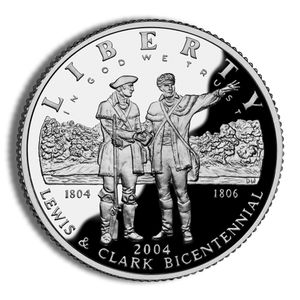
Buy Lewis and Clark Commemorative Coins Online
Our Lewis and Clark commemorative coin offering is built around a single U.S. Mint program: the 2004-P Lewis and Clark Bicentennial silver dollar, struck at Philadelphia to mark 200 years since the Corps of Discovery set out on its journey to the Pacific. We list it in both of the finishes the Mint produced, a brilliant uncirculated coin and a proof coin with frosted design elements over mirror-like fields.
The two versions share the same design, the same .900 fine silver composition and the same 0.7734 troy ounces of pure silver, so the choice comes down to finish, presentation and price. Each product page shows the live ask alongside our current bid, which lets you see how the market values a proof against an uncirculated example before you commit to either one.
What Are Lewis and Clark Commemorative Coins?
These are legal tender silver dollars authorized by Congress, struck by the U.S. Mint and sold directly to collectors at a set price that included a surcharge for bicentennial organizations. They were never released into circulation. Unlike an American Silver Eagle, which is a .999 fine bullion coin produced every year in large numbers, the Lewis and Clark dollar is a one-year issue in traditional .900 coin silver with a capped mintage.
Buyers come to this coin for different reasons. Some are assembling a run of modern U.S. commemorative dollars, others collect Americana tied to westward exploration, and many simply want a well-made government issue connected to a story they care about, such as a family link to a trail state. The proof suits buyers who want display quality, while the uncirculated coin appeals to those who prefer a mint-fresh business-style finish.
History and Background
After the Louisiana Purchase of 1803, President Thomas Jefferson sent Captains Meriwether Lewis and William Clark to explore the new territory and find a route to the Pacific. The Corps of Discovery left the St. Louis area in May 1804, traveled up the Missouri River, crossed the Rocky Mountains and reached the Pacific coast near the mouth of the Columbia River in late 1805 before returning to St. Louis in September 1806.
The bicentennial dollar was authorized under the Lewis and Clark Expedition Bicentennial Commemorative Coin Act and launched in May 2004 at the Missouri History Museum in St. Louis. Each coin carried a $10 surcharge directed to bicentennial commemoration efforts. Congress authorized up to 500,000 coins, and sales finished just short of that limit, with 351,989 proofs and 142,015 uncirculated coins sold. The Mint also packaged the coin in special sets, including a Coinage and Currency Set and a Coin and Pouch Set, which are historical offerings rather than items in our catalog.
This wasn't the first time the expedition appeared on American coinage. The 1904 and 1905 Lewis and Clark Exposition gold dollars honored the centennial with a world's fair in Portland, Oregon, and the 2004 and 2005 Westward Journey nickels marked the same bicentennial on circulating coins.
Purity, Weight, and Specifications
Both coins follow the standard specification for modern U.S. commemorative silver dollars: 26.73 grams of an alloy that is 90% silver and 10% copper. That works out to 0.7734 troy ounces of pure silver per coin, measured on the troy scale used for all precious metals, where one ounce equals about 31.1 grams. The copper adds hardness and is part of the long American tradition of coin silver.
Both versions carry the P mint mark of the Philadelphia Mint, along with the $1 face value and the dates of the expedition. There's no serial number or assay card on a coin like this; its government origin and specifications are established by the Mint's own production records and the details struck into the coin.
Available Brands, Mints, and Product Variations
Every coin here comes from the United States Mint, and both were designed and sculpted by Mint artist Donna Weaver. The obverse shows Lewis and Clark on a riverbank framed by foliage, with Lewis holding his journal and rifle as Clark looks into the distance, and the dates 1804 and 1806 on either side. The reverse reproduces the back of the Jefferson Indian peace medal, the kind the captains presented to tribal leaders they met, flanked by two feathers and topped by 17 stars for the states in the Union when the journey began.
The variation that matters is finish. The brilliant uncirculated coin has a bright, even mint luster, while the proof was struck more than once on specially polished planchets for sharper detail and stronger contrast. Both are specific-year coins dated 2004, not random year products.
Pricing, Premiums, and Market Factors
A Lewis and Clark commemorative coin doesn't trade close to its silver value. Its melt value moves with the spot price, but the price you pay reflects a collector premium shaped by several things: mintage, condition and any third-party grade, whether the coin is a proof or uncirculated, whether it comes in original government packaging with the Mint box and certificate of authenticity, and how much collectors want this particular subject at a given time.
Mintage is a good example of how those factors interact. The uncirculated version was made in far smaller numbers than the proof, yet proof coins have their own following because of their eye appeal. Rather than guessing which one is the better buy, compare the live ask and bid on each listing, which shows both the premium today and how wide the spread is.
Condition, Packaging, and What to Expect
The uncirculated coin should show full mint luster without wear, though light contact marks from production and storage are normal at this level and aren't defects. The proof should arrive with clean, reflective fields, but after two decades some coins develop light toning or faint hairlines, particularly if they were ever removed from their capsule. When a listing includes the Mint's box and certificate of authenticity, the coin ships in that packaging; otherwise it's packed to protect its surfaces in transit.
Authenticity and Verification
Counterfeits of modern U.S. commemoratives do turn up, so verification starts with the basics: weight close to 26.73 grams, crisp detail in the faces and foliage, correct lettering, and a P mint mark in the right place. On proofs, the contrast between the frosted figures and mirrored fields is hard for a counterfeiter to reproduce well.
We buy from established wholesalers and distributors and inspect each coin against the listing before it ships. As a member of the American Numismatic Association and the National Coin and Bullion Association, and an authorized dealer for PCGS and NGC, we follow industry practice for confirming that what you receive is a genuine U.S. Mint coin.
Liquidity and Resale Considerations
With close to half a million coins sold, the 2004 Lewis and Clark dollar is one of the better-known modern commemoratives and is familiar to most coin dealers, which helps when it comes time to sell. It changes hands through dealer buy programs, coin shows and online auctions, and it's often priced against recent sales of the same finish.
Keep in mind that collector coins resell on collector terms. Demand for the subject, the condition of the coin and whether the original Mint box and certificate are still with it all influence the bid, and those factors can move independently of silver prices.
Storage and Security
Coin silver tones over time, especially in humid air, so store these coins in a cool, dry place with a desiccant pack nearby and away from rubber, wood and paper products that release sulfur. Leave the coin in its capsule; handling a proof with bare fingers can leave marks that become permanent. If you have the Mint box, store it flat and dry so the packaging stays in good condition, since it can matter at resale. A small home safe is enough for one or two coins, while a bank safe deposit box suits larger holdings.
Selling and Buyback Options
You can sell your coin back to us through the same marketplace you bought it from. The bid shown on the product page is your starting point, and our purchasing team confirms the price, receives and checks the coin, and issues payment. Coins that come back with their original box and certificate, and proofs with clean, untouched surfaces, are the simplest to evaluate at full value.
Why Buy Lewis and Clark Commemorative Coins?
The appeal starts with the subject. Few events are as central to the American story as the expedition, and this dollar ties it to a carefully executed design that draws directly on the peace medals the captains carried west. Because it's a U.S. legal tender coin with a fixed authorized mintage, it also carries the recognizability that comes with a federal issue.
Practicality helps too. It's a single coin rather than a multi-year series, so one or both finishes complete the program, and its silver content gives it tangible metal value alongside its historical interest.
Why Buy from Bullion Standard?
We've been in business since 2010, operating out of San Diego, California, and our approach is simple: you only get one chance to earn a customer's trust. That's why we show both sides of the market on every product page, so you know what a commemorative coin costs and what it would bring if you sold it back. We hold an A+ rating with the Better Business Bureau, and we accept Visa, Mastercard, American Express, Discover, PayPal, bank payments through Plaid, wire transfer, paper check and cryptocurrency through BitPay.
Get Near-Spot Pricing with Bullion Standard Pro
Bullion Standard Pro gives members access to live, executable wholesale bid and ask pricing, with no additional dealer markup or dealer spread added on top. Prices move with real wholesale supply and demand, so you can see how a product is actually trading rather than relying on a fixed retail figure.
Members also get portfolio valuation at live wholesale bid prices and research tools such as historical premium analysis and spread analysis. For collectors who buy U.S. Mint silver regularly, it's a clearer view of how each coin is priced from one week to the next.


 (833) 278-4653