Buy Proof Gold & Silver Coins Online
Our catalog of proof gold and silver coins spans a broad range of minting programs, precious metal types, denominations, and years, offering buyers access to both historically significant issues and ongoing government-issued collectibles. You'll find proof American Eagles in gold and silver across multiple sizes, proof Gold American Buffalos, commemorative silver dollars issued by the U.S. Mint, certified examples graded by PCGS and NGC, and individual year-specific pieces ranging from the inaugural 1986-dated issues through the mid-1990s. Many listings include original government packaging with the certificate of authenticity, while others reflect raw ungraded examples in varying conditions.
Bullion Standard operates as a transparent, two-way precious metals marketplace, which means our proof coin inventory is priced to reflect real-time market conditions rather than inflated retail markups. Whether you're sourcing a complete set or a specific date for your collection, the products listed here come verified for authenticity and graded or described accurately based on observable condition and packaging status.
The depth of this selection reflects demand across a wide spectrum of buyers. Some prioritize specific calendar years or mint marks, while others focus on certified grades from PCGS or NGC for grading consistency. Still others are drawn to original mint packaging from early U.S. Mint proof programs. Whatever the motivation, the catalog presented here covers meaningful ground across both gold and silver proof coinage from the United States Mint.
What Are Proof Gold & Silver Coins?
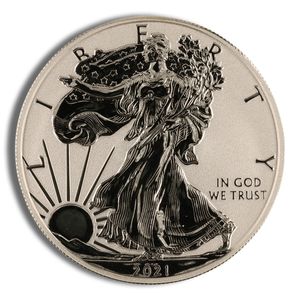
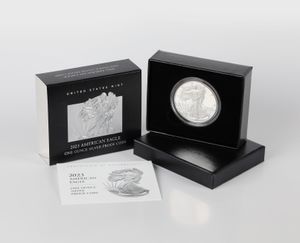
Proof coins are a distinct category of government-issued coinage produced through a specialized minting process designed to achieve sharper detail and a higher-quality finish than standard bullion strikes. Dies used in proof production are polished to a mirror-like surface, and the planchets, the blank discs struck into coins, are cleaned and treated before striking. Each coin is typically struck multiple times at lower press speeds to maximize design sharpness and surface clarity, resulting in the characteristic frosted relief figures against deeply reflective fields that define the proof aesthetic.
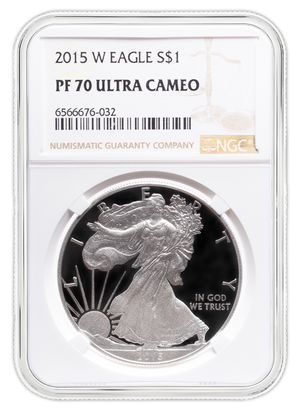
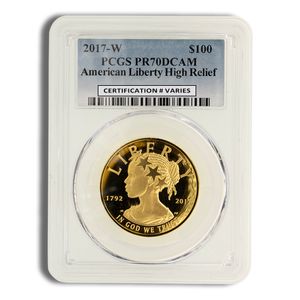
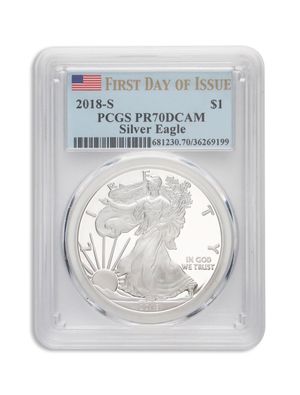
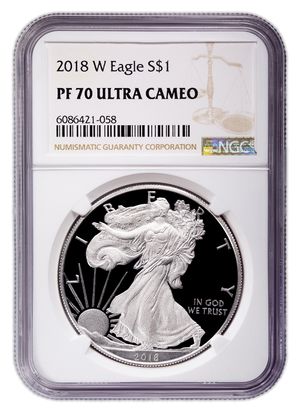
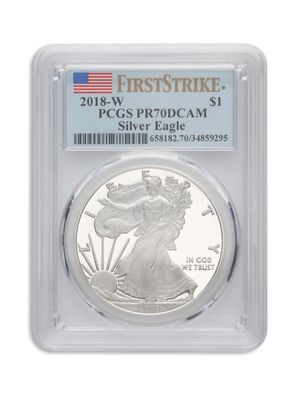
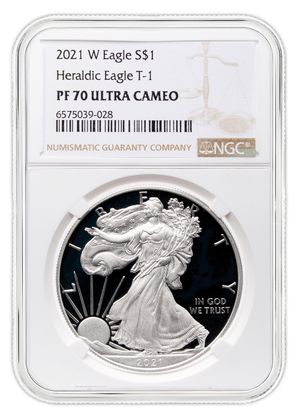
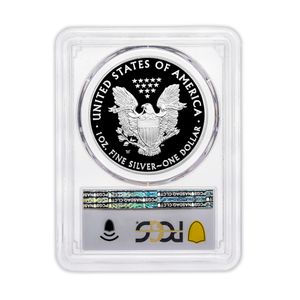
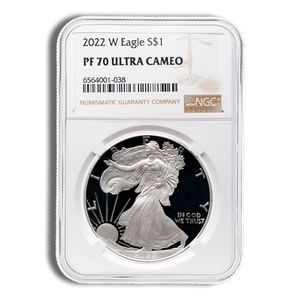
The term "proof" refers to the method of manufacture, not the condition grade. A proof coin graded PF69 has been certified by a third-party grading service as nearly perfect, while a raw proof in original mint packaging may carry no official grade at all. This distinction matters when evaluating price. Certified examples from PCGS and NGC carry a grading-service guarantee and are encapsulated in tamper-evident slabs, which can influence liquidity and resale. Raw proofs in original box-and-COA packaging retain collectibility but require more buyer-level diligence around condition.
Proof coins differ meaningfully from bullion-finish or burnished uncirculated coins. Burnished and standard bullion versions of coins like the Gold American Eagle or Silver American Eagle share the same precious metal content and purity as their proof counterparts but lack the mirror-field, frosted-relief finish that distinguishes proof coinage. That visual and production distinction, combined with lower annual mintages for proof issues, tends to support a premium above standard bullion pricing.
History and Background
The U.S. Mint has produced proof coinage for collectors since the early 19th century, initially striking proof examples for presentation purposes or by special request. The modern era of proof bullion coinage in the United States began in earnest in 1986, when the Mint introduced the American Gold Eagle and Silver Eagle programs. Both series launched with proof versions available alongside their bullion counterparts, establishing a dual-track model that persists today. The 1986-S proof Silver Eagle and 1986-W proof Gold Eagle are the founding issues of those respective programs, and they appear in this catalog.
Throughout the late 1980s and into the 1990s, the Mint expanded its proof offerings with annual commemorative silver dollar programs tied to significant American historical events and anniversaries. These included the 1982 George Washington half dollar, the 1983 and 1984 Los Angeles Olympic silver dollars, the 1986 Statue of Liberty dollar, the 1987 Constitution dollar, and numerous others that continued through the mid-1990s. Each of these commemoratives was struck at 90% silver with a proof finish and sold in limited quantities, often with an original box and COA. The programs covered here include issues tied to the Korean War, World War II, Mt. Rushmore, the U.S. Capitol, the Civil War, and the 1995 Atlanta Olympics, among others.
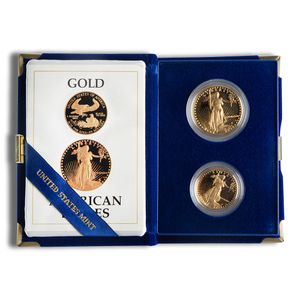
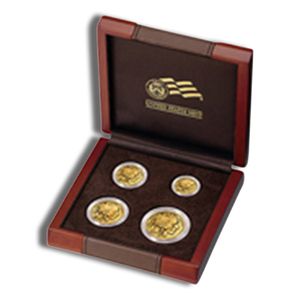
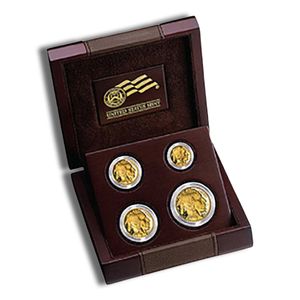
The Gold American Buffalo proof program launched in 2006 as the first 24-karat gold coin issued by the U.S. government, with the proof version setting the standard for high-purity American gold coinage. Four-coin proof Gold Eagle sets, combining the 1/10, 1/4, 1/2, and 1 oz denominations in a single presentation case, have been issued annually and are represented in this catalog from 1988 through 1995. These complete sets have long attracted buyers who value comprehensive representation of a given year's proof gold eagle program in original government packaging.
Purity, Weight, and Specifications
Gold American Eagles, including all proof versions shown here, are struck at 22-karat purity, or 0.9167 fine gold, with the remaining alloy composed of copper and silver to improve durability. The 1 oz denomination measures 32.7 mm in diameter and 2.87 mm in thickness, carrying a $50 face value. Fractional proof Gold Eagles include the 1/2 oz ($25 face value, 27 mm diameter), 1/4 oz ($10 face value, 22 mm diameter), and 1/10 oz ($5 face value, 16.5 mm diameter). The four-coin set combines all four denominations for a total of 1.85 troy ounces of gold content.
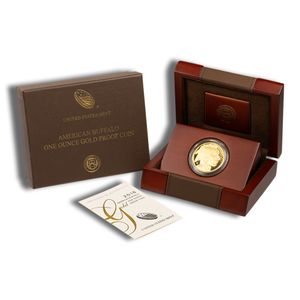
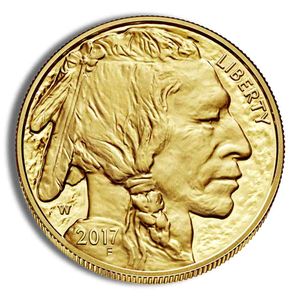
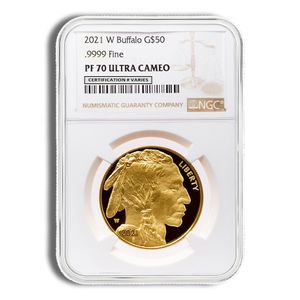
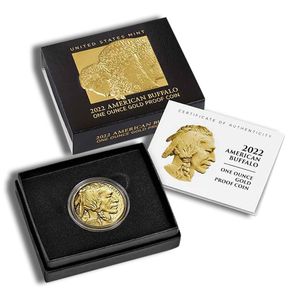
The proof Gold American Buffalo is struck at 0.9999 fine gold, making it one of the purest gold coins issued by the U.S. Mint. The 1 oz denomination shares the same $50 face value and 32.7 mm diameter as the Gold Eagle but differs in alloy composition and finish quality. Silver American Eagles, both proof and standard, contain exactly 1 troy ounce of 0.999 fine silver, measure 40.6 mm in diameter, and carry a $1 face value. The commemorative silver dollars in this catalog are struck at 90% silver (0.9 fine) and contain approximately 0.7734 troy ounces of silver, consistent with the composition standard used across U.S. Mint commemorative coinage of that era.
Eisenhower silver dollars, such as the 1974-S proof example listed here, contain approximately 0.316 troy ounces of silver at 0.999 purity, while the 1982 George Washington half dollar contains roughly 0.3617 troy ounces at 90% silver. Understanding these weight and purity distinctions matters when comparing products based on precious metal content versus collectibility-driven premium.
Available Brands, Mints, and Product Variations
Every coin in this catalog originates from the United States Mint, which operates facilities at Philadelphia (P mint mark), San Francisco (S mint mark), and West Point (W mint mark). Proof Gold Eagles struck from 1986 through 1991 carry either a W (West Point) or P (Philadelphia) mint mark depending on the year and denomination. Beginning in 1992 and extending through the mid-1990s, proof Gold Eagles generally shifted to the W mint mark, which has since become standard for proof gold coinage. Proof Silver Eagles from 1986 through 1992 were struck at San Francisco, with the 1993 and beyond dates transitioning to Philadelphia and eventually West Point.
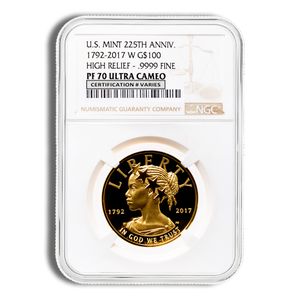
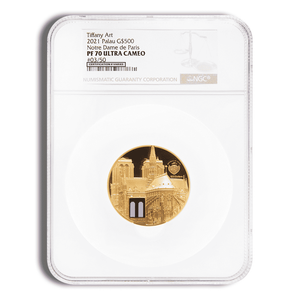
Certified examples in this catalog carry grades from PCGS and NGC, the two leading third-party grading services in the numismatic market. Products graded PF70 by either service represent a perfect strike with no post-production blemishes visible under 5x magnification. PF69 examples are near-perfect with at most one minor imperfection. Graded slabs from both services include anti-counterfeiting security features and guarantee the coin's authenticity and stated grade. Several products listed here include PCGS PR69, PCGS PF70, NGC PF69, and NGC PF70 designations across both gold and silver issues.
Beyond certified examples, the catalog includes raw proof coins in original U.S. Mint packaging, with the government-issued box and certificate of authenticity intact. It also includes random-year proof and BU-finish versions of Gold Eagles and Silver Eagles where the specific year is determined by available inventory. One listing covers an impaired-condition example described as cull grade, which carries a lower premium appropriate to its condition. The 1995-W proof Silver Eagle is a notable inclusion, as it was available only as part of the 1995 American Eagle 10th Anniversary Gold and Silver Proof Set, making it the lowest-mintage proof Silver Eagle in the series.
Pricing, Premiums, and Market Factors
Proof coins carry premiums above spot price that reflect production costs, mintage figures, original packaging, collector demand, and the presence or absence of third-party grading. The premium for a raw proof Silver Eagle in original box-and-COA packaging differs from the premium for the same coin encapsulated in a PCGS or NGC slab, particularly for low-mintage dates like 1994 or 1995. Proof gold coins generally carry higher premiums than their bullion counterparts due to lower mintage levels and the cost of the proof minting process itself.
Mintage figures matter significantly within proof coinage. A year with a production run of 400,000 examples trades differently than a year with fewer than 100,000, even when the underlying metal content is identical. This dynamic is especially pronounced in the proof Silver Eagle series, where years like 1986 and 1987 were struck in high quantities, while key dates like 1995-W carry significant collector premiums relative to silver spot. The four-coin proof Gold Eagle sets tend to carry a meaningful premium over purchasing the four denominations individually, reflecting both the convenience of matched-year packaging and the fact that complete sets are typically preserved intact rather than broken apart.
Bullion Standard prices proof coins using real-time market data and transparent bid/ask structures. The bid price displayed on each product page reflects current wholesale market conditions, giving buyers a clear picture of both acquisition cost and the approximate liquidation value at the time of purchase. This approach is intended to reduce information asymmetry and help buyers understand the spread they're working within before committing to a purchase.
Condition, Packaging, and What to Expect
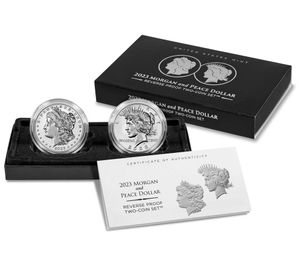
Proof coins sold with original government packaging include the velvet-lined presentation box and the printed certificate of authenticity issued by the U.S. Mint at the time of sale. These sets remain sealed or have been opened for inspection but retain all original components. Products described as "with Box and COA" are expected to arrive with both items intact, though the exterior condition of the box itself may show age-related wear consistent with storage over several decades.
Raw proof coins without packaging have been removed from their original presentation cases, whether intentionally for handling or as a result of how they entered the secondary market. These examples are typically stored in coin flips, holders, or capsules and are priced to reflect the absence of original packaging. Certified examples arrive in their grading-service slabs with no additional packaging required, as the slab itself serves as the protective and authenticating enclosure.
Impaired or cull-grade proof coins, such as the impaired-condition 1994-P proof Silver Eagle listed in this catalog, carry visible wear, contact marks, or surface damage that distinguishes them from presentation-quality examples. These are priced at a discount relative to clean proof examples and are typically purchased for their metal content rather than their collectibility. Buyers should review condition disclosures carefully, as the description and grade listed on each product page reflect the actual state of the coin offered.
Authenticity and Verification
All proof coins sold through Bullion Standard are verified for authenticity and accurate description before listing. U.S. Mint proof coins carry well-established physical characteristics, including precise weight tolerances, diameter specifications, and die-quality surface details that are difficult to replicate convincingly. The U.S. Mint's proof coinage is among the most widely traded government-issue collectible coin in the world, and authentication resources are well-developed across the industry.
Third-party graded coins from PCGS and NGC carry an additional layer of assurance through the encapsulation process. Each slab contains a QR code or certification number that can be verified through the respective grading service's online registry, confirming the coin's authenticity, grade, and description. Bullion Standard is an authorized dealer for both PCGS and NGC, maintaining direct relationships that support consistent product integrity across certified offerings.
For raw proof coins, authentication relies on physical inspection against documented specifications. The weight, diameter, edge reeding, surface quality, and mint mark position are all verifiable against U.S. Mint published standards. Buyers who have concerns about a specific example are encouraged to submit coins to a grading service for independent authentication, and our team can provide guidance on that process as part of our customer support resources.
Liquidity and Resale Considerations
Proof Gold Eagles, proof Silver Eagles, and proof Gold American Buffalos are among the most widely recognized government-issued proof coins in the global precious metals market. Their legal tender status, standardized weight and purity, and the longstanding reputation of the U.S. Mint mean that these products trade actively across dealer networks, auction houses, and the secondary coin market. Broadly recognized products are generally easier to sell quickly and at competitive prices than obscure or limited-distribution issues.
Commemorative silver dollars occupy a different liquidity tier. While they are genuine U.S. Mint products with established collector markets, their resale environment tends to be more collector-driven than bullion-driven. Buyers seeking maximum liquidity typically focus on coins with the broadest market recognition, such as proof American Eagles, while commemoratives appeal more to thematic collectors. This distinction influences buyback pricing and should factor into purchase decisions depending on the buyer's priorities.
Condition, packaging completeness, and grading status all affect resale outcomes. A PF70-certified example typically commands a premium over an ungraded raw proof, and a raw proof with original box and COA typically outperforms a raw example without packaging. Understanding these dynamics before purchasing helps buyers calibrate expectations for both the acquisition cost and the eventual resale transaction.
Storage and Security
Proof coins require more careful handling and storage than standard bullion products due to their polished surfaces and the ease with which fingerprints, hairline scratches, and humidity can degrade their visual appeal and numismatic value. Touching proof surfaces without cotton gloves can leave oils that etch into mirrored fields over time. Handling should always be done by the edge of the coin rather than the obverse or reverse face.
Certified examples in PCGS or NGC slabs are already protected within sealed acrylic enclosures and do not require additional individual coin holders. These can be stored in slab boxes, binders with slab pages, or locked safe deposit boxes. Raw proof coins in original government presentation cases should remain in those cases whenever possible, stored flat in a climate-controlled environment away from humidity, direct sunlight, and temperature fluctuation. Acid-free coin flips and Mylar holders are appropriate alternatives when original packaging is absent.
For larger collections of proof coinage, a home safe with dehumidifier packets or dedicated vault storage provides meaningful protection against both environmental damage and physical loss. Bank safe deposit boxes offer security but may limit access during banking hours. Bullion Standard does not offer on-site vault storage, but our team can provide general guidance on third-party vault and storage options available to customers who hold significant holdings.
Selling and Buyback Options
Bullion Standard maintains an active buyback program that covers proof gold and silver coins, including U.S. Mint proof Eagles, commemorative silver dollars, and certified examples from PCGS and NGC. Our purchasing team evaluates buyback pricing based on current spot prices, prevailing wholesale market conditions, product type, condition, packaging status, and the liquidity profile of the specific coin being sold. Products in original mint packaging or certified in top-tier grades generally attract more competitive buyback offers than impaired or loose examples.
The process is designed to be straightforward. Sellers request a quote, receive current bid pricing based on the products they hold, and can complete the transaction through our platform. Bullion Standard's two-way market model means we are consistently active on both the buy and sell side of the market, which supports pricing consistency and reduces friction for customers looking to liquidate. Rather than directing sellers to other channels or secondary markets, our goal is to provide a reliable, in-house liquidity option that reflects genuine market pricing.
Buyers who use Bullion Standard Pro have additional visibility into live wholesale bid pricing across the catalog, which provides a more detailed picture of the current liquidation environment for specific products before or after a purchase. This transparency is intentional and reflects our belief that liquidity should be evaluated alongside acquisition cost as part of any informed purchasing decision.
Why Buy Proof Gold & Silver Coins?
Proof coins occupy a distinct position in the precious metals market that standard bullion products do not fill. The combination of government backing, precious metal content, low mintage figures, and collector demand creates a format that appeals simultaneously to buyers focused on metal content and those focused on numismatic quality. For buyers who want the tangible substance of physical gold or silver alongside the refined aesthetics of proof-quality minting, this category offers both in a single product.
The U.S. Mint's proof programs carry significant institutional credibility. Proof American Eagles and proof Gold Buffalos are recognized globally, carry legal tender status, and are produced under the oversight of the federal government using specified precious metal content. This recognition supports resale across a wide range of buyer types, from dealers and auction houses to individual collectors in domestic and international markets.
For buyers interested in specific date collecting, the annual nature of U.S. Mint proof programs provides a natural collecting framework. Year-specific proof Gold Eagles and proof Silver Eagles from the late 1980s through the mid-1990s represent the early chapters of those series and are increasingly viewed as historical reference points within the broader American bullion coinage landscape. Completing date runs or acquiring key dates within a proof series is a purchasing motivation that distinguishes this format from generic bullion accumulation.
Why Buy from Bullion Standard?
Bullion Standard was founded in 2010 in San Diego, California, and has grown into a nationally recognized precious metals marketplace by prioritizing transparency and operational integrity above aggressive sales tactics. Our A rating with the Better Business Bureau, membership in the American Numismatic Association and the National Coin and Bullion Association, and our status as an authorized dealer for both PCGS and NGC reflect a sustained commitment to industry standards and customer trust.
Every product sold through Bullion Standard is verified for authenticity, accurate description, and appropriate condition grading before it is listed. Our pricing reflects real-time market conditions and is structured around the bid/ask spread model, giving buyers clear visibility into both what they're paying and what the current liquidation value looks like. We don't rely on opaque pricing structures or last-minute surcharges. The price you see on the product page reflects the actual cost of the transaction.
Our payment flexibility, secure checkout infrastructure, and reliable fulfillment processes are designed to make the purchasing experience straightforward and trustworthy. Customers can pay using Visa, Mastercard, American Express, Discover, PayPal, bank-connected payments through Plaid, wire transfer, paper check, or cryptocurrency through BitPay. Post-purchase support is available through our responsive customer service team, and our two-way market model means we remain a resource for customers long after the initial transaction is complete.
Get Near-Spot Pricing with Bullion Standard Pro
Bullion Standard Pro is designed for buyers who want direct access to live wholesale bid and ask pricing across our catalog, including proof gold and silver coins. Rather than transacting at fixed retail price points with dealer markups applied on top, Pro members execute at executable wholesale market prices that reflect actual supply and demand within the wholesale precious metals market. Premiums and bid/ask spreads fluctuate based on real market conditions rather than static retail pricing structures.
For buyers who purchase proof coins with any regularity, the pricing efficiency available through Bullion Standard Pro can reduce the cost of each transaction meaningfully over time. The platform also includes portfolio valuation based on live wholesale bid pricing, allowing members to see the current liquidation value of their holdings rather than an estimated retail value. This distinction matters for buyers who want an accurate picture of their position in real market terms.
Bullion Standard Pro also provides access to proprietary analytics tools that allow members to evaluate products using historical premium data, spread analysis, liquidity metrics, and market-wide bid/ask conditions. Within a category like proof coinage, where premiums can vary significantly by date, mint mark, grade, and packaging status, having access to objective historical data allows buyers to identify relative value and make decisions based on observable pricing trends rather than marketing claims alone.


 (833) 278-4653