Proof Gold Eagles | Bullion Standard
Buy Proof Gold Eagles Online
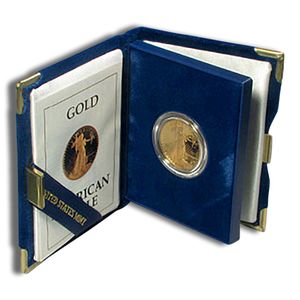
Our catalog of proof gold eagles covers one of the most recognized and consistently traded government-issued gold products in the American market. From fractional options like the 1/10 oz, 1/4 oz, and 1/2 oz coins to the flagship 1 oz issue, buyers will find individual coins as well as complete four-coin sets spanning decades of production. The selection includes both raw coins with original U.S. Mint box and Certificate of Authenticity as well as professionally graded examples certified by NGC and PCGS in grades including PF70 and PR70.
Coins are available across a wide range of dates, from the inaugural 1986-W issue through the early 2000s and beyond, with West Point and Philadelphia mint marks represented throughout. Random year options offer a cost-conscious entry point for buyers who prioritize metal content over specific dates. Two-coin sets, four-coin sets, specialty issues like the 1999-W unfinished proof die coins, and slabbed collector specimens round out a catalog that serves both the bullion buyer and the numismatic collector.
Bullion Standard sources proof gold eagles through established channels and presents pricing with the clarity this market deserves. Whether you're building a date set, adding a four-coin set to your holdings, or picking up a single year for its metal content, the products shown here are verified for authenticity and presented with complete specification transparency.
What Are Proof Gold Eagles?
Proof gold eagles are a distinct finish of the American Gold Eagle coin program produced annually by the United States Mint. Unlike bullion-finish American Gold Eagles, proof coins are struck multiple times using specially polished dies and carefully prepared planchets, producing a characteristic mirror-like background field contrasted against frosted design elements. This production process results in a coin with sharper detail and a more refined surface quality than standard bullion strikes.
The proof designation refers to the manufacturing method, not the condition of a specific coin. A proof coin leaves the Mint in that finished state by design. Because of this, proof gold eagles occupy an interesting position in the market: they carry the same gold content and government backing as bullion American Gold Eagles while commanding a higher premium tied to their specialized production process, packaging, and collector demand.
Buyers choose proof gold eagles for several reasons. Collectors value the craftsmanship, the original presentation packaging, and the mintage figures that are typically lower than bullion issues. Buyers focused primarily on metal content often find proof coins at competitive premiums in the secondary market, particularly for older dates. The four-coin set format, containing 1 oz, 1/2 oz, 1/4 oz, and 1/10 oz coins, is especially popular as a self-contained acquisition of the full American Gold Eagle size spectrum.
History and Background
The American Gold Eagle program launched in 1986 following the Gold Bullion Coin Act of 1985, which authorized the United States Mint to produce gold coins for public sale. The first proof issues were released the same year the bullion program began, making the 1986-W proof a foundational piece in the series. These early coins were struck at the West Point Mint and carry the "W" mint mark, a distinction that continued through most of the program's history.
Early proof issues from 1986 through the early 1990s were struck at both the West Point and Philadelphia Mints, with Philadelphia coins bearing the "P" mint mark on fractional denominations through the 1993 production year. Starting in 1993 and 1994, production gradually consolidated to West Point for most denominations, and the "W" mint mark became the standard identifier for proof American Gold Eagles across the series. The 1987 two-coin set represented the Mint's first multi-coin proof offering before the full four-coin format became a regular annual release.
The 1999-W unfinished proof die issue represents one of the more historically notable moments in the program. These coins were struck using proof dies that had not yet been fully finished, resulting in a surface appearance that differs from standard proof coins. The error-type nature of these pieces has made them a distinctive entry in the series, with certified examples graded MS69 by both NGC and PCGS appearing regularly in the collector market. The broader proof eagle program has maintained continuous production with few interruptions, reflecting the sustained demand for government-backed gold coins in a proof presentation.
Purity, Weight, and Specifications
All American Gold Eagle coins, including proof issues, are struck in 22-karat gold with a fineness of 0.9167. The remaining alloy is composed of silver and copper, which gives the coin its characteristic warm gold tone and contributes durability compared to 24-karat issues. Each coin contains its stated gold content by weight, with the 1 oz coin delivering exactly one troy ounce of gold regardless of its total coin weight, which is slightly higher due to the alloy composition.
The four standard sizes in the proof program are the 1 oz ($50 face value, 32.7mm diameter, 2.87mm thickness), the 1/2 oz ($25 face value, 27mm diameter), the 1/4 oz ($10 face value, 22mm diameter), and the 1/10 oz ($5 face value, 16.5mm diameter). Total gold content in a complete four-coin set is 1.85 troy ounces. Face values are legal tender denominations established by Congress, though they bear no practical relationship to market value.
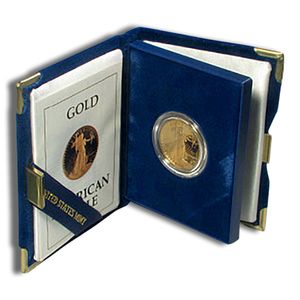
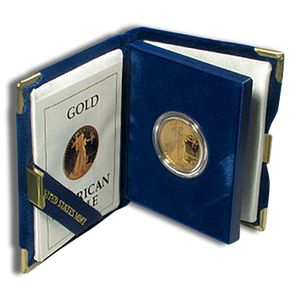
Proof coins are presented in protective capsules and housed in original U.S. Mint packaging, which typically consists of a velvet-lined display case and an outer box. A Certificate of Authenticity accompanies each coin or set, serving as the Mint's documentation of the issue. Graded specimens are encapsulated in NGC or PCGS holders that display the assigned numeric grade and authenticate the coin through the respective grading service's verification process.
Available Brands, Mints, and Product Variations
Every proof gold eagle in our catalog is a product of the United States Mint, the sole authorized producer of American Gold Eagle coins. The West Point Mint in West Point, New York handles the vast majority of proof production, which is why most coins in this series carry the "W" mint mark. Fractional proof issues from 1987 through the early 1990s bearing the "P" mint mark were produced at the Philadelphia Mint, and both mint mark variants appear in the catalog for corresponding years.
The catalog includes individual coins across all four size denominations as well as complete four-coin proof sets for years including 1988, 1989, 1990, 1991, 1992, 1993, 1994, 1995, 1996, 1997, 1998, 1999, 2000, 2001, 2002, and 2003. Two-coin sets combining the 1 oz and 1/2 oz denominations from the 1987 program are also available. Professionally graded specimens from NGC and PCGS appear in the catalog in grades such as PF70 and PR70, as well as the MS69-graded 1999-W unfinished proof die coins, which are a recognized sub-type within the series.
Random year options are available for buyers who want proof gold eagles across the standard denominations without specifying a date. These are sourced from existing inventory and may include any production year available at the time of fulfillment. The random year format is a practical choice when the primary objective is acquiring proof-finish gold content at a potentially more efficient price point than specific date-matched inventory.
Pricing, Premiums, and Market Factors
Proof gold eagle pricing moves in relation to the spot price of gold but typically carries a higher premium than bullion-finish American Gold Eagles. That premium reflects the specialized minting process, original government packaging, Certificate of Authenticity, lower mintage figures, and the additional collector demand that comes with the proof designation. For any given date and denomination, the premium can vary based on how scarce the specific issue is, whether original packaging is intact, and where the coin trades in the broader secondary market.
Four-coin sets generally carry a different premium structure than individual coins purchased separately. In some cases the set commands a premium over the sum of individual pieces; in others, particularly in the secondary market for older dates, individual coins or complete sets may be priced more competitively. Graded examples certified PF70 or PR70 by NGC or PCGS typically carry the highest premiums within the series, reflecting the scarcity of coins achieving the top numeric grade on the professional grading scale.
Bullion Standard presents pricing in real-time based on current market conditions. Our platform is built around transparency rather than complexity, and the bid/ask spread displayed on each product page reflects live market data rather than a fixed retail markup applied over a hidden formula. For buyers focused on minimizing acquisition costs, understanding the full premium structure, including both the ask price and the expected buyback level, provides a more accurate picture of the true cost of ownership.
Condition, Packaging, and What to Expect
Proof gold eagles sold with original box and COA come in the packaging produced by the U.S. Mint at the time of issue. Most years feature a velvet-lined presentation case within a printed outer box, along with a serialized or otherwise identified Certificate of Authenticity. Packaging styles have varied across production years, particularly between the 1980s and the 2000s, and buyers receiving older dates should expect packaging that reflects the design conventions of those respective years.
Coins listed as graded by NGC or PCGS are encapsulated in sonically sealed plastic holders bearing the assigned grade, certification number, and coin identification. The holder itself serves as both protection and authentication. Graded proof coins will not include original Mint packaging unless specifically noted, as they are typically submitted for grading after removal from their cases.
Random year products are fulfilled from available inventory and will ship in the packaging appropriate to the specific coin or set provided. The year received may vary from what appears in any representative photograph. Cosmetic variation in older packaging is normal and expected for items that have been stored for decades. Coins themselves in proof condition are handled with care by the Mint and will arrive reflecting their original proof surface characteristics.
Authenticity and Verification
American Gold Eagle coins, proof and bullion alike, are produced exclusively by the United States Mint under Congressional authorization. The Mint's production standards, alloy specifications, and quality controls are well-documented and consistent across decades of production. Each coin's design, weight, diameter, and fineness are regulated and publicly specified, giving buyers and dealers a reliable benchmark against which individual coins can be evaluated.
For graded specimens, NGC and PCGS each employ multi-step verification and grading processes that include expert examination, authentication, and encapsulation. The assigned grade is printed on the holder along with a unique certification number that can be verified through the respective grading service's online registry. Bullion Standard is an authorized dealer for both PCGS and NGC, and our sourcing process is aligned with the authentication standards these organizations maintain.
Every product that passes through Bullion Standard is verified for authenticity, weight, and purity before reaching the customer. Our sourcing network draws from established mints, wholesalers, and distributors operating within recognized industry channels. The A rating maintained with the Better Business Bureau, along with our membership in the American Numismatic Association and the National Coin and Bullion Association, reflects the standards we hold ourselves to across all product categories.
Liquidity and Resale Considerations
American Gold Eagles, including proof issues, are among the most widely recognized gold coins in the world. The program's uninterrupted production history since 1986, combined with U.S. government backing and a standardized alloy specification, makes these coins broadly accepted across the dealer network, both domestically and internationally. That recognition translates directly into resale accessibility, as most reputable dealers are familiar with the product and can price it efficiently.
Within the proof series, liquidity varies by denomination, date, condition, and packaging status. Common dates in the most frequently produced denominations, particularly the 1 oz coin, tend to trade most fluidly in the secondary market. Coins with original box and COA intact often carry better resale positioning than those with incomplete packaging. Graded examples at the top numeric grades, PF70 and PR70, occupy a more specialized collector market where liquidity may be narrower but pricing can reflect meaningful premiums over raw examples.
Rare issues such as the 1999-W unfinished proof die coins trade in a more defined collector segment and should be understood on those terms. Their resale environment is shaped more by numismatic demand than by standard bullion market dynamics. Buyers considering any proof product from a liquidity perspective benefit from evaluating not just the acquisition price but the realistic resale environment for that specific coin type under current market conditions.
Storage and Security
Proof gold eagles in original Mint packaging should be stored in a stable environment that protects both the coin and its presentation case from humidity, temperature fluctuation, and direct light exposure. The proof surface is highly reflective and sensitive to handling, so direct contact with the coin itself should be avoided at all times. If a coin is removed from its capsule for any reason, cotton gloves are the minimum appropriate precaution.
For home storage, a fire-rated safe bolted to a structural element of the building provides a reasonable baseline for smaller quantities. Vaulted storage through a third-party precious metals depository is worth considering for larger holdings or higher-value items, particularly graded specimens where condition preservation directly influences resale value. Many depositories offer segregated storage options that keep specific coins in their original packaging rather than commingling them with other inventory.
Four-coin sets and multi-coin presentation cases can be stored upright or flat, but should be kept away from surfaces that generate static or friction against the case material. Safety deposit boxes at banking institutions offer a reasonable option for mid-tier quantities, though access limitations and insurance considerations vary by provider. Whatever storage method is chosen, consistency in environmental conditions matters more than the specific format used.
Selling and Buyback Options
Proof gold eagles are buyable assets in both the bullion and numismatic markets, but the mechanics of selling them depend on which market the specific coin lives in. Standard proof issues with original box and COA in common dates are most efficiently sold back through dealer buyback programs that price based on gold content and current market conditions, with adjustments for packaging status and demand. Graded examples at PF70 or PR70 may be better suited to numismatic-focused channels where collectors are actively seeking top-pop pieces.
Factors that influence the buyback price a dealer offers include the denomination and date, the presence of original packaging and COA, the coin's surface condition, whether it has been graded by a recognized service, and overall market demand at the time of sale. Proof coins in compromised packaging or with visible handling marks on the proof surface may be priced more conservatively than examples that have been properly stored and remain in pristine condition.
Bullion Standard operates a two-way market, meaning we actively purchase proof gold eagles in addition to selling them. Our buyback pricing is transparent and tied to live market conditions rather than arbitrary dealer discretion. Sellers can request a quote through our platform and the process is designed to be straightforward, with clear communication about pricing before any transaction is finalized. The same emphasis on transparency that shapes our sales process applies equally to how we approach purchasing from customers.
Why Buy Proof Gold Eagles?
Proof gold eagles appeal to a broad range of buyers because they combine government-backed gold content with a collectible presentation that distinguishes them from standard bullion coins. For buyers interested in the American Gold Eagle program broadly, proof versions offer a way to engage with the same underlying product at a different tier of finish and packaging, one that carries additional numismatic context beyond pure metal weight.
The availability of four denominations, and the four-coin set format that bundles them together, gives buyers flexibility that few other programs offer within a single annual release. A collector building a complete date set can do so across multiple decades; a buyer focused primarily on the 1 oz denomination can pursue individual coins by year without committing to the full set. The 1999-W unfinished proof die issue adds a historically significant sub-type that rewards collectors interested in the production history of the series.
Graded proof eagles in top numeric grades represent the most refined segment of the market and carry a clearly defined collector premium over raw examples. For buyers interested in that collector tier, NGC- and PCGS-certified proof gold eagles in PF70 and PR70 grades are among the most straightforwardly identifiable and verifiable products in the certified gold coin market. Their standardized government issuance makes graded comparisons across years and denominations more consistent than many private or world coin issues.
Why Buy from Bullion Standard?
Bullion Standard was founded in 2010 and has grown into a nationally recognized precious metals marketplace by building the buying and selling experience around transparency rather than pressure. Our pricing reflects live market conditions and is structured to be understood, not obscured. Every product page displays a bid/ask spread that evolves with the market, so buyers can see both the acquisition cost and the current resale environment at a glance.
We source proof gold eagles from established channels including authorized Mint distributors, reputable wholesalers, and the broader secondary market, and every product is verified before it ships. As an authorized dealer for both PCGS and NGC and a member of the American Numismatic Association and the National Coin and Bullion Association, we operate within the professional standards these organizations represent. Our A rating with the Better Business Bureau reflects a consistent commitment to customer confidence across all transaction types.
Checkout is supported by a wide range of payment methods including Visa, Mastercard, American Express, Discover, PayPal, bank-connected payments through Plaid, wire transfer, paper check, and cryptocurrency through BitPay. Shipping and fulfillment are designed around security and reliability, and customer support is accessible throughout the process. For buyers who want to sell as well as purchase, our two-way market model means you can return to the same platform and transact on both sides with the same commitment to pricing transparency.
Get Near-Spot Pricing with Bullion Standard Pro
Bullion Standard Pro is designed for buyers who want to transact closer to wholesale market pricing. Members gain access to live, executable wholesale bid and ask prices across a broad range of products including proof gold eagles. Rather than applying fixed dealer markups over a static retail pricing structure, the Pro platform allows premiums and spreads to fluctuate naturally based on real-time supply and demand conditions in the wholesale precious metals market.
Members can also access proprietary research tools that allow proof gold eagles to be evaluated alongside other products using objective metrics including historical premium analysis, premium percentile rankings, bid/ask spread comparisons, and liquidity data. These tools are built to help buyers make more informed decisions based on current market data rather than marketing claims, which is particularly useful when comparing specific years, denominations, or proof versus bullion finish across the American Gold Eagle program.
Portfolio valuation within Bullion Standard Pro uses live executable wholesale bid pricing, giving members a realistic view of their holdings based on current liquidation values rather than estimated retail figures. For buyers who intend to hold proof gold eagles for any meaningful period and eventually return them to the market, having access to live wholesale pricing on both sides of the transaction provides a more complete picture of what ownership actually costs over time. The platform is designed to reduce the information gap between retail buyers and the wholesale market, giving members the tools to participate more efficiently.


 (833) 278-4653