Buy Royal Canadian Mint Silver Bars Online
Our catalog features Royal Canadian Mint silver bars in two of the most practical and widely recognized weight options available: the 10 oz minted bar and the 100 oz cast bar. Both are produced by the Royal Canadian Mint to a purity of .9999 fine silver, placing them among the purest silver bars commercially available from any sovereign mint. Whether you're adding a specific weight to an existing position or building a larger physical silver holding, both options are worth examining closely before deciding which format fits your needs.
Bullion Standard sources these bars through established wholesale channels and applies transparent, real-time pricing that reflects current spot market conditions. Our product pages display both the purchase price and the bid/ask spread so buyers can evaluate the full cost of ownership before completing a transaction. That level of pricing clarity is central to how we operate.
What Are Royal Canadian Mint Silver Bars?
Royal Canadian Mint silver bars are silver bullion bars manufactured directly by the Royal Canadian Mint, a Canadian Crown corporation and one of the most respected sovereign mints in the world. These bars are produced to strict industrial and commercial standards, carrying the RCM hallmark, purity designation, and weight stamped directly onto each bar. Unlike privately minted bars, RCM bars carry the credibility of a government-affiliated institution, which contributes to their recognition in both domestic and international markets.
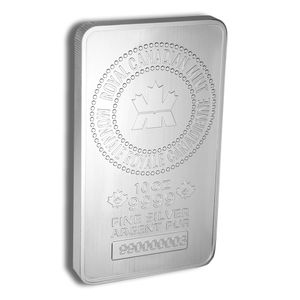
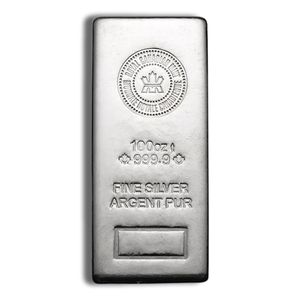
The two formats available here represent different production methods. The 10 oz bar is a minted bar, produced by striking pre-cut blanks with a die press to achieve a clean, precise finish with sharp edges and a refined surface appearance. The 100 oz bar is a cast bar, produced by pouring molten silver into a mold, which results in a heavier, more industrial product with surface characteristics that reflect the casting process. Both are .9999 fine silver and share the same core purity, but they serve somewhat different buyer preferences in terms of size, handling, and intended use.
Buyers typically choose RCM silver bars when they want a recognized sovereign-mint product at a format that balances premium efficiency with market liquidity. Bars generally carry lower premiums over spot than coins or rounds of equivalent weight, which makes them a practical choice for buyers focused on acquiring silver content rather than numismatic or collector value.
History and Background
The Royal Canadian Mint was established in 1908 as a branch of the British Royal Mint and became a fully independent Crown corporation in 1969. Over the course of more than a century, the RCM has developed a global reputation for precision manufacturing, security technology, and product quality. Today it operates two facilities: the Ottawa mint, which focuses on collector coins, bullion coins, and specialty products, and the Winnipeg mint, which handles high-volume circulation coinage and a range of bullion products.
The RCM's entry into the modern silver bullion bar market reflected broader trends across the industry as institutional and retail demand for recognized sovereign-mint silver products grew through the latter half of the twentieth century. The mint's decision to produce bars at commercial and industrial weight standards gave buyers access to RCM-hallmarked silver in formats suited for larger accumulation. The .9999 purity standard became a defining feature of RCM silver products and helped differentiate them from refineries offering the more common .999 fine standard.
Silver itself has a deep industrial and commercial history, serving as both a monetary metal and a critical input for manufacturing, photography, electronics, and renewable energy technologies. While the monetary role of silver has diminished since the end of the silver standard, industrial demand has grown substantially. That combination of historical monetary significance and expanding industrial use has kept silver relevant as a physical asset across different market environments.
Purity, Weight, and Specifications
Both RCM silver bars in our catalog are produced to a fineness of .9999, which is expressed as 9999 parts per thousand pure silver. This is considered four-nines fine silver and exceeds the .999 purity standard common among many privately produced silver bars. The .9999 designation is stamped directly on each bar alongside the RCM hallmark and the weight in troy ounces.
The 10 oz bar measures 90.02 mm in length, 51.92 mm in width, and 2.04 mm in thickness. The 100 oz bar, given its significantly greater silver content, is substantially larger at 182.4 mm in length, 81.2 mm in width, and 21.2 mm in thickness. Both bars are measured and stamped according to troy ounce standards, where one troy ounce equals approximately 31.1 grams. Buyers accustomed to avoirdupois ounces should note that troy weight is the standard across all precious metals markets globally.
The 10 oz minted bar features a clean die-struck finish with precise dimensional tolerances, while the 100 oz cast bar has a more industrial surface character typical of the casting process. Neither format is classified as a numismatic or collector item. Both are straightforward bullion products valued primarily based on their silver content and recognized purity level.
Available Brands, Mints, and Product Variations
Our current RCM silver bar offerings include the 10 oz silver bar (SKU: BST-001789AB90) in minted format and the 100 oz silver bar (SKU: BST-000038DEED) in cast format. Both are manufactured by the Royal Canadian Mint and carry full RCM provenance. The mint mark and purity are integral to each bar rather than applied as a label, which is standard practice for all RCM bullion products.
The Royal Canadian Mint is widely regarded as one of the premier precious metals producers in the world. Its silver bullion products are recognized by refineries, dealers, and institutional buyers globally, which contributes to efficient pricing and resale liquidity. RCM hallmarks are trusted across North America and internationally, reducing the friction that sometimes accompanies lesser-known private mint products when it comes time to verify or liquidate.
Buyers should be aware that RCM bars in this weight range may ship in assay card packaging depending on the specific bar and current production runs, though this can vary. The minted 10 oz bar format is more commonly packaged with assay documentation, while cast 100 oz bars typically ship without individual assay cards given their intended use as commercial-grade silver bullion. Product packaging details are reflected in individual product listings.
Pricing, Premiums, and Market Factors
Silver bar pricing is based on the real-time spot price of silver, expressed in US dollars per troy ounce, plus a premium that reflects manufacturing costs, mint reputation, distribution expenses, and current supply and demand conditions. RCM silver bars typically carry a modest premium over spot relative to sovereign silver coins, which makes them appealing for buyers focused on accumulating silver content efficiently. The premium on larger bars, such as the 100 oz cast bar, tends to be lower on a per-ounce basis than the premium on the 10 oz minted bar.
Premium levels across the silver bar market are not static. They respond to wholesale availability, mint production schedules, and broader market activity. During periods of elevated demand, premiums on sovereign-mint silver bars tend to expand as wholesale supply tightens. Conversely, premiums can compress when supply is more readily available relative to buying activity. Bullion Standard's pricing updates in real time to reflect these changing conditions rather than relying on fixed markups that may not accurately represent the current market.
The bid/ask spread displayed on each product page is an important element of the full transaction picture. Evaluating both the acquisition cost and the expected resale value gives buyers a more complete understanding of what they're actually paying to own a specific product. Bullion Standard displays this spread transparently so buyers can factor it into their decision before committing to a purchase.
Condition, Packaging, and What to Expect
RCM silver bars in both the 10 oz and 100 oz formats are sold as new bullion products. The 10 oz minted bar may arrive in individual assay card packaging, which provides tamper-evident protection and documents the bar's weight and purity. The 100 oz cast bar is a commercial-grade product and typically ships without individual assay packaging. Both are inspected prior to shipment to confirm they meet standard bullion specifications.
Cast silver bars, including the 100 oz RCM, may exhibit surface characteristics inherent to the casting process. These can include minor surface irregularities, crystalline texture variations, or slight tonal differences. These are not defects. They are normal features of cast bullion and do not affect the silver content or purity. Buyers unfamiliar with cast bar aesthetics should expect a more utilitarian appearance compared to the cleaner finish of minted bars.
Shipping presentation is handled with appropriate packaging to protect bars from surface damage during transit. Bullion Standard ships all orders in discreet packaging without exterior markings that identify the contents as precious metals, which is standard practice for security and privacy reasons.
Authenticity and Verification
Every RCM silver bar sold through Bullion Standard has been verified for authenticity, weight, and purity as part of our standard sourcing and receiving process. We source products from reputable mints, refineries, wholesalers, and authorized distributors, and our team conducts verification checks before products reach our fulfillment pipeline. Buyers can purchase with confidence knowing that no bar ships without passing through this process.
The Royal Canadian Mint incorporates a number of features into its silver products that support verification. The RCM hallmark, purity stamp, and weight designation are die-struck directly into the bar's surface. For minted bars in assay card packaging, the card itself provides an additional layer of documentation and tamper evidence. Buyers can also verify dimensional specifications against the measurements published in our product listings as a secondary check.
Bullion Standard maintains an A rating with the Better Business Bureau and holds memberships with the American Numismatic Association and the National Coin and Bullion Association. We are also an authorized dealer for PCGS and NGC. These affiliations reflect our commitment to operating according to established industry standards and contributing to a more trustworthy marketplace overall.
Liquidity and Resale Considerations
Market recognition is one of the most practically important factors when evaluating silver bar liquidity. RCM silver bars benefit from broad institutional and dealer recognition across North America and internationally. The Royal Canadian Mint's reputation and the .9999 purity standard are well understood by refineries, wholesale buyers, and retail dealers, which generally supports tighter spreads and easier resale compared to bars from less recognized private mints.
The 100 oz cast bar is particularly common in commercial and wholesale silver markets, where larger bar sizes are standard trade units. This format is familiar to dealers and refineries, which helps maintain consistent resale demand. The 10 oz minted bar appeals to a broader range of buyers, including those who prefer a more manageable unit size, and trades efficiently across both dealer buyback and secondary market channels.
Buyers should understand that resale pricing is based on current market conditions at the time of sale rather than the original purchase price. The condition of a bar, the integrity of its packaging, and the strength of the mint's market recognition all influence the buyback price a dealer is willing to offer. Maintaining original packaging, where present, is generally advisable.
Storage and Security
The storage approach that makes sense for RCM silver bars depends primarily on the total weight and value being held. A single 10 oz minted bar can be stored conveniently in a home safe or fireproof lockbox alongside assay documentation without much difficulty. A 100 oz cast bar, given its size and weight, benefits from more deliberate handling and a secure environment that can accommodate a heavier physical footprint.
For buyers accumulating multiple bars or building a larger silver position over time, third-party vault storage or a secure home safe rated for the combined weight is worth considering. Bank safe deposit boxes are another option, though they typically lack insurance coverage for precious metals contents. Buyers using safe deposit boxes should verify their contents are separately insured through a homeowner's or specialty policy.
Silver is susceptible to toning and surface oxidation when exposed to humidity and atmospheric sulfur compounds over extended periods. Minted bars in sealed assay packaging are generally well protected in their original packaging. Cast bars stored long-term should be kept in a low-humidity environment, ideally in protective sleeves or airtight containers, to minimize surface changes over time.
Selling and Buyback Options
Bullion Standard operates as a two-way market, meaning customers can both buy and sell precious metals within the same platform. When you're ready to sell RCM silver bars, our purchasing team evaluates each product based on current market conditions, spot pricing, the product's mint recognition, condition, and packaging integrity. Buyback quotes reflect live market pricing rather than fixed schedules, so the price offered at any given time accurately represents what the market supports at that moment.
Products that retain their original packaging typically command better buyback pricing because the assay documentation or tamper-evident packaging provides an additional layer of verification for our team and for any downstream buyers. A 10 oz RCM minted bar in its original sealed assay card is generally easier to process than a bar without documentation, and this is reflected in how buyback pricing is structured. The 100 oz cast bar, being a commercial-grade product, is evaluated primarily on its silver content, mint marking, and physical condition.
We encourage buyers to consider liquidity before completing a purchase rather than only when they decide to sell. Understanding the expected bid price alongside the ask price at the time of purchase gives a more complete picture of the true cost of ownership and helps set realistic expectations about resale outcomes.
Why Buy Royal Canadian Mint Silver Bars?
RCM silver bars offer a combination of sovereign-mint credibility and premium efficiency that makes them practical for a wide range of buyers. The .9999 fine purity standard, which exceeds the baseline .999 found on many private-mint products, is one distinguishing characteristic that influences both dealer recognition and resale treatment. That extra purity step matters in markets where refineries apply different terms based on documented fineness.
Silver's role in industrial applications adds another dimension to its market relevance that gold and platinum-group metals don't share in exactly the same way. Silver is a critical input in solar panel manufacturing, electronics, medical devices, and a range of chemical processes. This industrial demand layer creates a different supply and demand dynamic compared to purely monetary metals, and it's one reason why silver maintains active physical markets across both commercial and retail channels.
The availability of two distinct bar formats, a minted 10 oz and a cast 100 oz, also gives buyers meaningful flexibility. Buyers who prefer a more refined product with individual packaging tend toward the minted 10 oz bar. Those prioritizing the lowest possible per-ounce cost and maximum silver content per transaction typically find the 100 oz cast bar more appropriate. Both are legitimate, well-recognized products from one of the world's most established sovereign mints.
Why Buy from Bullion Standard?
Bullion Standard was founded in 2010 in San Diego, California, with a specific focus on making the physical precious metals market more transparent and easier to navigate. Over more than a decade of operation, that focus has shaped every part of the platform, from how products are priced and sourced to how customer service and post-purchase support are structured. We don't operate like a traditional high-pressure precious metals dealer, and that difference is deliberate.
Pricing on our platform reflects real-time market conditions and is structured around clarity rather than complexity. The bid/ask spread displayed on each product page is one expression of that commitment. We believe buyers deserve to see the complete transaction picture, not just the purchase price. All products are verified for authenticity, weight, and purity before shipment, and we source exclusively through reputable mints, refineries, wholesalers, and authorized distributors.
Our two-way market model means buyers and sellers operate within the same ecosystem, with competitive buyback pricing available alongside purchase pricing. This structure reinforces our belief that liquidity should be a consideration from the moment a purchase is made. Combined with our A BBB rating, ANA and NCBA memberships, and PCGS and NGC dealer authorizations, Bullion Standard is built to serve buyers who expect professionalism and operational integrity from the platform they use.
Get Near-Spot Pricing with Bullion Standard Pro
Bullion Standard Pro is designed for buyers who want access to the pricing structures typically available only at the wholesale market level. Members transact at live, executable wholesale bid and ask prices rather than retail-priced listings, which means premiums and bid/ask spreads reflect actual market conditions in real time without additional dealer markups layered on top. For buyers regularly transacting in silver bars, this pricing efficiency compounds meaningfully over time.
Beyond pricing, Bullion Standard Pro provides access to a range of proprietary market intelligence tools, including historical premium analysis, premium percentile rankings, spread analysis, liquidity metrics, and wholesale market activity data. These tools allow members to evaluate where a specific product sits relative to its own historical pricing range and relative to comparable products across our catalog. Rather than relying on marketing claims, members can assess value using objective, data-driven metrics.
Portfolio valuation within Bullion Standard Pro uses live executable wholesale bid pricing rather than estimated retail values, which gives members a more realistic view of current liquidation value at any point in time. For buyers managing meaningful silver positions across multiple bar sizes, having that level of real-time visibility into both purchase pricing and portfolio value represents a material improvement over what the standard retail experience offers.

 (833) 278-4653