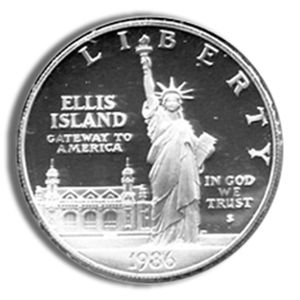
Buy Statue of Liberty Commemorative Coins Online
The 1986 Statue of Liberty silver dollar celebrated the statue's centennial and the immigrants who passed beneath it on their way to Ellis Island. Our Statue of Liberty commemorative coin listings cover both versions the U.S. Mint struck: the 1986-P Brilliant Uncirculated dollar from Philadelphia and the 1986-S proof dollar from San Francisco.
Both are .900 fine silver dollars with the same design, so the choice between them comes down to finish, mint and price. Each product page shows the live ask alongside our current bid, giving you a clear view of what either coin costs to own and what it brings on resale.
What Are Statue of Liberty Commemorative Coins?
They're legal tender coins authorized by Congress for the 100th anniversary of the Statue of Liberty and sold by the U.S. Mint in 1986 at prices that included a surcharge. The program had three denominations: a copper-nickel clad half dollar, the silver dollar offered here, and a $5 gold half eagle. Only the silver dollar appears in our catalog on this page.
Unlike a bullion coin, which is priced mainly on metal content, a commemorative dollar is a single-year collector issue. Buyers usually come to it for the subject, for a complete run of modern commemorative dollars, or to own a proof and uncirculated pair from one of the most widely collected programs of the 1980s.
History and Background
Designed by the French sculptor Frédéric Auguste Bartholdi and given to the United States by the people of France, the statue was dedicated in New York Harbor on October 28, 1886. By the early 1980s, a century of weather had taken its toll, and a major restoration was organized ahead of the centennial, with the statue reopening to the public during the Liberty Weekend celebrations of July 1986.
Congress authorized the commemorative coins in 1985, and surcharges from their sale went toward restoring the statue and the immigration station on Ellis Island. The program proved enormously popular, and the proof silver dollar alone was struck in the millions, a level few modern commemoratives have approached. The uncirculated version was produced in far smaller numbers, though still well into the hundreds of thousands.
Purity, Weight, and Specifications
The Statue of Liberty dollar is struck in 90% silver and 10% copper, with a gross weight of 26.73 grams and 0.7734 troy ounces of pure silver. That's the same standard the Mint has used for nearly all modern commemorative silver dollars, and it matches the alloy of classic Morgan and Peace dollars.
The obverse shows the statue with the Ellis Island immigration building behind it, while the reverse depicts a hand holding the torch alongside lines from Emma Lazarus's poem "The New Colossus." There's no fineness stamp on the coin. Look instead for the date, the denomination ONE DOLLAR, and the mint mark: P for Philadelphia on the uncirculated coin and S for San Francisco on the proof.
Available Brands, Mints, and Product Variations
Both listings are genuine U.S. Mint products, and they differ in mint and finish rather than design. The 1986-P Brilliant Uncirculated dollar was struck once on standard dies, giving it a soft, even luster. The 1986-S proof was struck multiple times with polished dies on prepared planchets, producing mirror-like fields with frosted devices that make the statue and torch stand out.
The proof is listed with "Proof - BU" in its title, but it's a proof strike, not an uncirculated coin. Buyers who want one of each finish can pair the two coins as a centennial set, while those focused on eye appeal often lean toward the proof.
Pricing, Premiums, and Market Factors
Statue of Liberty dollars trade at collector premiums above the value of their 0.7734 oz of silver, not at spot. Silver sets a base that moves with the market, but mintage, finish, condition and demand shape the rest. Because the proof was produced in such large quantities, its premium tends to stay modest for a commemorative, while the lower-mintage uncirculated coin is priced on its own supply and demand.
Original government packaging also matters. Coins that still have the Mint's case and certificate of authenticity are generally preferred to loose coins, and any spotting, haze or handling marks will weigh on price. We display both the bid and ask for each version, so you can see the spread before you choose a finish.
Condition, Packaging, and What to Expect
The Mint originally sold these dollars in a capsule within a presentation case and box, along with a certificate of authenticity. If the box and COA are important to you, check the listing or ask our team before ordering, since complete examples are priced differently from loose coins.
Coins from 1986 have spent four decades in capsules, so mild toning or light haze is not unusual, particularly on proof surfaces. Proofs should look bright with clear contrast between the frosted statue and the mirrored field, and uncirculated coins should show even luster without wear.
Authenticity and Verification
A genuine Statue of Liberty dollar weighs 26.73 grams and has a reeded edge, sharp lettering in the Lazarus inscription and crisp detail in the Ellis Island building. Those features are hard for counterfeiters to reproduce well, and a precise scale catches most fakes immediately.
Bullion Standard is a member of the American Numismatic Association and an authorized dealer for NGC and PCGS. We source U.S. Mint commemoratives through established wholesale channels and inspect each coin's date, mint mark, finish and surfaces against the listing before it ships.
Liquidity and Resale Considerations
Because the program sold in such volume, the Statue of Liberty dollar is one of the most familiar modern commemoratives in the market, and dealers recognize it at a glance. That familiarity supports steady trading, though demand still comes mainly from collectors rather than bullion buyers, and complete examples with original packaging tend to be the easiest to sell.
The large proof mintage means plenty of supply when you sell, so the proof's price leans more on silver content and broad collector demand than on scarcity. The uncirculated coin's smaller population gives it a somewhat different market, so it's worth comparing bids on both versions rather than assuming they move together.
Storage and Security
Leave each coin in its original capsule and keep the case in a dry, temperature-stable spot away from direct sunlight. Humidity and sulfur in some woods, papers and rubber bands can accelerate toning on silver, so a sealed container with a silica gel packet is a sensible addition. A home safe or bank safe deposit box is ample for a pair of coins, and keeping the boxes and certificates with them preserves their completeness.
Selling and Buyback Options
When it's time to sell, our two-way market lets you sell Statue of Liberty dollars back to us at the bid posted on the product page. Our purchasing team confirms the price, verifies the coin on arrival and issues payment once inspection is complete.
The bid reflects the finish, condition, packaging and current silver price, as well as how actively each version is trading. Coins with intact capsules, cases and certificates are the most straightforward to value, while loose, cleaned or damaged coins generally bring less.
Why Buy Statue of Liberty Commemorative Coins?
Few American symbols carry the weight of the Statue of Liberty, and this Statue of Liberty commemorative coin ties it directly to the immigrant story of Ellis Island. For collectors, that makes it an obvious anchor for a modern commemorative set or a meaningful gift for families who trace their history through New York Harbor.
It's also an accessible way into U.S. Mint commemoratives. A known silver content, full government backing and two clear finish options make the coin easy to understand, and its wide recognition among dealers makes it practical to own.
Why Buy from Bullion Standard?
Since 2010, Bullion Standard has run its marketplace from San Diego, California, with an emphasis on transparent pricing and long-term relationships over high-pressure sales. We hold an A+ rating with the Better Business Bureau and are members of the American Numismatic Association and the National Coin and Bullion Association.
Our posted bid on every listing reflects a market we actually make, and our product research tools let you compare premiums and spreads across the catalog. You can pay by Visa, Mastercard, American Express, Discover, PayPal, Plaid bank payment, wire transfer, paper check or BitPay cryptocurrency, and each coin is verified before it leaves our facility.
Get Near-Spot Pricing with Bullion Standard Pro
Bullion Standard Pro opens up live, executable wholesale bid and ask pricing for members, with no added dealer markup or spread layered on top. On bullion, that structure brings execution close to spot; on collector coins such as the Statue of Liberty dollar, its real value is visibility into how the wholesale market actually prices what you're buying.
Members can also track holdings at live wholesale bid values and use tools like historical premium analysis, spread analysis and liquidity metrics to see how products trade over time. For repeat buyers who want data rather than sales talk, Pro offers the clearest picture of the market.


 (833) 278-4653