Buy World Cup Commemorative Coins Online
Our world cup commemorative coin selection focuses on one U.S. Mint issue: the 1994 silver dollar struck when the United States hosted the FIFA World Cup for the first time. Every coin on this page contains 0.7734 troy ounces of silver in a .900 fine alloy, and the dollar is offered in both of its original finishes, the uncirculated version from the Denver Mint and the proof from San Francisco.
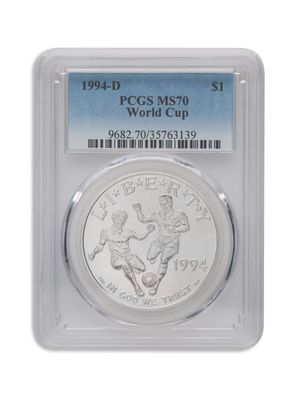
Raw and certified examples are both represented. The 1994-D uncirculated dollar is listed as a Brilliant Uncirculated coin and graded MS70 by PCGS, while the 1994-S proof appears raw and in PF70 holders from both PCGS and NGC. Live ask and bid prices sit on every product page, so the cost of stepping up from a raw coin to a perfect-graded one is easy to see before you choose.
What Are World Cup Commemorative Coins?
A World Cup commemorative coin is a legal tender issue struck to mark a FIFA World Cup, most often by the host nation. The 1994 U.S. program was authorized by Congress, and a surcharge included in the Mint's original sale price was directed to the tournament's organizers. That's what separates the 1994 dollar from the many private medals and rounds that carry soccer imagery: it's government-issued coinage with a one dollar face value.
Next to silver bullion, the 1994 dollar is a collector coin first. It holds less than an ounce of silver, it was sold for a limited period, and it's priced on finish, grade and collector demand rather than on silver content alone. Buyers range from soccer fans who want a piece of the 1994 tournament to collectors assembling modern U.S. commemorative dollars and type collectors who want one proof and one uncirculated example of each design.
History and Background
FIFA awarded the 1994 tournament to the United States in 1988, a bold choice for a country that didn't yet have a top-tier professional league. Matches were spread across nine host cities, from the Rose Bowl in Pasadena to Giants Stadium in New Jersey, and the crowds set an attendance record for the tournament at the time. Brazil won the final at the Rose Bowl, beating Italy on penalties after a scoreless draw, and the event is widely credited with helping launch Major League Soccer, which began play in 1996.
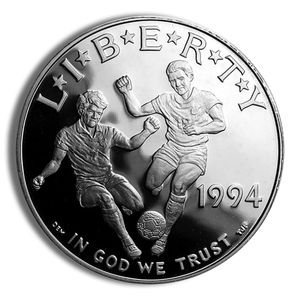
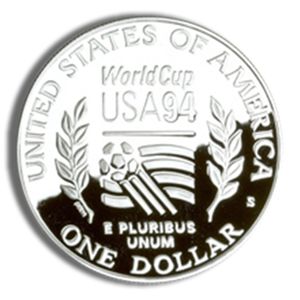
Congress authorized a three-coin program for the tournament: a copper-nickel clad half dollar, this silver dollar and a $5 gold half eagle, each sold in uncirculated and proof versions. The silver dollar's obverse shows two players challenging for the ball, while the reverse carries the official World Cup USA 1994 emblem. The silver dollar sits between the inexpensive clad half and the far costlier gold coin, which makes it the natural middle ground for many collectors of the set.
Sales fell well short of the program's authorized limits, a pattern shared by many commemoratives of the mid-1990s as the number of programs grew. The proof dollar was produced in much larger numbers than the Denver uncirculated coin, a detail that still shapes how the two finishes are priced. In 2026 the World Cup returned to North America, co-hosted by the United States, Canada and Mexico, giving the 1994 coins fresh relevance for fans who followed both tournaments.
Purity, Weight, and Specifications
Congress specified the familiar commemorative dollar standard for the 1994 World Cup issue, so each coin weighs 26.73 grams and is 90% silver and 10% copper, or 0.7734 troy ounces of pure silver. It's the same alloy found in classic Morgan and Peace dollars, and it's identical in the uncirculated and proof versions. The coin carries a face value of one dollar and is legal tender.
Telling the two versions apart takes only a glance at the mint mark. The uncirculated coin carries a D for Denver and the proof an S for San Francisco. Unlike bullion coins, the dollar doesn't state its weight or fineness on its surface, so the date, mint mark and finish are the details to match against a listing.
Available Brands, Mints, and Product Variations
All five listings are U.S. Mint coins, divided between two facilities and two finishes. The 1994-D dollar from Denver has the soft, satin luster of an uncirculated strike and is offered as a Brilliant Uncirculated coin and in a PCGS MS70 holder. The 1994-S proof from San Francisco shows mirrored fields with frosted players and lettering, and it's available raw or graded PF70 by either PCGS or NGC.
That range gives buyers a clear set of choices. A raw example suits someone who wants the coin as the Mint issued it, while MS70 and PF70 coins add independent confirmation of a flawless strike plus a sealed holder that protects it. Choosing PCGS or NGC at the same grade usually comes down to which service matches the rest of a collection.
Pricing, Premiums, and Market Factors
The silver in a 1994 World Cup dollar sets a floor under its price, but these coins sell at collector premiums above their metal value, and that premium differs from one version to the next. Production numbers come first. Because far fewer Denver uncirculated coins were struck than San Francisco proofs, the uncirculated dollar can command more than its plainer finish might suggest.
Grade is the next layer. MS70 and PF70 coins are scarcer than raw examples and are priced accordingly, and the gap between a raw proof and a PF70 reflects how hard a perfect grade is to earn. For raw coins, original government packaging, meaning the Mint's presentation case and certificate of authenticity, generally supports a higher price than a loose coin. Demand from soccer fans and collectors of 1990s commemoratives moves on its own schedule, independent of the silver market.
Our product pages place the live ask beside our bid. Checking the spread on each version before buying shows how tightly it trades and what it would bring if sold back through our two-way market.
Condition, Packaging, and What to Expect
Raw uncirculated coins should show full mint luster, though small contact marks from production and packaging are normal at this level. Raw proofs should have reflective fields and clean frosted devices, but after three decades some can show light haze or spotting, particularly if they've been handled outside the capsule.
Graded examples come in sealed PCGS or NGC slabs, and the label grade matches the one in the listing. Whether a raw coin includes its original presentation case and certificate depends on the individual listing, which spells it out. Photos are representative of the issue, and individual coins may vary slightly in toning.
Authenticity and Verification
Because the 1994 dollar was struck to fixed specifications, authenticity checks are straightforward. Weight should match the 26.73 gram standard, the mint mark should match the finish, and the detail in the players and the emblem should agree with genuine examples. Proof surfaces are also hard to reproduce convincingly, which helps expose counterfeits.
For certified coins, each PCGS and NGC holder carries a certification number that can be entered on the grading service's website to confirm the coin's details and grade. As an authorized dealer for both services, we source certified coins through established channels and inspect every coin before it leaves our facility.
Liquidity and Resale Considerations
The 1994 World Cup dollar is a familiar modern commemorative, and its standardized specifications make it easy for dealers and collectors to identify and price. Certified MS70 and PF70 examples are especially simple to value without an in-person look, while raw coins in original packaging generally sell more easily than loose ones.
Demand is narrower than it is for bullion, so pricing depends on collector interest in this particular issue rather than on the metals market alone. Comparing the current bid with the ask on our product pages gives a grounded sense of how each version trades today.
Storage and Security
Keep raw coins in their capsules and store them somewhere cool and dry, away from humidity, PVC flips and household chemicals, all of which can damage silver surfaces. Proofs are the most sensitive, so avoid opening the capsule unless necessary, and hold the coin by its edges if you do.
Graded coins should stay in their holders and be stored upright in slab boxes where the plastic won't scratch. A home safe works for a handful of coins, while a larger commemorative collection may justify a bank safe deposit box or depository storage. Keep a record of each certificate or certification number for insurance purposes.
Selling and Buyback Options
You can sell a 1994 World Cup dollar back to us through the same platform you buy from. The bid on each product page shows our current price, and our purchasing team handles verification and payment once the coin arrives.
Buyback pricing depends on the version, its grade or packaging and current collector demand, with silver prices setting the floor. Certified coins in intact holders are the simplest to price, and raw coins with their original case and certificate generally bring more than loose examples.
Why Buy World Cup Commemorative Coins?
For soccer fans, the 1994 dollar is a government-issued keepsake from the tournament that changed the sport's standing in the United States. It pairs a defined silver content with a design tied to a single event, which gives it appeal well beyond its metal value.
For collectors, the issue is compact and achievable. Two finishes from two mints, each available raw or top-graded, make a complete set easy to assemble, and the coin fits naturally into a wider collection of modern U.S. commemorative silver dollars or sports-themed coinage.
Why Buy from Bullion Standard?
Bullion Standard was founded in San Diego in 2010 and has grown into a national online precious metals marketplace guided by a simple rule: you get one chance to earn a customer's trust. Every World Cup listing states its mint, finish and grade, so you know exactly which version you're buying.
Both PCGS and NGC have authorized us to sell their certified coins, which matters on a page where three of the five listings are slabbed. The Better Business Bureau rates us A+, and we're members of the American Numismatic Association and the National Coin and Bullion Association. You can pay with a major credit card, PayPal, a bank account linked through Plaid, a wire, a paper check or cryptocurrency via BitPay, and since we also buy coins, every bid shown is one we'll actually honor.
Get Near-Spot Pricing with Bullion Standard Pro
Bullion Standard Pro connects members to the wholesale side of the market, where they can act on live, executable bid and ask quotes that carry no dealer markup or dealer spread from us. Pricing follows wholesale supply and demand for each product, which keeps the cost of every purchase transparent.
Holdings in a Pro account are marked at the live wholesale bid, so their value reflects what they'd actually fetch, and the platform's premium history, spread and liquidity data show how a product has been trading. For collectors who buy regularly across commemoratives and bullion, it's the most direct view of how products are priced at the wholesale level.


 (833) 278-4653