The 1999-W Gold American Eagle Unfinished Proof Die is one of the most distinctive and numismatically significant coins ever produced by the United States Mint. Struck at the West Point Mint in .9167 fine gold with a weight of one-tenth of a troy ounce, this coin occupies a unique position in American numismatics as a production accident that was formally recognized and never replicated. Graded MS69 by NGC, this example represents a near-perfect specimen of an already extraordinary issue.
Unlike standard bullion American Eagles or their intentionally struck Proof counterparts, the Unfinished Proof Die coins were struck using proof dies that had not yet received their final polishing treatment. The result is a coin that is neither a conventional bullion strike nor a true proof, but something entirely its own. We carry this coin because it represents a rare convergence of historical accident, minting precision, and numismatic collectibility that sets it apart from virtually everything else in the American Eagle program.
The Gold American Eagle series was introduced by the United States
…The 1999-W Gold American Eagle Unfinished Proof Die is one of the most distinctive and numismatically significant coins ever produced by the United States Mint. Struck at the West Point Mint in .9167 fine gold with a weight of one-tenth of a troy ounce, this coin occupies a unique position in American numismatics as a production accident that was formally recognized and never replicated. Graded MS69 by NGC, this example represents a near-perfect specimen of an already extraordinary issue.
Unlike standard bullion American Eagles or their intentionally struck Proof counterparts, the Unfinished Proof Die coins were struck using proof dies that had not yet received their final polishing treatment. The result is a coin that is neither a conventional bullion strike nor a true proof, but something entirely its own. We carry this coin because it represents a rare convergence of historical accident, minting precision, and numismatic collectibility that sets it apart from virtually everything else in the American Eagle program.
The Gold American Eagle series was introduced by the United States Mint in 1986 following the passage of the Gold Bullion Coin Act of 1985, which authorized the production of gold coins from domestically mined gold. The West Point Mint quickly became the primary facility for gold eagle production, and the "W" mintmark carried on this coin reflects that ongoing role. The series has been issued continuously since 1986 across four fractional sizes and a full-ounce denomination.
The 1999-W Unfinished Proof Die issue came about under unusual circumstances. During 1999, the Mint was producing both bullion and proof versions of the American Eagle. At some point during production, coins were struck using proof dies that had not yet undergone the final polishing process that imparts the mirror-like fields characteristic of a finished proof. These coins entered circulation channels before the discrepancy was recognized. The Mint never officially issued them as a distinct product, yet their existence was later acknowledged, and they have since been collected as a formally recognized variety.
NGC classified these coins within the mint state grading system, as they were neither intentionally produced as proofs nor struck with standard bullion dies. Their legitimacy as a recognized variety has been confirmed through years of market acceptance, registry set competition, and documented auction history. Very few examples have been certified at the MS69 level, making high-grade specimens genuinely scarce in the marketplace.
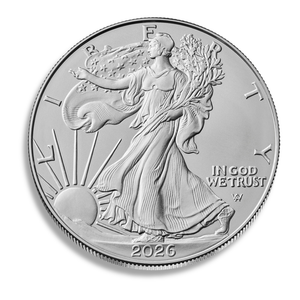
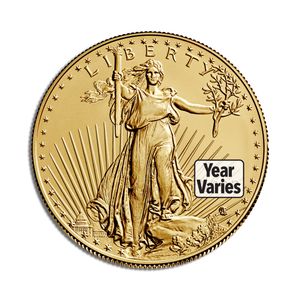
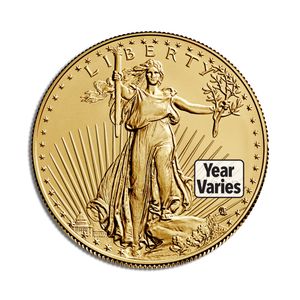
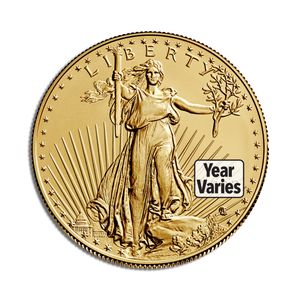
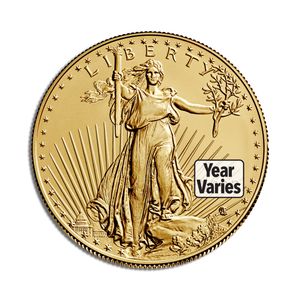
The obverse of the Gold American Eagle carries Augustus Saint-Gaudens' iconic design, originally created for the $20 Double Eagle gold coin in 1907. It depicts Lady Liberty striding forward, torch raised in her right hand and an olive branch in her left, with the Capitol building visible in the background and rays of sunlight emanating outward. The inscriptions "LIBERTY" and the date appear on this side, along with the W mintmark on the West Point issues.
The reverse features Miley Busiek's design of a family of American bald eagles, with a male eagle carrying an olive branch returning to a nest where a female eagle shields her eaglets. "UNITED STATES OF AMERICA," "E PLURIBUS UNUM," "IN GOD WE TRUST," the denomination "FIVE DOLLARS," and the gold content "1/10 OZ. FINE GOLD" all appear on this side. At one-tenth of an ounce, the coin is compact but carries all the visual detail of the larger denominations in the series.
What distinguishes the Unfinished Proof Die visually is the surface character that falls between a bullion strike and a finished proof. The fields show some reflectivity but lack the full depth and mirror finish of an intentionally struck proof, while the devices retain the sharpness associated with proof die production. This creates a distinctive aesthetic that experienced numismatists can identify immediately and that NGC's MS69 certification confirms has been preserved in exceptional condition.
At one-tenth of a troy ounce, this coin represents the smallest denomination in the American Eagle gold series. For collectors pursuing the 1999-W Unfinished Proof Die variety, the 1/10 oz format presents a more accessible price point than the larger denominations while still delivering the full numismatic significance of the issue. The coin's compact physical size does not diminish its collectibility or the scarcity of high-grade certified examples.
The fractional size also means that individual transaction costs are lower in absolute terms, which can matter when building a registry set or acquiring a specific certified example. That said, the premium on this particular coin is driven by its variety status and NGC grade rather than its metal weight alone, and buyers should approach it as a numismatic collectible rather than a fractional bullion piece.
This coin was produced by the United States Mint, one of the most scrutinized minting institutions in the world, with a mandate to meet strict purity and weight standards on every issue. The .9167 fine gold content and 1/10 oz weight are part of that institutional standard, and the West Point Mint's production controls ensure that every coin in this series meets those specifications precisely. The coin's legitimacy as a recognized variety is further reinforced by its NGC certification.
NGC encapsulation provides independent third-party verification of authenticity, metal content, and grade. The MS69 designation indicates a coin with fully struck details, exceptional luster for its strike type, and only the most minor imperfections that prevent a perfect grade. As an authorized NGC dealer, we have the expertise to evaluate certified coins accurately, and we stand behind the authenticity and grade of every certified product we offer.
The MS69 grade assigned by NGC reflects a coin that is essentially perfect in all meaningful respects, with at most one or two trivial imperfections not visible without magnification. For a coin of this variety and historical significance, the MS69 designation places this example among the finest known and is considered the practical ceiling for this issue given the very limited number of MS70-graded examples, if any, that exist.
As a graded coin, this piece ships sealed in its original NGC plastic holder, commonly referred to as a slab. The NGC holder protects the coin from environmental exposure, contact marks, and handling damage while displaying the grade, certification number, and variety attribution clearly on the label. No additional packaging manipulation is required or recommended, as the slab provides appropriate long-term preservation for a coin of this grade and collectible status.
Pricing for the 1999-W Unfinished Proof Die MS69 reflects two distinct components: the underlying gold value of the 1/10 oz content at current spot prices, and the numismatic premium commanded by a scarce, certified variety with recognized collector demand. The spot-price component fluctuates with real-time gold market conditions, while the numismatic premium is influenced by population reports, registry set activity, and overall collector interest in this specific issue.
Because NGC population data directly affects perceived scarcity, any shifts in the number of MS69-graded examples can influence pricing materially. We price this coin transparently based on real-time market conditions, and the bid/ask spread displayed on our product page reflects current wholesale market dynamics for this type of numismatic gold coin rather than arbitrary retail markups.
The 1999-W Unfinished Proof Die is well established within the numismatic community as a recognized variety, and NGC-certified examples trade regularly through auction houses, dealer networks, and online platforms. The combination of NGC certification and a strong MS69 grade provides the documentation that informed buyers require when transacting in the secondary market. Certified coins of this type tend to attract competitive interest from registry set builders and serious American Eagle specialists.
We operate a two-way market that supports both buying and selling within the same platform. Liquidity for numismatic coins is more variable than standard bullion, and pricing at resale reflects current collector demand and population data rather than spot price alone. We encourage buyers to review current bid pricing on our product page before purchasing to understand the full transaction picture.
This coin occupies a category almost entirely its own within the American Eagle program. It was not planned, not officially marketed as a distinct product at the time of its production, and has never been reproduced. Its recognition as a legitimate variety, combined with the difficulty of finding examples certified MS69 or higher, makes it genuinely compelling for collectors focused on the American Eagle series or on significant U.S. Mint errors and varieties.
The NGC MS69 grade adds a layer of confidence that is difficult to replicate with raw or lower-grade examples. For collectors building registry sets or simply seeking a documented, high-grade specimen of one of the most unusual coins the West Point Mint has ever produced, this piece represents a concrete opportunity to acquire something with a clear and confirmed historical backstory.
We have built our reputation on transparent pricing, honest representation, and the kind of long-term customer relationships that only come from consistently doing right by the people we work with. Our A rating with the Better Business Bureau, membership in the American Numismatic Association, and membership in the National Coin and Bullion Association reflect a track record that goes beyond marketing claims. As an authorized dealer for both NGC and PCGS, we are positioned to offer certified numismatic products with full confidence in grade accuracy and authentication.
Our platform is designed to give buyers the information they need to make confident decisions without pressure or ambiguity. Transparent pricing, real-time bid/ask data, and a two-way market model mean that you can evaluate this coin with a complete picture of what you are paying and what resale conditions look like before you ever complete a purchase. We handle every product with care and fulfill orders through a process built around security, reliability, and clear communication from purchase through delivery.
Bullion Standard Pro gives members direct access to live, executable wholesale bid and ask pricing, which is particularly useful when evaluating a numismatic coin where the relationship between gold spot value and collector premium can shift based on market conditions, NGC population changes, and collector demand cycles. Pro members can monitor both the intrinsic metal component and the numismatic premium layer with greater precision using real-time pricing data rather than static retail estimates.
Beyond pricing, Pro provides access to proprietary market intelligence tools, historical premium analysis, and portfolio valuation based on current wholesale bid prices rather than retail assumptions. For a coin like the 1999-W Unfinished Proof Die, where a meaningful portion of the value is tied to numismatic scarcity rather than metal weight alone, having access to transparent, data-driven market insight makes it easier to evaluate the full picture before committing to a purchase or a sale.
We support a wide range of payment methods to make the buying process as straightforward as possible. Customers can pay using Visa, Mastercard, American Express, or Discover, as well as PayPal, bank-connected payments through Plaid, wire transfer, paper check, or cryptocurrency through BitPay. Every transaction is processed through a secure environment designed to protect both payment information and order details.
Regardless of which payment method you choose, the experience is built around security, clarity, and convenience. Our checkout process is designed to be transparent at every step, with no hidden fees or last-minute surprises, so you can complete your purchase with full confidence in what you are paying and how your order will be handled.
Product ID: BST-00158866A9
| Year | 1999 |
|---|---|
| Precious Metal Type | Gold |
| Bullion Coin Type | Eagle |
| Format | Coin |
| Country of Origin | United States |
| Brand/Mint | U.S. Mint |
| Mint Mark | W - West Point |
| Purity | 0.9167 |
| Weight | 0.1 oz |
| Thickness (mm) | 1.26 mm |
| Diameter (mm) | 16.5 mm |
| Grade | MS69 |
| Grading Service | NGC |
The 1999-W Gold American Eagle Unfinished Proof Die is one of the most distinctive and numismatically significant coins ever produced by the United States Mint. Struck at the West Point Mint in .9167 fine gold with a weight of one-tenth of a troy ounce, this coin occupies a unique position in American numismatics as a production accident that was formally recognized and never replicated. Graded MS69 by NGC, this example represents a near-perfect specimen of an already extraordinary issue.
Unlike standard bullion American Eagles or their intentionally struck Proof counterparts, the Unfinished Proof Die coins were struck using proof dies that had not yet received their final polishing treatment. The result is a coin that is neither a conventional bullion strike nor a true proof, but something entirely its own. We carry this coin because it represents a rare convergence of historical accident, minting precision, and numismatic collectibility that sets it apart from virtually everything else in the American Eagle program.
The Gold American Eagle series was introduced by the United States
…The 1999-W Gold American Eagle Unfinished Proof Die is one of the most distinctive and numismatically significant coins ever produced by the United States Mint. Struck at the West Point Mint in .9167 fine gold with a weight of one-tenth of a troy ounce, this coin occupies a unique position in American numismatics as a production accident that was formally recognized and never replicated. Graded MS69 by NGC, this example represents a near-perfect specimen of an already extraordinary issue.
Unlike standard bullion American Eagles or their intentionally struck Proof counterparts, the Unfinished Proof Die coins were struck using proof dies that had not yet received their final polishing treatment. The result is a coin that is neither a conventional bullion strike nor a true proof, but something entirely its own. We carry this coin because it represents a rare convergence of historical accident, minting precision, and numismatic collectibility that sets it apart from virtually everything else in the American Eagle program.
The Gold American Eagle series was introduced by the United States Mint in 1986 following the passage of the Gold Bullion Coin Act of 1985, which authorized the production of gold coins from domestically mined gold. The West Point Mint quickly became the primary facility for gold eagle production, and the "W" mintmark carried on this coin reflects that ongoing role. The series has been issued continuously since 1986 across four fractional sizes and a full-ounce denomination.
The 1999-W Unfinished Proof Die issue came about under unusual circumstances. During 1999, the Mint was producing both bullion and proof versions of the American Eagle. At some point during production, coins were struck using proof dies that had not yet undergone the final polishing process that imparts the mirror-like fields characteristic of a finished proof. These coins entered circulation channels before the discrepancy was recognized. The Mint never officially issued them as a distinct product, yet their existence was later acknowledged, and they have since been collected as a formally recognized variety.
NGC classified these coins within the mint state grading system, as they were neither intentionally produced as proofs nor struck with standard bullion dies. Their legitimacy as a recognized variety has been confirmed through years of market acceptance, registry set competition, and documented auction history. Very few examples have been certified at the MS69 level, making high-grade specimens genuinely scarce in the marketplace.
The obverse of the Gold American Eagle carries Augustus Saint-Gaudens' iconic design, originally created for the $20 Double Eagle gold coin in 1907. It depicts Lady Liberty striding forward, torch raised in her right hand and an olive branch in her left, with the Capitol building visible in the background and rays of sunlight emanating outward. The inscriptions "LIBERTY" and the date appear on this side, along with the W mintmark on the West Point issues.
The reverse features Miley Busiek's design of a family of American bald eagles, with a male eagle carrying an olive branch returning to a nest where a female eagle shields her eaglets. "UNITED STATES OF AMERICA," "E PLURIBUS UNUM," "IN GOD WE TRUST," the denomination "FIVE DOLLARS," and the gold content "1/10 OZ. FINE GOLD" all appear on this side. At one-tenth of an ounce, the coin is compact but carries all the visual detail of the larger denominations in the series.
What distinguishes the Unfinished Proof Die visually is the surface character that falls between a bullion strike and a finished proof. The fields show some reflectivity but lack the full depth and mirror finish of an intentionally struck proof, while the devices retain the sharpness associated with proof die production. This creates a distinctive aesthetic that experienced numismatists can identify immediately and that NGC's MS69 certification confirms has been preserved in exceptional condition.
At one-tenth of a troy ounce, this coin represents the smallest denomination in the American Eagle gold series. For collectors pursuing the 1999-W Unfinished Proof Die variety, the 1/10 oz format presents a more accessible price point than the larger denominations while still delivering the full numismatic significance of the issue. The coin's compact physical size does not diminish its collectibility or the scarcity of high-grade certified examples.
The fractional size also means that individual transaction costs are lower in absolute terms, which can matter when building a registry set or acquiring a specific certified example. That said, the premium on this particular coin is driven by its variety status and NGC grade rather than its metal weight alone, and buyers should approach it as a numismatic collectible rather than a fractional bullion piece.
This coin was produced by the United States Mint, one of the most scrutinized minting institutions in the world, with a mandate to meet strict purity and weight standards on every issue. The .9167 fine gold content and 1/10 oz weight are part of that institutional standard, and the West Point Mint's production controls ensure that every coin in this series meets those specifications precisely. The coin's legitimacy as a recognized variety is further reinforced by its NGC certification.
NGC encapsulation provides independent third-party verification of authenticity, metal content, and grade. The MS69 designation indicates a coin with fully struck details, exceptional luster for its strike type, and only the most minor imperfections that prevent a perfect grade. As an authorized NGC dealer, we have the expertise to evaluate certified coins accurately, and we stand behind the authenticity and grade of every certified product we offer.
The MS69 grade assigned by NGC reflects a coin that is essentially perfect in all meaningful respects, with at most one or two trivial imperfections not visible without magnification. For a coin of this variety and historical significance, the MS69 designation places this example among the finest known and is considered the practical ceiling for this issue given the very limited number of MS70-graded examples, if any, that exist.
As a graded coin, this piece ships sealed in its original NGC plastic holder, commonly referred to as a slab. The NGC holder protects the coin from environmental exposure, contact marks, and handling damage while displaying the grade, certification number, and variety attribution clearly on the label. No additional packaging manipulation is required or recommended, as the slab provides appropriate long-term preservation for a coin of this grade and collectible status.
Pricing for the 1999-W Unfinished Proof Die MS69 reflects two distinct components: the underlying gold value of the 1/10 oz content at current spot prices, and the numismatic premium commanded by a scarce, certified variety with recognized collector demand. The spot-price component fluctuates with real-time gold market conditions, while the numismatic premium is influenced by population reports, registry set activity, and overall collector interest in this specific issue.
Because NGC population data directly affects perceived scarcity, any shifts in the number of MS69-graded examples can influence pricing materially. We price this coin transparently based on real-time market conditions, and the bid/ask spread displayed on our product page reflects current wholesale market dynamics for this type of numismatic gold coin rather than arbitrary retail markups.
The 1999-W Unfinished Proof Die is well established within the numismatic community as a recognized variety, and NGC-certified examples trade regularly through auction houses, dealer networks, and online platforms. The combination of NGC certification and a strong MS69 grade provides the documentation that informed buyers require when transacting in the secondary market. Certified coins of this type tend to attract competitive interest from registry set builders and serious American Eagle specialists.
We operate a two-way market that supports both buying and selling within the same platform. Liquidity for numismatic coins is more variable than standard bullion, and pricing at resale reflects current collector demand and population data rather than spot price alone. We encourage buyers to review current bid pricing on our product page before purchasing to understand the full transaction picture.
This coin occupies a category almost entirely its own within the American Eagle program. It was not planned, not officially marketed as a distinct product at the time of its production, and has never been reproduced. Its recognition as a legitimate variety, combined with the difficulty of finding examples certified MS69 or higher, makes it genuinely compelling for collectors focused on the American Eagle series or on significant U.S. Mint errors and varieties.
The NGC MS69 grade adds a layer of confidence that is difficult to replicate with raw or lower-grade examples. For collectors building registry sets or simply seeking a documented, high-grade specimen of one of the most unusual coins the West Point Mint has ever produced, this piece represents a concrete opportunity to acquire something with a clear and confirmed historical backstory.
We have built our reputation on transparent pricing, honest representation, and the kind of long-term customer relationships that only come from consistently doing right by the people we work with. Our A rating with the Better Business Bureau, membership in the American Numismatic Association, and membership in the National Coin and Bullion Association reflect a track record that goes beyond marketing claims. As an authorized dealer for both NGC and PCGS, we are positioned to offer certified numismatic products with full confidence in grade accuracy and authentication.
Our platform is designed to give buyers the information they need to make confident decisions without pressure or ambiguity. Transparent pricing, real-time bid/ask data, and a two-way market model mean that you can evaluate this coin with a complete picture of what you are paying and what resale conditions look like before you ever complete a purchase. We handle every product with care and fulfill orders through a process built around security, reliability, and clear communication from purchase through delivery.
Bullion Standard Pro gives members direct access to live, executable wholesale bid and ask pricing, which is particularly useful when evaluating a numismatic coin where the relationship between gold spot value and collector premium can shift based on market conditions, NGC population changes, and collector demand cycles. Pro members can monitor both the intrinsic metal component and the numismatic premium layer with greater precision using real-time pricing data rather than static retail estimates.
Beyond pricing, Pro provides access to proprietary market intelligence tools, historical premium analysis, and portfolio valuation based on current wholesale bid prices rather than retail assumptions. For a coin like the 1999-W Unfinished Proof Die, where a meaningful portion of the value is tied to numismatic scarcity rather than metal weight alone, having access to transparent, data-driven market insight makes it easier to evaluate the full picture before committing to a purchase or a sale.
We support a wide range of payment methods to make the buying process as straightforward as possible. Customers can pay using Visa, Mastercard, American Express, or Discover, as well as PayPal, bank-connected payments through Plaid, wire transfer, paper check, or cryptocurrency through BitPay. Every transaction is processed through a secure environment designed to protect both payment information and order details.
Regardless of which payment method you choose, the experience is built around security, clarity, and convenience. Our checkout process is designed to be transparent at every step, with no hidden fees or last-minute surprises, so you can complete your purchase with full confidence in what you are paying and how your order will be handled.