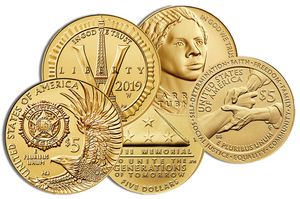
Buy $5 Gold Commemorative Coins Online
Since 1986, Congress has authorized dozens of $5 gold commemorative coins, each one honoring a single anniversary, institution or person in American history. Our catalog offers them through a random year listing: a U.S. $5 modern gold commemorative in brilliant uncirculated condition, struck by the U.S. Mint in .900 fine gold with 0.2419 troy ounces of pure gold, shipped without the original Mint box and certificate of authenticity.
Because we select the year and design from inventory, this listing is about the format rather than a particular program. It's a straightforward way to own a genuine U.S. Mint gold commemorative at a quarter-ounce scale, with live pricing and our current bid shown on the product page so you can see what the coin trades for on both sides.
What Are $5 Gold Commemorative Coins?
A $5 gold commemorative coin, sometimes called a modern commemorative half eagle, is a legal tender U.S. coin made in limited numbers for a specific program and sold by the Mint to collectors rather than released into circulation. Each program has its own design, its own authorizing legislation and its own mintage limit, but the coins share one physical standard.
They occupy a middle ground in American gold. A 1/4 oz American Gold Eagle holds a similar amount of gold but is a bullion coin with a design that stays the same every year, while a pre-1933 half eagle is a classic circulating coin with more than a century of age. Buyers choose modern $5 commemoratives for their variety of designs, their government origin and their compact size, which makes them a practical way to add gold to a U.S. coin collection.
History and Background
Gold returned to U.S. commemorative coinage with the 1984 Los Angeles Olympic $10 eagle, and the $5 denomination followed in 1986 with the Statue of Liberty Centennial half eagle, designed by Chief Engraver Elizabeth Jones. Over the next decade the format was used for a long list of programs, including the Constitution bicentennial, the Bicentennial of Congress, Mount Rushmore, the Columbus quincentenary and the 1996 Atlanta Olympics.
So many programs appeared in the early 1990s that Congress responded with the Commemorative Coin Reform Act of 1996, which limited the Mint to two commemorative programs per year. Later $5 issues included the 1999 George Washington half eagle, based on a design Laura Gardin Fraser had proposed decades earlier, and the 2014 Baseball Hall of Fame coin, the first U.S. coin struck with a curved, domed shape. A surcharge built into each coin's original price funded the organization named in that program's legislation.
Purity, Weight, and Specifications
Modern $5 gold commemoratives follow the same standard as the classic half eagles struck before 1933: 8.359 grams of .900 fine gold, with the balance made up of silver and copper for durability. That works out to 0.2419 troy ounces of pure gold per coin, measured on the troy scale where one ounce equals about 31.1 grams. The figure on our listing refers to that pure gold content, not the coin's total weight.
Every coin shows its $5 face value, its date and a mint mark identifying where it was struck. There's no serial number or assay card, since government-issued coins are verified through the Mint's published specifications and the coin's own design details.
Available Brands, Mints, and Product Variations
All coins in this listing come from the United States Mint. Most modern $5 commemoratives were struck at the West Point Mint and carry a W mint mark, though a number of programs were struck at other Mint facilities, which is why the mint mark varies. The design varies too: depending on the year, you might receive a coin honoring a national landmark, an anniversary, a historic figure or a sporting event.
Most programs were sold in both proof and uncirculated versions. This listing is for brilliant uncirculated examples, which have a satiny mint finish rather than the mirror-like fields of a proof. If you want a particular year or design, a named listing is the better route; the random year option is for buyers who value the coin's gold content and U.S. Mint origin more than a specific subject.
Pricing, Premiums, and Market Factors
Although these coins hold a fixed amount of gold, they don't trade like bullion. Their melt value follows the spot price, but a collector premium sits on top, and it depends on mintage, condition and grade, proof versus uncirculated finish, whether original government packaging with the box and certificate of authenticity is included, and how much demand there is for the subject.
Mintage alone creates wide gaps between programs. Some uncirculated $5 issues, such as the 1997 Jackie Robinson half eagle, sold in very small numbers and are priced individually as key dates, while others were made in far greater quantities. A random year coin without its box and certificate is priced on gold content and general demand for the format rather than on any one program, and the live bid and ask on the product page show exactly where that premium stands today.
Condition, Packaging, and What to Expect
You'll receive one brilliant uncirculated $5 gold commemorative from the U.S. Mint, with the year and design chosen by us. The coin ships without the Mint's original box and certificate of authenticity, which is reflected in the price, and it may differ from the photo shown on the product page. Expect original mint luster with no circulation wear, though small handling marks from years in and out of packaging are normal for coins sold outside their original presentation.
Authenticity and Verification
Because the specifications of a $5 gold commemorative are published and consistent, verification is straightforward. A genuine coin should weigh close to 8.359 grams and show sharp, correct detail for its specific program, and an electronic metal analyzer can confirm the gold alloy without harming the coin. Without a certificate, those physical checks are what establish authenticity, and they're the same checks dealers use. We source our coins from established wholesalers and distributors and inspect each one before it ships.
Liquidity and Resale Considerations
U.S. Mint gold carries strong recognition, and modern $5 commemoratives are a familiar item at coin dealers, coin shows and online auctions. Their gold content gives them a clear baseline when they're bought back, and many dealers maintain ongoing buy prices for common dates. Coins without original packaging are generally valued closer to their gold content than boxed examples, and scarcer dates are priced on their own merits.
Storage and Security
A $5 gold commemorative is small enough to store easily, but its size also makes it easy to misplace. Keep each coin in an airtight capsule to protect the surfaces, and store capsules in a coin box or tray inside a fire-rated home safe. For larger collections, a bank safe deposit box or a professional depository adds a layer of security, and a simple inventory listing each coin's year and program helps with insurance records.
Selling and Buyback Options
Our two-way market means you can sell these coins back to us just as easily as you buy them. The bid on the product page is the starting point, and our purchasing team handles the rest, from confirming price to verifying the coin and sending payment. Buyback pricing reflects the gold spot price, the coin's condition and current demand, and coins that match common-date, no-box listings are the simplest to price.
Why Buy $5 Gold Commemorative Coins?
These coins connect gold ownership to American history in a format that's easy to hold and store. Each one is a U.S. government issue with a defined gold content, and the long run of programs since 1986 gives collectors a wide range of designs to explore.
For many buyers, the random year listing is also a practical entry point. It offers authentic U.S. Mint gold in a quarter-ounce size without the added cost of original packaging, while still delivering a coin with its own commemorative story.
Why Buy from Bullion Standard?
Bullion Standard started in 2010 in San Diego, California, and we've built our business on the idea that trust is earned once. Every coin we sell is verified before it ships, and every product page shows both our selling price and our buying price, so there are no surprises when you decide to sell. We hold an A+ rating with the Better Business Bureau, belong to the American Numismatic Association and the National Coin and Bullion Association, and accept cards, PayPal, Plaid, wire transfer, check and cryptocurrency through BitPay.
Get Near-Spot Pricing with Bullion Standard Pro
Bullion Standard Pro is designed for buyers who want to see how the wholesale market prices precious metals. Members trade at live, executable wholesale bid and ask prices with no dealer markup or dealer spread added, so premiums reflect actual supply and demand rather than a retail price list.
Pro also values your holdings at live wholesale bid prices and adds tools like spread analysis, historical premium data and buy/sell ratio indicators. For anyone who buys gold coins on a regular basis, that visibility makes it easier to judge each purchase on objective data.


 (833) 278-4653