Buy 50 Gram Gold Bars Online
Our catalog of 50 gram gold bars brings together some of the most respected names in the refining world, including PAMP Suisse, Valcambi, Perth Mint, Geiger Edelmetalle, and Istanbul Gold Refinery. Each bar carries a fineness of .9999 and contains approximately 1.6075 troy ounces of pure gold, making this weight class one of the most practical mid-range options available to buyers who want meaningful gold content without committing to a full kilogram or 100 gram format.
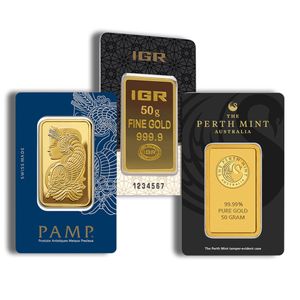
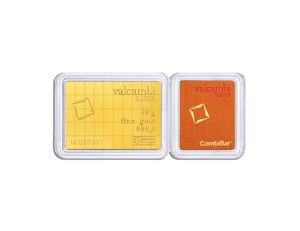
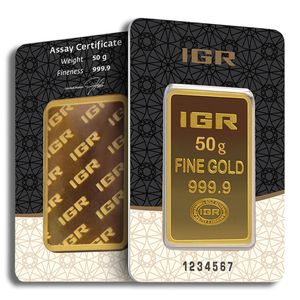
Packaging and format vary across the lineup. Several bars are presented in sealed assay cards with mill certificates confirming weight and purity, while others are available without assay packaging for buyers focused purely on metal content. The Valcambi CombiBar stands apart entirely, offering 50 individually divisible 1 gram segments in a single bar format. Random brand options are also available for buyers who prioritize price over manufacturer preference.
Bullion Standard sources these bars from authorized distributors and reputable refineries, and every product is verified for authenticity before it reaches a customer. Pricing is displayed in real time against spot market conditions, so the premium structure is visible and straightforward rather than buried in complex markups.
What Are 50 Gram Gold Bars?
A 50 gram gold bar is a minted or cast gold product weighing exactly 50 grams, which converts to roughly 1.6075 troy ounces of pure gold. The 50 gram format sits in a practical middle ground between the widely traded 1 oz and 100 gram bar categories, offering a higher total gold content than standard one-ounce bars while remaining far more accessible in unit price than larger formats like the 100 gram or kilogram bar.
The bars in this range are predominantly minted rather than cast, meaning they are precision-stamped from refined gold blanks to produce a clean, uniform surface with sharp defined edges. Minted bars typically feature the refinery's logo, a purity mark, the weight designation, and a serial number on the assay card or the bar itself. This production method lends itself to consistent presentation and is the standard approach used by refineries such as PAMP Suisse, Valcambi, and Perth Mint.
Buyers tend to gravitate toward this weight class when they want a size that balances stackability, premium efficiency, and liquidity. The 50 gram format is internationally recognized, accepted by dealers and refineries worldwide, and fits comfortably into both individual and portfolio-scale purchasing decisions.
History and Background
The modern minted gold bar industry developed significantly in the second half of the twentieth century as private refineries in Switzerland, Germany, and later Australia established themselves as leading producers of investment-grade bullion. Swiss refineries like PAMP Suisse and Valcambi, both headquartered in the Ticino canton, helped define the standard for minted bar production, introducing assay packaging and serialization practices that became industry norms across the global market.
The 50 gram denomination emerged alongside broader metrication of the bullion market during this period. As international gold trading expanded and buyers in Europe, Asia, and the Middle East sought standardized formats beyond troy ounce denominations, gram-weight bars gained widespread adoption. Refineries aligned their product lines to meet this demand, and the 50 gram bar became a staple offering alongside the 10 gram, 20 gram, and 100 gram formats.
Today, 50 gram gold bars are produced by refineries across multiple continents, from the Perth Mint in Western Australia to Istanbul Gold Refinery in Turkey and Geiger Edelmetalle in Germany. Each refinery has built its own production standards and branding traditions over decades, contributing to a market where product recognition and refinery reputation meaningfully influence buyer preference and secondary market pricing.
Purity, Weight, and Specifications
Every 50 gram gold bar in our catalog carries a purity of .9999 fine gold, which is the highest standard commercial purity widely used in the bullion market and is sometimes referred to as four nines fine. This fineness level means the bar contains 99.99% pure gold with negligible trace elements remaining from the refining process. All major refineries represented here, including PAMP Suisse, Valcambi, Perth Mint, Geiger Edelmetalle, and IGR, produce to this standard.
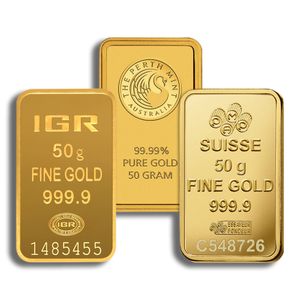
In terms of troy weight, 50 grams converts to approximately 1.6075 troy ounces of gold. It is worth noting that precious metals use the troy ounce system rather than the avoirdupois ounce used in everyday commerce. One troy ounce equals approximately 31.1 grams, so the 50 gram bar contains slightly more than one and a half troy ounces of metal content. Physical dimensions vary by manufacturer: the PAMP Suisse and Valcambi bars each measure approximately 47 mm by 27 mm, while the IGR bar is notably longer and narrower at roughly 50 mm by 29 mm.
Bars presented in assay cards carry markings printed or embossed on the packaging that include the refinery name, gold purity, weight, metal content, and in most cases a unique serial number. These markings form part of the bar's chain of custody and are used to verify authenticity both at the point of sale and during any future resale transaction.
Available Brands, Mints, and Product Variations
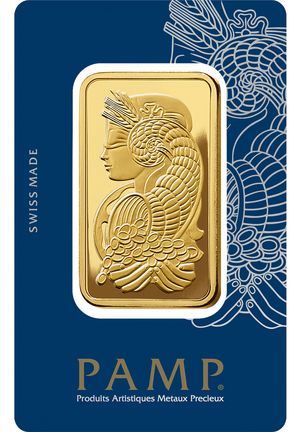
PAMP Suisse is among the most recognized names in the minted bar market, and the Lady Fortuna design on their 50 gram bar has become one of the most iconic motifs in investment gold. The reverse features the Roman goddess Fortuna holding a cornucopia and a wheel, rendered in detailed relief against a frosted background. PAMP bars are produced in Castel San Pietro, Switzerland, and are widely accepted in resale markets across North America, Europe, and Asia.
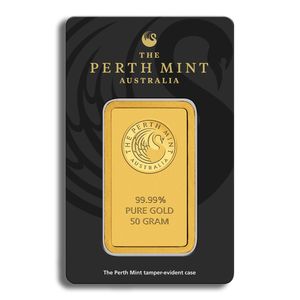
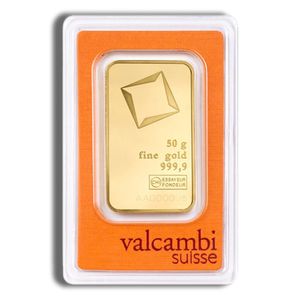
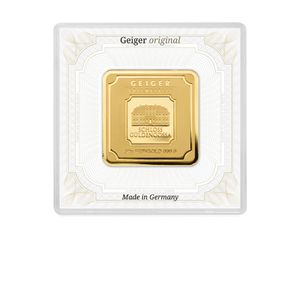
Valcambi Suisse, also based in Switzerland, offers two distinct products in this weight class. Their standard 50 gram minted bar is presented in an assay card with the classic Valcambi branding and .9999 fineness marks. The Valcambi CombiBar is an entirely different format, consisting of a 74 mm by 52.5 mm sheet of gold pre-scored into 50 individual 1 gram segments. Each segment can be separated along the scored lines, making the CombiBar functionally versatile compared to a single solid bar of equivalent weight. Perth Mint's 50 gram bar, produced under the authority of the Government of Western Australia, carries government-backed assurance and is recognized globally. Geiger Edelmetalle, the German private refinery, produces a square-format bar measuring 39.2 mm on each side, a distinctive departure from the rectangular profile used by most other refineries. Istanbul Gold Refinery rounds out the branded offerings with a Turkish-produced bar carrying the same .9999 purity standard.
Random brand options are also available, both with and without assay cards. These bars are sourced from recognized refineries but sold without guarantee of a specific manufacturer, making them an option for buyers prioritizing metal content per dollar over branding. Random brand bars without assay packaging carry slightly different resale dynamics, which buyers should factor into their purchasing decision.
Pricing, Premiums, and Market Factors
The price of any 50 gram gold bar is calculated by multiplying the current spot price of gold by the bar's troy ounce content, then adding a premium above that base metal value. Premiums on 50 gram bars are generally lower per troy ounce than fractional formats like 1 gram or 5 gram bars, but they typically run slightly higher than the per-ounce premium on 100 gram or kilogram bars. This relationship reflects the economics of production, packaging, and inventory management across weight classes.
Brand and packaging influence premiums meaningfully at this size. PAMP Suisse bars consistently carry among the highest premiums due to brand recognition and global secondary market demand. Valcambi, Perth Mint, and Geiger bars tend to occupy a slightly lower premium tier while still commanding recognition in resale markets. Random brand bars, particularly those sold without assay cards, are typically the lowest-premium option within the 50 gram format and appeal to buyers who want maximum metal content for their dollar without paying for brand equity.
Bullion Standard displays premiums and bid/ask spreads transparently on each product page, so buyers can evaluate the full cost of ownership alongside the buyback price at the time of purchase. This structure removes the opacity common in traditional dealer pricing and allows buyers to make direct comparisons across products based on real-time market data rather than marketing copy.
Condition, Packaging, and What to Expect
Most 50 gram gold bars in our catalog are delivered in sealed assay packaging. Assay cards are typically composed of a hard plastic sleeve or blister pack containing the bar and a paper or printed certificate confirming the bar's weight, purity, and serial number. This packaging is designed to leave visible evidence of tampering and should arrive intact and sealed directly from the refinery or authorized distributor.
The Geiger bar uses a distinctive square capsule format rather than a flat assay card, reflecting the bar's unique square dimensions. The Valcambi CombiBar arrives in its own assay sleeve sized to accommodate the wider sheet format. Random brand bars sold with assay cards will arrive in assay packaging, though the specific brand and packaging style may vary based on available inventory at the time of fulfillment.
Minor surface handling marks or light contact marks on the face of a bar are not uncommon and do not affect the bar's weight, purity, or metal value. Bars sold without assay packaging may show more visible surface contact from handling and storage prior to sale. Buyers purchasing random brand products without assay cards should expect cosmetic variation and packaging that may differ from sealed assay presentations.
Authenticity and Verification
Every product sold through Bullion Standard is sourced from authorized distributors, mints, and refineries, and is verified for authenticity, weight, and purity prior to fulfillment. We do not sell products acquired through unverified secondary channels without proper authentication procedures in place. This sourcing discipline is foundational to how we operate.
Assay cards serve as one layer of verification, as the tamper-evident packaging and accompanying mill certificate provide refinery-level confirmation of the bar's specifications. Many bars also carry a unique serial number engraved or stamped on the bar itself or printed on the assay card, allowing individual units to be traced through the supply chain. PAMP Suisse bars include a unique serial number on each assay card, while Valcambi and Perth Mint bars carry similar identifying markings.
For buyers who want additional assurance, industry-standard verification methods include professional XRF testing, ultrasonic thickness testing, and density verification. Bullion Standard maintains an A rating with the Better Business Bureau and holds active memberships with the American Numismatic Association and the National Coin and Bullion Association. These affiliations reflect ongoing commitments to industry standards rather than simply a credential displayed on a webpage.
Liquidity and Resale Considerations
The 50 gram format is recognized by dealers, refineries, and secondary market buyers across North America, Europe, and Asia. Bars carrying prominent refinery markings from PAMP Suisse, Valcambi, Perth Mint, or Geiger tend to move efficiently in resale environments because their brand recognition reduces the friction that comes with verifying products from less familiar sources. Buyers and dealers familiar with these refineries generally have well-established processes for accepting and pricing their products.
Random brand bars, particularly those sold without assay cards, may require additional verification steps during resale and can carry slightly lower buyback prices relative to branded, assay-packaged bars of equal weight and purity. The absence of a recognized manufacturer and sealed assay packaging introduces more variability into the resale process, which is worth considering before purchase.
Bullion Standard operates a two-way market, meaning customers can both purchase and sell gold bars within the same platform. This structure allows buyers to evaluate the buyback price alongside the purchase price before committing to a transaction, providing a more complete picture of the true spread between acquisition cost and expected resale value. Liquidity considerations like these are best made before a purchase rather than after.
Storage and Security
A 50 gram gold bar is compact enough to store in a wide range of secure environments. At roughly the dimensions of a thick credit card for most minted formats, these bars are well-suited to home safes, safety deposit boxes at a bank, or private vault storage through a third-party precious metals custodian. The physical footprint is minimal relative to the gold content, which makes them easier to organize and store efficiently compared to bulkier coin formats.
Assay-packaged bars should be kept in their original sealed packaging whenever possible. The assay card protects the bar's surface from contact marks and preserves the documentation that supports future resale. Opening an assay card is generally not recommended as it can reduce the bar's resale appeal, particularly for branded products like PAMP Suisse or Valcambi where the intact assay presentation is part of what buyers expect to receive.
Environmental considerations for gold storage are relatively straightforward compared to silver. Gold does not tarnish or react with oxygen under normal conditions, so humidity and atmospheric exposure present far less concern than they do for silver or copper. That said, physical security remains the primary concern, and keeping bars in a properly anchored safe or professionally managed vault is advisable regardless of the amount being stored.
Selling and Buyback Options
Selling 50 gram gold bars back into the market is generally a straightforward process for bars from recognized refineries in original assay packaging. Dealers and refineries typically quote buyback prices based on the current spot price of gold adjusted for the product's recognized metal content, with the specific buyback premium or discount varying by product type, condition, packaging, and current market demand for that particular bar.
Assay packaging plays a meaningful role in the buyback process. Bars returned in original sealed assay cards from manufacturers like PAMP Suisse, Valcambi, and Perth Mint typically receive buyback pricing that reflects their brand recognition and reduced verification requirements. Bars without assay cards or from unrecognized sources may require additional testing before a buyback price is confirmed, which can introduce delays and pricing adjustments into the process.
Bullion Standard maintains a streamlined buyback program that allows customers to request a buyback quote directly through the platform. Our purchasing team evaluates products based on current wholesale market conditions, product type, packaging, and condition. Because we operate a two-way market, buyback pricing is structured to reflect real-time wholesale bid levels rather than arbitrary dealer-set discounts. This transparency allows sellers to understand where their product stands relative to the current market before committing to a sale.
Why Buy 50 Gram Gold Bars?
The 50 gram format occupies a useful position in the gold bar market because it offers a per-ounce premium that is meaningfully lower than fractional gram bars while still remaining far more accessible in total unit cost than 100 gram or kilogram bars. For buyers who want to accumulate gold in reasonably sized increments without paying the premium premium associated with small fractions, the 50 gram bar hits a practical balance point that works across a range of purchasing budgets.
Storage efficiency is another practical advantage. Compared to coin formats of equivalent metal content, minted bars stack cleanly and take up less physical space per gram of gold. For buyers storing meaningful quantities, this compactness translates into more efficient use of vault or safe space. The uniform dimensions of most minted bar formats also make them easy to organize and inventory over time.
The availability of branded bars from globally recognized refineries within this weight class adds a layer of flexibility that buyers value. Whether the priority is the collector appeal of a PAMP Lady Fortuna design, the divisibility of a Valcambi CombiBar, or simply the lowest possible premium through a random brand option, the 50 gram format accommodates a wider range of buying strategies than most weight classes.
Why Buy from Bullion Standard?
Bullion Standard has operated as a San Diego-based precious metals dealer since 2010, building a nationally recognized marketplace on principles that prioritize transparency over sales pressure. Every aspect of the buying experience, from how prices are displayed to how buybacks are processed, is designed around the idea that customers make better decisions when they have access to clear, complete information rather than marketing-driven opacity.
Our sourcing process is rigorous. We work with authorized distributors, mints, and refineries, and every product is verified for authenticity, weight, and purity before it ships. We hold an A rating with the Better Business Bureau and maintain active memberships with the American Numismatic Association and the National Coin and Bullion Association. These affiliations reflect ongoing operational standards rather than credentials collected for display.
Payment flexibility, secure checkout, and reliable fulfillment are built into the platform as operational priorities rather than afterthoughts. Customers can pay by Visa, Mastercard, American Express, Discover, PayPal, bank-connected payments through Plaid, wire transfer, paper check, or cryptocurrency through BitPay. Our customer service team is accessible before, during, and after a purchase, and the experience is designed to feel like a transparent marketplace rather than a high-pressure sales environment.
Get Near-Spot Pricing with Bullion Standard Pro
Bullion Standard Pro is designed for buyers who want direct access to the pricing dynamics that typically exist only at the wholesale level. Members transact at live, executable wholesale bid and ask prices across a broad range of precious metals products, including 50 gram gold bars. Because Pro pricing reflects real-time wholesale market conditions rather than fixed retail markups, the spreads between buy and sell prices adjust naturally based on actual supply and demand rather than dealer-determined margins.
One of the more significant structural differences in the Pro model is the absence of additional dealer markups applied on top of wholesale pricing. Members see and transact at wholesale market prices directly, which compresses the spread between acquisition cost and current buyback value compared to standard retail purchasing. For buyers who purchase gold in meaningful quantities or transact with any regularity, this pricing efficiency compounds over time in ways that static retail pricing cannot replicate.
Beyond pricing, Pro members gain access to portfolio valuation based on live executable wholesale bid pricing, which provides a more realistic view of current liquidation value than retail-estimated portfolio tools. Historical premium data, premium percentile rankings, bid/ask spread analysis, liquidity metrics, and proprietary market intelligence tools are also available to members who want to evaluate products and market conditions using objective data rather than assumptions. For buyers who take a considered approach to accumulating physical gold, Bullion Standard Pro is designed to make that process more transparent and more efficient.

 (833) 278-4653