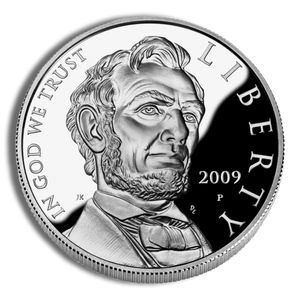
Buy Abraham Lincoln Commemorative Coins Online
Every Abraham Lincoln commemorative coin in our catalog is the 2009-P silver dollar the U.S. Mint struck for the bicentennial of Lincoln's birth. It's offered four ways: a raw brilliant uncirculated coin, a raw proof, an NGC MS70 uncirculated example and an NGC PF70 proof, all struck at the Philadelphia Mint in .900 fine silver.
Focusing on a single issue lets you choose by finish and grade instead of by design. Collectors who want the coin as the Mint released it can start with the raw versions, while those chasing perfect grades can go straight to the 70-graded slabs.
Live pricing on each listing shows the ask next to our current bid. With four versions of the same coin, that side-by-side view makes it clear how much of the price comes from silver and how much comes from finish and certification.
What Are Abraham Lincoln Commemorative Coins?
An Abraham Lincoln commemorative coin is a special legal tender issue authorized by Congress to honor the 16th president, struck in limited numbers and sold to collectors rather than released into circulation. The 2009 silver dollar carries a $1 face value, contains 0.7734 troy ounces of silver and was available directly from the Mint only during its official sales period.
It differs from Lincoln's everyday appearances on American money. The Lincoln cent and the 2010 Presidential $1 coin were made for circulation in huge quantities, while the commemorative dollar was struck to proof and uncirculated standards in a capped mintage. That's why buyers treat it as a collectible coin first and a silver coin second.
Buyers tend to come at it from a few directions. Civil War and Lincoln collectors want it as the modern centerpiece of a Lincoln set, commemorative collectors need it to complete a run of 21st century silver dollars, and gift buyers often pick it for graduations or milestones because the Gettysburg Address text needs no explanation.
History and Background
Lincoln was born on February 12, 1809, in Kentucky, and the 200th anniversary of his birth prompted a nationwide bicentennial celebration. Congress authorized a commemorative silver dollar for the occasion, and the Mint struck both versions at Philadelphia with a legislated ceiling on total production. Surcharges on each sale supported the bicentennial effort.
The obverse portrait was inspired by Daniel Chester French's seated statue at the Lincoln Memorial, giving the coin a contemplative, monumental look. The reverse carries the closing passage of the Gettysburg Address, which Lincoln delivered in November 1863, so the president's own words dominate that side of the coin.
Lincoln's numismatic history runs deep. The Lincoln cent debuted in 1909 for the centennial of his birth, the 1918 Illinois Centennial half dollar carried his portrait, and in 2009 the cent received four special reverse designs tracing his life from Kentucky to Washington, D.C. Those coins aren't part of our current offering, but they place the 2009 silver dollar within a century of tributes.
Purity, Weight, and Specifications
The 2009 Lincoln dollar uses the standard composition for modern U.S. commemorative silver dollars: 90% silver and 10% copper, a total weight of 26.73 grams and 0.7734 troy ounces of pure silver. The .900 fineness is the traditional coin silver standard, which gives the coin better wear resistance than pure silver.
Both the uncirculated and proof versions carry the P mint mark for Philadelphia, so the mint mark alone won't tell you the finish. Instead, look at the surfaces: proofs have mirrored fields and frosted relief, while uncirculated coins have an even satin luster.
Available Brands, Mints, and Product Variations
All four listings are the same U.S. Mint coin, which makes the variations straightforward. The raw brilliant uncirculated coin shows the satin finish produced by the Mint's uncirculated process, while the raw proof was struck multiple times on polished planchets with specially prepared dies. The proof listing's name includes a BU tag, but the coin itself is a proof.
The two certified options are graded by NGC at the top of the 70-point scale. The MS70 is an uncirculated coin with no post-production imperfections visible under magnification, and the PF70 is a proof meeting the same standard. Both sit sealed in NGC holders with certification numbers you can verify online.
Choosing among them usually comes down to priorities. If you want the coin as originally sold, the raw versions keep you closer to the Mint's presentation, while the slabs add a documented top grade and long-term protection.
Pricing, Premiums, and Market Factors
The Lincoln dollar sells at a collector premium, not near spot. Its silver content provides a baseline, but the larger share of the price reflects its capped mintage, its finish, its grade and the steady demand for anything tied to Lincoln, one of the most widely collected figures in American numismatics.
Finish and certification set the spread across our four listings. Proofs have historically been produced in larger numbers than uncirculated coins for many modern commemoratives, so the two finishes don't always rank in price the way buyers expect. A 70 grade from NGC adds a premium over raw coins, and raw coins kept in original government packaging, with the box and certificate of authenticity, generally fare better than loose ones.
Because those factors don't track the silver price directly, we show both the bid and the ask on each listing. That comparison is the most direct way to see what each version costs and what it would realistically bring back.
Condition, Packaging, and What to Expect
Raw Lincoln dollars are sold as described, with the proof showing deep mirrored fields and the uncirculated coin showing satin luster. Silver of this age can develop light toning even in Mint capsules, which is common and doesn't indicate damage. Keep the capsule sealed to avoid fingerprints and moisture on the surfaces.
The MS70 and PF70 coins arrive in sealed NGC holders exactly as graded, and the label states the coin, finish and grade. Minor marks on the outside of a holder are normal from storage and shipping and have no effect on the coin.
Authenticity and Verification
Modern silver dollars are a target for counterfeiters, mostly through loose base-metal copies, so provenance matters. A genuine 2009 Lincoln dollar weighs 26.73 grams and shows crisp lettering in the Gettysburg Address text on the reverse, which counterfeits often fail to reproduce cleanly.
For certified coins, NGC's online verification confirms the certification number, coin and grade. We're an authorized NGC dealer, source these coins through established channels and inspect every coin, raw or slabbed, before it ships.
Liquidity and Resale Considerations
Lincoln's popularity gives this coin a broad buyer base, and dealers recognize the 2009 silver dollar immediately. That familiarity helps raw and certified examples alike.
Top-graded slabs depend more on the collector market than the silver market, so their resale prices can move independently of spot. Raw coins with complete Mint packaging tend to be easier to sell at full value than loose examples, and the bid on our product pages offers a current reference point for each version.
Storage and Security
Store raw Lincoln dollars in their original capsules and cases, upright and away from heat, humidity and household chemicals that can accelerate toning. Proofs need the most care, since spots on mirrored fields are permanent and easy to see.
NGC slabs belong in a dedicated slab box where they won't scratch or crack. A home safe suits a few coins, while a safe deposit box or depository makes sense if you build a larger presidential collection, and keeping a list of certification numbers simplifies insurance.
Selling and Buyback Options
When you're ready to sell, our two-way market lets you sell the same Lincoln dollars back to us. The current bid is posted on each product page, and our purchasing team handles confirmation, verification on arrival and payment.
Bids depend on finish, grade, condition and packaging, as well as the silver price and current demand. An NGC PF70 or MS70 in an undamaged holder, or a raw proof with its box and certificate, is the easiest to price at full value.
Why Buy Abraham Lincoln Commemorative Coins?
Few presidents carry the historical weight of Lincoln, and the 2009 dollar captures it in a design built around his statue at the Lincoln Memorial and his words at Gettysburg. For many buyers that combination of portrait and text is the main appeal.
The coin also offers government backing and a clear set of options. It's a legal tender U.S. Mint issue with documented specifications, and choosing among uncirculated, proof and 70-graded versions lets you match the coin to your goals, whether that's a single display piece or a top-grade pair.
Why Buy from Bullion Standard?
Since opening in San Diego in 2010, Bullion Standard has grown into a national online marketplace by treating trust as something you only get one chance to earn. On a coin offered in four versions, that shows up as clear listings and visible bid and ask pricing on each one.
We maintain an A+ BBB rating, belong to the ANA and NCBA and are an authorized NGC and PCGS dealer, so certified Lincoln dollars come through proper channels and are verified before shipping. Payment options include credit cards, PayPal, Plaid, wire, check and BitPay cryptocurrency, and our research tools let you compare premiums and spreads across products using objective data.
Get Near-Spot Pricing with Bullion Standard Pro
Bullion Standard Pro gives members live, executable wholesale bid and ask pricing without additional dealer markups or dealer spreads. Pricing reflects real supply and demand in the wholesale market rather than a fixed retail structure.
For a collector coin like the Lincoln dollar, Pro doesn't erase the collector premium, but it does show it clearly. Members can track holdings at live wholesale bid values and use historical premium and spread analysis to see how products have traded, which helps repeat buyers make each purchase on current data.


 (833) 278-4653