Buy Presidential Commemorative Coins Online
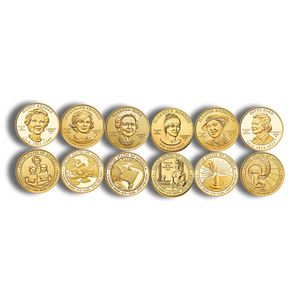
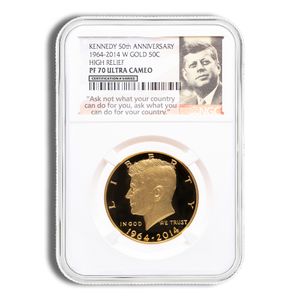
Our presidential commemorative coins bring together U.S. Mint issues that honor American presidents and first spouses, struck in silver and gold across four decades. You'll find the 1982 George Washington half dollar, silver dollars for Dwight Eisenhower, James Madison, Thomas Jefferson, Dolley Madison and Abraham Lincoln, the 2014-W 3/4 oz gold Kennedy half dollar and 1/2 oz First Spouse gold coins, along with 1 oz silver presidential medals for George Washington and John Adams.
Most issues come in more than one form. Many of the silver dollars are offered both as uncirculated coins and as proofs in original government packaging, and several are also available sealed in NGC holders at MS70 or PF70. The Kennedy gold half appears in its original box with certificate and in NGC and PCGS holders graded 69 and 70, while the First Spouse gold coin is a random year listing.
Every product page displays the live ask beside our current bid, so you can see what a given presidential coin costs and what it would bring if you sold it back to us. That matters with commemoratives, where grade and packaging can move the price far more than the metal does.
What Are Presidential Commemorative Coins?
A presidential commemorative coin is a legal tender coin struck by the U.S. Mint to mark an anniversary or legacy tied to a president or a first spouse. Unlike circulating coinage, these pieces are produced in limited quantities, sold directly to collectors for a set period and struck to proof or uncirculated standards. Most of the coins in our catalog are .900 fine silver dollars or half dollars, while the Kennedy half and First Spouse coins are struck in .9999 fine gold.
The silver presidential medals are a separate format worth understanding. The 2018 George Washington and John Adams medals are struck by the U.S. Mint in 1 oz of .999 fine silver, but they carry no face value and aren't legal tender. They belong to the Mint's long tradition of presidential medals rather than to its commemorative coin programs, though collectors often keep the two side by side.
Buyers come to these coins for different reasons. Some build a run of every modern presidential commemorative, others focus on a single figure such as Lincoln or Washington, and many simply want a well-made government issue tied to a piece of American history they care about.
History and Background
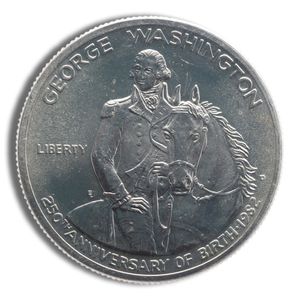
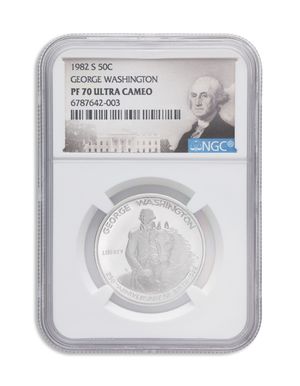
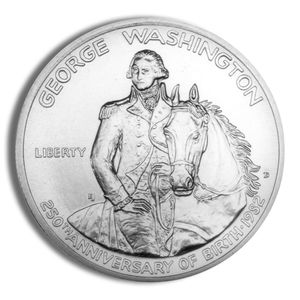
The modern commemorative era began with a presidential coin. After the Carver-Washington half dollar program ended in 1954, the Mint issued no commemoratives for nearly three decades, until the 1982 George Washington half dollar marked the 250th anniversary of his birth. It was also the first 90% silver coin the Mint had struck since 1964, and its success helped convince Congress to authorize the steady stream of commemoratives that followed.
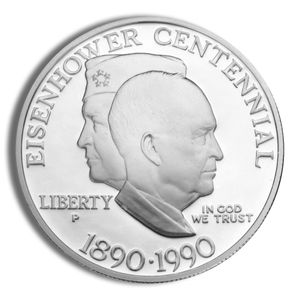
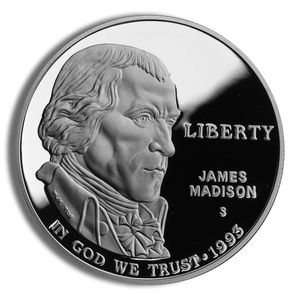
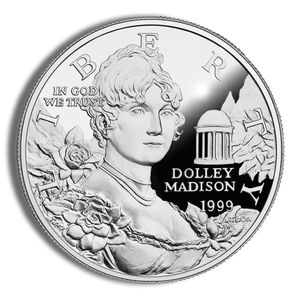
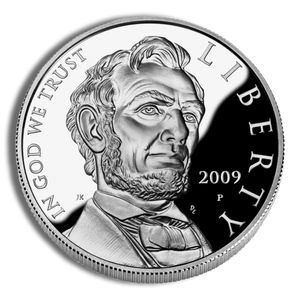
Presidents remained a recurring theme. The 1990 Eisenhower dollar marked the centennial of his birth, the 1993 Madison dollar honored the Bill of Rights he drafted, and the 1993 Jefferson dollar celebrated the 250th anniversary of his birth in 1743. Dolley Madison received her own silver dollar in 1999 on the 150th anniversary of her death, and the 2009 Lincoln dollar was issued for the bicentennial of his birth.
Two longer programs broadened the field. The First Spouse gold coins were authorized alongside the Presidential $1 coins and ran from 2007 to 2016, with a later Barbara Bush issue in 2020. In 2014 the Mint struck a 3/4 oz gold version of the Kennedy half dollar for that coin's 50th anniversary, and in 2018 it began offering 1 oz silver editions of its historic presidential medals, starting with Washington.
Purity, Weight, and Specifications
The silver commemoratives here follow the traditional coin silver standard of 90% silver and 10% copper. Each silver dollar weighs 26.73 grams and contains 0.7734 troy ounces of pure silver, which applies to the Eisenhower, Madison, Jefferson, Dolley Madison and Lincoln issues alike. The 1982 Washington half dollar weighs 12.5 grams with 0.3617 troy ounces of silver.
The gold coins are struck in .9999 fine 24 karat gold. The 2014-W Kennedy half dollar contains 3/4 troy ounce of gold while still carrying its 50 cent denomination, and each First Spouse coin contains 1/2 troy ounce of gold with a $10 face value. Both programs were struck at the West Point Mint and carry the W mint mark.
The 2018 Washington and John Adams medals contain a full troy ounce of .999 fine silver. Because they're medals rather than coins, they carry no denomination or mint mark. On the coins, the mint mark identifies the facility: D for Denver, S for San Francisco, P for Philadelphia and W for West Point.
Available Brands, Mints, and Product Variations
Every piece in our presidential selection comes from the U.S. Mint, but the facilities vary by program. The 1982 Washington half was struck as an uncirculated 1982-D and a proof 1982-S, and the 1993 Madison dollar follows the same Denver and San Francisco split. The 1990 Eisenhower dollar reverses the usual pattern, with the uncirculated coin from West Point and the proof from Philadelphia, while the 1993 Jefferson dollar comes as a 1993-P uncirculated and a 1993-S proof.
The 1999 Dolley Madison and 2009 Lincoln dollars were struck at Philadelphia in both finishes. Dolley Madison's design was developed with Tiffany & Co., whose mark appears on the reverse, an unusual collaboration for a U.S. coin. The Lincoln dollar pairs a portrait inspired by Daniel Chester French's Lincoln Memorial statue with the closing passage of the Gettysburg Address.
Certified options include the 1982-S Washington half in NGC PF70, the 1993-P Jefferson dollar in NGC MS70 and the 2009 Lincoln dollar in NGC MS70 and PF70. The 2014-W Kennedy gold half, a proof-only issue that revived the original Gilroy Roberts portrait and Frank Gasparro reverse, is offered in its Mint box and in NGC and PCGS holders at 69 and 70 with random labels. The silver medals are graded NGC MS69 and MS70.
Pricing, Premiums, and Market Factors
Presidential commemoratives sell at collector premiums, not close to spot. Silver content sets a floor, since a Lincoln dollar still holds 0.7734 oz of silver, but the price above that is driven by mintage, condition, finish, packaging and how much collectors want the subject. A Washington half from a mintage in the millions behaves very differently from a First Spouse coin struck in small numbers.
Grade and format compound those factors. A proof in its original government packaging, with the box and certificate of authenticity, usually costs more than a loose uncirculated example, and an NGC or PCGS 70 can carry a premium well beyond a 69 of the same coin. Popular figures such as Lincoln and Kennedy tend to draw stronger demand than less widely collected issues, which shows up in both the ask and the bid.
Because those premiums aren't standardized the way bullion pricing is, it pays to compare before buying. Our product pages show the current bid next to the ask on each presidential coin, and the spread tells you a good deal about how actively that coin trades.
Condition, Packaging, and What to Expect
Raw commemoratives listed with box and COA arrive as the Mint sold them: the coin sealed in a plastic capsule, set in a presentation case inside an outer box, with a certificate of authenticity. Proofs show mirror-like fields and frosted devices, while uncirculated coins have a softer satin finish. Keep the capsule closed, since fingerprints and moisture can mark surfaces permanently.
Certified coins and medals arrive in sealed NGC or PCGS holders, and the grade on the label is the grade you receive. Kennedy gold halves listed with a random label may come in any of the label styles the grading service has used, so the coin and grade match the listing even when the label design differs from the photo.
The First Spouse coin is sold as a random year listing, which means we select the honoree and year from inventory and the listing spans both uncirculated and proof strikes. If a specific first spouse matters to you, contact us before ordering.
Authenticity and Verification
Commemorative coins attract counterfeiters just as bullion does, and the most common fakes are base-metal copies sold loose. Buying coins still in Mint packaging with a matching certificate, or sealed in a recognized grading holder, removes most of that risk. For loose silver dollars, weight is a quick first check, since a genuine coin should weigh 26.73 grams.
Every NGC and PCGS holder carries a certification number that can be looked up on the grading service's website to confirm the coin, date and grade. As an authorized dealer for both services, we source certified presidential coins through established channels and confirm that each holder matches the listing before it ships.
Raw coins are inspected for weight, finish and packaging before they leave us. Combined with our membership in the American Numismatic Association and the National Coin and Bullion Association, that process is built to give you confidence in what arrives.
Liquidity and Resale Considerations
Modern U.S. commemoratives are widely recognized by dealers, and the presidential issues are among the most familiar. Silver dollars like the 2009 Lincoln and 1993 Jefferson trade regularly, and the Kennedy gold half has an active certified market, so finding a buyer is rarely the obstacle.
Price is where liquidity varies. High-mintage coins such as the 1982 Washington half often trade at modest premiums, so their resale value leans heavily on silver content, while lower-mintage or top-graded coins depend more on collector demand at the time of sale. Coins that keep their original packaging or holders are simpler to sell than loose examples.
The bid we display on each product page is a useful reference for that gap. Checking it before you buy gives you a realistic picture of how a particular coin and format trades today.
Storage and Security
Presidential commemoratives in Mint packaging should be stored in their original cases, kept upright and away from humidity, heat and direct sunlight. The capsules protect the coins, but PVC-free storage and a stable environment matter over years, especially for proof coins whose mirrored fields show spotting easily.
Keep each certificate of authenticity with its coin, and file the outer boxes somewhere dry if you separate them, since the full set of packaging can affect resale. Slabbed coins store best in purpose-built slab boxes, and recording certification numbers makes insurance and inventory far simpler.
A home safe works for modest holdings, while larger collections, particularly those with gold Kennedy halves or First Spouse coins, may be better suited to a bank safe deposit box or a professional depository.
Selling and Buyback Options
We buy presidential commemoratives through the same two-way market we sell them in. The current bid appears on each product page, and our purchasing team handles price confirmation, verification on arrival and payment.
Buyback pricing reflects the coin's metal content, its grade and finish, its packaging and current collector demand. A Lincoln proof dollar with its box and certificate, or a Kennedy gold half in a 70 holder, is straightforward to price, while loose coins or incomplete packaging may receive a lower bid. Gold and silver issues also move with spot.
Why Buy Presidential Commemorative Coins?
History is the clearest draw. Each coin ties a president or first spouse to a specific anniversary, and the designs, from Elizabeth Jones's mounted Washington to the Gettysburg Address on the Lincoln dollar, are among the more thoughtful in modern American coinage.
Government backing and recognizability matter too. These are U.S. Mint issues with documented specifications, and most are legal tender, which gives them a standing that private rounds don't have. Their silver and gold content adds a tangible metal component beneath the collector premium.
Finally, they lend themselves to collecting with a plan. You can pair the uncirculated and proof versions of a single issue, build a run across administrations or focus on top-graded examples, all within a field that's well documented and broadly understood.
Why Buy from Bullion Standard?
Bullion Standard has operated out of San Diego, California since 2010, growing from a local dealer into a national online marketplace on a simple premise: in this business, trust is earned once. That's why we show both sides of the market on every presidential coin rather than only the price we sell at.
We hold an A+ rating with the Better Business Bureau, belong to the ANA and NCBA, and are an authorized PCGS and NGC dealer, which is especially relevant when buying certified Lincoln dollars or Kennedy gold halves. Each order is verified before shipping and packed for secure, reliable delivery.
You can pay by Visa, Mastercard, American Express, Discover, PayPal, Plaid bank payments, wire, check or cryptocurrency through BitPay. Our research tools also let you compare premiums and spreads across products, so you can weigh one commemorative against another on data rather than marketing claims.
Get Near-Spot Pricing with Bullion Standard Pro
Bullion Standard Pro gives members access to live, executable wholesale bid and ask pricing with no additional dealer markup or dealer spread layered on top. Prices reflect actual wholesale supply and demand, so you see how individual products are valued at the wholesale level rather than through a fixed retail schedule.
Commemoratives still carry collector premiums under Pro, but the structure makes those premiums visible and keeps them closer to where the market actually trades. Members also see holdings valued at live wholesale bid prices and can use tools such as historical premium analysis and spread analysis to judge how a coin has been priced over time.
For collectors who buy presidential coins regularly, that transparency is the practical benefit. It turns each purchase into a decision based on current market data rather than a retail price taken on faith.


 (833) 278-4653