Buy American Buffalo Commemorative Coins Online
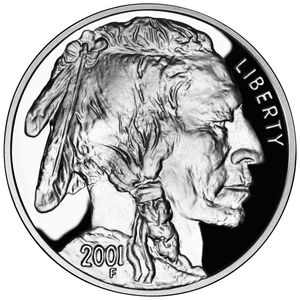
The 2001 American Buffalo silver dollar brought James Earle Fraser's Buffalo nickel design back to U.S. coinage on a larger, silver canvas, and it remains one of the best-known modern commemoratives. Our catalog covers the American Buffalo commemorative coin in both of its original finishes: the 2001-D uncirculated dollar struck at the Denver Mint and the 2001-P proof struck in Philadelphia.
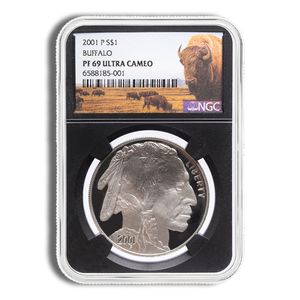
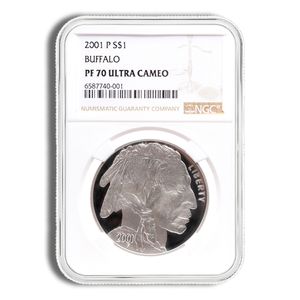
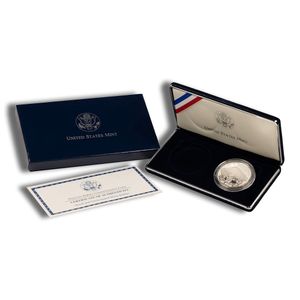
Within those two versions you'll find a wide range of presentations. Raw coins in original government packaging with the box and certificate of authenticity sit alongside certified examples, including NGC MS69 and MS70 uncirculated coins, PCGS MS70, NGC PF69 and PF70 proofs, and a PCGS PR70 proof. Several NGC coins are housed in the grading service's black holder, a look some collectors prefer for display.
Every listing is the same 90% silver, $1 face value coin, so the decision comes down to finish, grade and packaging. Each product page shows the live ask with the current bid beside it, which makes it easy to compare what you'd pay for a raw proof in its box against a top-graded coin.
What Are American Buffalo Commemorative Coins?
American Buffalo commemorative coins are the 2001 silver dollars authorized by Congress and struck by the U.S. Mint to support the Smithsonian's National Museum of the American Indian. Like other modern commemoratives, they were sold by the Mint for a limited time under a mintage cap, with a surcharge built into the price for the beneficiary. The program consisted of the silver dollar alone, issued as a Denver uncirculated coin and a Philadelphia proof.
They are not the same thing as the American Gold Buffalo, the .9999 fine gold bullion series the Mint introduced in 2006 using a version of the same Fraser design. That gold series is struck year after year and has its own pages on our site. The 2001 dollar is a single-year silver commemorative, and its pricing is driven by collectors rather than by the gold or silver bullion market.
Buyers come to this coin for several reasons. Some want the Buffalo nickel design in a large silver format, others collect modern commemoratives by year, and many are drawn to the coin's connection to Native American history and the museum it helped fund. The range of certified grades also makes it a popular coin for registry set collectors.
History and Background
Fraser's Buffalo nickel entered circulation in 1913 and was struck until 1938. Its obverse portrait of a Native American man was, by Fraser's own account, a composite drawn from several individuals, and the reverse showed an American bison standing in profile. The design became one of the most admired in American coinage, and it was an obvious choice when Congress looked for a way to support a new national museum devoted to Native peoples.
Legislation passed in 2000 authorized a silver dollar reproducing Fraser's obverse and reverse, limited to 500,000 coins across both finishes. When the Mint released the coins in 2001, demand was strong enough that the full authorized mintage sold out within weeks, an unusually fast result for a modern commemorative. Surcharges from those sales went toward the National Museum of the American Indian, which opened on the National Mall in Washington, D.C., in 2004.
The coin's success helped renew interest in Fraser's work at the Mint, and his design returned in 2006 on the American Gold Buffalo, the first .9999 fine gold coin struck by the U.S. Mint. That gold series is part of the design's later story rather than part of the commemorative dollars offered on this page.
Purity, Weight, and Specifications
Each 2001 American Buffalo silver dollar weighs 26.73 grams and is struck in an alloy of 90% silver and 10% copper, giving it 0.7734 troy ounces of pure silver. This is the standard used for U.S. commemorative silver dollars for decades and matches the silver content of a Morgan or Peace dollar. The copper makes the coin more resistant to wear than pure silver would be.
The mint mark tells you which version you have. A D mark identifies the Denver Mint's uncirculated coin, with a satin finish across the fields and design, while a P mark identifies the Philadelphia proof, struck multiple times on specially prepared blanks to produce frosted devices against mirror-like fields. There was no uncirculated Philadelphia coin or proof Denver coin in the program.
Certified coins add a layer of documentation. NGC and PCGS labels record the date, mint mark, denomination, grade and a unique certification number. Note that the two services label proofs differently: NGC uses PF and PCGS uses PR, so an NGC PF70 and a PCGS PR70 are equivalent grades from different graders.
Available Brands, Mints, and Product Variations
Every coin here is a U.S. Mint product, divided between the 2001-D uncirculated and 2001-P proof versions. On the uncirculated side, our selection includes a raw BU coin with its original box and COA, an NGC MS69 in a black holder, NGC MS70 coins in both the standard and black holders, and a PCGS MS70. Those choices let you decide how much weight to put on a perfect grade and on holder style.
Proof collectors will find raw 2001-P proofs presented in original Mint packaging with the box and certificate of authenticity, along with certified proofs graded NGC PF69 in a black holder, NGC PF70 and PCGS PR70. A raw proof in its Mint presentation case shows the coin as it was originally sold, while a PF70 or PR70 represents the top grade either service assigns.
The NGC black holder is a presentation choice rather than a separate grading standard. A coin graded MS70 by NGC meets the same criteria whether it sits in a black or a standard holder, though some collectors pay extra for the black version because of its contrast with silver. There are no random year options, since every coin here is dated 2001.
Pricing, Premiums, and Market Factors
American Buffalo silver dollars sell at collector premiums well above their silver value, and that's true even for the raw coins. Spot silver sets a floor under the price, but the bulk of what you pay reflects the program's mintage, the coin's condition and grade, the difference between proof and uncirculated strikes, whether original government packaging with box and COA is present, and the depth of collector demand for this particular design.
That demand is unusually deep. Because the 500,000 coin limit sold out quickly and the design is so widely admired, the American Buffalo dollar has long traded at a higher premium than most commemorative dollars of its era. The Denver uncirculated version was struck in smaller numbers than the Philadelphia proof, which affects how the two are valued.
Grade creates the widest spread on this page. The difference between an MS69 and an MS70, or between a PF69 and a PF70, can be substantial, and holder style and grading service can shift prices further. Our product pages show the bid and the ask for each listing, so you can see how much of the price gap between two versions is likely to be recovered on resale.
Condition, Packaging, and What to Expect
Certified coins arrive sealed in their NGC or PCGS holders, and the grade on the label is the grade you receive. Slabs should stay sealed, since breaking one out voids the certification. Light marks on the outside of the plastic are common and don't affect the coin.
Raw coins listed with box and COA include the original U.S. Mint packaging, typically a capsule inside a presentation case along with the certificate. After more than two decades, boxes may show some wear and the silver may have developed light toning or small spots, both of which are normal for silver commemoratives of this age.
Where a listing doesn't mention box and COA, expect the coin and protective packaging described on its product page. On certified coins, the label's grade and holder style are the most reliable guide to exactly what you'll receive.
Authenticity and Verification
The 2001 Buffalo dollar's popularity has made it a target for counterfeiters, which is one reason many collectors favor certified examples. NGC and PCGS authenticate every coin before grading, and each holder carries a certification number that can be entered into the service's online lookup to confirm the coin's details and grade. Both services also build security features into their labels and holders.
For raw coins, we inspect each piece before it ships, checking weight, strike detail, surface quality and mint mark against the Mint's specifications for that version. A genuine D-mint uncirculated coin should never show proof surfaces, and a P-mint coin should show the mirrored fields and frosted devices of a proof.
We source certified and raw coins through established wholesale channels and are an authorized dealer for both PCGS and NGC. The Mint's certificate of authenticity belongs with the original packaging, but it's the inspection of the coin itself that confirms it.
Liquidity and Resale Considerations
Among modern U.S. commemoratives, the American Buffalo dollar is one of the most recognized, and dealers nationwide know how to price it. That recognition makes it easier to sell than many lesser-known commemoratives, though it still trades in the collector market rather than alongside standardized bullion.
Certified coins from NGC and PCGS are generally the simplest to sell sight unseen, since the grade is already established. Raw coins with complete Mint packaging come next, and loose or spotted coins call for closer evaluation. Top-grade coins can be more sensitive to changes in collector demand than mid-grade examples.
A quick look at our bid and ask on the specific version you're considering is the most grounded way to judge how it trades today. It won't tell you anything about future prices, but it does show the real spread between buying and selling.
Storage and Security
Slabbed Buffalo dollars store best upright in a slab box, away from heat, humidity and sunlight. Avoid stacking holders loosely, which can scratch the plastic and make labels harder to read, and keep a list of certification numbers separate from the coins.
Raw coins should stay in their original Mint capsules and presentation cases, which protect the surfaces and preserve the packaging that supports resale. Store them where humidity is low and steady, and keep them away from rubber bands, cardboard and other materials that can tone silver.
A fire-rated home safe is sufficient for most collections of this size, while a bank safe deposit box or professional depository suits larger holdings. Never clean a Buffalo dollar, raw or certified, since cleaning causes permanent damage that collectors recognize immediately.
Selling and Buyback Options
We buy American Buffalo silver dollars through the same two-way marketplace where we sell them. The bid on each product page is a working price, and our purchasing team confirms the quote, receives the coin, verifies it and arranges payment.
Our offer depends on which version you're selling, its grade or condition, its holder or original packaging, current collector demand and the silver price. Sealed NGC and PCGS holders are straightforward to price, as are raw coins in complete Mint boxes with COA.
Coins that have left their original packaging, or slabs with cracked holders or damaged labels, are evaluated individually. In some cases a damaged holder may need to be replaced by the grading service before the coin can be valued at its full grade.
Why Buy American Buffalo Commemorative Coins?
The design is the first reason. Fraser's portrait and bison are among the most celebrated images in American numismatics, and the 2001 dollar presents them in silver at a size that shows off detail the original nickel couldn't. For many collectors, it's the definitive modern tribute to that design.
The coin's story adds to its appeal. It honors Native American history, helped fund the National Museum of the American Indian, and sold out its full authorized mintage in a matter of weeks. That combination of meaning and a fixed supply gives the American Buffalo commemorative coin a standing few modern commemoratives share.
Finally, it offers flexibility. Between Denver uncirculated and Philadelphia proof versions, raw coins in original packaging and certified grades from MS69 to PF70, there's a version for a first commemorative purchase and for a registry-level collection alike, all with the same 0.7734 troy ounces of silver.
Why Buy from Bullion Standard?
Bullion Standard was founded in 2010 in San Diego, California, and has grown into a national online precious metals marketplace on a straightforward premise: you get one chance to earn someone's trust. With a coin that counterfeiters have targeted and whose price is as grade-sensitive as the Buffalo dollar's, that means verified product and clear listings every time.
We're an authorized dealer for PCGS and NGC, a member of the American Numismatic Association and the National Coin and Bullion Association, and A+ rated by the Better Business Bureau. Our product research tools let you compare premiums and spreads across products using objective data instead of sales claims.
Payment is flexible, with Visa, Mastercard, American Express, Discover, PayPal, Plaid bank payments, wire transfer, paper check and BitPay cryptocurrency all accepted. Because we buy as well as sell, the bid displayed on each product page comes from a real two-way market.
Get Near-Spot Pricing with Bullion Standard Pro
Bullion Standard Pro provides members with live, executable wholesale bid and ask pricing on a broad range of precious metals products. No additional dealer markup or dealer spread is applied to member prices, so premiums and spreads reflect real wholesale supply and demand, which brings bullion pricing close to spot and makes the premium on a collector coin plain to see.
Members can also track their holdings at live wholesale bid value, which gives a more realistic picture of what a collection would bring today than a retail estimate. Tools for historical premium analysis, spread analysis, liquidity metrics and buy/sell ratios show how individual products have been priced and traded over time.
For collectors who buy certified commemoratives regularly or who want to understand how much of a Buffalo dollar's price is silver and how much is premium, Pro brings wholesale-level transparency to that decision.


 (833) 278-4653