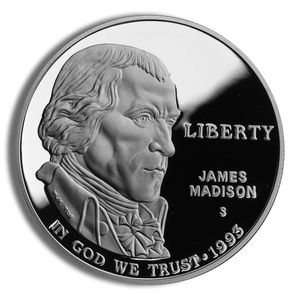
Buy Bill of Rights Commemorative Coins Online
The 1993 Bill of Rights commemorative coins honored James Madison, the Virginian who drafted the amendments and later became the fourth president. Our catalog carries the silver dollar from that program in both of its versions: the 1993-D uncirculated dollar from the Denver Mint and the 1993-S proof dollar from the San Francisco Mint.
Each is a .900 fine silver coin with 0.7734 troy ounces of pure silver and a one-dollar face value, so the pair covers every finish of the Madison dollar. Product pages show live pricing and the current bid/ask spread, giving you a clear view of both the purchase price and what the coin would bring if you sold it back to us.
What Are Bill of Rights Commemorative Coins?
These are legal tender U.S. Mint coins authorized by Congress to recognize Madison and the first ten amendments to the Constitution, sold directly to collectors at a premium rather than issued for circulation. The 1993 program included a silver half dollar, a silver dollar and a $5 gold coin, and the silver dollar is the denomination we offer.
The difference between our two listings is finish. The Denver coin is an uncirculated strike with an even, satiny surface, while the San Francisco proof was struck on polished blanks and shows mirror-like fields with frosted design elements. Collectors who want the complete dollar issue typically buy both.
History and Background
Madison introduced the proposed amendments in the House of Representatives in 1789, and the ten that became the Bill of Rights were ratified on December 15, 1791. His role in shaping both the Constitution and its first amendments is why the coins carry his portrait rather than an allegorical figure. Struck shortly after the amendments' bicentennial, the 1993 program used surcharges to support the James Madison Memorial Fellowship Foundation, which funds graduate study for teachers of American history and government.
The silver dollar pairs a portrait of Madison on the obverse with Montpelier, his family estate in Virginia, on the reverse. The uncirculated dollar is the scarcer of the two, with fewer than 100,000 struck, while the proof was produced in far larger numbers, roughly half a million coins.
Purity, Weight, and Specifications
The Madison dollar follows the standard modern commemorative silver dollar format: 26.73 grams of 90% silver and 10% copper. Our listings show 0.7734 troy ounces, which is the pure silver content rather than the full weight of the coin, a little under 0.86 troy ounces including the copper.
A D mint mark identifies the Denver uncirculated coin and an S identifies the San Francisco proof. The coin carries its denomination and the standard U.S. legends, and as a government issue it relies on the Mint's specifications rather than an assay card or serial number.
Available Brands, Mints, and Product Variations
Both coins are U.S. Mint products, split between Denver for the uncirculated strike and San Francisco for the proof. Both listings are raw coins rather than third-party graded examples, and neither is a random year or random design product. Each is the specific 1993 dollar from its named mint.
The proof's listing title includes the abbreviation BU, but the 1993-S is a proof and will have a proof finish. The uncirculated listing's title is shortened to "Bill Rights," and it refers to the same 1993 James Madison and Bill of Rights silver dollar program.
Pricing, Premiums, and Market Factors
Madison dollars sell for collector premiums above their silver value. Mintage is a big part of the picture, and the Denver uncirculated coin's low production generally gives it a higher premium than the more plentiful proof. Condition also shapes price, since spotting or hairlines reduce a raw coin's appeal, and examples certified in top grades by a grading service are priced well above raw ones.
Proof and uncirculated versions are valued as separate issues, and coins that still have their original government packaging, the Mint box and certificate of authenticity, are generally preferred. Interest in Madison and in constitutional history also drives demand independently of the silver price. Our product pages show the bid alongside the ask so you can see the spread for each version before you buy.
Condition, Packaging, and What to Expect
Both coins have never circulated, but silver struck in 1993 can show light toning or small white spots after decades in storage, even with careful handling. Expect an original coin in the finish described, with proof fields more prone to visible hairlines than the satin uncirculated surface. If the original Mint box and certificate are important to you, confirm the packaging on the product page before ordering.
Authenticity and Verification
Each coin is checked for authenticity, weight and purity before shipping. On a Madison dollar, that includes confirming the 26.73 gram weight, matching the mint mark to the finish and looking closely at the portrait and the Montpelier facade, where reproductions tend to lose detail.
For buyers who want independent confirmation, both NGC and PCGS grade this issue and print a verifiable certification number on every holder. We're an authorized dealer for both and a member of the American Numismatic Association.
Liquidity and Resale Considerations
Dealers who handle modern U.S. commemoratives recognize the Madison dollar, which makes it straightforward to identify and price. Its market is smaller than the market for bullion silver, though, and bids reflect collector interest in this particular issue as well as metal value.
The scarcer uncirculated coin depends more on finding a collector who needs it, while the proof trades more routinely. Looking at the bid and ask on our product pages before you buy gives you a practical sense of the spread on each version.
Storage and Security
Store each coin in an airtight, inert capsule and touch it only by the edge to avoid fingerprints on the silver. Keep coins away from heat, humidity, PVC holders and rubber, and consider a silica gel packet in any closed container.
Two silver dollars need very little space, so a small fire-rated safe or a bank safe deposit box is plenty. Keep any Mint boxes and certificates flat and dry with the coins, along with a simple inventory record for insurance.
Selling and Buyback Options
Bullion Standard buys as well as sells, so you can sell a Madison dollar back through the same marketplace. The current bid appears on the product page, and our purchasing team confirms the price, inspects the coin and issues payment after verification.
Buyback prices depend on finish, condition, original packaging, current demand for the issue and the silver market. Coins with clean, original surfaces and complete packaging are the easiest to price.
Why Buy Bill of Rights Commemorative Coins?
Few documents shape daily American life as directly as the Bill of Rights, and these coins put the man most responsible for it on a government-issued silver dollar. For collectors of presidential and founding-era subjects, Madison is an essential name, and Montpelier gives the design a personal touch.
The program is also compact enough to complete. With just two versions of the dollar, a pair of 1993 Bill of Rights commemorative coins covers the entire silver dollar issue, each with fixed silver content and a documented mintage.
Why Buy from Bullion Standard?
Since opening in San Diego in 2010, Bullion Standard has expanded from a local dealer into a national online marketplace, guided by the belief that trust is earned in a single transaction. We carry an A+ rating with the Better Business Bureau and belong to the American Numismatic Association and the National Coin and Bullion Association.
Every order is sourced through reputable channels and verified before it ships. We accept major credit cards, PayPal, Plaid bank payments, wire transfers, paper checks and BitPay cryptocurrency, and because we also buy, the posted bid on a Madison dollar is a real offer.
Get Near-Spot Pricing with Bullion Standard Pro
With Bullion Standard Pro, members buy and sell at live, executable wholesale bid and ask prices, without any dealer markup or dealer spread added. Commemorative premiums remain part of a coin like the Madison dollar, but Pro makes those premiums visible at the wholesale level instead of folding them into a retail price.
Members also see portfolio values based on live wholesale bids and can use tools like liquidity metrics, volatility metrics and premium percentile rankings. For frequent buyers, that transparency makes it easier to judge exactly what each purchase costs.


 (833) 278-4653