Buy Eisenhower Commemorative Coins Online
Our Eisenhower commemorative coin selection is built around the 1990 Eisenhower Centennial silver dollar, the U.S. Mint issue that marked 100 years since Dwight D. Eisenhower's birth. We carry both versions the Mint produced: the 1990-W uncirculated dollar struck at West Point and the 1990-P proof dollar struck at Philadelphia. Each is a .900 fine silver coin containing 0.7734 troy ounces of pure silver, with a one-dollar face value.
Two listings may look like a short list, but together they represent the entire silver dollar program, so a collector can complete the issue in a single order. Live pricing and the current bid/ask spread appear on each product page, letting you see what the coin costs now and what we would pay for it if you sold it back.
What Are Eisenhower Commemorative Coins?
An Eisenhower commemorative coin is a legal tender U.S. Mint issue authorized by Congress to honor the 34th president, sold to collectors at a set price above face value rather than released into circulation. The 1990 centennial dollar is often confused with the large Eisenhower dollar struck from 1971 to 1978, but that was a circulating coin whose collector versions were 40% silver. The 1990 piece is a separate commemorative with its own design and a 90% silver composition.
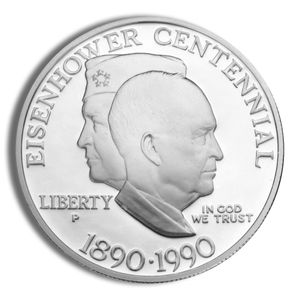
The two coins in our catalog share metal content and differ in finish. The West Point coin has the soft, satiny surface of an uncirculated strike, while the Philadelphia proof was struck on specially prepared blanks with polished dies, leaving mirror-like fields behind frosted portraits and lettering. Most buyers pick based on the look they prefer, and many simply buy both.
History and Background
Eisenhower was born in Denison, Texas, on October 14, 1890, commanded Allied forces in Europe during World War II and served two terms as president from 1953 to 1961. Congress approved a silver dollar for his centennial, and the Mint struck it in 1990. Unlike most commemorative programs, which direct their surcharges to a memorial or foundation, this one sent its surcharges toward reducing the national debt.
John Mercanti's obverse places two overlapping profiles of Eisenhower side by side, one as the five-star general and one as president, an arrangement almost never seen on U.S. coinage. Marcel Jovine's reverse shows the Eisenhower farmhouse at Gettysburg, Pennsylvania, where Ike and Mamie retired after the White House and which is now preserved as the Eisenhower National Historic Site. Proof sales far outpaced the uncirculated version, with more than a million proofs sold against roughly 241,000 uncirculated coins.
Purity, Weight, and Specifications
Both 1990 Eisenhower dollars follow the standard specification for modern U.S. commemorative silver dollars: 26.73 grams of 90% silver and 10% copper. The 0.7734 troy ounce figure you'll see on our listings is the pure silver content, not the coin's gross weight, which comes to a little under 0.86 troy ounces once the copper alloy is counted.
The mint mark is the quickest way to tell the two apart. A P identifies the Philadelphia proof and a W identifies the West Point uncirculated coin. Like other U.S. commemoratives, both carry LIBERTY, IN GOD WE TRUST and E PLURIBUS UNUM along with the one-dollar denomination, so there's no separate assay card or serial number involved.
Available Brands, Mints, and Product Variations
Every coin here is a U.S. Mint product, and the variations come down to facility and finish. The 1990-W is the uncirculated coin from the West Point Mint. The 1990-P is the proof from the Philadelphia Mint, which was itself a little unusual, since San Francisco struck the proofs for most commemoratives of that period.
Neither listing is a random year product, and both are raw coins rather than third-party graded examples. The proof's listing title also includes the abbreviation BU, but the coin is a proof strike, and you should expect the reflective finish that goes with it.
Pricing, Premiums, and Market Factors
These coins don't trade near spot. Silver content gives each one a baseline, but the price you pay reflects a collector premium shaped by several things. Mintage matters, which is why the West Point uncirculated coin, with roughly a fifth of the proof's mintage, tends to carry the stronger premium of the two. Condition matters as well, because a coin with spotting or hairlines is worth less to a collector than a clean one, and a coin certified in a top grade can be priced well above a raw example.
Finish, packaging and subject all play a role. Proof and uncirculated coins are priced as separate issues, coins with their original government packaging, meaning the Mint box and certificate of authenticity, are generally preferred over loose coins, and demand from collectors of World War II and presidential subjects keeps interest in Eisenhower issues steady. Because none of this is visible from the spot price, we show the bid and ask together on every product page.
Condition, Packaging, and What to Expect
Both coins are offered in Brilliant Uncirculated condition, meaning they have never circulated, but they are more than 35 years old and silver reacts with its environment over time. Light toning or small white spots can appear even on coins that were never handled, so expect an original coin rather than one that looks freshly struck. Proof surfaces show fingerprints and hairlines more readily than satin ones.
The Mint originally sold these dollars in protective capsules with a box and certificate of authenticity. Our listings describe the coin itself, so if the original packaging matters to you, check the product page or contact us before you order.
Authenticity and Verification
Every coin we sell is verified for authenticity, weight and purity before it ships. For a 1990 Eisenhower dollar that means confirming the 26.73 gram weight, the correct mint mark for the finish and the fine details of both portraits and the farmhouse, which counterfeits often render soft or flat.
If you'd like independent confirmation on top of ours, PCGS and NGC both grade this issue, and a certified coin carries a numbered holder that can be checked online. We're an authorized dealer for both services and a member of the American Numismatic Association.
Liquidity and Resale Considerations
The Eisenhower dollar is a familiar modern commemorative, and dealers who handle U.S. Mint silver dollars generally know it well. That recognition helps when selling, but the market for commemoratives is narrower than the market for bullion coins, and bids are set by collector demand for the specific issue and finish as much as by silver.
Because the proof exists in large numbers, it tends to change hands readily, while the scarcer uncirculated coin depends on finding collectors who want it. Comparing the bid and ask on our product pages gives you a grounded view of the spread before you commit.
Storage and Security
Keep each coin in an inert, airtight capsule and handle it only by the edge, since skin oils can leave marks that become permanent on silver. A cool, dry location away from rubber bands, PVC flips, cardboard and household chemicals helps slow toning, and a silica gel packet in the storage box is a simple safeguard.
A pair of silver dollars takes up very little space, so a fire-rated home safe or a bank safe deposit box is usually plenty. Keep a record of what you own, and if you keep the Mint boxes, store them flat and dry, because damaged packaging can affect how a coin is received when you sell.
Selling and Buyback Options
You can sell these coins back to us through the same two-way market you buy from. The product page shows our current bid, and our purchasing team confirms the price, inspects the coin on arrival and issues payment once it checks out.
Buyback pricing reflects the finish, the coin's condition, whether it comes with its original packaging and current demand for the issue, along with the silver market. Selling the proof and uncirculated coins together as a matched pair is common, though each is priced on its own merits.
Why Buy Eisenhower Commemorative Coins?
For many buyers the appeal is Eisenhower himself, one of the few Americans to lead both a world war coalition and the country, shown on a single coin in both roles. The design ties directly to his history, and the Gettysburg reverse adds a personal side that most presidential coins leave out.
The practical side matters too. This is a government-issued coin with defined silver content and a mintage that's documented and finite, and the whole program fits into two coins. An Eisenhower commemorative coin is an approachable way to add a 20th century president to a commemorative collection without chasing a long list of varieties.
Why Buy from Bullion Standard?
Bullion Standard has been in business since 2010 and operates from San Diego, California. We started as a local dealer and grew into a national online marketplace by treating each transaction as a chance to earn trust that we only get once. Holding an A+ rating with the Better Business Bureau and membership in the American Numismatic Association and the National Coin and Bullion Association, we source from established wholesalers and distributors and inspect every coin before shipment.
Checkout supports Visa, Mastercard, American Express, Discover, PayPal, bank-connected payments through Plaid, wire transfer, paper check and cryptocurrency through BitPay. Since we buy and sell, the bid on an Eisenhower dollar's product page is a live quote from an active market rather than a placeholder.
Get Near-Spot Pricing with Bullion Standard Pro
Bullion Standard Pro opens live, executable wholesale bid and ask pricing to members, with no dealer markup or dealer spread added on top. Commemorative silver dollars still carry collector premiums at the wholesale level, but Pro shows you exactly where those premiums sit and how they move with supply and demand instead of hiding them inside a retail price.
Members also get portfolio valuation at live wholesale bid prices, plus tools such as historical premium analysis, spread analysis and liquidity metrics. If you buy commemoratives and bullion regularly, that view of the wholesale market is the clearest way to judge what you're paying and what your coins would bring.


 (833) 278-4653