Buy George Washington Commemorative Coins Online
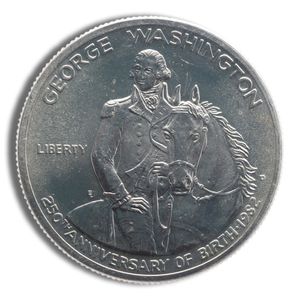
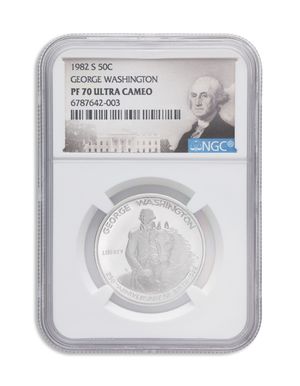
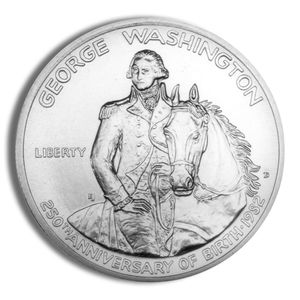
Our George Washington commemorative coin selection centers on two U.S. Mint issues: the 1982 silver half dollar struck for the 250th anniversary of Washington's birth, and the 2018 1 oz silver presidential medal that bears his likeness. The half dollar is offered as an uncirculated 1982-D from Denver, a raw 1982-S proof from San Francisco and a 1982-S proof certified by NGC at PF70.
The 2018 medal comes in NGC holders graded MS69 and MS70. It's struck in .999 fine silver rather than the 90% coin silver of the half dollar, and as a medal it has no face value, which gives buyers two quite different ways to own a Washington piece from the same Mint.
Each listing shows its live ask alongside our current bid. Because a PF70 slab and an uncirculated half from the same year can sit far apart in price, seeing both sides of the market makes those differences easy to understand before you buy.
What Are George Washington Commemorative Coins?
A George Washington commemorative coin is a special issue struck to honor the first president, sold to collectors for a limited period rather than released into circulation. The 1982 half dollar fits that definition exactly: a congressionally authorized, legal tender 50 cent coin made in .900 fine silver for a specific anniversary.
The 2018 Washington silver medal is a close relative but not a coin. The Mint has struck presidential medals for generations, and the 2018 piece reproduces that tradition in a full ounce of fine silver without a denomination. Collectors who focus on Washington often keep both, since together they show how the Mint has honored him in coin and medal form.
Most buyers fall into one of three groups. Some want the half dollar because it opened the modern commemorative era, some want the finest graded examples, and others want an affordable, government-made link to Washington himself.
History and Background
By 1982 the U.S. Mint hadn't issued a commemorative coin in almost three decades. The last program, the Carver-Washington half dollar honoring Booker T. Washington and George Washington Carver, ended in 1954. Congress revived the practice for the 250th anniversary of George Washington's birth in 1732, and the resulting half dollar was also the first 90% silver coin the Mint had struck since 1964.
The coin's obverse, designed by Chief Engraver Elizabeth Jones, shows Washington on horseback, while the reverse depicts Mount Vernon, his Virginia estate. Production ran into the millions across both finishes, and the program's popularity helped launch the steady series of commemoratives the Mint has issued ever since.
Washington's place on American coinage goes back much further. He shared the 1900 Lafayette dollar, the first U.S. commemorative silver dollar, and the Washington quarter was introduced in 1932 for the bicentennial of his birth. Later, a 1999 $5 gold coin marked the bicentennial of his death, and in 2007 he led off the Presidential $1 coin series. None of those are in our current catalog, but they show how often the Mint returns to him.
Purity, Weight, and Specifications
The 1982 Washington half dollar is struck in 90% silver and 10% copper, weighs 12.5 grams and contains 0.3617 troy ounces of pure silver. It carries a 50 cent face value, and its mint mark identifies the finish: D for the uncirculated Denver coins and S for the San Francisco proofs.
The 2018 Washington presidential medal follows a different standard. It contains one troy ounce of .999 fine silver, nearly three times the silver of the half dollar, but it has no denomination and isn't legal tender. That makes it closer to a silver bullion piece in metal content, while its U.S. Mint origin and NGC grade give it collector standing.
Available Brands, Mints, and Product Variations
All five listings come from the U.S. Mint, split across three products. The 1982-D is the uncirculated version, struck at Denver with a satin finish. The 1982-S is the proof version, struck at San Francisco on polished planchets with specially prepared dies, which produces mirrored fields and frosted devices on the portrait and the Mount Vernon scene.
The 1982-S proof is available raw and in an NGC PF70 holder. A PF70 grade means NGC graders found no post-production imperfections under magnification, which sets it apart from raw proofs that may show small spots or handling marks after four decades. The raw proof is also listed with a BU descriptor, but it is a proof coin, not a brilliant uncirculated one.
The 2018 Washington medal appears in NGC MS69 and MS70. The single grade point between them reflects the difference between a near-perfect strike with minor flaws and one with none visible, and it's the main thing separating the two listings.
Pricing, Premiums, and Market Factors
Washington commemoratives sell at collector premiums rather than near the spot price of silver. With only 0.3617 oz of silver in each half dollar, the melt value is a small share of the price, and the rest reflects mintage, finish, grade, packaging and collector interest in Washington and in this historic first issue.
Mintage cuts both ways here. Because millions of 1982 halves were made, raw examples are plentiful and premiums tend to stay moderate, while a PF70 example commands far more because so few coins reach that grade. Original government packaging with a box and certificate of authenticity generally adds to a raw coin's appeal, and proofs typically cost more than uncirculated coins.
The medals follow similar logic. Their silver content is higher, but MS70 medals still carry a premium over MS69 that has nothing to do with the metal. Comparing the bid and ask on each listing is the clearest way to see how those factors are priced right now.
Condition, Packaging, and What to Expect
The raw 1982 half dollars are sold as described in each listing, with uncirculated luster on the 1982-D and mirror surfaces on the 1982-S proof. Coins of this age can show light toning or minor spotting even when never handled, which is normal for 90% silver stored over many years. Check the product page for packaging details on raw listings.
Graded listings arrive sealed in NGC holders, with the coin or medal matching the grade printed on its label. Holders can show light scuffs on the outside from storage and shipping, which don't affect the coin or medal inside. Keep them sealed, since opening a holder ends its certification.
Authenticity and Verification
NGC certification is the simplest safeguard for the PF70 half dollar and both medals. Every holder has a unique certification number that can be checked on NGC's website, confirming the date, mint, grade and description, and we're an authorized NGC dealer sourcing through established channels.
For raw half dollars, the specifications offer a straightforward check. A genuine 1982 Washington half weighs 12.5 grams, shows sharp detail in Jones's equestrian portrait and carries the correct mint mark for its finish. Every coin we ship is inspected for weight, finish and condition before it leaves our facility.
Liquidity and Resale Considerations
The 1982 Washington half is one of the most familiar modern commemoratives, and dealers recognize it immediately. That recognition makes it easy to sell, though high mintage means raw examples rarely bring large premiums.
Certified pieces depend more on collector demand. The PF70 half and MS70 medal draw buyers focused on top grades, and their prices respond to that interest more than to silver. The bid on each product page gives a realistic view of today's market for each format.
Storage and Security
Silver half dollars are prone to toning if exposed to air, humidity or sulfur-bearing materials, so keep raw coins in inert capsules or their original packaging and store them in a cool, dry place. Avoid older PVC flips, which can leave a damaging residue over time.
NGC holders are best kept upright in a slab box, protected from drops and scratches. A small home safe is usually enough for a Washington collection of this size, and recording each certification number helps with insurance and future resale.
Selling and Buyback Options
We buy back George Washington commemoratives through our two-way market. Product pages show our current bid, and our purchasing team confirms the price, verifies the coins or medals when they arrive and issues payment.
Your bid will depend on finish, grade, packaging and condition. A clean 1982-S proof or a sealed NGC MS70 medal is straightforward to value, while raw coins with spotting or handling marks may bid closer to silver content. Silver prices also move the bid on both formats.
Why Buy George Washington Commemorative Coins?
The 1982 half dollar holds a real place in American numismatic history as the coin that restarted the commemorative program. Owning one connects you to Washington's 250th birthday celebration and to the revival of commemoratives that followed.
These pieces are also accessible. The half dollar's modest silver content keeps raw examples within reach, while the medal offers a full ounce of .999 silver with Mint provenance. Together they let collectors choose between a legal tender coin and a fine silver medal, or own both.
Why Buy from Bullion Standard?
Founded in 2010 and based in San Diego, California, Bullion Standard has built a national marketplace around transparent pricing and a belief that trust is earned once. For a Washington half or medal, that means you see the bid and the ask, not just the sale price.
We're an authorized NGC and PCGS dealer with an A+ BBB rating and memberships in the ANA and NCBA, and every product is verified before shipping. Checkout accepts major credit cards, PayPal, Plaid bank payments, wire transfers, paper checks and cryptocurrency through BitPay.
Get Near-Spot Pricing with Bullion Standard Pro
Bullion Standard Pro opens up live, executable wholesale bid and ask pricing with no added dealer markup or dealer spread on member pricing. For collectors, the value is clarity: you can see the wholesale price of a product rather than a retail figure set in advance.
Commemoratives like the Washington half still carry collector premiums, and Pro doesn't change that. What it adds is visibility, through portfolio valuation at live wholesale bid and tools such as historical premium analysis and spread analysis that show how a product has been priced over time.


 (833) 278-4653