Buy JFK Commemorative Coins Online
Fifty years after the first Kennedy half dollar, the U.S. Mint struck the design in gold, and that 2014-W 3/4 oz gold half dollar is the coin behind every JFK commemorative coin in our catalog. Struck at the West Point Mint in .9999 fine gold, it carries the original Kennedy portrait and presidential coat of arms along with a 50-cent face value.
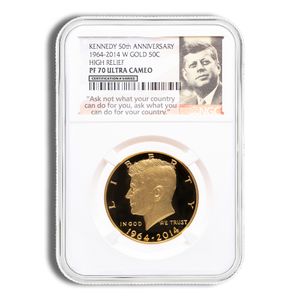
We offer the coin in several presentations. Two listings are the coin in its original U.S. Mint box with certificate of authenticity, and four are certified proofs: NGC PF69 and PF70, and PCGS PR69 and PR70, each with a random label. Live pricing and the current bid/ask spread on every product page let you compare how the market values each grade and holder.
What Are JFK Commemorative Coins?
A JFK commemorative coin is a special issue honoring President John F. Kennedy, as opposed to the Kennedy half dollars made for circulation since 1964. The 2014-W gold half is a legal tender U.S. Mint coin made for collectors, sold at a premium to the public and produced in limited numbers to mark the half dollar's 50th anniversary. It is a gold coin first and a half dollar in name, holding three quarters of a troy ounce of pure gold.
The coin was produced only as a proof, with mirror-like fields and frosted devices. What separates our listings is how each coin is presented. Coins in original government packaging come as the Mint shipped them, while NGC and PCGS examples have been authenticated, graded and sealed by a third-party service.
Buyers who value the full Mint presentation tend to prefer the boxed coins, while set collectors and grade-focused buyers lean toward certified examples. A PF70 or PR70 represents the finest grade either service assigns, and a 69 offers nearly the same eye appeal at a lower premium.
History and Background
President Kennedy was assassinated in Dallas on November 22, 1963, and within weeks Congress authorized a new half dollar in his memory. Gilroy Roberts, then the Mint's chief engraver, adapted his own Kennedy portrait for the obverse, and Frank Gasparro designed the reverse around the presidential coat of arms. Jacqueline Kennedy is widely reported to have favored the half dollar over replacing Washington on the quarter.
The first Kennedy halves of 1964 were struck in 90% silver and were hoarded almost as fast as the Mint could produce them. Silver content dropped to 40% from 1965 through 1970, and the coin moved to copper-nickel clad for circulation in 1971. Those circulating issues are part of the coin's story but aren't what we list here.
For the 50th anniversary in 2014, the Mint revisited the original design in .9999 fine gold, adding the dual date 1964-2014 and striking every coin at West Point. The gold coin launched at the American Numismatic Association's World's Fair of Money that August, where long lines formed for it. The Mint also issued silver and clad anniversary products that year, which sit outside our current catalog.
Purity, Weight, and Specifications
Each 2014-W gold Kennedy half contains 0.75 troy ounces of .9999 fine gold, which is 24 karat gold and works out to about 23.33 grams. Because the coin is essentially pure gold, its gross weight and its gold content are nearly the same figure, unlike the 22 karat alloys used on some other U.S. gold coins.
The W mint mark identifies West Point, the only facility that struck the coin, and the obverse carries the 1964-2014 anniversary dates. The face value is 50 cents, a legal formality that has no bearing on its gold value. Certified examples add a holder label showing the date, denomination, grade and a unique certification number.
Available Brands, Mints, and Product Variations
Every coin here comes from the U.S. Mint's West Point facility, so variety comes entirely from packaging and grading. The two boxed listings are proof coins in original government packaging with the certificate of authenticity. Although their titles use the abbreviation BU, the Mint struck this coin only as a proof, and that's the finish you should expect.
The certified listings cover both major grading services at the two top grades. NGC uses the PF prefix for proof grades and PCGS uses PR, so NGC PF70 and PCGS PR70 describe the same perfect grade, as do NGC PF69 and PCGS PR69. Many collectors have a preference between the two services, and offering both lets you match the rest of your collection.
All four certified listings are sold with a random label. Both NGC and PCGS have used several label designs on this issue over the years, including special release labels, and we ship whichever label is in inventory at the stated grade. If a specific label matters to you, contact us before ordering.
Pricing, Premiums, and Market Factors
Gold content sets a meaningful baseline for this coin, since 3/4 oz of gold is substantial metal, but it still sells above melt as a collector issue. Its limited mintage relative to bullion coins is one reason. Condition and grade are another, with a PF70 or PR70 typically commanding more than a 69 grade of the same coin because perfect examples are harder to find.
Format and packaging matter too. The coin was made only as a proof, so its premium reflects proof production costs from the start, and coins in their original government packaging with box and COA are usually preferred over loose examples. Collector demand for Kennedy, one of the most recognized presidential subjects in American coinage, adds a premium that can move apart from the gold market.
Because the spread between a boxed coin and a top-graded certified one can be wide, we display the ask and bid on every product page. Comparing those numbers across the six listings is the fastest way to see what each grade or holder adds to the price.
Condition, Packaging, and What to Expect
Boxed coins arrive in the original U.S. Mint presentation case with the certificate of authenticity, the coin held in its protective capsule. Gold doesn't tone the way silver does, but proof fields are delicate, so leave the coin in its capsule and expect the presentation the Mint intended.
Certified coins come sealed in NGC or PCGS holders, and the grade on the label is the grade you'll receive. Because these are random label listings, the label design may differ from the product photo. Light scuffs on the outside of a holder are normal and don't affect the coin.
Authenticity and Verification
Before any gold Kennedy half leaves our facility, we verify its authenticity, weight and purity. That process includes confirming weight and checking the fine details of the portrait, the coat of arms and the dual date, the areas where counterfeits most often fall short.
Certified coins come with an extra check you can run yourself. NGC and PCGS both print a unique certification number on each holder, which can be entered on the grading service's website to confirm the coin, date and grade. Bullion Standard is an authorized dealer for both services.
Liquidity and Resale Considerations
The gold Kennedy half has a recognizable profile among U.S. Mint gold collectors, and certified examples at the 69 and 70 grades are priced off a standard most dealers follow. That makes it more straightforward to value than many modern commemoratives.
Collector demand still plays a larger role than it would for a bullion coin of similar gold content, so bids reflect both the gold market and interest in this issue. Checking the bid next to the ask on our product pages before you buy helps set realistic expectations for what the coin will bring later.
Storage and Security
A 3/4 oz gold coin is compact but carries real value, so a fire-rated home safe, a bank safe deposit box or a professional depository makes sense depending on the size of your holdings. Keep the Mint box and certificate together and dry, since missing or damaged packaging can lower the price a boxed coin brings.
Store NGC and PCGS holders upright in a slab box so they don't scratch against each other, and never open a holder to inspect the coin. A record of each certification number is worth keeping alongside your insurance documents.
Selling and Buyback Options
Our two-way market means you can sell a gold Kennedy half back to us as easily as you bought it. The product page shows the current bid, and our purchasing team handles pricing confirmation, inspection and payment.
Buyback pricing depends on the grade, the grading service, whether a raw coin still has its original box and COA, and current demand for the issue, along with the gold price. Coins in intact holders or complete Mint packaging are the simplest to price.
Why Buy JFK Commemorative Coins?
Few presidential subjects carry the emotional weight of Kennedy, and his half dollar has been in production for more than 60 years. The 2014-W gold half connects that long run to a single anniversary issue, using the original 1964 design in gold rather than silver or clad.
It also brings together collectibility and substantial gold content in one government-issued coin. Whether you want a boxed proof with its original paperwork or a JFK commemorative coin in a top-graded NGC or PCGS holder, our catalog covers both approaches.
Why Buy from Bullion Standard?
Bullion Standard opened in San Diego, California, in 2010, and the principle we started with hasn't changed: in this business, trust is earned once. From those local beginnings we've built a national online marketplace, and we hold an A+ BBB rating alongside membership in the ANA and the National Coin and Bullion Association.
As an authorized PCGS and NGC dealer, we source certified coins through established channels and inspect every order before it ships. Payment can be made by card, PayPal, Plaid bank transfer, wire, check or cryptocurrency through BitPay. Since we buy back what we sell, the bid on a gold Kennedy half reflects a real two-way market.
Get Near-Spot Pricing with Bullion Standard Pro
Bullion Standard Pro gives members live, executable wholesale bid and ask pricing with no added dealer markup or dealer spread. Collector premiums on a gold commemorative don't disappear at wholesale, but Pro shows them plainly and lets them move with real supply and demand rather than a fixed retail markup.
Members can see their holdings valued at live wholesale bid prices and use tools such as historical premium analysis, spread tightness rankings and buy/sell ratio indicators. For buyers who add gold regularly, it's a clearer way to understand how coins like the 2014-W gold half are priced.


 (833) 278-4653