Buy Thomas Jefferson Commemorative Coins Online
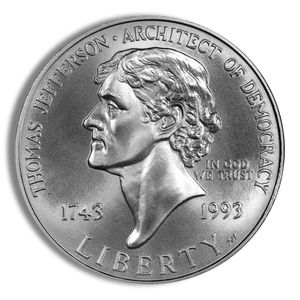
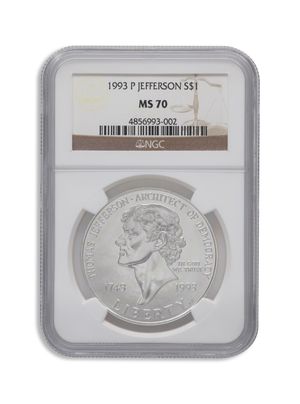
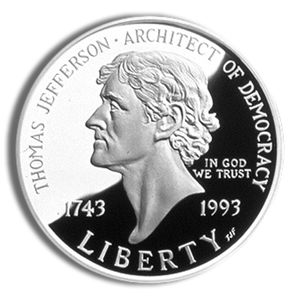
Thomas Jefferson's 250th birthday gave the U.S. Mint the occasion for one of its more understated silver dollars, and that coin is the focus of our Thomas Jefferson commemorative coin listings. We offer it three ways: the 1993-P uncirculated dollar from the Philadelphia Mint, the same 1993-P coin certified MS70 by NGC, and the 1993-S proof from the San Francisco Mint.
All three are .900 fine silver with 0.7734 troy ounces of pure silver and a one-dollar face value, so the choice is really about finish and certification. A raw uncirculated coin, a top-graded example in a sealed holder and a mirror-finish proof each suit a different kind of collector, and live bid/ask pricing on every product page shows how the market values each one.
What Are Thomas Jefferson Commemorative Coins?
A Thomas Jefferson commemorative coin is a legal tender issue authorized by Congress and struck by the U.S. Mint to honor the third president, sold to collectors at a premium rather than placed into circulation. Jefferson already appears on everyday money, with his portrait on the nickel since 1938 and on the $2 note, but those are circulating designs. The 1993 silver dollar was a one-time collector issue made in limited numbers.
The coins in our catalog divide along two lines. One is finish: the P-mint coin is an uncirculated strike with a satin surface, while the S-mint coin is a proof with polished, reflective fields. The other is certification: the NGC MS70 example has been independently authenticated, graded and sealed, while the other two are sold as raw coins.
Collectors tend to buy them for different reasons. Some want the most affordable way to own the issue, some want the finest certified grade available, and set builders often want the proof to sit beside other proof commemoratives of the early 1990s.
History and Background
Jefferson was born at Shadwell in colonial Virginia on April 13, 1743, drafted the Declaration of Independence and served as president from 1801 to 1809. Congress authorized a silver dollar for the 250th anniversary of his birth, and although the coin is dated 1993, the Mint's sales of it continued into 1994.
Both sides were designed by T. James Ferrell. The obverse is a portrait of Jefferson, and the reverse shows Monticello, the home near Charlottesville that he designed and rebuilt over decades and the same building familiar from the reverse of the Jefferson nickel. Surcharges from sales supported organizations connected to Jefferson's legacy.
The uncirculated dollar also found a second life outside its own packaging. In 1994 the Mint paired it with a matte finish 1994-P Jefferson nickel and a $2 Federal Reserve note in the Jefferson Coinage and Currency Set, and that matte nickel, available only in the set, became a well-known modern variety. That set is part of the coin's history and isn't something we currently list.
Purity, Weight, and Specifications
Jefferson's dollar was struck to the same standard the Mint used for its other modern silver dollars, a 26.73 gram coin made from nine parts silver to one part copper. The 0.7734 troy ounces listed on our product pages is the pure silver content, while the full coin weighs a little under 0.86 troy ounces.
Look for the mint mark to confirm which version you have. P marks the Philadelphia uncirculated coin, including the NGC MS70 example, and S marks the San Francisco proof. As with all U.S. Mint commemoratives, the coin itself carries the denomination and required legends, and the NGC holder adds the grade, mint mark and a unique certification number on its label.
Available Brands, Mints, and Product Variations
All three listings are U.S. Mint coins, and the Mint split production between two facilities, with Philadelphia striking the uncirculated coins and San Francisco striking the proofs. That makes the 1993-P and 1993-S the two core varieties, and our catalog covers both.
Within the P-mint coin there's a further choice between raw and certified. The NGC MS70 is graded at the top of the 70-point Sheldon scale, with no post-production imperfections visible under magnification, and it's sealed in an NGC holder. The raw 1993-P is the same coin without independent grading.
One note on naming: the proof listing's title includes the abbreviation BU, but the 1993-S is a proof strike and you should expect a proof finish. None of these listings are random year or random design products, since each is the specific coin named.
Pricing, Premiums, and Market Factors
Jefferson dollars sell at collector premiums, not at a small markup over silver. Mintage is the starting point, since the Mint produced only a few hundred thousand of each version, a little under 270,000 uncirculated coins and roughly 330,000 proofs. Those numbers are modest next to bullion coins and help explain why the issue carries a premium.
Grade can matter even more. An NGC MS70 is priced as a top-population coin, often well above a raw example of the same date and mint, because collectors who want the finest certified coin compete for a limited supply. Proof and uncirculated versions are priced as separate issues, and coins with their original government packaging, the Mint box and certificate of authenticity, are generally preferred over loose ones.
Collector demand for Jefferson as a subject adds another layer that moves independently of silver. We show the bid and ask on each product page so you can compare the raw coin, the certified coin and the proof side by side and see what each spread looks like before you buy.
Condition, Packaging, and What to Expect
The raw 1993-P and 1993-S coins have never circulated, but three decades of storage can leave light toning or small spots on silver, and proof fields show hairlines and fingerprints easily. Expect an original coin with the finish described, not one that looks newly minted. The Mint originally sold these coins in capsules with a box and certificate, and if that packaging is important to you, confirm the details on the product page before ordering.
The NGC MS70 arrives sealed in its NGC holder, and the grade on the label is the grade you receive. Leave the holder intact, since breaking it out ends the certification, and minor scuffs on the outside of the plastic don't affect the coin.
Authenticity and Verification
We verify every coin for authenticity, weight and purity before it leaves our facility. On a Jefferson dollar that means checking the 26.73 gram weight, the mint mark against the finish and the fine detail in Jefferson's hair and the columns and dome of Monticello, which counterfeits tend to blur.
The certified coin adds a second layer. Each NGC holder carries a unique certification number that can be entered on NGC's website to confirm the coin's date, mint mark and grade, and the holder includes security features that make tampering easier to detect. Bullion Standard is an authorized NGC and PCGS dealer.
Liquidity and Resale Considerations
Modern commemorative silver dollars are widely traded among coin dealers, and the Jefferson issue is a recognized part of that series. Still, its market is smaller than the market for bullion coins, and bids depend on collector demand for the specific version as well as on silver.
The certified MS70 is often the easiest to price remotely, because the NGC grade does much of the work. Raw coins are priced after inspection, so condition carries more weight in the final bid. Checking both sides of the spread on our product pages is a practical way to set expectations.
Storage and Security
Raw coins belong in inert capsules, handled only by the edge, and kept somewhere cool and dry. Avoid PVC flips, rubber bands and paper envelopes, all of which can react with silver, and add a silica gel packet if you store coins in a closed box.
NGC holders are best stored upright in a slab box where they won't rub against each other. A fire-rated home safe works well for a small Jefferson set, and a bank safe deposit box adds protection for larger holdings. Keep a written record of the NGC certification number for insurance and inventory purposes.
Selling and Buyback Options
When you're ready to sell, our two-way market lets you sell back to the same place you bought. The current bid is posted on each product page, and our purchasing team confirms pricing, verifies the coin when it arrives and sends payment once it checks out.
Several things shape that bid: whether the coin is raw or certified, its grade, its finish, whether it comes with its original packaging and how much demand there is for the issue at the time, along with the silver market. Coins in clean, intact NGC holders and raw coins with original surfaces are the simplest to price.
Why Buy Thomas Jefferson Commemorative Coins?
Jefferson's reach across American history is hard to match, from the Declaration of Independence to the Louisiana Purchase to the founding of the University of Virginia. His 250th anniversary dollar captures that in a restrained design that pairs the man with the house he spent most of his life building.
The coin is also practical to collect. It's government-issued, its silver content is fixed and its mintage is documented, and the three versions in our catalog give you a clear range from a raw uncirculated coin to a top-graded NGC MS70. For anyone assembling presidential commemoratives, a Thomas Jefferson commemorative coin is an obvious early addition.
Why Buy from Bullion Standard?
We founded Bullion Standard in San Diego in 2010 on the idea that a dealer gets one chance to earn a customer's trust, and that idea still governs how we price and ship. What began as a local business is now a national online marketplace with an A+ rating from the Better Business Bureau, along with membership in the American Numismatic Association and the National Coin and Bullion Association.
Our inventory comes from established mints, wholesalers and distributors, and each coin is checked before it ships. You can pay by Visa, Mastercard, American Express, Discover, PayPal, Plaid bank payment, wire, paper check or BitPay cryptocurrency, and because we're active buyers too, the bid shown next to the ask on a Jefferson dollar reflects what we'll actually pay.
Get Near-Spot Pricing with Bullion Standard Pro
Pro members trade at live, executable wholesale bid and ask prices with no added dealer markup or dealer spread. A Jefferson silver dollar still carries its collector premium at wholesale, but Pro removes the retail layer on top of it and lets premiums move with real supply and demand.
The platform also values holdings at live wholesale bid prices and adds research tools such as premium percentile rankings, historical premium analysis and spread comparisons across products. For collectors who buy often or care about every point of spread, it's the most transparent way to see how coins like these are priced.


 (833) 278-4653