Buy Veterans Commemorative Coins Online
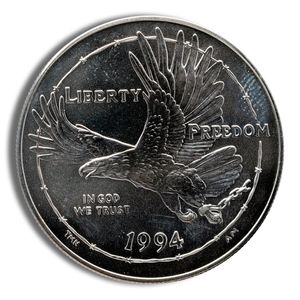
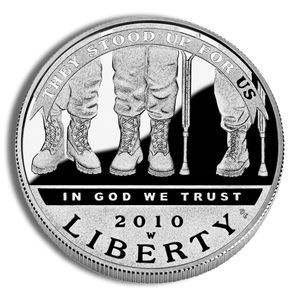
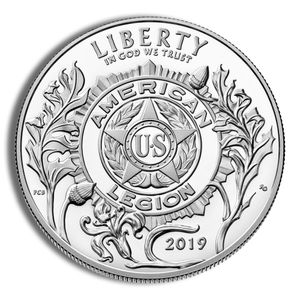
Veterans commemorative coins pay tribute to the men and women who served, and to the memorials, museums and organizations that keep their stories in public view. Our catalog focuses on five U.S. Mint silver dollar programs: the 1994 Prisoner of War, Vietnam Veterans Memorial and Women in Military Service for America Memorial coins, the 2010 American Veterans Disabled for Life dollar, and the 2019 American Legion centennial dollar.
Each program is offered in both of the finishes the Mint produced. The three 1994 coins come as West Point uncirculated strikes and Philadelphia proofs, the 2010 Disabled Veterans dollar is a West Point coin in both uncirculated and proof, and the 2019 American Legion dollar is a Philadelphia coin in both finishes.
You'll see live pricing and the current bid on each product page. With commemoratives, where the gap between what a coin costs and what it brings back varies from one issue to another, that two-sided view helps you choose between programs and finishes with clear numbers in front of you.
What Are Veterans Commemorative Coins?
Where many military coins celebrate a battle, a branch or a service academy, these coins center on the veteran. Their subjects are prisoners of war and the missing, those who served in Vietnam, women in uniform, veterans living with permanent disabilities from their service, and the largest organization formed by veterans of the First World War. Each was authorized by Congress, and a surcharge built into the original issue price went to the memorial or organization being honored.
That funding link is what sets them apart from a souvenir medal. Buying one of these silver dollars from the Mint helped build the Women in Military Service for America Memorial at Arlington, the National Prisoner of War Museum in Georgia and the American Veterans Disabled for Life Memorial in Washington. On the secondary market, the coins keep that connection as part of their history.
Buyers tend to fall into a few groups: veterans and their families marking a personal connection, collectors assembling modern U.S. commemoratives by year or theme, and people looking for a meaningful gift for a retirement, homecoming or Veterans Day. The choice between proof and uncirculated versions lets each buyer weigh appearance against price.
History and Background
The year 1994 was unusual in U.S. commemorative history because the Mint issued three veterans' silver dollars at once. Collectors often call them the 1994 veterans set, and they were frequently bought together. The Prisoner of War dollar raised funds for the National Prisoner of War Museum at Andersonville National Historic Site in Georgia, site of a notorious Civil War prison camp, and the museum opened later that decade.
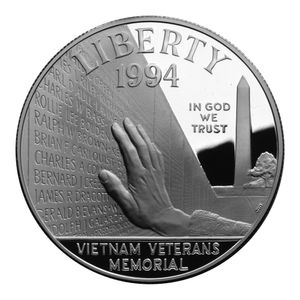
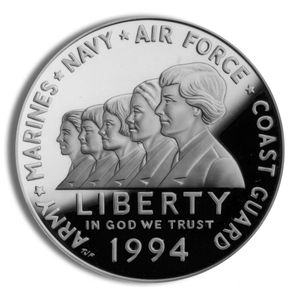
The Vietnam Veterans Memorial dollar supported the memorial in Washington, D.C., dedicated in 1982, and its obverse shows a hand reaching out to touch names on the Wall. The Women in Military Service dollar helped fund the Women in Military Service for America Memorial at the ceremonial entrance to Arlington National Cemetery, which was dedicated in 1997 to honor women who have served in every branch and era.
The theme returned in 2010 with the American Veterans Disabled for Life silver dollar, whose surcharges went toward a memorial near the U.S. Capitol that was dedicated in 2014. Its reverse carries forget-me-not flowers, a symbol of remembrance. In 2019 the Mint marked the centennial of the American Legion, founded by veterans of the American Expeditionary Forces in Paris in 1919 and chartered by Congress later that year, with a program that included a silver dollar.
Purity, Weight, and Specifications
The 1994 and 2010 dollars are struck to the traditional U.S. commemorative silver dollar standard: 26.73 grams of 90% silver and 10% copper, carrying 0.7734 troy ounces of pure silver. Our listings show that 0.7734 oz figure as the weight, but it's the silver content rather than the total weight of the coin.
The 2019 American Legion dollar was struck after the Mint moved its silver commemorative dollars to .999 fine silver, keeping the same 26.73 gram weight, so it holds somewhat more pure silver than the earlier coins. Every coin here has a face value of one dollar and is U.S. legal tender, though that denomination has nothing to do with its market price.
None of these dollars states its weight or purity in the design, as bullion coins typically do. Their identifying marks are the date, the mint mark and the program's inscriptions, and on these coins the mint mark doubles as a guide to finish, as the next section explains.
Available Brands, Mints, and Product Variations
All ten coins in our veterans selection are U.S. Mint issues, and they divide neatly by program and finish. For each of the three 1994 coins, the W mint mark identifies the uncirculated version struck at West Point and the P mark identifies the proof from Philadelphia. That pattern makes it easy to tell at a glance which version of the Prisoner of War, Vietnam Veterans Memorial or Women in Military Service dollar you're looking at.
The 2010 Disabled Veterans dollar breaks that rule, since West Point struck both the uncirculated and proof coins and both carry the W. The 2019 American Legion dollar is the reverse case, with both finishes struck at Philadelphia and bearing the P. For those two programs, the finish itself is the giveaway: proofs have deeply mirrored fields with frosted designs, while uncirculated coins have an even satin surface.
Several listing titles combine "Proof" with "BU", which can be confusing. A coin listed as a proof is a proof, and one listed as BU without "Proof" is an uncirculated strike. Collectors who want a complete 1994 trio in one finish, or a matched proof and uncirculated pair from a single program, can build either from the coins here.
Pricing, Premiums, and Market Factors
These are collector coins, and they sell at collector premiums above their silver value rather than near spot. Silver content sets a floor, but most of what separates one veterans dollar from another comes from numismatic factors that have little to do with the metals market.
Mintage leads the list. In the 1994 programs, the West Point uncirculated coins were struck in far smaller numbers than the Philadelphia proofs, and that difference shows up in pricing for collectors who want the scarcer version. Condition and grade come next, since spots, hairlines or toning on a raw coin lower its appeal, and the finish matters on its own because proof and uncirculated coins attract different buyers.
Packaging and subject round it out. A coin in its original government packaging, with the Mint box and certificate of authenticity, is generally more desirable than a loose coin, and demand for the subject, whether that's Vietnam service, women veterans or the American Legion, moves premiums independently of silver. Comparing the ask and bid on each product page shows you how wide the spread is on the specific coin you're considering.
Condition, Packaging, and What to Expect
Our veterans dollars are original U.S. Mint coins that were never released into circulation. Uncirculated examples show a satin luster, while proofs have mirrored backgrounds that make fingerprints and hairlines more visible, so proofs should be handled only in their capsules.
Most of these coins are now decades old, and light toning or small spots can develop even in sealed capsules, so expect some variation in appearance from coin to coin. The Mint originally sold each one in a capsule with a presentation box and certificate of authenticity. Whether a particular coin ships with its original box and certificate is noted on the listing, so check before you order if complete packaging is important to you.
If you're buying the 1994 coins as a group, keep in mind that the West Point uncirculated and Philadelphia proof versions look quite different side by side. Matching finishes across all three gives the most uniform display, while mixing them is a reasonable way to manage cost.
Authenticity and Verification
Each coin is inspected before it ships to confirm that the date, mint mark and finish match the listing you ordered. We buy from established wholesalers and distributors, not anonymous sellers, which keeps provenance clear from the start.
A few simple checks help with any commemorative silver dollar. The coin's weight should match the 26.73 gram standard, the mint mark should sit where it belongs for that design, and the fine details of the design should be crisp rather than soft or mushy. The Mint's certificate of authenticity, when present, ties the coin to its original issue, and as an authorized PCGS and NGC dealer we can point you toward certification if you'd like a coin independently graded.
Liquidity and Resale Considerations
The 1994 proofs were issued in substantial numbers and change hands often enough that dealers can price them without much difficulty. The lower mintage uncirculated versions and the 2010 and 2019 coins have smaller, more collector-driven markets, which can mean a slightly longer search for the right buyer at a given price.
Complete packaging and good surfaces make any of these coins easier to sell. A coin in its original box with its certificate is simpler to describe and price than a loose one, and keeping the three 1994 coins together as a matched set can broaden their appeal to collectors who want all three.
Timing plays a role as well. Interest in veterans coins often picks up around Veterans Day, Memorial Day and milestone anniversaries of the organizations behind them, but those shifts are modest and hard to predict. It's more useful to buy the coin you want for its own sake and treat the bid on our product pages as an honest snapshot of today's market.
Storage and Security
Leave proof coins in their original capsules, which seal out air and keep the mirrored fields from being touched. If you're keeping the Mint boxes, store them flat and dry, because the boxes and certificates are part of what you'd hand a buyer later.
A cool, dry spot with stable temperature slows toning on 90% silver, and keeping coins away from rubber, PVC flips, wood cabinets and household cleaners avoids the chemical exposure that causes spotting. Small collections fit easily in a home safe, while a bank safe deposit box offers more protection for larger groups. Photograph each coin and record its date and mint mark for insurance.
Selling and Buyback Options
When you're ready to sell, our two-way marketplace lets you sell veterans dollars back to the same dealer you bought them from. The bid on each product page gives you a reference point, and our purchasing team handles price confirmation, inspection and payment.
Bids depend on the program and finish, the coin's condition, whether the original box and certificate are included, and current collector demand. For the .900 silver coins and the .999 American Legion dollar alike, silver prices form only part of the equation, so a coin in excellent condition with full packaging will typically receive a stronger bid than a loose or spotted example.
Why Buy Veterans Commemorative Coins?
These coins carry meaning that bullion can't. A Women in Military Service dollar recognizes servicewomen of every era, whose service had no major national memorial of its own until the 1990s, and a Disabled Veterans dollar acknowledges service whose cost continues long after discharge. For many families, a coin like this marks a specific person's service in a way a plaque or certificate doesn't.
They're also practical collectibles. Ten coins across five programs is a manageable set to complete, the mint marks make proof and uncirculated versions easy to tell apart, and each coin contains a known quantity of silver. As government-issued U.S. legal tender, they carry a recognized origin that private medals can't match.
Why Buy from Bullion Standard?
We've been buying and selling precious metals since 2010 from our base in San Diego, California, and our approach rests on a simple belief: you get one chance to earn a customer's trust. With collector coins like these, that means describing finish, packaging and condition plainly so you know exactly what you're getting.
Bullion Standard is an authorized PCGS and NGC dealer with an A+ Better Business Bureau rating and memberships in the American Numismatic Association and the National Coin and Bullion Association. Checkout accepts major credit cards, PayPal, bank payments through Plaid, wire, check and cryptocurrency through BitPay. Since we also buy coins back, the bid you see on our pages is part of a working two-way market, and our product research tools let you compare premiums and spreads side by side.
Get Near-Spot Pricing with Bullion Standard Pro
Bullion Standard Pro opens up live, executable wholesale bid and ask pricing with no added dealer markup or dealer spread. Rather than a fixed retail price list, members see prices that move with real wholesale supply and demand across a broad range of precious metals products.
For commemoratives, that doesn't erase the collector premium, but it shows you exactly where that premium sits in the wholesale market. Pro members can value their holdings at live wholesale bid, track historical premiums and spreads, and use liquidity data to see how actively a coin trades, which is useful context for anyone buying veterans coins regularly or paying close attention to cost.


 (833) 278-4653