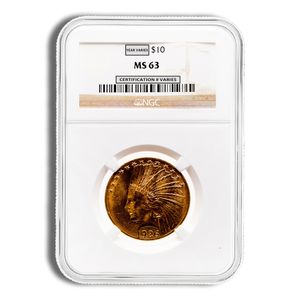
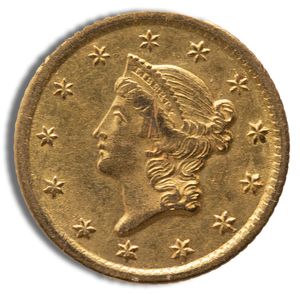
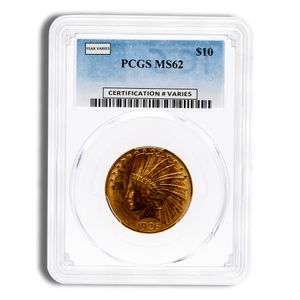
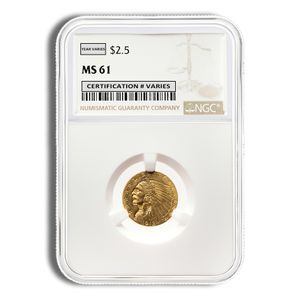
The $1 Gold Indian Head Type 3 is a nineteenth-century United States gold coin struck in .900 fine gold, weighing 0.0483 troy ounces. Issued by the United States Mint, it represents the final and most refined iteration of the small-format gold dollar series, distinguished by a larger portrait head that addressed earlier design criticisms. The examples we offer are graded MS62 by NGC, meaning each coin has been independently authenticated, evaluated, and encapsulated in a tamper-evident holder. Because these are designated as random year, the specific date will vary based on available inventory, though all coins fall within the Type 3 production window.
These are genuine nineteenth-century U.S. Mint coins, not modern reproductions, and they carry the historical weight of a denomination that circulated during a transformative era in American monetary history. For collectors and buyers focused on early American gold coinage, the MS62 grade represents solid circulated-to-uncirculated quality with visible luster and only minor surface imperfections consistent with the grade.
History and Background
The gold dollar series was introduced by the United…
Overview of $1 Gold Indian Type 3
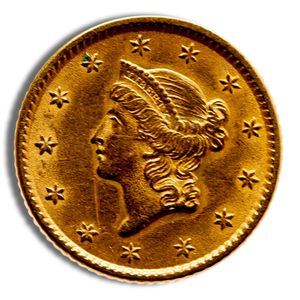
The $1 Gold Indian Head Type 3 is a nineteenth-century United States gold coin struck in .900 fine gold, weighing 0.0483 troy ounces. Issued by the United States Mint, it represents the final and most refined iteration of the small-format gold dollar series, distinguished by a larger portrait head that addressed earlier design criticisms. The examples we offer are graded MS62 by NGC, meaning each coin has been independently authenticated, evaluated, and encapsulated in a tamper-evident holder. Because these are designated as random year, the specific date will vary based on available inventory, though all coins fall within the Type 3 production window.
These are genuine nineteenth-century U.S. Mint coins, not modern reproductions, and they carry the historical weight of a denomination that circulated during a transformative era in American monetary history. For collectors and buyers focused on early American gold coinage, the MS62 grade represents solid circulated-to-uncirculated quality with visible luster and only minor surface imperfections consistent with the grade.
History and Background
The gold dollar series was introduced by the United States Mint in 1849 following the California Gold Rush, which dramatically increased the nation's gold supply and created practical demand for a small-denomination gold coin. The original Type 1 design, featuring a Liberty Head portrait, was struck from 1849 to 1854 but drew widespread criticism for its diminutive size and difficult readability. James Longacre, the Mint's chief engraver, responded with two successive redesigns, culminating in the Type 3 Indian Princess Head in 1856.
The Type 3 design remained in production through 1889, making it the longest-lived of the three gold dollar types. Coins of this series were produced across multiple U.S. Mint facilities, which accounts for the "Various" mint designation on this product. By the time the denomination was discontinued, changing economic conditions and the broader shift in monetary policy had rendered the gold dollar effectively obsolete, but its legacy as an early American gold coin remains well established in numismatic circles.
Design and Aesthetics
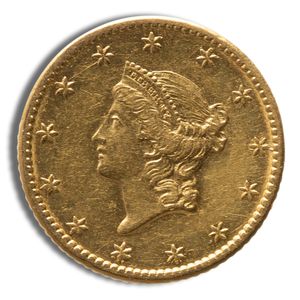
The obverse of the Type 3 gold dollar features a significantly larger portrait of an Indian Princess wearing a feathered headdress compared to the earlier Type 2 iteration. The redesign increased the head's diameter to improve legibility and visual impact within the coin's small format, resulting in a portrait that reads clearly even at roughly 15 millimeters in diameter. The word "LIBERTY" is inscribed across the headband, and the date appears at the bottom of the obverse field.
The reverse depicts a simple wreath encircling the denomination "1 DOLLAR" along with the year in some configurations, rendered with fine engraving detail. The overall composition balances classical American numismatic style with the technical constraints of the small-diameter gold planchet. In MS62 condition, both sides typically retain significant original mint luster with light abrasions or contact marks that fall within the acceptable range for the grade, giving each coin a distinctly collectible but actively handled appearance.
Fractional Size and Accessibility
At 0.0483 troy ounces of .900 fine gold, the $1 Gold Indian Type 3 is among the smallest gold coins produced by the U.S. Mint, a fact that has practical implications for how buyers approach it. The per-coin cost is lower than larger gold denominations, which makes it possible to acquire genuine nineteenth-century U.S. gold coinage without committing to the price point of a full ounce or even a half ounce.
That said, buyers should understand that small-format gold coins like this one typically carry higher premiums relative to metal content than larger bullion-oriented coins, partly because of their numismatic value and partly because of the production economics of small planchets. The appeal here is not primarily the gold content alone but the combination of historical authenticity, NGC certification, and the collectibility of the Type 3 series within a modest price range.
Authenticity and Product Integrity
Every coin in this listing has been graded and encapsulated by NGC, one of the two most respected third-party grading services in the numismatic industry. NGC certification confirms that the coin is genuine, accurately graded, and free from alterations or cleaning that would affect its numismatic integrity. The hard plastic NGC slab provides tamper-evident protection and includes a label displaying the coin's designation, grade, and certification number, which can be independently verified through NGC's online database.
We are an authorized NGC dealer, which means the coins we list have been handled and evaluated through a recognized and established chain of professional numismatic standards. For a coin of this age and historical significance, third-party certification is particularly meaningful, as it removes the guesswork associated with authentication and grade assessment for pre-twentieth-century U.S. gold coinage.
Condition and Packaging
MS62 is a Mint State grade indicating an uncirculated coin with noticeable contact marks or minor blemishes that prevent it from achieving a higher grade. The coin will show original mint luster, but that luster may be partially obscured or interrupted by bag marks and surface abrasions consistent with how coins were handled and stored during and after production. At MS62, the overall eye appeal remains strong relative to circulated examples, and the designation confirms no signs of cleaning, artificial enhancement, or post-mint damage.
Because these coins are NGC-graded, each example ships individually within its sealed NGC plastic slab. There is no additional protective flip required or added, as the certification holder itself serves as the packaging. The NGC slab protects the coin from physical contact and environmental exposure while allowing full examination of both sides through the clear encapsulation.
Pricing and Market Factors
Pricing for NGC-graded $1 Gold Indian Type 3 coins reflects both the underlying gold spot price and a numismatic premium that goes well beyond what the metal content alone would command. The gold content of 0.0483 troy ounces contributes a baseline, but the primary pricing driver for coins of this type is collector demand, historical scarcity, and the specific grade assigned by NGC. MS62 examples are more common than higher-grade survivors but considerably scarcer than lower circulated grades, which places them at a meaningful premium within the series.
Year-to-year collector interest, broader rare coin market conditions, and the availability of certified examples at auction all influence what buyers pay in the current market. Our pricing reflects real-time conditions and is structured to give buyers a clear picture of what they are paying relative to market activity rather than obscuring value behind opaque markups.
Selling and Liquidity
The $1 Gold Indian Type 3 in NGC MS62 occupies a recognized position within the U.S. type coin market, which means it has an established collector base and a relatively consistent resale environment through dealers, auction houses, and private sales. NGC certification significantly improves liquidity compared to raw, ungraded examples of the same coin, because buyers can transact with confidence in the grade and authenticity without requiring their own expert evaluation.
We operate a two-way market that supports both purchasing and selling through competitive buyback pricing, and we encourage buyers to think about the liquidity side of any purchase before completing a transaction. Understanding how a coin like this trades at different grade levels and across different market cycles is part of making a well-informed acquisition decision, and our platform is designed to support that kind of thinking.
Why Buy the $1 Gold Indian Type 3 NGC MS62?
The appeal of the Type 3 gold dollar in MS62 comes from the combination of genuine historical significance, NGC certification, and a price point that remains accessible relative to larger certified gold coins. This is a nineteenth-century U.S. Mint product with a design history that collectors actively study and pursue, and MS62 represents a grade where strong luster and collector-grade eye appeal are present without the premium associated with gems at MS64 and above.
For buyers building a type set of U.S. gold coinage, the Type 3 gold dollar is a required inclusion, and certified examples like these simplify the acquisition process considerably. The random year format means the specific date will vary, but every example falls within the authentic Type 3 production run, making it a straightforward way to add a certified piece of early American gold history to a collection without hunting individual auction records for a specific date.
Why Buy from Bullion Standard?
We have been operating as a trusted precious metals and numismatic dealer since 2010, and our commitment to transparency, accurate product representation, and long-term customer relationships defines how we approach every sale. As authorized dealers for both NGC and PCGS, we maintain direct professional relationships with the leading grading services, which matters when it comes to certified coins like this one. Our A rating with the Better Business Bureau and membership in both the American Numismatic Association and the National Coin and Bullion Association reflect a long-standing commitment to professional standards.
Our pricing is structured around real-time market conditions rather than static retail markups, and we display bid/ask spreads on product pages so buyers can evaluate the true cost of ownership from both directions. Whether you are purchasing for a collection or thinking about eventual resale, we believe you should have the information needed to make that decision confidently before the transaction is complete.
Get Near-Spot Pricing with Bullion Standard Pro
Bullion Standard Pro gives members access to live, executable wholesale bid and ask pricing across our catalog, including certified numismatic coins like the $1 Gold Indian Type 3. For buyers who are active in the rare coin and certified gold market, having real-time visibility into wholesale pricing provides meaningful context for evaluating where current retail premiums stand relative to actual market conditions. Pro members can also access historical premium data and proprietary analytics that help frame where a specific product sits within its own pricing range over time.
Portfolio valuation through Pro uses live wholesale bid pricing rather than estimated retail values, which gives certified coin holders a more grounded view of current liquidation value. For coins like this one, where premiums above melt are driven by numismatic demand rather than metal content, understanding how that premium moves relative to the broader market is the kind of information Pro is built to surface.
Flexible and Secure Payment Options
We support a broad range of payment methods to make the purchasing process straightforward and secure regardless of how you prefer to transact. Accepted payment options include Visa, Mastercard, American Express, and Discover credit cards, along with PayPal, bank-connected payments through Plaid, wire transfer, paper check, and cryptocurrency payments processed through BitPay. Each method is handled through a secure transaction environment, and our checkout process is designed to give buyers confidence at every step. If you have questions about payment options or need assistance completing a purchase, our customer support team is available to help.
The $1 Gold Indian Head Type 3 is a nineteenth-century United States gold coin struck in .900 fine gold, weighing 0.0483 troy ounces. Issued by the United States Mint, it represents the final and most refined iteration of the small-format gold dollar series, distinguished by a larger portrait head that addressed earlier design criticisms. The examples we offer are graded MS62 by NGC, meaning each coin has been independently authenticated, evaluated, and encapsulated in a tamper-evident holder. Because these are designated as random year, the specific date will vary based on available inventory, though all coins fall within the Type 3 production window.
These are genuine nineteenth-century U.S. Mint coins, not modern reproductions, and they carry the historical weight of a denomination that circulated during a transformative era in American monetary history. For collectors and buyers focused on early American gold coinage, the MS62 grade represents solid circulated-to-uncirculated quality with visible luster and only minor surface imperfections consistent with the grade.
History and Background
The gold dollar series was introduced by the United…
Overview of $1 Gold Indian Type 3
The $1 Gold Indian Head Type 3 is a nineteenth-century United States gold coin struck in .900 fine gold, weighing 0.0483 troy ounces. Issued by the United States Mint, it represents the final and most refined iteration of the small-format gold dollar series, distinguished by a larger portrait head that addressed earlier design criticisms. The examples we offer are graded MS62 by NGC, meaning each coin has been independently authenticated, evaluated, and encapsulated in a tamper-evident holder. Because these are designated as random year, the specific date will vary based on available inventory, though all coins fall within the Type 3 production window.
These are genuine nineteenth-century U.S. Mint coins, not modern reproductions, and they carry the historical weight of a denomination that circulated during a transformative era in American monetary history. For collectors and buyers focused on early American gold coinage, the MS62 grade represents solid circulated-to-uncirculated quality with visible luster and only minor surface imperfections consistent with the grade.
History and Background
The gold dollar series was introduced by the United States Mint in 1849 following the California Gold Rush, which dramatically increased the nation's gold supply and created practical demand for a small-denomination gold coin. The original Type 1 design, featuring a Liberty Head portrait, was struck from 1849 to 1854 but drew widespread criticism for its diminutive size and difficult readability. James Longacre, the Mint's chief engraver, responded with two successive redesigns, culminating in the Type 3 Indian Princess Head in 1856.
The Type 3 design remained in production through 1889, making it the longest-lived of the three gold dollar types. Coins of this series were produced across multiple U.S. Mint facilities, which accounts for the "Various" mint designation on this product. By the time the denomination was discontinued, changing economic conditions and the broader shift in monetary policy had rendered the gold dollar effectively obsolete, but its legacy as an early American gold coin remains well established in numismatic circles.
Design and Aesthetics
The obverse of the Type 3 gold dollar features a significantly larger portrait of an Indian Princess wearing a feathered headdress compared to the earlier Type 2 iteration. The redesign increased the head's diameter to improve legibility and visual impact within the coin's small format, resulting in a portrait that reads clearly even at roughly 15 millimeters in diameter. The word "LIBERTY" is inscribed across the headband, and the date appears at the bottom of the obverse field.
The reverse depicts a simple wreath encircling the denomination "1 DOLLAR" along with the year in some configurations, rendered with fine engraving detail. The overall composition balances classical American numismatic style with the technical constraints of the small-diameter gold planchet. In MS62 condition, both sides typically retain significant original mint luster with light abrasions or contact marks that fall within the acceptable range for the grade, giving each coin a distinctly collectible but actively handled appearance.
Fractional Size and Accessibility
At 0.0483 troy ounces of .900 fine gold, the $1 Gold Indian Type 3 is among the smallest gold coins produced by the U.S. Mint, a fact that has practical implications for how buyers approach it. The per-coin cost is lower than larger gold denominations, which makes it possible to acquire genuine nineteenth-century U.S. gold coinage without committing to the price point of a full ounce or even a half ounce.
That said, buyers should understand that small-format gold coins like this one typically carry higher premiums relative to metal content than larger bullion-oriented coins, partly because of their numismatic value and partly because of the production economics of small planchets. The appeal here is not primarily the gold content alone but the combination of historical authenticity, NGC certification, and the collectibility of the Type 3 series within a modest price range.
Authenticity and Product Integrity
Every coin in this listing has been graded and encapsulated by NGC, one of the two most respected third-party grading services in the numismatic industry. NGC certification confirms that the coin is genuine, accurately graded, and free from alterations or cleaning that would affect its numismatic integrity. The hard plastic NGC slab provides tamper-evident protection and includes a label displaying the coin's designation, grade, and certification number, which can be independently verified through NGC's online database.
We are an authorized NGC dealer, which means the coins we list have been handled and evaluated through a recognized and established chain of professional numismatic standards. For a coin of this age and historical significance, third-party certification is particularly meaningful, as it removes the guesswork associated with authentication and grade assessment for pre-twentieth-century U.S. gold coinage.
Condition and Packaging
MS62 is a Mint State grade indicating an uncirculated coin with noticeable contact marks or minor blemishes that prevent it from achieving a higher grade. The coin will show original mint luster, but that luster may be partially obscured or interrupted by bag marks and surface abrasions consistent with how coins were handled and stored during and after production. At MS62, the overall eye appeal remains strong relative to circulated examples, and the designation confirms no signs of cleaning, artificial enhancement, or post-mint damage.
Because these coins are NGC-graded, each example ships individually within its sealed NGC plastic slab. There is no additional protective flip required or added, as the certification holder itself serves as the packaging. The NGC slab protects the coin from physical contact and environmental exposure while allowing full examination of both sides through the clear encapsulation.
Pricing and Market Factors
Pricing for NGC-graded $1 Gold Indian Type 3 coins reflects both the underlying gold spot price and a numismatic premium that goes well beyond what the metal content alone would command. The gold content of 0.0483 troy ounces contributes a baseline, but the primary pricing driver for coins of this type is collector demand, historical scarcity, and the specific grade assigned by NGC. MS62 examples are more common than higher-grade survivors but considerably scarcer than lower circulated grades, which places them at a meaningful premium within the series.
Year-to-year collector interest, broader rare coin market conditions, and the availability of certified examples at auction all influence what buyers pay in the current market. Our pricing reflects real-time conditions and is structured to give buyers a clear picture of what they are paying relative to market activity rather than obscuring value behind opaque markups.
Selling and Liquidity
The $1 Gold Indian Type 3 in NGC MS62 occupies a recognized position within the U.S. type coin market, which means it has an established collector base and a relatively consistent resale environment through dealers, auction houses, and private sales. NGC certification significantly improves liquidity compared to raw, ungraded examples of the same coin, because buyers can transact with confidence in the grade and authenticity without requiring their own expert evaluation.
We operate a two-way market that supports both purchasing and selling through competitive buyback pricing, and we encourage buyers to think about the liquidity side of any purchase before completing a transaction. Understanding how a coin like this trades at different grade levels and across different market cycles is part of making a well-informed acquisition decision, and our platform is designed to support that kind of thinking.
Why Buy the $1 Gold Indian Type 3 NGC MS62?
The appeal of the Type 3 gold dollar in MS62 comes from the combination of genuine historical significance, NGC certification, and a price point that remains accessible relative to larger certified gold coins. This is a nineteenth-century U.S. Mint product with a design history that collectors actively study and pursue, and MS62 represents a grade where strong luster and collector-grade eye appeal are present without the premium associated with gems at MS64 and above.
For buyers building a type set of U.S. gold coinage, the Type 3 gold dollar is a required inclusion, and certified examples like these simplify the acquisition process considerably. The random year format means the specific date will vary, but every example falls within the authentic Type 3 production run, making it a straightforward way to add a certified piece of early American gold history to a collection without hunting individual auction records for a specific date.
Why Buy from Bullion Standard?
We have been operating as a trusted precious metals and numismatic dealer since 2010, and our commitment to transparency, accurate product representation, and long-term customer relationships defines how we approach every sale. As authorized dealers for both NGC and PCGS, we maintain direct professional relationships with the leading grading services, which matters when it comes to certified coins like this one. Our A rating with the Better Business Bureau and membership in both the American Numismatic Association and the National Coin and Bullion Association reflect a long-standing commitment to professional standards.
Our pricing is structured around real-time market conditions rather than static retail markups, and we display bid/ask spreads on product pages so buyers can evaluate the true cost of ownership from both directions. Whether you are purchasing for a collection or thinking about eventual resale, we believe you should have the information needed to make that decision confidently before the transaction is complete.
Get Near-Spot Pricing with Bullion Standard Pro
Bullion Standard Pro gives members access to live, executable wholesale bid and ask pricing across our catalog, including certified numismatic coins like the $1 Gold Indian Type 3. For buyers who are active in the rare coin and certified gold market, having real-time visibility into wholesale pricing provides meaningful context for evaluating where current retail premiums stand relative to actual market conditions. Pro members can also access historical premium data and proprietary analytics that help frame where a specific product sits within its own pricing range over time.
Portfolio valuation through Pro uses live wholesale bid pricing rather than estimated retail values, which gives certified coin holders a more grounded view of current liquidation value. For coins like this one, where premiums above melt are driven by numismatic demand rather than metal content, understanding how that premium moves relative to the broader market is the kind of information Pro is built to surface.
Flexible and Secure Payment Options
We support a broad range of payment methods to make the purchasing process straightforward and secure regardless of how you prefer to transact. Accepted payment options include Visa, Mastercard, American Express, and Discover credit cards, along with PayPal, bank-connected payments through Plaid, wire transfer, paper check, and cryptocurrency payments processed through BitPay. Each method is handled through a secure transaction environment, and our checkout process is designed to give buyers confidence at every step. If you have questions about payment options or need assistance completing a purchase, our customer support team is available to help.
This website uses cookies for analytics and to deliver personalized content. By continuing to
use our site, you acknowledge that you have read and agree to our Privacy Policy and Cookie
Policy.
Current Quantities Available
Unfortunately, we only have 0
of
this item in
stock.
Please call us at (833) 278-4653
or email us at support@bullionstandard.com
if you wish to purchase a larger quantity than what is available on our website.
We can often locate additional quantities.

 (833) 278-4653


.png)