Overview of $1 Gold Indian Type 3
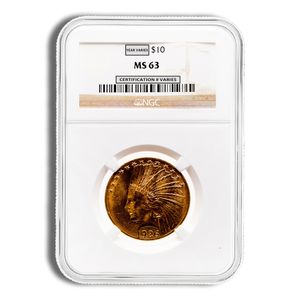
The $1 Gold Indian Type 3 is a nineteenth-century United States gold coin struck in .900 fine gold and weighing approximately 0.0483 troy ounces. Produced by the United States Mint, these coins were issued between 1856 and 1889, making them among the final small-denomination gold pieces ever struck for circulation by the federal government. The example offered here carries a PCGS MS62 grade, confirming that it has been authenticated, attributed, and encapsulated by the Professional Coin Grading Service.
We offer this coin as a Random Year piece, meaning the specific date and mint mark will vary based on available inventory. Each example, regardless of year, meets the MS62 standard and ships in a PCGS holder. Buyers focused on the type rather than a specific date will find this an efficient way to acquire a certified, circulation-era gold piece at a straightforward price point.
History and Background
The one-dollar gold coin was authorized by Congress in 1849, initially as a response to the influx of California gold following the discovery at Sutter's Mill. The early Type 1 and Type 2 designs struggled with practical issues related to size and relief, and by 1856 the Mint had refined the series into what collectors now identify as the Type 3. This final design iteration ran continuously until 1889, when Congress discontinued the denomination entirely.
The Type 3 represents the most refined and longest-lived version of the small gold dollar series. Production occurred primarily at the Philadelphia Mint, with some issues from branch mints including Charlotte, Dahlonega, and San Francisco depending on the year. Total mintage figures vary considerably by date, and surviving examples in mint state condition are scarcer than the broadly available bullion coins of the modern era.
The discontinuation of the gold dollar denomination in 1889 marked the end of small-denomination gold coinage in the United States. The series now occupies a distinct place in American numismatic history as both a product of the gold rush era and a reflection of the technical evolution of nineteenth-century coin production at the United States Mint.
Design and Aesthetics
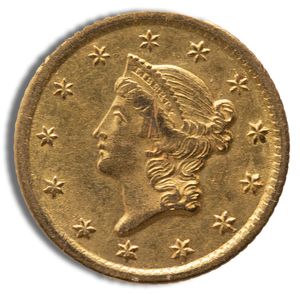
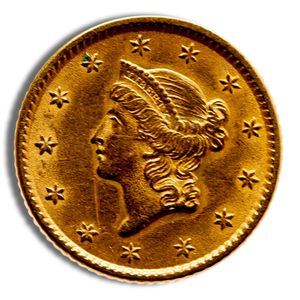
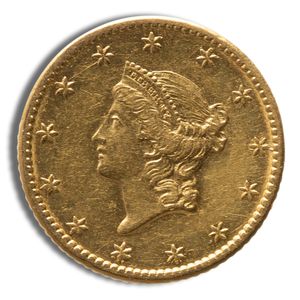
The obverse of the Type 3 gold dollar features a portrait of a Native American princess wearing a feathered headdress, a design attributed to Mint engraver James B. Longacre. The portrait is larger and more refined than the previous Type 2 design, with improved definition in the hair and headdress details. The date appears below the portrait, flanked by stars along the lower rim.
The reverse carries an agricultural wreath encircling the denomination "1 DOLLAR," with the inscription "UNITED STATES OF AMERICA" running along the outer edge. The wreath itself is composed of corn, wheat, cotton, and tobacco, reflecting the agricultural identity of mid-nineteenth-century America. Despite the coin's small physical size, the design elements are well-executed and display clearly on higher-grade examples.
Fractional Size and Accessibility
At roughly half the diameter of a modern dime, the $1 Gold Indian Type 3 is one of the smallest coins ever produced by the United States Mint. Its compact size is a direct consequence of its low face value relative to gold's intrinsic worth during the period of production, and it presents a handling challenge that contributed to the denomination's eventual retirement. Collectors frequently note that the coin's scale amplifies the impression of its craftsmanship, as the detail work achieved at this size reflects the technical skill of nineteenth-century engravers.
From a practical standpoint, the small format makes certified examples easier to store within existing numismatic housing. A PCGS slab holder provides both protection and context, making the coin accessible to buyers who want a tangible piece of early American gold without the space or cost commitment of larger denominations.
Authenticity and Product Integrity
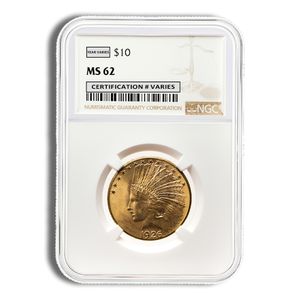
Each coin in this listing has been graded and encapsulated by PCGS, one of the two most widely respected third-party grading services in the numismatic industry. PCGS authentication involves examination by multiple expert graders who confirm the coin's genuineness, weigh and measure the piece against known specifications, and assign a numeric grade on the Sheldon scale before sealing it in a tamper-evident plastic holder. The holder includes a unique certification number that can be verified through the PCGS database.
We are an authorized PCGS dealer, which means we work directly within the grading service's established distribution network. Every certified coin we offer has been handled and stored in a manner consistent with preserving the integrity of the holder and the grade assigned to it. The PCGS slab itself is the primary instrument of authentication for this product, and buyers can verify their specific coin's certification number independently through PCGS's online registry.
Condition and Packaging
MS62 is a mint state grade indicating a fully uncirculated coin with a modest number of contact marks or minor surface distractions that prevent it from achieving a higher numerical designation. At this grade level, the coin retains its original mint luster with no wear on the high points, but closer inspection will reveal some bag marks or light abrasions consistent with handling during or after production. For a nineteenth-century issue, MS62 represents a meaningful level of preservation, and examples at this grade display the design with strong clarity.
This coin ships in its PCGS tamper-evident holder, which serves as both a protective enclosure and a certificate of authenticity. No additional flip or tube packaging applies to certified numismatic pieces of this type. The slab format is standard for graded coins and is widely accepted across the collector and dealer marketplace.
Pricing and Market Factors
Pricing for this coin reflects both the current spot price of gold and the numismatic premium associated with a certified, nineteenth-century United States Mint issue in mint state condition. Because the coin contains only 0.0483 troy ounces of gold, its melt value is relatively modest, and the dominant pricing driver is the numismatic component rather than metal content alone. The PCGS MS62 grade, the age of the series, and the coin's historical significance all contribute to the premium structure above spot.
Because this is offered as a Random Year piece, pricing is calibrated to reflect the range of dates typically available within the Type 3 series at this grade level rather than the premium commanded by specific key dates. Supply of certified examples in MS62 is limited compared to modern bullion issues, and market premiums can shift meaningfully based on collector demand and available inventory within the secondary market. Our pricing reflects current market conditions and is updated in real time as spot prices move.
Selling and Liquidity
The $1 Gold Indian Type 3 in PCGS MS62 trades within both the numismatic collector market and the broader certified gold coin market. PCGS certification significantly supports resale liquidity by providing a universally recognized authentication and grading standard that eliminates the need for buyers to independently assess the coin's condition. Dealers, auction houses, and private collectors all use PCGS grades as a common reference point when pricing and transacting certified coins.
Liquidity for Random Year examples at this grade is generally driven by type collectors rather than date specialists, and the coin's appeal as a certified nineteenth-century gold piece broadens its potential buyer pool beyond purely date-focused numismatists. We operate a two-way market that supports both buying and selling within the same platform, and our competitive buyback pricing is designed to reflect current wholesale market conditions rather than arbitrary markdowns from retail price.
Why Buy the $1 Gold Indian Type 3 PCGS MS62?
A certified Type 3 gold dollar in MS62 offers something that modern bullion coins cannot replicate, specifically a tangible connection to nineteenth-century American coinage at a grade level that reflects genuine preservation rather than circulated survivorship. The combination of PCGS certification, mint state designation, and historical origin makes this a well-defined product with clear grading standards and an established market for both buying and selling.
For buyers interested in early American gold who want the protection of third-party authentication, this coin checks the practical boxes. The PCGS holder removes guesswork about authenticity and condition, the Random Year format keeps the entry price efficient, and the Type 3 design is among the most visually refined small gold coins the United States Mint ever produced.
Why Buy from Bullion Standard?
We are an authorized dealer for both PCGS and NGC, and our work within those grading service networks reflects a commitment to the certified coin market that goes beyond simply listing products. Our A rating with the Better Business Bureau and memberships in the American Numismatic Association and the National Coin and Bullion Association represent an ongoing accountability to professional standards that matter when you are buying certified numismatic material.
Transparent pricing is central to how we operate. Our product pages reflect real-time market pricing with no hidden markups, and our bid/ask spread is displayed openly so buyers can evaluate the complete cost of ownership before committing. We take the same approach to selling, with competitive buyback pricing that reflects current wholesale market conditions. Our goal is a straightforward, trust-based experience from the first page view through delivery and beyond.
Get Near-Spot Pricing with Bullion Standard Pro
Bullion Standard Pro gives members access to live, executable wholesale bid and ask pricing across our product catalog, including certified numismatic pieces like this Type 3 gold dollar. Rather than relying on static retail price points, Pro members can see how premiums and bid/ask spreads for certified coins behave in real time, providing meaningful context for evaluating whether current pricing reflects favorable or elevated market conditions. Portfolio valuation through Pro uses live wholesale bid pricing rather than estimated retail values, which offers a more accurate picture of what holdings would realistically return in the current market.
For buyers who follow the certified gold coin market closely, Pro's proprietary analytics and product research tools allow for direct comparison of premiums, spreads, and liquidity characteristics across products. This kind of data-driven visibility is rarely available in the traditional numismatic dealer environment, and it supports more informed decisions at both the acquisition stage and when evaluating the right time to sell.
Flexible and Secure Payment Options
We support a broad range of payment methods to make the purchasing process straightforward and secure. Accepted options include Visa, Mastercard, American Express, Discover, PayPal, bank-connected payments through Plaid, wire transfer, paper check, and cryptocurrency payments processed through BitPay. Each method is integrated with our secure checkout infrastructure to protect your transaction from start to finish.
Selecting the right payment method can also affect your final cost, as certain options carry different processing considerations. Our checkout process is designed to present these distinctions clearly so you can make the choice that best fits your purchase size and preferences without any ambiguity.

 (833) 278-4653


.png)