Overview of $1 Gold Indian Type 3
The $1 Gold Indian Head Type 3 is a nineteenth-century United States gold coin struck in .900 fine gold with a weight of 0.0483 troy ounces. It carries legal tender status as a product of the United States Mint and represents the final design iteration of the one-dollar gold series, which ran from 1856 through 1889. The piece offered here is graded MS63 by PCGS, certifying it as an uncirculated example with only a small number of contact marks visible under close inspection.
We carry these coins as random-year selections, meaning the specific year will vary based on current inventory. Every coin in this listing shares the same grade, metal composition, and certification standard, so buyers can expect a consistent quality level regardless of which year they receive.
History and Background
The one-dollar gold coin was introduced by the United States Mint in 1849 following the California Gold Rush, which dramatically increased domestic gold supplies. The series evolved through three distinct design types over its forty-year run, with the Type 3 introduced in 1856 as a refined and enlarged version of the earlier Type 2. James Barton Longacre, the Mint's Chief Engraver at the time, was responsible for all three designs.
The Type 3 design addressed practical concerns with the Type 2, which had proven difficult to strike clearly due to its recessed features and narrow planchet. The enlarged diameter introduced in 1856 improved strike quality and made the coins more legible in circulation. Production continued at various United States Mint facilities, including Philadelphia, San Francisco, and others, until the series was discontinued in 1889 following a significant decline in demand.
Today, Type 3 gold dollars occupy an interesting position in American numismatics. They are small enough to be overlooked by casual collectors but historically significant enough to attract serious attention from those focused on nineteenth-century U.S. coinage. Surviving examples in uncirculated condition are far less common than their mintage figures might suggest, as many circulated extensively before being set aside.
Design and Aesthetics
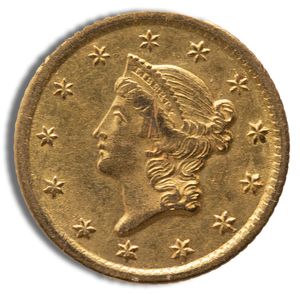
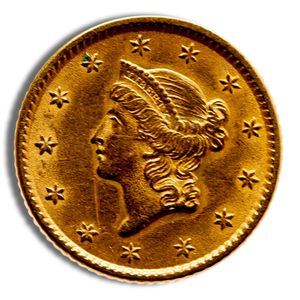
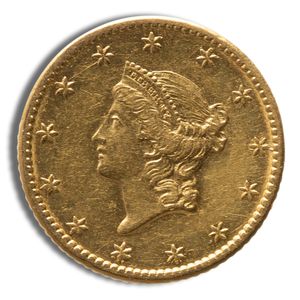
The obverse of the Type 3 gold dollar features a left-facing portrait of a Native American princess wearing a feathered headdress. The design is more refined and larger in scale than the preceding Type 2, with cleaner detail across the facial features and headdress elements. The inscription "UNITED STATES OF AMERICA" arcs around the upper field, and the date appears below the portrait.
The reverse centers on an agricultural wreath encircling the denomination "1 DOLLAR," with the coin's gold composition implied through its context rather than explicitly stated. The overall composition is compact and dense given the small diameter, which makes a well-struck, high-grade example particularly visually striking. On an MS63-graded piece, the design details retain their original luster with only minor surface marks that fall within the range expected for the grade.
Fractional Size and Accessibility
At 0.0483 troy ounces, the $1 Gold Indian Type 3 represents one of the smallest denominations in American coinage history. The physical size of the coin reflects its modest gold content, making it an accessible entry point for those building a collection of nineteenth-century U.S. gold without committing to the weight and premium of larger denominations like the quarter eagle or half eagle.
The compact format also suits collectors who prioritize historical significance and grade over sheer metal content. Because pricing on numismatic pieces like this one is driven more by collector demand and grade than by spot price alone, the fractional gold content is less central to the conversation than it might be for a modern bullion coin.
Authenticity and Product Integrity
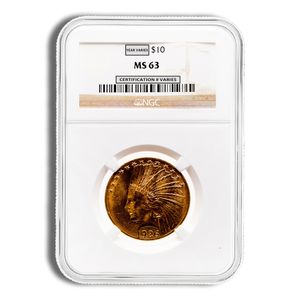
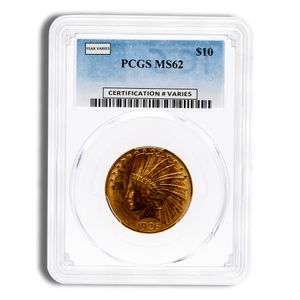
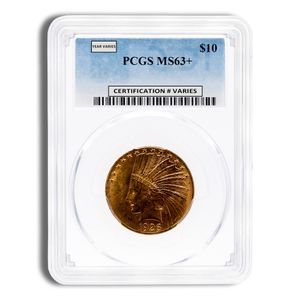
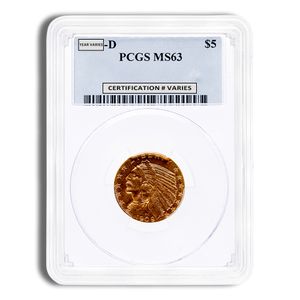
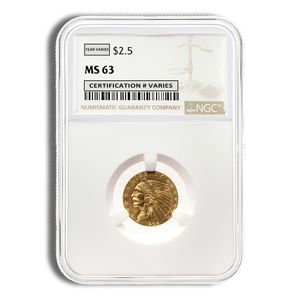
Each coin in this listing is certified by PCGS, the Professional Coin Grading Service, which is one of the two most recognized third-party grading services in the numismatic industry. PCGS encapsulates every graded coin in a tamper-evident, sonically sealed plastic holder that displays the grade, certification number, and coin description. This holder protects the coin from handling and environmental exposure while providing an independently verified record of its condition and authenticity.
We are an authorized PCGS dealer, which means we are held to specific standards in how we represent and sell certified coins. Every PCGS-graded coin we offer has passed through the service's multi-stage authentication and grading process, which cross-references the coin against known examples and checks for cleaning, alterations, and other factors that would affect its numeric grade. Buyers can verify the certification details of any coin we sell directly through the PCGS online registry using the number printed on the holder.
Condition and Packaging
MS63 is an uncirculated grade assigned by PCGS to coins that exhibit full mint luster but show a small number of contact marks or minor blemishes that prevent a higher classification. On a coin of this age and size, an MS63 represents a genuinely well-preserved example. The luster should be intact across most of the surface, with any marks concentrated in less prominent areas of the design.
Because this coin is individually encapsulated in a PCGS slab, it arrives in its certified holder without any additional packaging required to protect the coin itself. The holder serves as both the protective case and the authentication document. Random-year selections are shipped in the slab as received from PCGS, and buyers should expect no difference in condition or presentation based on the year assigned.
Pricing and Market Factors
Pricing on PCGS-graded numismatic coins like the Type 3 gold dollar reflects a combination of the underlying gold content and the collector premium associated with the grade, date, and overall market demand for the series. Unlike modern bullion coins where the premium above spot tends to be the primary variable, the MS63 designation carries its own market-driven value that can move independently of the gold spot price.
Our pricing reflects current wholesale market conditions and the certified grade of each coin, rather than fixed retail markups. Because these are random-year selections, premiums are set based on the overall availability and demand for common-date MS63 Type 3 examples rather than on any specific scarce date or mint mark. Buyers seeking specific dates or exceptional eye appeal may find the numismatic market more nuanced, but for consistent grade and authenticity, the random-year format offers a straightforward option.
Selling and Liquidity
PCGS-certified coins trade within a well-established secondary market supported by auction houses, coin dealers, and online platforms. The MS63 grade on a Type 3 gold dollar is a recognized and commonly traded classification, which supports resale without requiring the buyer to negotiate over the coin's condition or authenticity. The PCGS certification removes much of the friction that can complicate private transactions for raw coins.
We operate a two-way market that allows customers to sell back coins as well as purchase them. Our competitive buyback pricing reflects current wholesale bid levels, giving sellers a realistic picture of what their certified coins can bring in the current market. Understanding the bid side of the transaction before purchasing is a straightforward way to evaluate the full cost of ownership rather than discovering it only when it is time to sell.
Why Buy the $1 Gold Indian Type 3 PCGS MS63?
The Type 3 gold dollar in MS63 occupies a useful position for collectors interested in nineteenth-century American coinage without the significant outlay required for high-grade quarter eagles, half eagles, or eagles. It is a historically grounded coin that carries genuine numismatic significance, certified by PCGS to a standard that makes it immediately tradeable in the secondary market.
The random-year format works well for buyers focused on grade and type rather than a specific date, and it generally offers more competitive pricing than hand-picked date selections. For those building a type set of United States gold coinage, this listing provides a direct path to completing the one-dollar gold section with a properly graded and authenticated example.
Why Buy from Bullion Standard?
We are an authorized PCGS dealer and a member of both the American Numismatic Association and the National Coin and Bullion Association, and we maintain an A rating with the Better Business Bureau. These relationships and credentials reflect a commitment to accurate product representation and consistent professional standards that we hold ourselves to on every transaction, not just when it is convenient.
Our pricing is structured around real-time market conditions rather than static markups. We display both buy and sell pricing so customers can evaluate the full picture before committing to a purchase. The goal is a straightforward experience built around honest pricing, authenticated products, and support that does not disappear after the sale. Every certified coin we sell has been verified for authenticity and condition, and our fulfillment process is designed to deliver it to you in the same condition it left our facility.
Get Near-Spot Pricing with Bullion Standard Pro
Bullion Standard Pro gives members access to live, executable wholesale bid and ask pricing across a broad range of precious metals products, including certified numismatic coins. For a product like the PCGS MS63 Type 3 gold dollar, where premiums are driven by collector demand rather than spot price alone, Pro's proprietary market intelligence tools help members better understand how bid/ask spreads, liquidity, and premium levels have shifted over time relative to comparable graded examples in the market.
Real-time portfolio valuation through Pro uses current wholesale bid pricing rather than estimated retail values, giving members a more accurate picture of what their holdings would bring in the current market. Combined with product research tools that allow direct comparison across the catalog, Pro is designed to reduce the information asymmetry that has traditionally made numismatic pricing less transparent than standard bullion products.
Flexible and Secure Payment Options
We support a wide range of payment methods to make the purchasing process straightforward and secure. Accepted options include Visa, Mastercard, American Express, Discover, PayPal, bank-connected payments through Plaid, wire transfer, paper check, and cryptocurrency via BitPay. Each method is integrated into a secure checkout process designed to protect your transaction and personal information at every step.
Whether you prefer the convenience of a credit card or the efficiency of a wire transfer for larger purchases, the flexibility is there to accommodate how you prefer to transact. Our goal is to remove unnecessary friction from the buying experience while maintaining the security standards that physical precious metals transactions require.

 (833) 278-4653


.png)