The $1 Gold Indian Head Type 3 is one of the most distinctive and compact gold coins produced by the United States Mint, struck from 1856 through 1889. Each coin contains 0.0483 troy ounces of gold at .900 fine purity, giving it a small but tangible physical presence that reflects the monetary standards of the late 19th century. The pieces we carry in this listing have been graded MS64 by PCGS, placing them firmly in the uncirculated tier and making them attractive to collectors who want a grade-worthy example without paying the premium commanded by gem-grade survivors.
Because the specific year within the Type 3 series is selected at random, buyers receive an authentic PCGS-certified coin from one of the production years spanning the series run. Each coin arrives in its original PCGS holder with the assigned grade clearly labeled, ensuring full transparency around condition before the item is ever in hand.
History and Background
The $1 gold coin series has an interesting and somewhat turbulent history within American numismatics. The denomination was introduced in 1849 during the California Gold Rush era, and the initial Type 1 design was quic…
Overview of $1 Gold Indian Type 3
The $1 Gold Indian Head Type 3 is one of the most distinctive and compact gold coins produced by the United States Mint, struck from 1856 through 1889. Each coin contains 0.0483 troy ounces of gold at .900 fine purity, giving it a small but tangible physical presence that reflects the monetary standards of the late 19th century. The pieces we carry in this listing have been graded MS64 by PCGS, placing them firmly in the uncirculated tier and making them attractive to collectors who want a grade-worthy example without paying the premium commanded by gem-grade survivors.
Because the specific year within the Type 3 series is selected at random, buyers receive an authentic PCGS-certified coin from one of the production years spanning the series run. Each coin arrives in its original PCGS holder with the assigned grade clearly labeled, ensuring full transparency around condition before the item is ever in hand.
History and Background
The $1 gold coin series has an interesting and somewhat turbulent history within American numismatics. The denomination was introduced in 1849 during the California Gold Rush era, and the initial Type 1 design was quickly succeeded by the larger-diameter Type 2 in 1854. The Type 2 design proved difficult to strike cleanly and was replaced just two years later by the Type 3 in 1856, which retained the enlarged diameter but refined the design elements to improve strike quality and visual consistency.
The Type 3 design was produced continuously through 1889, when Congress officially eliminated the $1 gold denomination. The Philadelphia, San Francisco, Charlotte, Dahlonega, New Orleans, and other mints all contributed to the series at various points, though production volumes varied considerably by year and mint mark. Some dates are genuinely scarce, while others were struck in sufficient quantities to remain accessible in collector grades today. The series represents the final chapter in American gold dollar coinage, and no subsequent U.S. Mint has revived the denomination in circulation form.
Design and Aesthetics
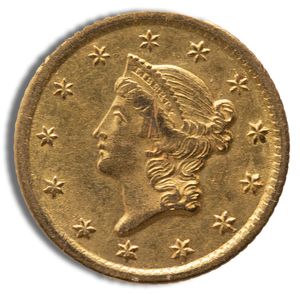
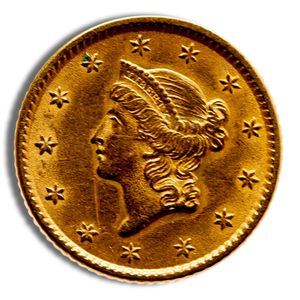
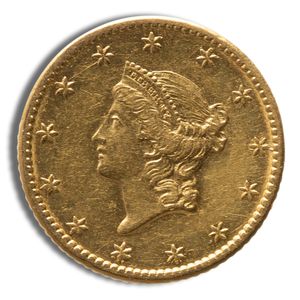
The obverse of the Type 3 features a left-facing portrait of a Native American princess wearing a feathered headdress, a design element that gave the coin its common name. The portrait is rendered with more detail and relief than the earlier Type 2, which was widely criticized for its shallow and often mushy strikes. The word "LIBERTY" appears on the headband, and the date is placed below the portrait, framed by stars. Despite the coin's diminutive size, the engraving carries a level of fine detail that reflects the craftsmanship standards of the era.
The reverse centers on an agricultural wreath encircling the denomination "1 DOLLAR," with "UNITED STATES OF AMERICA" inscribed around the border. The wreath incorporates elements including corn, wheat, and other crops, giving the reverse a refined and balanced composition. At MS64, the coin retains nearly full luster with only minor surface imperfections that fall just short of the gem threshold, making the visual presentation noticeably sharp and well-preserved relative to circulated examples.
Fractional Size and Accessibility
At 0.0483 troy ounces, the $1 Gold Indian Type 3 occupies the smallest tier of American gold coinage. That compact size makes it an accessible entry point for collectors who want a certified, uncirculated example of 19th-century U.S. gold without committing to the capital required for larger denominations. The physical coin itself is notably small compared to modern bullion products, which adds to its historical character and makes it a natural fit for type sets focused on U.S. gold coinage.
The small gold content also means that pricing is driven more by numismatic demand and collector grade than by the underlying metal value alone. Buyers approaching this coin purely from a gold content perspective will find the premium significant, but those focused on the certified grade and historical significance will find the MS64 designation a meaningful qualifier within the Type 3 series.
Authenticity and Product Integrity
Every coin in this listing has been graded and encapsulated by PCGS, one of the two most widely respected third-party grading services in the numismatic industry. PCGS authentication involves a rigorous examination of the coin's strike, surface preservation, luster, and eye appeal by professional numismatists before the grade is assigned and the coin is sealed in a tamper-evident holder. That process eliminates ambiguity around authenticity and condition, which is especially important for 19th-century U.S. gold coins that have existed in the market long enough to encounter cleaning, alterations, or outright counterfeits.
We are an authorized PCGS dealer, which gives us access to certified inventory through professional channels and reinforces our commitment to offering only authenticated, properly graded material. Every coin we carry is verified before it reaches a customer, and the PCGS holder itself serves as the primary assurance of both metal composition and grade integrity.
Condition and Packaging
An MS64 grade from PCGS indicates an uncirculated coin with above-average mint luster and only a small number of minor contact marks or light surface imperfections. The coin will not show wear on the high points, but it will fall just short of the gem MS65 tier due to some visible, if slight, post-mint contact. For a coin series that dates to the 1850s through 1880s, an MS64 survivor represents a well-preserved specimen that has avoided both circulation and significant handling over more than a century.
Each coin arrives encapsulated in its original PCGS plastic slab, which provides secure physical protection and permanently documents the grade assigned. Because these are individually graded collectibles rather than standard bullion units, packaging is determined by the slab format rather than tubes or boxes. The PCGS holder also protects the coin from environmental exposure while keeping it fully visible, which is the standard presentation for certified numismatic material.
Pricing and Market Factors
Pricing on this coin reflects both the current spot price of gold and the numismatic premium attached to the specific grade, series, and condition. Because the gold content is small at 0.0483 troy ounces, the numismatic component of the price carries more weight here than it would on a larger bullion coin. The MS64 grade from PCGS commands a measurable premium above raw or problem examples of the same date, and that premium reflects the certified authenticity, confirmed condition, and collector demand associated with PCGS-graded U.S. gold.
Market pricing for graded 19th-century gold can also respond to broader collector market trends, auction results, and changes in the supply of certified examples at specific grade levels. Because the year within the Type 3 series is assigned at random, buyers should expect pricing to reflect average MS64 Type 3 values rather than the specific date premium that scarcer issues might command. Our pricing is structured to reflect real-time market conditions transparently, with no hidden markups applied after the fact.
Selling and Liquidity
The $1 Gold Indian Type 3 in certified MS64 condition trades in an active collector market supported by major auction platforms, dealer networks, and type set collectors who need one representative example from this series. PCGS certification significantly improves liquidity by removing the uncertainty around authenticity and grade that buyers in raw coin transactions must navigate. A slab from a recognized grading service like PCGS allows the coin to move efficiently between buyers and sellers who agree on the grade without needing to independently verify the coin.
We operate a two-way market that supports both purchasing and selling within the same platform. Customers considering a sale can access competitive buyback pricing rather than having to seek out third-party buyers through unfamiliar channels. Understanding the resale side of any numismatic purchase before committing is something we actively encourage, and our model is built to support both sides of that transaction.
Why Buy the $1 Gold Indian Type 3 in PCGS MS64?
This coin sits at a practical intersection of historical significance, certified quality, and relative accessibility within the $1 gold series. An MS64 is a meaningful grade for a 19th-century American gold coin, offering strong visual appeal and verified authenticity without reaching into the substantially higher price territory of gem MS65 and above examples. For collectors assembling a type set of U.S. gold coinage, a PCGS MS64 Type 3 satisfies the requirement with a coin that presents well and carries recognized credentialing.
The PCGS holder removes the principal risks associated with buying antique gold coins through less formal channels, namely uncertainty about authenticity and disagreement over condition. Buyers who prioritize verified grade and confirmed metal content will find the slab format more reliable than purchasing raw examples and assessing condition independently. For a coin that exists in a collector market where cleaned or altered examples are not uncommon, third-party certification from PCGS carries real practical value.
Why Buy from Bullion Standard?
We have been active in the precious metals and numismatic market since 2010, and our approach has always centered on transparency, verified authenticity, and pricing that reflects actual market conditions. Our A rating with the Better Business Bureau and our membership in both the American Numismatic Association and the National Coin and Bullion Association reflect a consistent standard of professionalism that we hold ourselves to on every transaction. As an authorized PCGS dealer, we have access to certified inventory through recognized professional channels and carry coins that meet the authentication standards buyers expect when purchasing numismatic material.
Our model is built around honest pricing and a two-way market that treats selling as seriously as buying. We do not operate as a one-direction retail outlet that maximizes the spread between acquisition and resale. Customers who want to understand both sides of a numismatic purchase before committing will find our platform designed to support that kind of informed decision-making. Our fulfillment process is reliable, our customer support team is knowledgeable about the products we carry, and our transactions are secured by processes that prioritize both data security and product integrity.
Get Near-Spot Pricing with Bullion Standard Pro
Bullion Standard Pro gives members access to live, executable wholesale bid and ask pricing across our catalog, including graded numismatic material like the $1 Gold Indian Type 3. For a coin where the numismatic premium above spot plays a more significant role than the gold content alone, having real-time visibility into wholesale market pricing helps members understand exactly what they are paying relative to current market conditions rather than relying on static retail price lists. Pro also provides real-time portfolio valuation using live wholesale bid pricing, which reflects actual liquidation values rather than estimated retail figures.
Beyond pricing transparency, Pro members can access proprietary research and comparison tools that allow products to be evaluated side by side using metrics including premiums, historical premium data, bid/ask spreads, and liquidity characteristics. For numismatic buyers navigating a market where pricing on certified coins can shift based on auction results and collector demand cycles, access to this kind of objective data provides a clearer picture of where a specific product sits within the broader market at any given time.
Flexible and Secure Payment Options
We support a broad range of payment methods to make the purchasing process straightforward and secure regardless of how a buyer prefers to transact. Accepted payment options include Visa, Mastercard, American Express, Discover, PayPal, bank-connected payments through Plaid, wire transfer, paper check, and cryptocurrency via BitPay. Each method is processed through secure channels, and the overall transaction experience is designed to minimize friction while maintaining the security standards expected in a financial marketplace. Whether a buyer prefers the convenience of a credit card or the efficiency of a wire transfer, the options are in place to support a smooth and confident purchase.
The $1 Gold Indian Head Type 3 is one of the most distinctive and compact gold coins produced by the United States Mint, struck from 1856 through 1889. Each coin contains 0.0483 troy ounces of gold at .900 fine purity, giving it a small but tangible physical presence that reflects the monetary standards of the late 19th century. The pieces we carry in this listing have been graded MS64 by PCGS, placing them firmly in the uncirculated tier and making them attractive to collectors who want a grade-worthy example without paying the premium commanded by gem-grade survivors.
Because the specific year within the Type 3 series is selected at random, buyers receive an authentic PCGS-certified coin from one of the production years spanning the series run. Each coin arrives in its original PCGS holder with the assigned grade clearly labeled, ensuring full transparency around condition before the item is ever in hand.
History and Background
The $1 gold coin series has an interesting and somewhat turbulent history within American numismatics. The denomination was introduced in 1849 during the California Gold Rush era, and the initial Type 1 design was quic…
Overview of $1 Gold Indian Type 3
The $1 Gold Indian Head Type 3 is one of the most distinctive and compact gold coins produced by the United States Mint, struck from 1856 through 1889. Each coin contains 0.0483 troy ounces of gold at .900 fine purity, giving it a small but tangible physical presence that reflects the monetary standards of the late 19th century. The pieces we carry in this listing have been graded MS64 by PCGS, placing them firmly in the uncirculated tier and making them attractive to collectors who want a grade-worthy example without paying the premium commanded by gem-grade survivors.
Because the specific year within the Type 3 series is selected at random, buyers receive an authentic PCGS-certified coin from one of the production years spanning the series run. Each coin arrives in its original PCGS holder with the assigned grade clearly labeled, ensuring full transparency around condition before the item is ever in hand.
History and Background
The $1 gold coin series has an interesting and somewhat turbulent history within American numismatics. The denomination was introduced in 1849 during the California Gold Rush era, and the initial Type 1 design was quickly succeeded by the larger-diameter Type 2 in 1854. The Type 2 design proved difficult to strike cleanly and was replaced just two years later by the Type 3 in 1856, which retained the enlarged diameter but refined the design elements to improve strike quality and visual consistency.
The Type 3 design was produced continuously through 1889, when Congress officially eliminated the $1 gold denomination. The Philadelphia, San Francisco, Charlotte, Dahlonega, New Orleans, and other mints all contributed to the series at various points, though production volumes varied considerably by year and mint mark. Some dates are genuinely scarce, while others were struck in sufficient quantities to remain accessible in collector grades today. The series represents the final chapter in American gold dollar coinage, and no subsequent U.S. Mint has revived the denomination in circulation form.
Design and Aesthetics
The obverse of the Type 3 features a left-facing portrait of a Native American princess wearing a feathered headdress, a design element that gave the coin its common name. The portrait is rendered with more detail and relief than the earlier Type 2, which was widely criticized for its shallow and often mushy strikes. The word "LIBERTY" appears on the headband, and the date is placed below the portrait, framed by stars. Despite the coin's diminutive size, the engraving carries a level of fine detail that reflects the craftsmanship standards of the era.
The reverse centers on an agricultural wreath encircling the denomination "1 DOLLAR," with "UNITED STATES OF AMERICA" inscribed around the border. The wreath incorporates elements including corn, wheat, and other crops, giving the reverse a refined and balanced composition. At MS64, the coin retains nearly full luster with only minor surface imperfections that fall just short of the gem threshold, making the visual presentation noticeably sharp and well-preserved relative to circulated examples.
Fractional Size and Accessibility
At 0.0483 troy ounces, the $1 Gold Indian Type 3 occupies the smallest tier of American gold coinage. That compact size makes it an accessible entry point for collectors who want a certified, uncirculated example of 19th-century U.S. gold without committing to the capital required for larger denominations. The physical coin itself is notably small compared to modern bullion products, which adds to its historical character and makes it a natural fit for type sets focused on U.S. gold coinage.
The small gold content also means that pricing is driven more by numismatic demand and collector grade than by the underlying metal value alone. Buyers approaching this coin purely from a gold content perspective will find the premium significant, but those focused on the certified grade and historical significance will find the MS64 designation a meaningful qualifier within the Type 3 series.
Authenticity and Product Integrity
Every coin in this listing has been graded and encapsulated by PCGS, one of the two most widely respected third-party grading services in the numismatic industry. PCGS authentication involves a rigorous examination of the coin's strike, surface preservation, luster, and eye appeal by professional numismatists before the grade is assigned and the coin is sealed in a tamper-evident holder. That process eliminates ambiguity around authenticity and condition, which is especially important for 19th-century U.S. gold coins that have existed in the market long enough to encounter cleaning, alterations, or outright counterfeits.
We are an authorized PCGS dealer, which gives us access to certified inventory through professional channels and reinforces our commitment to offering only authenticated, properly graded material. Every coin we carry is verified before it reaches a customer, and the PCGS holder itself serves as the primary assurance of both metal composition and grade integrity.
Condition and Packaging
An MS64 grade from PCGS indicates an uncirculated coin with above-average mint luster and only a small number of minor contact marks or light surface imperfections. The coin will not show wear on the high points, but it will fall just short of the gem MS65 tier due to some visible, if slight, post-mint contact. For a coin series that dates to the 1850s through 1880s, an MS64 survivor represents a well-preserved specimen that has avoided both circulation and significant handling over more than a century.
Each coin arrives encapsulated in its original PCGS plastic slab, which provides secure physical protection and permanently documents the grade assigned. Because these are individually graded collectibles rather than standard bullion units, packaging is determined by the slab format rather than tubes or boxes. The PCGS holder also protects the coin from environmental exposure while keeping it fully visible, which is the standard presentation for certified numismatic material.
Pricing and Market Factors
Pricing on this coin reflects both the current spot price of gold and the numismatic premium attached to the specific grade, series, and condition. Because the gold content is small at 0.0483 troy ounces, the numismatic component of the price carries more weight here than it would on a larger bullion coin. The MS64 grade from PCGS commands a measurable premium above raw or problem examples of the same date, and that premium reflects the certified authenticity, confirmed condition, and collector demand associated with PCGS-graded U.S. gold.
Market pricing for graded 19th-century gold can also respond to broader collector market trends, auction results, and changes in the supply of certified examples at specific grade levels. Because the year within the Type 3 series is assigned at random, buyers should expect pricing to reflect average MS64 Type 3 values rather than the specific date premium that scarcer issues might command. Our pricing is structured to reflect real-time market conditions transparently, with no hidden markups applied after the fact.
Selling and Liquidity
The $1 Gold Indian Type 3 in certified MS64 condition trades in an active collector market supported by major auction platforms, dealer networks, and type set collectors who need one representative example from this series. PCGS certification significantly improves liquidity by removing the uncertainty around authenticity and grade that buyers in raw coin transactions must navigate. A slab from a recognized grading service like PCGS allows the coin to move efficiently between buyers and sellers who agree on the grade without needing to independently verify the coin.
We operate a two-way market that supports both purchasing and selling within the same platform. Customers considering a sale can access competitive buyback pricing rather than having to seek out third-party buyers through unfamiliar channels. Understanding the resale side of any numismatic purchase before committing is something we actively encourage, and our model is built to support both sides of that transaction.
Why Buy the $1 Gold Indian Type 3 in PCGS MS64?
This coin sits at a practical intersection of historical significance, certified quality, and relative accessibility within the $1 gold series. An MS64 is a meaningful grade for a 19th-century American gold coin, offering strong visual appeal and verified authenticity without reaching into the substantially higher price territory of gem MS65 and above examples. For collectors assembling a type set of U.S. gold coinage, a PCGS MS64 Type 3 satisfies the requirement with a coin that presents well and carries recognized credentialing.
The PCGS holder removes the principal risks associated with buying antique gold coins through less formal channels, namely uncertainty about authenticity and disagreement over condition. Buyers who prioritize verified grade and confirmed metal content will find the slab format more reliable than purchasing raw examples and assessing condition independently. For a coin that exists in a collector market where cleaned or altered examples are not uncommon, third-party certification from PCGS carries real practical value.
Why Buy from Bullion Standard?
We have been active in the precious metals and numismatic market since 2010, and our approach has always centered on transparency, verified authenticity, and pricing that reflects actual market conditions. Our A rating with the Better Business Bureau and our membership in both the American Numismatic Association and the National Coin and Bullion Association reflect a consistent standard of professionalism that we hold ourselves to on every transaction. As an authorized PCGS dealer, we have access to certified inventory through recognized professional channels and carry coins that meet the authentication standards buyers expect when purchasing numismatic material.
Our model is built around honest pricing and a two-way market that treats selling as seriously as buying. We do not operate as a one-direction retail outlet that maximizes the spread between acquisition and resale. Customers who want to understand both sides of a numismatic purchase before committing will find our platform designed to support that kind of informed decision-making. Our fulfillment process is reliable, our customer support team is knowledgeable about the products we carry, and our transactions are secured by processes that prioritize both data security and product integrity.
Get Near-Spot Pricing with Bullion Standard Pro
Bullion Standard Pro gives members access to live, executable wholesale bid and ask pricing across our catalog, including graded numismatic material like the $1 Gold Indian Type 3. For a coin where the numismatic premium above spot plays a more significant role than the gold content alone, having real-time visibility into wholesale market pricing helps members understand exactly what they are paying relative to current market conditions rather than relying on static retail price lists. Pro also provides real-time portfolio valuation using live wholesale bid pricing, which reflects actual liquidation values rather than estimated retail figures.
Beyond pricing transparency, Pro members can access proprietary research and comparison tools that allow products to be evaluated side by side using metrics including premiums, historical premium data, bid/ask spreads, and liquidity characteristics. For numismatic buyers navigating a market where pricing on certified coins can shift based on auction results and collector demand cycles, access to this kind of objective data provides a clearer picture of where a specific product sits within the broader market at any given time.
Flexible and Secure Payment Options
We support a broad range of payment methods to make the purchasing process straightforward and secure regardless of how a buyer prefers to transact. Accepted payment options include Visa, Mastercard, American Express, Discover, PayPal, bank-connected payments through Plaid, wire transfer, paper check, and cryptocurrency via BitPay. Each method is processed through secure channels, and the overall transaction experience is designed to minimize friction while maintaining the security standards expected in a financial marketplace. Whether a buyer prefers the convenience of a credit card or the efficiency of a wire transfer, the options are in place to support a smooth and confident purchase.
This website uses cookies for analytics and to deliver personalized content. By continuing to
use our site, you acknowledge that you have read and agree to our Privacy Policy and Cookie
Policy.
Current Quantities Available
Unfortunately, we only have 0
of
this item in
stock.
Please call us at (833) 278-4653
or email us at support@bullionstandard.com
if you wish to purchase a larger quantity than what is available on our website.
We can often locate additional quantities.

 (833) 278-4653


.png)