Overview of $1 Gold Princess Type 2
The $1 Gold Princess Type 2 is a 19th-century American gold coin struck by the United States Mint, carrying a face value of one dollar and composed of .900 fine gold. Each coin weighs 0.0483 troy ounces, placing it among the smallest gold coins ever produced for general circulation in U.S. history. We carry these coins from various mint facilities, offered in cleaned or low-grade condition as an accessible entry point into authentic U.S. gold coinage.
Because these coins are sold in random years, the exact date and mint mark will vary. What remains consistent is the coin's fundamental character: a genuine piece of U.S. Mint-struck gold from the mid-to-late 1800s with standardized metal content and a recognizable design series still respected among collectors and bullion buyers alike.
History and Background
The United States Mint introduced the gold dollar denomination in 1849, initially struck in the Type 1 design before transitioning to the larger-diameter Type 2 in 1854. The Type 2 design was created by James B. Longacre, the Mint's Chief Engraver, and featured a more elaborate portrait of Lady Liberty wearing a feathered headdress, replacing the earlier small head design. The diameter was enlarged to make the coin easier to handle, as the original Type 1 had drawn widespread criticism for being difficult to identify and grip.
The Type 2 design had a relatively short run, produced only from 1854 through 1856, before being replaced by the refined Type 3 design. This brief production window, combined with lower mintage figures for many dates within the series, gives Type 2 dollars a degree of historical distinction that goes beyond their modest gold content. The coins were struck primarily at the Philadelphia, Dahlonega, Charlotte, New Orleans, and San Francisco Mints during this period.
As the smallest U.S. gold coin by both size and denomination, the gold dollar series reflects an era of currency expansion driven by California Gold Rush surpluses and growing demand for low-denomination coinage. The Type 2, despite its brief lifespan, occupies a meaningful chapter in American numismatic history.
Design and Aesthetics
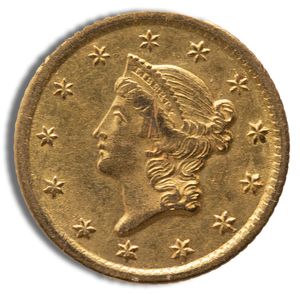
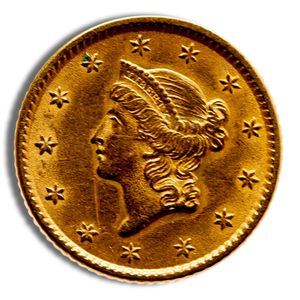
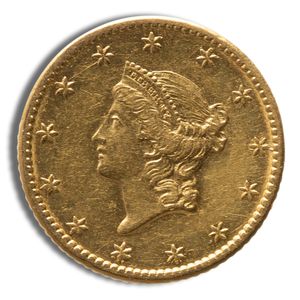
The obverse of the Type 2 gold dollar features a stylized portrait of Lady Liberty facing left, wearing a tall feathered headdress with the word "LIBERTY" inscribed across the band. Stars encircle the portrait, and the date appears at the bottom of the coin. The design is more ornate than its predecessor, though its small diameter of approximately 15mm made fine detail difficult to strike consistently, which is part of why the series was redesigned after just three years.
The reverse displays an agricultural wreath encircling the denomination "1 DOLLAR" and the coin's date, with "UNITED STATES OF AMERICA" surrounding the outer edge. The overall composition is compact and dense, reflecting the constraints of the small planchet. On circulated or cleaned examples, some of the finer relief details may be softened, but the core design elements remain identifiable on most surviving pieces.
Fractional Size and Accessibility
At 0.0483 troy ounces, the $1 Gold Princess Type 2 represents one of the smallest gold coins a buyer can acquire with genuine U.S. Mint origins. This fractional size means the acquisition cost is lower in absolute dollar terms compared to larger gold products, making it a practical option for buyers who want to hold historic American gold without committing to the cost of a full troy ounce.
The small physical size does require careful handling. These coins are easy to misplace and should be stored in protective flips or coin holders to preserve their condition. Despite the compact format, the .900 fine gold composition and the coin's documented place in U.S. Mint history give it a weight of significance well beyond its dimensions.
Authenticity and Product Integrity
Every $1 Gold Princess Type 2 we carry is verified for authenticity, weight, and purity prior to being offered for sale. These coins were struck to U.S. Mint specifications requiring .900 fine gold and a net gold weight of 0.0483 troy ounces, standards that have been documented and cross-referenced for over 150 years of numismatic study. Their composition and origin make authentication through established channels straightforward.
As authorized dealers for both PCGS and NGC, we are equipped to facilitate third-party grading for customers who want additional certification on specific pieces. For coins sold in cleaned or lower-grade condition, authentication remains grounded in the coin's physical characteristics and known Mint production standards rather than numerical grade. We verify each coin's fundamental integrity before it is made available through our platform.
Condition and Packaging
These coins are offered in cleaned or low-grade condition, which means individual pieces will show evidence of past cleaning, visible wear, surface marks, or some combination of these characteristics. Cleaning refers to the use of chemicals or abrasives at some point in a coin's history that may have altered its original surface luster. Low-grade examples will display significant circulation wear consistent with a coin that spent time in active commerce during the 19th century. Neither condition affects the coin's authenticity or gold content.
Individual coins ship in protective plastic flips to prevent further contact damage during transit. When purchasing in larger quantities, packaging shifts to tubes or sealed containers appropriate for the quantity ordered. Because these are raw, circulated coins rather than graded slabs, handling with care and storing in proper holders after receipt is recommended to avoid introducing additional surface changes.
Pricing and Market Factors
Pricing for the $1 Gold Princess Type 2 is anchored to the current spot price of gold, adjusted for the coin's specific gold content of 0.0483 troy ounces at .900 fine purity. The premium above spot reflects several intersecting factors: the coin's age and historical scarcity, the relatively low production volumes of the Type 2 series, and the sustained collector and numismatic demand for pre-1933 U.S. gold coinage.
Cleaned or low-grade examples typically trade at more modest premiums than strictly uncirculated or problem-free circulated coins, which can make them an efficient way to gain exposure to authentic 19th-century U.S. gold at a lower cost of entry. Our pricing reflects real-time market conditions and is structured to give buyers a clear and honest picture of what they are paying relative to the underlying metal value and the coin's numismatic context.
Selling and Liquidity
Pre-1933 U.S. gold coins, including the $1 Gold Princess Type 2, are well-recognized within the numismatic and bullion markets. Their documented history, standardized composition, and U.S. Mint origin make them straightforward to identify and trade. While cleaned or lower-grade examples command less premium than higher-quality pieces, they still trade actively among buyers who prioritize authentic gold content and historical origin over condition.
We operate as a two-way market, meaning customers can both purchase and sell these coins through our platform. Understanding liquidity before making a purchase is a core part of how we approach the buying experience, and our buyback pricing for U.S. gold coins reflects genuine market demand rather than arbitrary discounts. For customers evaluating resale expectations, our platform displays bid and ask spreads to help frame the full cost of ownership from the outset.
Why Buy the $1 Gold Princess Type 2?
The appeal of this coin lies at the intersection of genuine U.S. Mint history, fractional gold content, and accessibility. The Type 2 design had a production window of only three years, which gives it a degree of scarcity not found in longer-running series. For a buyer who values authentic American gold coinage with documented origins, this coin delivers something that modern bullion products cannot replicate.
Cleaned or low-grade examples provide access to a legitimately rare historical series at a price point that reflects condition rather than artificially inflated premiums. For buyers focused primarily on holding physical U.S. Mint gold at a lower entry cost, these coins offer that without requiring a compromise on authenticity. The coin's compact size also makes it easy to store alongside a broader collection of fractional or full-ounce gold pieces.
Why Buy from Bullion Standard?
We have been buying and selling physical precious metals since 2010, and our approach has always centered on transparency rather than pressure. Our pricing reflects live market conditions, our product descriptions communicate condition accurately, and we do not obscure the real cost of ownership behind vague premium structures. That consistency has contributed to our A rating with the Better Business Bureau and our long-standing membership in both the American Numismatic Association and the National Coin and Bullion Association.
As authorized dealers for PCGS and NGC, we are positioned to support customers who want third-party authentication or grading services for significant pieces. Every coin we carry is reviewed for authenticity before being listed. Our two-way market model means that the relationship does not end at the point of purchase. When it is time to sell, customers can transact within the same platform using competitive buyback pricing that reflects actual wholesale market conditions rather than arbitrary dealer discounts.
Get Near-Spot Pricing with Bullion Standard Pro
Bullion Standard Pro gives members access to live, executable wholesale bid and ask pricing across a wide range of products, including pre-1933 U.S. gold coins. Rather than relying on retail price estimates, Pro members can view real-time wholesale market pricing that reflects actual supply and demand conditions, helping buyers evaluate premiums, bid/ask spreads, and liquidity metrics for specific products before committing to a purchase.
For a coin like the $1 Gold Princess Type 2, where condition grades and market demand can meaningfully influence pricing, having access to objective market data and historical premium analytics adds genuine value to the decision-making process. Portfolio valuation through Pro uses live executable wholesale bid pricing rather than estimated retail values, giving members a more accurate picture of what their holdings are worth in current market conditions.
Flexible and Secure Payment Options
We support a broad range of payment methods to make the buying process straightforward and secure. Customers can pay using Visa, Mastercard, American Express, Discover, PayPal, bank-connected payments through Plaid, wire transfer, paper check, or cryptocurrency through BitPay. Each option is designed to give buyers flexibility without introducing unnecessary friction or uncertainty into the transaction.
Transaction security is built into every step of the purchasing experience. Whether paying by credit card or crypto, customers can expect consistent order processing, reliable fulfillment, and accessible support throughout the process.

 (833) 278-4653

.png)