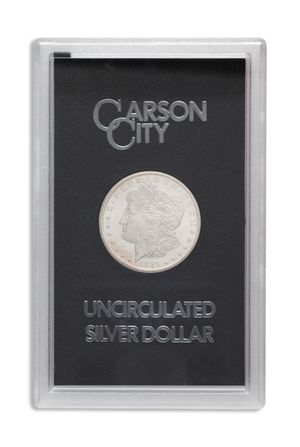
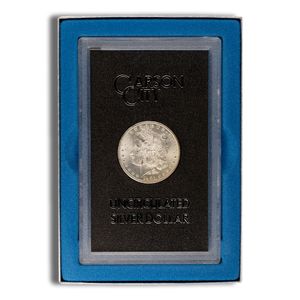
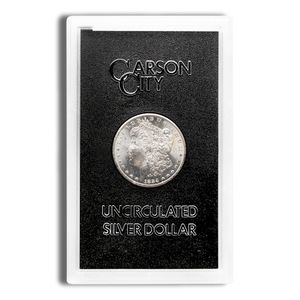
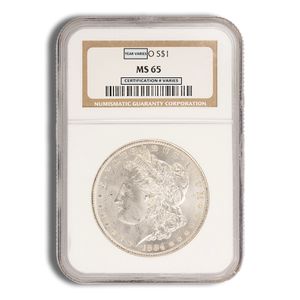
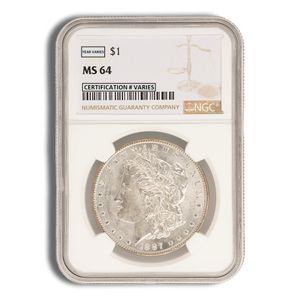
The 1882-CC GSA Morgan Silver Dollar graded MS66 by NGC represents one of the most storied intersections of American numismatic history and institutional preservation. Struck at the Carson City Mint in 1882, this coin is composed of .900 fine silver and weighs 0.7734 troy ounces, consistent with the standard Morgan dollar specifications established by the Coinage Act of 1873. What distinguishes this example from a standard circulated or even uncertified Morgan dollar is its GSA pedigree, NGC certification, and a grade of MS66 that places it firmly among the finest surviving examples of its type.
GSA Morgans refer to coins distributed by the General Services Administration during a series of public sales conducted between 1972 and 1980. These coins had been held in federal storage for decades and were released directly to the public in sealed hard plastic holders. An NGC-graded MS66 example carries that history forward with professional authentication and a grade that reflects exceptional surface preservation and eye appeal.
History and Background
The Morgan dollar series takes its name from George T. Morgan, the U.S. Mint engrave…
Overview of the 1882-CC GSA Morgan Silver Dollar
The 1882-CC GSA Morgan Silver Dollar graded MS66 by NGC represents one of the most storied intersections of American numismatic history and institutional preservation. Struck at the Carson City Mint in 1882, this coin is composed of .900 fine silver and weighs 0.7734 troy ounces, consistent with the standard Morgan dollar specifications established by the Coinage Act of 1873. What distinguishes this example from a standard circulated or even uncertified Morgan dollar is its GSA pedigree, NGC certification, and a grade of MS66 that places it firmly among the finest surviving examples of its type.
GSA Morgans refer to coins distributed by the General Services Administration during a series of public sales conducted between 1972 and 1980. These coins had been held in federal storage for decades and were released directly to the public in sealed hard plastic holders. An NGC-graded MS66 example carries that history forward with professional authentication and a grade that reflects exceptional surface preservation and eye appeal.
History and Background
The Morgan dollar series takes its name from George T. Morgan, the U.S. Mint engraver who designed the coin following the Bland-Allison Act of 1878. That legislation mandated the government purchase and coining of significant quantities of silver, largely in response to lobbying from Western mining interests. Carson City, sitting at the heart of Nevada's silver country, became a central production site for the series during its early decades.
The Carson City Mint operated from 1870 to 1893, producing coins that have long carried a premium among collectors for their regional identity and relatively modest surviving populations compared to issues from Philadelphia and San Francisco. The "CC" mintmark found on coins from this facility has become one of the most recognized identifiers in American numismatics, and the 1882-CC issue is one of the more available Carson City Morgans in high grades due in large part to the GSA distribution.
The GSA sale of the late 1970s and early 1980s brought hundreds of thousands of Carson City Morgans to the public after they had been sitting in Treasury vaults since their original minting. Rather than entering circulation, many of these coins survived in remarkable condition, which explains the relative availability of GSA examples in Mint State grades compared to other series where high-grade specimens are genuinely rare.
Design and Aesthetics
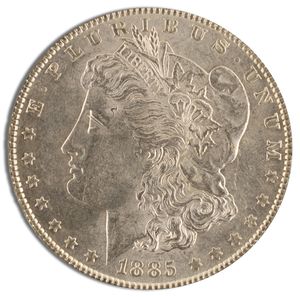
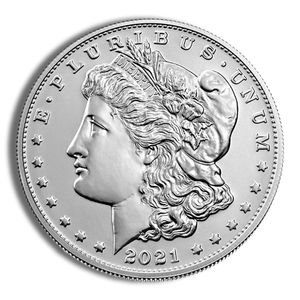
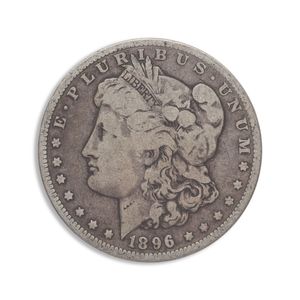
George Morgan's design reflects the neoclassical ideals of late 19th-century American coinage with unusual precision. The obverse features a left-facing portrait of Lady Liberty wearing a Phrygian cap inscribed with the word "LIBERTY," framed by thirteen stars and the date. The portrait was modeled after Philadelphia schoolteacher Anna Willess Williams and carries a naturalism uncommon for American coinage of the era. The inscription "E PLURIBUS UNUM" appears along the upper rim, while "IN GOD WE TRUST" is positioned above the portrait.
The reverse presents a heraldic eagle with outstretched wings, clutching arrows and an olive branch, with a ribbon inscribed "IN GOD WE TRUST" above. The eagle's breast is covered by a shield, and the inscriptions "UNITED STATES OF AMERICA" and "ONE DOLLAR" frame the design. At the MS66 grade level, both surfaces will display strong luster with only minimal, scattered contact marks and sharp, well-preserved detail throughout the design elements.
Authenticity and Product Integrity
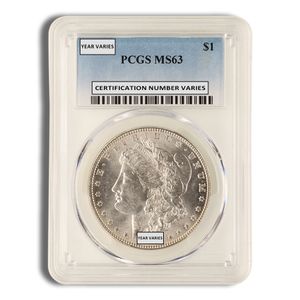
NGC certification at MS66 provides a definitive record of this coin's authenticity, grade, and surface quality. As an authorized NGC dealer, we are positioned to offer graded material with full confidence in the certification's legitimacy. Each NGC-graded coin is encapsulated in a tamper-evident holder with a unique certification number that can be verified directly through NGC's online registry.
The GSA origin adds an additional layer of historical provenance. These coins were distributed sealed in original GSA hard plastic holders, and many have since been cracked out and professionally graded by services like NGC. The combination of federal provenance, professional grading, and authorized dealer access means buyers can evaluate this coin with objective data rather than relying solely on seller representations.
Condition and Packaging
MS66 on the Sheldon scale indicates an exceptional Mint State example with above-average luster, well-struck detail, and only a small number of light contact marks visible under close inspection. For a coin struck in 1882, this grade reflects extraordinary preservation, and within the 1882-CC GSA population, MS66 represents a meaningfully high tier. Coins at this grade level are distinct from typical Mint State examples and will appeal both to type collectors and to those building high-grade Carson City sets.
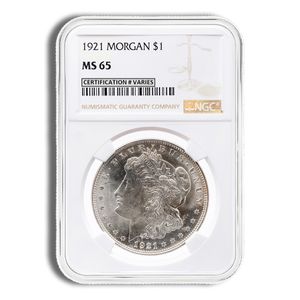
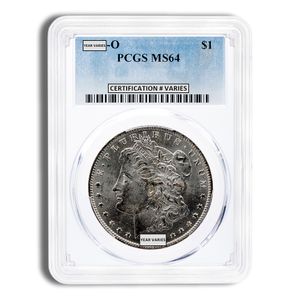
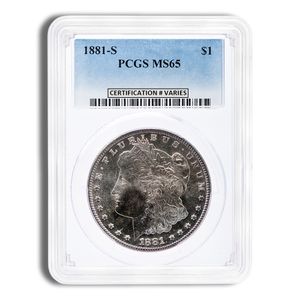
This coin is certified and encapsulated by NGC in a hard plastic slab that protects the surfaces without requiring additional handling. The NGC holder itself serves as the primary packaging and should not be opened, as breaking the seal would remove the certification and potentially affect the coin's recognized grade. We ship graded coins securely to prevent movement or impact during transit.
Pricing and Market Factors
The spot price of silver provides a base layer for pricing any silver coin, but a certified MS66 1882-CC GSA Morgan dollar trades well above melt on the strength of its numismatic attributes. Grade rarity within the Carson City Morgan population, collector demand for GSA-pedigreed material, and the broader market for high-grade 19th-century American coinage all contribute to the premium a coin of this caliber commands.
Our pricing reflects current market conditions for NGC-certified numismatic coins at this grade level, updated to account for changes in both the silver spot price and the collector premiums applicable to certified Carson City material. Understanding the relationship between spot price, numismatic premium, and the bid/ask spread on any given coin provides a clearer picture of the total cost of ownership.
Selling and Liquidity
Certified Morgan dollars, particularly those with Carson City mintmarks and GSA provenance, maintain an active secondary market across major auction platforms, dealer networks, and numismatic exchanges. The NGC certification provides a standardized, trusted grade that eliminates much of the negotiation around condition that affects raw coin transactions, making MS66-graded examples meaningfully easier to price and sell.
We operate a two-way market that supports both purchasing and selling within the same platform. For customers who eventually choose to sell, our competitive buyback pricing means liquidity is available without requiring a third-party transaction. We encourage buyers to consider the full transaction, including the bid side of the spread, before committing to any purchase.
Why Buy the 1882-CC GSA Morgan Silver Dollar?
The combination of Carson City provenance, GSA distribution history, and NGC certification at MS66 makes this a well-defined and researched coin within the Morgan dollar series. Collectors targeting high-grade CC Morgans find the 1882 date attractive because it remains more accessible than some of the rarer CC issues while still carrying the regional identity and historical context that drives demand for the series.
For those drawn to American numismatic history, a coin that passed through Nevada's silver country during the height of the Comstock era and was later held in federal storage before entering the collector market carries a narrative that most bullion products simply cannot match. The NGC slab documents that story objectively with a grade that confirms the coin's exceptional state of preservation.
Why Buy from Bullion Standard?
Our numismatic inventory is supported by authorized dealer relationships with both NGC and PCGS, which means the graded coins we sell carry verified certifications from the two most trusted grading services in the industry. That relationship matters, particularly for higher-grade numismatic material where authentication is critical to confident purchasing. We also hold membership in the American Numismatic Association and the National Coin and Bullion Association, reflecting our commitment to professional standards across both the coin and bullion categories.
Transparent pricing, competitive buyback rates, and a buying experience built around informed decision-making define how we operate. Our A rating with the Better Business Bureau reflects a track record of customer service and transactional integrity developed over more than a decade. Whether you are purchasing a single certified coin or building a broader collection, we provide the clarity and consistency needed to make decisions with confidence.
Get Near-Spot Pricing with Bullion Standard Pro
Bullion Standard Pro gives members access to live, executable wholesale bid and ask pricing alongside real-time portfolio valuation using current wholesale bid prices. For numismatic products like the 1882-CC GSA Morgan in MS66, understanding how the bid/ask spread evolves over time and how numismatic premiums shift with market demand provides meaningful context that static retail listings rarely offer. Our proprietary analytics and product research tools allow members to evaluate certified coins using objective data rather than relying solely on dealer representations.
Pro membership also extends to premium and spread analysis tools that help members understand the pricing characteristics of individual numismatic products relative to broader market conditions. This level of transparency, usually reserved for institutional participants, is accessible to any member who wants to evaluate their holdings with the same rigor applied to other financial assets.
Flexible and Secure Payment Options
We support a wide range of payment methods to make transactions straightforward and secure. Major credit cards including Visa, Mastercard, American Express, and Discover are accepted, along with PayPal, bank-connected payments through Plaid, wire transfer, paper check, and cryptocurrency via BitPay. Every transaction is processed through a secure platform designed to protect buyer information and support a confident purchasing experience from start to finish.
The 1882-CC GSA Morgan Silver Dollar graded MS66 by NGC represents one of the most storied intersections of American numismatic history and institutional preservation. Struck at the Carson City Mint in 1882, this coin is composed of .900 fine silver and weighs 0.7734 troy ounces, consistent with the standard Morgan dollar specifications established by the Coinage Act of 1873. What distinguishes this example from a standard circulated or even uncertified Morgan dollar is its GSA pedigree, NGC certification, and a grade of MS66 that places it firmly among the finest surviving examples of its type.
GSA Morgans refer to coins distributed by the General Services Administration during a series of public sales conducted between 1972 and 1980. These coins had been held in federal storage for decades and were released directly to the public in sealed hard plastic holders. An NGC-graded MS66 example carries that history forward with professional authentication and a grade that reflects exceptional surface preservation and eye appeal.
History and Background
The Morgan dollar series takes its name from George T. Morgan, the U.S. Mint engrave…
Overview of the 1882-CC GSA Morgan Silver Dollar
The 1882-CC GSA Morgan Silver Dollar graded MS66 by NGC represents one of the most storied intersections of American numismatic history and institutional preservation. Struck at the Carson City Mint in 1882, this coin is composed of .900 fine silver and weighs 0.7734 troy ounces, consistent with the standard Morgan dollar specifications established by the Coinage Act of 1873. What distinguishes this example from a standard circulated or even uncertified Morgan dollar is its GSA pedigree, NGC certification, and a grade of MS66 that places it firmly among the finest surviving examples of its type.
GSA Morgans refer to coins distributed by the General Services Administration during a series of public sales conducted between 1972 and 1980. These coins had been held in federal storage for decades and were released directly to the public in sealed hard plastic holders. An NGC-graded MS66 example carries that history forward with professional authentication and a grade that reflects exceptional surface preservation and eye appeal.
History and Background
The Morgan dollar series takes its name from George T. Morgan, the U.S. Mint engraver who designed the coin following the Bland-Allison Act of 1878. That legislation mandated the government purchase and coining of significant quantities of silver, largely in response to lobbying from Western mining interests. Carson City, sitting at the heart of Nevada's silver country, became a central production site for the series during its early decades.
The Carson City Mint operated from 1870 to 1893, producing coins that have long carried a premium among collectors for their regional identity and relatively modest surviving populations compared to issues from Philadelphia and San Francisco. The "CC" mintmark found on coins from this facility has become one of the most recognized identifiers in American numismatics, and the 1882-CC issue is one of the more available Carson City Morgans in high grades due in large part to the GSA distribution.
The GSA sale of the late 1970s and early 1980s brought hundreds of thousands of Carson City Morgans to the public after they had been sitting in Treasury vaults since their original minting. Rather than entering circulation, many of these coins survived in remarkable condition, which explains the relative availability of GSA examples in Mint State grades compared to other series where high-grade specimens are genuinely rare.
Design and Aesthetics
George Morgan's design reflects the neoclassical ideals of late 19th-century American coinage with unusual precision. The obverse features a left-facing portrait of Lady Liberty wearing a Phrygian cap inscribed with the word "LIBERTY," framed by thirteen stars and the date. The portrait was modeled after Philadelphia schoolteacher Anna Willess Williams and carries a naturalism uncommon for American coinage of the era. The inscription "E PLURIBUS UNUM" appears along the upper rim, while "IN GOD WE TRUST" is positioned above the portrait.
The reverse presents a heraldic eagle with outstretched wings, clutching arrows and an olive branch, with a ribbon inscribed "IN GOD WE TRUST" above. The eagle's breast is covered by a shield, and the inscriptions "UNITED STATES OF AMERICA" and "ONE DOLLAR" frame the design. At the MS66 grade level, both surfaces will display strong luster with only minimal, scattered contact marks and sharp, well-preserved detail throughout the design elements.
Authenticity and Product Integrity
NGC certification at MS66 provides a definitive record of this coin's authenticity, grade, and surface quality. As an authorized NGC dealer, we are positioned to offer graded material with full confidence in the certification's legitimacy. Each NGC-graded coin is encapsulated in a tamper-evident holder with a unique certification number that can be verified directly through NGC's online registry.
The GSA origin adds an additional layer of historical provenance. These coins were distributed sealed in original GSA hard plastic holders, and many have since been cracked out and professionally graded by services like NGC. The combination of federal provenance, professional grading, and authorized dealer access means buyers can evaluate this coin with objective data rather than relying solely on seller representations.
Condition and Packaging
MS66 on the Sheldon scale indicates an exceptional Mint State example with above-average luster, well-struck detail, and only a small number of light contact marks visible under close inspection. For a coin struck in 1882, this grade reflects extraordinary preservation, and within the 1882-CC GSA population, MS66 represents a meaningfully high tier. Coins at this grade level are distinct from typical Mint State examples and will appeal both to type collectors and to those building high-grade Carson City sets.
This coin is certified and encapsulated by NGC in a hard plastic slab that protects the surfaces without requiring additional handling. The NGC holder itself serves as the primary packaging and should not be opened, as breaking the seal would remove the certification and potentially affect the coin's recognized grade. We ship graded coins securely to prevent movement or impact during transit.
Pricing and Market Factors
The spot price of silver provides a base layer for pricing any silver coin, but a certified MS66 1882-CC GSA Morgan dollar trades well above melt on the strength of its numismatic attributes. Grade rarity within the Carson City Morgan population, collector demand for GSA-pedigreed material, and the broader market for high-grade 19th-century American coinage all contribute to the premium a coin of this caliber commands.
Our pricing reflects current market conditions for NGC-certified numismatic coins at this grade level, updated to account for changes in both the silver spot price and the collector premiums applicable to certified Carson City material. Understanding the relationship between spot price, numismatic premium, and the bid/ask spread on any given coin provides a clearer picture of the total cost of ownership.
Selling and Liquidity
Certified Morgan dollars, particularly those with Carson City mintmarks and GSA provenance, maintain an active secondary market across major auction platforms, dealer networks, and numismatic exchanges. The NGC certification provides a standardized, trusted grade that eliminates much of the negotiation around condition that affects raw coin transactions, making MS66-graded examples meaningfully easier to price and sell.
We operate a two-way market that supports both purchasing and selling within the same platform. For customers who eventually choose to sell, our competitive buyback pricing means liquidity is available without requiring a third-party transaction. We encourage buyers to consider the full transaction, including the bid side of the spread, before committing to any purchase.
Why Buy the 1882-CC GSA Morgan Silver Dollar?
The combination of Carson City provenance, GSA distribution history, and NGC certification at MS66 makes this a well-defined and researched coin within the Morgan dollar series. Collectors targeting high-grade CC Morgans find the 1882 date attractive because it remains more accessible than some of the rarer CC issues while still carrying the regional identity and historical context that drives demand for the series.
For those drawn to American numismatic history, a coin that passed through Nevada's silver country during the height of the Comstock era and was later held in federal storage before entering the collector market carries a narrative that most bullion products simply cannot match. The NGC slab documents that story objectively with a grade that confirms the coin's exceptional state of preservation.
Why Buy from Bullion Standard?
Our numismatic inventory is supported by authorized dealer relationships with both NGC and PCGS, which means the graded coins we sell carry verified certifications from the two most trusted grading services in the industry. That relationship matters, particularly for higher-grade numismatic material where authentication is critical to confident purchasing. We also hold membership in the American Numismatic Association and the National Coin and Bullion Association, reflecting our commitment to professional standards across both the coin and bullion categories.
Transparent pricing, competitive buyback rates, and a buying experience built around informed decision-making define how we operate. Our A rating with the Better Business Bureau reflects a track record of customer service and transactional integrity developed over more than a decade. Whether you are purchasing a single certified coin or building a broader collection, we provide the clarity and consistency needed to make decisions with confidence.
Get Near-Spot Pricing with Bullion Standard Pro
Bullion Standard Pro gives members access to live, executable wholesale bid and ask pricing alongside real-time portfolio valuation using current wholesale bid prices. For numismatic products like the 1882-CC GSA Morgan in MS66, understanding how the bid/ask spread evolves over time and how numismatic premiums shift with market demand provides meaningful context that static retail listings rarely offer. Our proprietary analytics and product research tools allow members to evaluate certified coins using objective data rather than relying solely on dealer representations.
Pro membership also extends to premium and spread analysis tools that help members understand the pricing characteristics of individual numismatic products relative to broader market conditions. This level of transparency, usually reserved for institutional participants, is accessible to any member who wants to evaluate their holdings with the same rigor applied to other financial assets.
Flexible and Secure Payment Options
We support a wide range of payment methods to make transactions straightforward and secure. Major credit cards including Visa, Mastercard, American Express, and Discover are accepted, along with PayPal, bank-connected payments through Plaid, wire transfer, paper check, and cryptocurrency via BitPay. Every transaction is processed through a secure platform designed to protect buyer information and support a confident purchasing experience from start to finish.
This website uses cookies for analytics and to deliver personalized content. By continuing to
use our site, you acknowledge that you have read and agree to our Privacy Policy and Cookie
Policy.
Current Quantities Available
Unfortunately, we only have 0
of
this item in
stock.
Please call us at (833) 278-4653
or email us at support@bullionstandard.com
if you wish to purchase a larger quantity than what is available on our website.
We can often locate additional quantities.

 (833) 278-4653

.png)