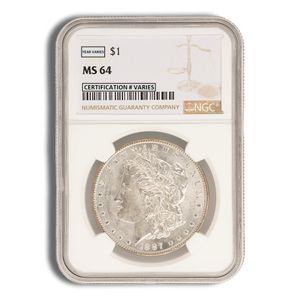
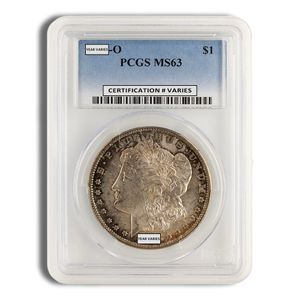
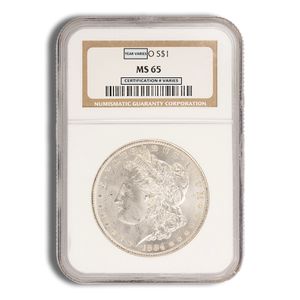
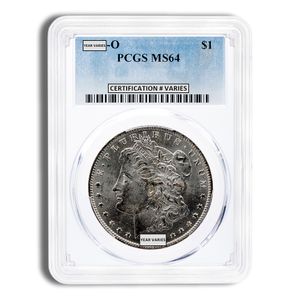
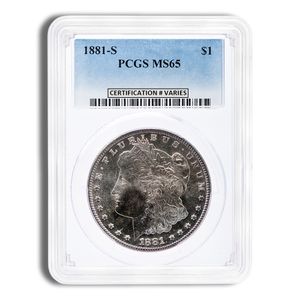
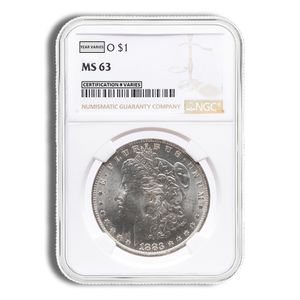
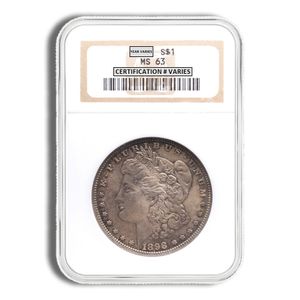
The Morgan silver dollar is one of the most recognized coins in American numismatic history, and the PCGS MS63 example we carry represents a certified choice-uncirculated specimen from the series produced between 1878 and 1904. Each coin contains 0.7734 troy ounces of silver at a purity of .900 fine, giving it a meaningful silver content alongside its substantial numismatic presence. Struck by the United States Mint across multiple facilities during the late nineteenth and early twentieth centuries, these coins carry both a distinct historical character and a standardized silver weight that collectors and silver buyers alike recognize immediately.
The PCGS MS63 grade places this coin in choice-uncirculated territory, meaning it has never circulated and retains its original mint luster, though it may show a modest number of contact marks or minor blemishes consistent with the grade. PCGS encapsulates and certifies each coin within a tamper-evident holder, providing reliable third-party authentication and a graded assessment that the broader market trusts.
History and Background
The Morgan silver dollar owes its name to George T. Morga…
Overview of 1878-1904 Morgan Silver Dollar
The Morgan silver dollar is one of the most recognized coins in American numismatic history, and the PCGS MS63 example we carry represents a certified choice-uncirculated specimen from the series produced between 1878 and 1904. Each coin contains 0.7734 troy ounces of silver at a purity of .900 fine, giving it a meaningful silver content alongside its substantial numismatic presence. Struck by the United States Mint across multiple facilities during the late nineteenth and early twentieth centuries, these coins carry both a distinct historical character and a standardized silver weight that collectors and silver buyers alike recognize immediately.
The PCGS MS63 grade places this coin in choice-uncirculated territory, meaning it has never circulated and retains its original mint luster, though it may show a modest number of contact marks or minor blemishes consistent with the grade. PCGS encapsulates and certifies each coin within a tamper-evident holder, providing reliable third-party authentication and a graded assessment that the broader market trusts.
History and Background
The Morgan silver dollar owes its name to George T. Morgan, the British-born engraver who joined the United States Mint in 1876 and was tasked with designing a new silver dollar following the Bland-Allison Act of 1878. That legislation mandated the federal government purchase and coin significant quantities of silver, effectively bringing the silver dollar back into production after a five-year absence. The resulting design entered circulation in 1878 and remained in production with minor interruptions through 1904, when declining silver reserves caused the Mint to suspend production.
During its original run, the Morgan dollar was produced at several mint facilities, including Philadelphia, New Orleans, San Francisco, Carson City, and New Orleans, each identified by a distinct mintmark on the coin's reverse. Carson City issues are particularly prized by collectors due to their lower mintages and connection to the silver mining era of the American West. The series was briefly revived in 1921 before being replaced mid-year by the Peace dollar, making the 1878 to 1904 span the definitive production window for classic Morgan dollar collectors.
The Morgan dollar series spans dozens of date and mintmark combinations with widely varying rarity levels, ranging from common Philadelphia issues to genuinely scarce Carson City dates. This depth gives the series lasting appeal for date collectors, type collectors, and silver stackers simultaneously, which has sustained strong demand and active trading across the secondary market for well over a century.
Design and Aesthetics
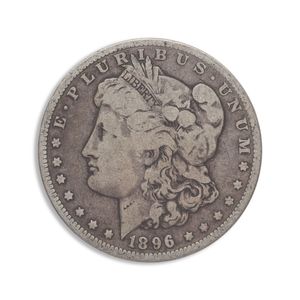
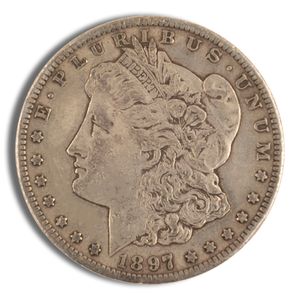
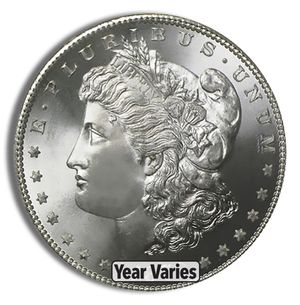
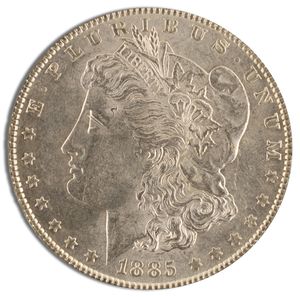
The obverse of the Morgan dollar features a left-facing portrait of Lady Liberty wearing a Phrygian cap adorned with wheat stalks and cotton blossoms, a design choice Morgan made as a deliberate American departure from classical European portraiture. The word LIBERTY appears on the headband, and the inscriptions E PLURIBUS UNUM and the date frame the portrait. Morgan used Anna Willess Williams, a Philadelphia schoolteacher, as his primary model, giving Liberty a distinctly naturalistic appearance that set the design apart from earlier allegorical coinage.
The reverse presents a heraldic eagle with outstretched wings, holding arrows and an olive branch in its talons while clutching a ribbon inscribed E PLURIBUS UNUM in its beak. A wreath surrounds the eagle at the base, and UNITED STATES OF AMERICA arcs above with ONE DOLLAR below. The detail in the eagle's feathers and the overall depth of the relief are defining characteristics of the design and part of what makes high-grade examples so visually striking.
At the MS63 grade, surviving luster across the high points and fields of the design is expected, and the coin's overall visual impression remains sharp and appealing despite any light contact marks the grade permits. The combination of Morgan's high-relief sculpting and the coin's large 38.1mm diameter makes even modest-grade uncirculated examples genuinely impressive to examine in hand.
Authenticity and Product Integrity
Each coin we sell in this grade has been independently examined and certified by PCGS, one of the two most respected third-party grading services in the numismatic industry. PCGS evaluates coins for authenticity, assigns a standardized grade based on condition, and encapsulates each piece in a sonically sealed, tamper-evident holder that protects the coin's surface while making the grade and certification number permanently accessible. We are an authorized dealer for PCGS, which means we work directly within their dealer network and handle certified products according to the standards that relationship requires.
For a coin series that has been actively collected and traded for over a century, professional third-party certification is particularly important. Morgan dollars have been widely counterfeited, and altered or cleaned examples are common in the secondary market. A PCGS-certified coin removes that uncertainty entirely, providing a reliable authentication baseline and a grade that the market accepts as objective.
Condition and Packaging
MS63, or choice uncirculated, indicates that the coin has never been spent in commerce and retains its original mint luster across the fields and devices. At this grade, PCGS allows for a modest number of contact marks and minor blemishes, but these are secondary details rather than distracting flaws. The luster should remain bright and uninterrupted across the coin's surface, and the strike is expected to be reasonably sharp across the design elements.
Each certified Morgan dollar ships in its PCGS encapsulation, which serves as both the coin's protective housing and its certificate of authenticity. The holder itself carries the coin's assigned grade, certification number, and series designation, and can be verified directly through PCGS's online database. Unlike raw coins, PCGS-graded coins do not require additional protective packaging, as the slab format is designed for long-term storage and handling without risk of surface damage.
Pricing and Market Factors
Pricing for a certified Morgan dollar in MS63 reflects two distinct components: the underlying silver value derived from the coin's 0.7734 troy ounce silver content and the numismatic premium associated with its grade, date, and mint origin. Unlike generic silver bullion, where premiums are primarily driven by supply and demand for the metal itself, certified coins carry premiums shaped by collector demand, population data from PCGS's registry, and the relative scarcity of the specific date and mintmark combination.
Common-date Morgan dollars in MS63 trade within a fairly active and transparent secondary market, and PCGS population data plays a meaningful role in how the market prices individual pieces. As grade population increases for a given date, premiums tend to compress, while lower-population survivors in the same grade command stronger collector premiums. Silver spot price movement also influences the floor of any Morgan dollar's price, providing a baseline that shifts with the broader metals market even as the numismatic premium remains independently driven.
Selling and Liquidity
The Morgan dollar series is among the most liquid in the numismatic market, with active buyers across collector, dealer, and auction channels at virtually every price level. PCGS-certified examples benefit specifically from the credibility that certification provides, allowing transactions to close faster and with less negotiation than comparable raw coins. The combination of a recognized series, a trusted grading service, and consistent demand across multiple buyer types makes these coins a genuinely active segment of the secondary market.
We operate a two-way market that supports both buying and selling, allowing customers to bring certified Morgan dollars back to us when they are ready to sell. Rather than requiring customers to find their own buyers, our buyback model keeps the transaction within a single ecosystem at competitive pricing tied to current market conditions.
Why Buy a PCGS MS63 Morgan Silver Dollar?
Certified Morgan dollars in MS63 occupy an accessible but meaningful position within the series. The grade is attainable enough that pricing remains competitive relative to higher-grade certified examples, yet it represents a genuinely uncirculated coin with retained luster and clear design detail. For collectors building a type set or date set without committing to the steep premiums that MS64 and MS65 examples command, MS63 consistently represents strong value within the series.
The PCGS certification itself is a meaningful part of the purchase. The authentication and grading eliminate the uncertainty that often accompanies raw coin transactions, particularly in a series with as much secondary market activity and potential for alterations as the Morgan dollar. Buyers can confirm the coin's certification number against PCGS's database, giving them an independent verification point that does not require trusting the seller alone.
Why Buy from Bullion Standard?
We are an authorized dealer for PCGS, and that relationship directly informs how we source and represent certified products. Every coin we carry has been authenticated by the grading service whose name appears on the holder, and we do not sell altered, cleaned, or ungenuine coins as certified examples. Our approach to numismatic inventory reflects the same standards we apply across the rest of our catalog: accurate descriptions, transparent pricing, and no misrepresentation of condition.
Our A rating with the Better Business Bureau reflects a consistent track record of doing right by customers, and our memberships in the American Numismatic Association and the National Coin and Bullion Association reflect the professional standards we hold ourselves to within the industry. Certified numismatic coins are a category where trust matters particularly, and our credentials within the space are not incidental. When you purchase a PCGS-certified Morgan dollar through us, you are transacting with a dealer whose authorization and accountability are publicly verifiable.
Get Near-Spot Pricing with Bullion Standard Pro
Bullion Standard Pro provides members with access to live, executable wholesale bid and ask pricing, which is especially useful when evaluating numismatic silver coins where premiums can shift meaningfully based on changing collector demand, silver spot movement, and secondary market conditions. Rather than relying on static price estimates, Pro members see real-time pricing that reflects what the market is actually doing at the wholesale level, which is particularly relevant for a series like the Morgan dollar where individual date and mintmark combinations can diverge significantly from one another in value.
Beyond pricing access, Pro includes proprietary market intelligence tools that let members evaluate historical premium trends, bid/ask spreads, and liquidity metrics across specific products. For a certified coin like the MS63 Morgan dollar, understanding how premiums have behaved over time and how the current ask compares to historical ranges provides meaningful context for any purchase or sale decision. Portfolio valuation through Pro uses live executable wholesale bid pricing, giving members a realistic picture of their holdings at current liquidation values rather than inflated retail estimates.
Flexible and Secure Payment Options
We support a wide range of payment options to make the transaction as straightforward as possible. Customers can pay using major credit cards including Visa, Mastercard, American Express, and Discover, as well as PayPal, bank-connected payments through Plaid, wire transfer, paper check, and cryptocurrency through BitPay. Every transaction is handled with security and efficiency as the primary considerations, and our payment infrastructure is designed to accommodate buyers across every preference without introducing unnecessary complexity into the checkout process.
Volume Discount Pricing
Orders paid by debit card, credit card, and PayPal are an item's full
list
price
and receive no discount. Orders paid by cryptocurrency receive a 3%
discount
from an item's full list price. Orders paid by eCheck (ACH), paper
check,
and
bank wire receive a 4% discount from an item's full list price.
In Stock
Ships within 1 business day of cleared payment
Select Your Quantity
For Non-Members:
Free shipping on orders
$497+
.
PRO
Pro Member Delivery:
$23.97 flat-rate, true
wholesale pricing. Free shipping on orders
$10,000+.
Product ID: BST-002128ABDC
Specifications
Random Year Status
Random Year
Precious Metal Type
Silver
Bullion Coin Type
Morgan Dollar
Format
Coin
Country of Origin
United States
Brand/Mint
U.S. Mint
Mint Mark
Various
Purity
0.9
Weight
0.7734 oz
Thickness (mm)
2.4
mm
Diameter (mm)
38.1
mm
Inner Pack (Quantity)
20
Grade
MS63
Grading Service
PCGS
Product Details
Overview of 1878-1904 Morgan Silver Dollar
The Morgan silver dollar is one of the most recognized coins in American numismatic history, and the PCGS MS63 example we carry represents a certified choice-uncirculated specimen from the series produced between 1878 and 1904. Each coin contains 0.7734 troy ounces of silver at a purity of .900 fine, giving it a meaningful silver content alongside its substantial numismatic presence. Struck by the United States Mint across multiple facilities during the late nineteenth and early twentieth centuries, these coins carry both a distinct historical character and a standardized silver weight that collectors and silver buyers alike recognize immediately.
The PCGS MS63 grade places this coin in choice-uncirculated territory, meaning it has never circulated and retains its original mint luster, though it may show a modest number of contact marks or minor blemishes consistent with the grade. PCGS encapsulates and certifies each coin within a tamper-evident holder, providing reliable third-party authentication and a graded assessment that the broader market trusts.
History and Background
The Morgan silver dollar owes its name to George T. Morga…
Overview of 1878-1904 Morgan Silver Dollar
The Morgan silver dollar is one of the most recognized coins in American numismatic history, and the PCGS MS63 example we carry represents a certified choice-uncirculated specimen from the series produced between 1878 and 1904. Each coin contains 0.7734 troy ounces of silver at a purity of .900 fine, giving it a meaningful silver content alongside its substantial numismatic presence. Struck by the United States Mint across multiple facilities during the late nineteenth and early twentieth centuries, these coins carry both a distinct historical character and a standardized silver weight that collectors and silver buyers alike recognize immediately.
The PCGS MS63 grade places this coin in choice-uncirculated territory, meaning it has never circulated and retains its original mint luster, though it may show a modest number of contact marks or minor blemishes consistent with the grade. PCGS encapsulates and certifies each coin within a tamper-evident holder, providing reliable third-party authentication and a graded assessment that the broader market trusts.
History and Background
The Morgan silver dollar owes its name to George T. Morgan, the British-born engraver who joined the United States Mint in 1876 and was tasked with designing a new silver dollar following the Bland-Allison Act of 1878. That legislation mandated the federal government purchase and coin significant quantities of silver, effectively bringing the silver dollar back into production after a five-year absence. The resulting design entered circulation in 1878 and remained in production with minor interruptions through 1904, when declining silver reserves caused the Mint to suspend production.
During its original run, the Morgan dollar was produced at several mint facilities, including Philadelphia, New Orleans, San Francisco, Carson City, and New Orleans, each identified by a distinct mintmark on the coin's reverse. Carson City issues are particularly prized by collectors due to their lower mintages and connection to the silver mining era of the American West. The series was briefly revived in 1921 before being replaced mid-year by the Peace dollar, making the 1878 to 1904 span the definitive production window for classic Morgan dollar collectors.
The Morgan dollar series spans dozens of date and mintmark combinations with widely varying rarity levels, ranging from common Philadelphia issues to genuinely scarce Carson City dates. This depth gives the series lasting appeal for date collectors, type collectors, and silver stackers simultaneously, which has sustained strong demand and active trading across the secondary market for well over a century.
Design and Aesthetics
The obverse of the Morgan dollar features a left-facing portrait of Lady Liberty wearing a Phrygian cap adorned with wheat stalks and cotton blossoms, a design choice Morgan made as a deliberate American departure from classical European portraiture. The word LIBERTY appears on the headband, and the inscriptions E PLURIBUS UNUM and the date frame the portrait. Morgan used Anna Willess Williams, a Philadelphia schoolteacher, as his primary model, giving Liberty a distinctly naturalistic appearance that set the design apart from earlier allegorical coinage.
The reverse presents a heraldic eagle with outstretched wings, holding arrows and an olive branch in its talons while clutching a ribbon inscribed E PLURIBUS UNUM in its beak. A wreath surrounds the eagle at the base, and UNITED STATES OF AMERICA arcs above with ONE DOLLAR below. The detail in the eagle's feathers and the overall depth of the relief are defining characteristics of the design and part of what makes high-grade examples so visually striking.
At the MS63 grade, surviving luster across the high points and fields of the design is expected, and the coin's overall visual impression remains sharp and appealing despite any light contact marks the grade permits. The combination of Morgan's high-relief sculpting and the coin's large 38.1mm diameter makes even modest-grade uncirculated examples genuinely impressive to examine in hand.
Authenticity and Product Integrity
Each coin we sell in this grade has been independently examined and certified by PCGS, one of the two most respected third-party grading services in the numismatic industry. PCGS evaluates coins for authenticity, assigns a standardized grade based on condition, and encapsulates each piece in a sonically sealed, tamper-evident holder that protects the coin's surface while making the grade and certification number permanently accessible. We are an authorized dealer for PCGS, which means we work directly within their dealer network and handle certified products according to the standards that relationship requires.
For a coin series that has been actively collected and traded for over a century, professional third-party certification is particularly important. Morgan dollars have been widely counterfeited, and altered or cleaned examples are common in the secondary market. A PCGS-certified coin removes that uncertainty entirely, providing a reliable authentication baseline and a grade that the market accepts as objective.
Condition and Packaging
MS63, or choice uncirculated, indicates that the coin has never been spent in commerce and retains its original mint luster across the fields and devices. At this grade, PCGS allows for a modest number of contact marks and minor blemishes, but these are secondary details rather than distracting flaws. The luster should remain bright and uninterrupted across the coin's surface, and the strike is expected to be reasonably sharp across the design elements.
Each certified Morgan dollar ships in its PCGS encapsulation, which serves as both the coin's protective housing and its certificate of authenticity. The holder itself carries the coin's assigned grade, certification number, and series designation, and can be verified directly through PCGS's online database. Unlike raw coins, PCGS-graded coins do not require additional protective packaging, as the slab format is designed for long-term storage and handling without risk of surface damage.
Pricing and Market Factors
Pricing for a certified Morgan dollar in MS63 reflects two distinct components: the underlying silver value derived from the coin's 0.7734 troy ounce silver content and the numismatic premium associated with its grade, date, and mint origin. Unlike generic silver bullion, where premiums are primarily driven by supply and demand for the metal itself, certified coins carry premiums shaped by collector demand, population data from PCGS's registry, and the relative scarcity of the specific date and mintmark combination.
Common-date Morgan dollars in MS63 trade within a fairly active and transparent secondary market, and PCGS population data plays a meaningful role in how the market prices individual pieces. As grade population increases for a given date, premiums tend to compress, while lower-population survivors in the same grade command stronger collector premiums. Silver spot price movement also influences the floor of any Morgan dollar's price, providing a baseline that shifts with the broader metals market even as the numismatic premium remains independently driven.
Selling and Liquidity
The Morgan dollar series is among the most liquid in the numismatic market, with active buyers across collector, dealer, and auction channels at virtually every price level. PCGS-certified examples benefit specifically from the credibility that certification provides, allowing transactions to close faster and with less negotiation than comparable raw coins. The combination of a recognized series, a trusted grading service, and consistent demand across multiple buyer types makes these coins a genuinely active segment of the secondary market.
We operate a two-way market that supports both buying and selling, allowing customers to bring certified Morgan dollars back to us when they are ready to sell. Rather than requiring customers to find their own buyers, our buyback model keeps the transaction within a single ecosystem at competitive pricing tied to current market conditions.
Why Buy a PCGS MS63 Morgan Silver Dollar?
Certified Morgan dollars in MS63 occupy an accessible but meaningful position within the series. The grade is attainable enough that pricing remains competitive relative to higher-grade certified examples, yet it represents a genuinely uncirculated coin with retained luster and clear design detail. For collectors building a type set or date set without committing to the steep premiums that MS64 and MS65 examples command, MS63 consistently represents strong value within the series.
The PCGS certification itself is a meaningful part of the purchase. The authentication and grading eliminate the uncertainty that often accompanies raw coin transactions, particularly in a series with as much secondary market activity and potential for alterations as the Morgan dollar. Buyers can confirm the coin's certification number against PCGS's database, giving them an independent verification point that does not require trusting the seller alone.
Why Buy from Bullion Standard?
We are an authorized dealer for PCGS, and that relationship directly informs how we source and represent certified products. Every coin we carry has been authenticated by the grading service whose name appears on the holder, and we do not sell altered, cleaned, or ungenuine coins as certified examples. Our approach to numismatic inventory reflects the same standards we apply across the rest of our catalog: accurate descriptions, transparent pricing, and no misrepresentation of condition.
Our A rating with the Better Business Bureau reflects a consistent track record of doing right by customers, and our memberships in the American Numismatic Association and the National Coin and Bullion Association reflect the professional standards we hold ourselves to within the industry. Certified numismatic coins are a category where trust matters particularly, and our credentials within the space are not incidental. When you purchase a PCGS-certified Morgan dollar through us, you are transacting with a dealer whose authorization and accountability are publicly verifiable.
Get Near-Spot Pricing with Bullion Standard Pro
Bullion Standard Pro provides members with access to live, executable wholesale bid and ask pricing, which is especially useful when evaluating numismatic silver coins where premiums can shift meaningfully based on changing collector demand, silver spot movement, and secondary market conditions. Rather than relying on static price estimates, Pro members see real-time pricing that reflects what the market is actually doing at the wholesale level, which is particularly relevant for a series like the Morgan dollar where individual date and mintmark combinations can diverge significantly from one another in value.
Beyond pricing access, Pro includes proprietary market intelligence tools that let members evaluate historical premium trends, bid/ask spreads, and liquidity metrics across specific products. For a certified coin like the MS63 Morgan dollar, understanding how premiums have behaved over time and how the current ask compares to historical ranges provides meaningful context for any purchase or sale decision. Portfolio valuation through Pro uses live executable wholesale bid pricing, giving members a realistic picture of their holdings at current liquidation values rather than inflated retail estimates.
Flexible and Secure Payment Options
We support a wide range of payment options to make the transaction as straightforward as possible. Customers can pay using major credit cards including Visa, Mastercard, American Express, and Discover, as well as PayPal, bank-connected payments through Plaid, wire transfer, paper check, and cryptocurrency through BitPay. Every transaction is handled with security and efficiency as the primary considerations, and our payment infrastructure is designed to accommodate buyers across every preference without introducing unnecessary complexity into the checkout process.
This website uses cookies for analytics and to deliver personalized content. By continuing to
use our site, you acknowledge that you have read and agree to our Privacy Policy and Cookie
Policy.
Current Quantities Available
Unfortunately, we only have 0
of
this item in
stock.
Please call us at (833) 278-4653
or email us at support@bullionstandard.com
if you wish to purchase a larger quantity than what is available on our website.
We can often locate additional quantities.

 (833) 278-4653

.png)