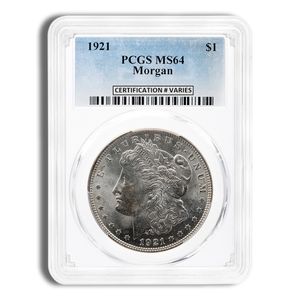
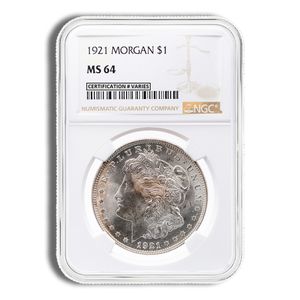
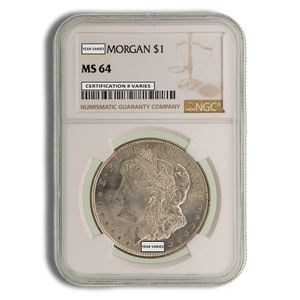
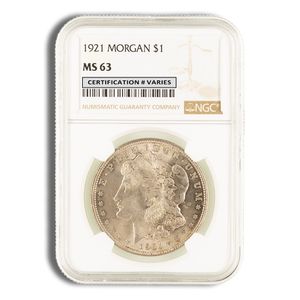
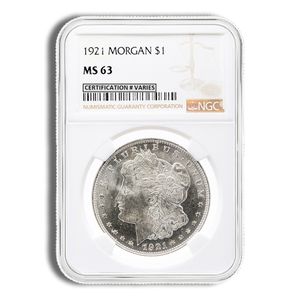
The 1921 Morgan Silver Dollar is one of the most widely recognized and actively traded coins in American numismatics. Struck in .900 fine silver with a total weight of 0.7734 troy ounces, it was produced by the United States Mint and carries a face value of one dollar. This particular example has been certified by PCGS at MS64, meaning it meets the strict grading criteria for an uncirculated coin with only minor surface distractions that prevent a higher designation.
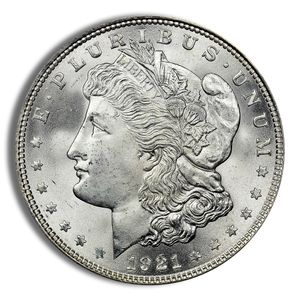
The toning noted on this coin is part of its numismatic character rather than a flaw. Natural toning that develops on silver coins over decades can range from light champagne hues to deeper blues, purples, and russets, and it is frequently associated with coins that have rested undisturbed in albums or original mint bags. For collectors and market participants alike, original, attractive toning is a recognized quality that enhances the visual appeal and market presence of a certified coin.
The Morgan Dollar series was introduced in 1878 following the Bland-Allison Act, which required the federal government to purchase silver and conv
…The 1921 Morgan Silver Dollar is one of the most widely recognized and actively traded coins in American numismatics. Struck in .900 fine silver with a total weight of 0.7734 troy ounces, it was produced by the United States Mint and carries a face value of one dollar. This particular example has been certified by PCGS at MS64, meaning it meets the strict grading criteria for an uncirculated coin with only minor surface distractions that prevent a higher designation.
The toning noted on this coin is part of its numismatic character rather than a flaw. Natural toning that develops on silver coins over decades can range from light champagne hues to deeper blues, purples, and russets, and it is frequently associated with coins that have rested undisturbed in albums or original mint bags. For collectors and market participants alike, original, attractive toning is a recognized quality that enhances the visual appeal and market presence of a certified coin.
The Morgan Dollar series was introduced in 1878 following the Bland-Allison Act, which required the federal government to purchase silver and convert it into coinage. Designed by George T. Morgan, the series ran continuously through 1904 before being discontinued. The 1921 date marks the coin's resumption under the Pittman Act of 1918, which authorized the melting of millions of existing silver dollars and their recoinage from newly purchased silver.
The 1921 Morgan is historically distinct in that it was the last year of production for the series before it was replaced by the Peace Dollar in 1922. All three active mint facilities at the time produced 1921-dated Morgan Dollars: Philadelphia, Denver, and San Francisco. The Philadelphia Mint struck the largest volume that year, and the combined mintage across all facilities reached tens of millions of coins, making the 1921 Morgan the highest-production year in the entire series.
Despite the large mintage, high-grade examples with original, undisturbed surfaces are far less common today. Many 1921 Morgans were released into circulation, melted, or cleaned at some point during their history. Coins that survived in original mint-bag storage or careful collections with intact, original surfaces represent a meaningful subset of what the market sees at this grade level.
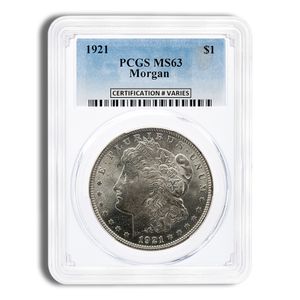
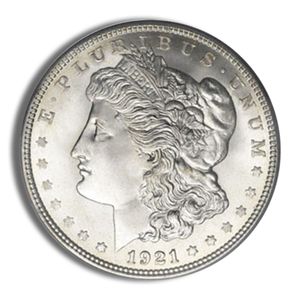
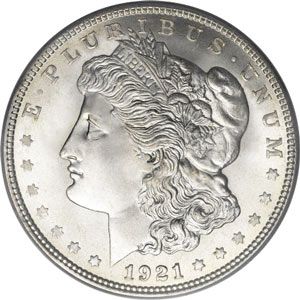
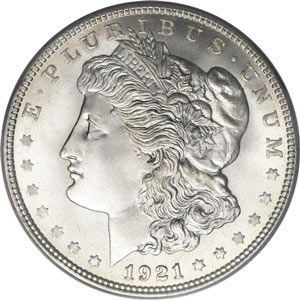
The obverse features a left-facing portrait of Liberty wearing a Phrygian cap adorned with wheat and cotton, symbolizing American agriculture and industry. The inscription "E PLURIBUS UNUM" arcs above, with "LIBERTY" displayed across the headband of the cap. The date appears at the bottom, flanked by stars along the rim. Morgan's initial "M" is positioned at the truncation of the neck, a subtle but well-known identifier among collectors.
The reverse presents a heraldic eagle with outstretched wings, clutching arrows in one talon and an olive branch in the other. A shield overlays the eagle's chest, and the inscriptions "UNITED STATES OF AMERICA" and "IN GOD WE TRUST" frame the design. The denomination "ONE DOLLAR" appears along the lower rim. The overall composition reflects the formal engraving conventions of late nineteenth-century American coinage.
For toned examples at the MS64 level, the surfaces that interact with light play a significant role in how the coin presents. Luster beneath the toning is typically still active and visible at this grade, and the combination of underlying cartwheel luster with developed color can produce a visual depth that flat, untoned coins do not replicate. PCGS certification confirms the coin's grade and the authenticity of the toning, which is an important consideration given the prevalence of artificially toned coins in the market.
This coin has been independently authenticated and graded by PCGS, one of the two most respected third-party grading services in the numismatic industry. PCGS certification involves physical examination under controlled conditions by experienced numismatists, and the coin is encapsulated in a tamper-evident holder with a unique certification number that can be verified through the PCGS registry. The holder itself serves as both a grade guarantee and a seal of authenticity.
We are an authorized dealer for both PCGS and NGC, which means we work directly within the certification infrastructure and are well-positioned to present certified products accurately. The specifications for this coin, including its .900 silver purity and 0.7734 troy ounce silver content, are consistent with the established standards for the Morgan Dollar series as struck by the United States Mint. No additional verification of metal content is necessary given the PCGS encapsulation and the extensive documentation available for this series.
The MS64 grade indicates an uncirculated coin with full mint luster and only minor surface marks that are not immediately noticeable without close inspection. At this level, the coin's fields and high points will show minimal disturbance, and the overall eye appeal is expected to be strong. The PCGS label identifies the specific date, designation, and toning attribution, providing a clear and documented description of the coin's character.
As a PCGS-certified coin, this piece ships in its original PCGS slab rather than a loose flip. The encapsulation protects the coin from handling damage and preserves the surfaces in the condition in which it was graded. No repackaging is applied to certified coins, as removing them from their holders would void the certification.
The base metal value of this coin reflects its 0.7734 troy ounces of .900 fine silver, which is priced relative to the current spot price of silver. However, the certified MS64 grade and original toning mean this coin trades with a numismatic premium that extends well beyond its melt value. The premium reflects collector demand, grade scarcity, the quality of the toning, and the added credibility that comes with PCGS certification.
Toned Morgan Dollars at higher grade levels occupy their own pricing tier within the market. Attractive, original toning at MS64 can command meaningful premiums over untoned examples of the same date and grade, particularly when the color spectrum and surface quality are considered desirable by the collector community. Our pricing reflects current market conditions for certified numismatic material, and the bid/ask spread displayed on our product page provides a transparent picture of both acquisition cost and current resale value.
The 1921 Morgan Dollar is among the most liquid numismatic coins in the domestic secondary market. Its combination of recognizable design, PCGS certification, and broad collector base means there is consistent demand across dealers, auction platforms, and direct marketplaces. Coins certified at MS64 with notable toning tend to attract both type collectors and date-specific specialists, which broadens the potential buyer pool.
We operate a two-way market that supports both purchasing and selling within the same platform, and our competitive buyback pricing is structured to reflect real wholesale market activity rather than arbitrary dealer discretion. For a coin at this grade with PCGS documentation, the path from purchase to resale is more straightforward than it is for raw, ungraded material, and the certification provides a common reference point that facilitates more efficient price discovery.
The 1921 Morgan Dollar occupies a unique position in the collector market as both a historically significant date and one of the few Morgan issues where original, high-grade examples are still accessible at a reasonable premium above type-coin pricing. The PCGS MS64 grade places this example firmly in the range where collector demand is active, and the original toning adds an additional layer of visual interest that many buyers actively seek.
Certified coins at this grade are also practical to hold and resell because the documentation is already in place. There is no guesswork about authenticity, silver content, or grade, and the PCGS holder provides protection that preserves the coin's market presentation over time. For buyers who want a piece that sits at the intersection of numismatic quality and recognized market liquidity, an MS64-graded 1921 Morgan with genuine toning represents a specific and well-defined point in the market rather than a generalized holding.
As an authorized PCGS and NGC dealer, we are well-equipped to present certified numismatic material accurately and responsibly. Our product listings reflect the actual coin in hand, and the grade, toning description, and pricing are all supported by the PCGS certification record. We hold an A rating with the Better Business Bureau and maintain active membership in both the American Numismatic Association and the National Coin and Bullion Association, which reflects a long-standing commitment to professional standards in the coin and precious metals industry.
Our platform is designed around transparency at every stage of the transaction. The bid/ask spread displayed on each product page reflects current market conditions for the specific item, not a generic estimate. Buyers can evaluate the full cost of ownership before making a decision, and our two-way market means liquidity is a consideration we take seriously from the beginning. We support every purchase with responsive customer service, secure fulfillment, and a straightforward process that treats experienced collectors and active buyers with the level of directness they expect.
Bullion Standard Pro gives members direct access to live, executable wholesale bid and ask pricing across certified numismatic and bullion products alike. For a coin like this 1921 Morgan PCGS MS64, where the numismatic premium can shift meaningfully with changes in collector demand, having visibility into real-time wholesale pricing provides a more grounded basis for evaluating whether current market conditions align with your buying or selling objectives. Portfolio valuations within Pro are calculated using live wholesale bid pricing, giving members a realistic view of liquidation value rather than a retail-based estimate.
The platform's product research and historical analytics tools allow members to evaluate certified coins using objective data including historical premium trends, bid/ask spread tightness, and liquidity metrics. Rather than relying on dealer assessments or secondary market anecdotes, Pro members can assess how a specific product has traded over time and how current pricing compares to historical norms. This kind of data-driven context is especially useful for numismatic material where premiums can vary considerably based on grade, toning quality, and prevailing market sentiment.
We support a wide range of payment methods to make the transaction process as straightforward as possible. Buyers can complete purchases using Visa, Mastercard, American Express, or Discover, as well as PayPal and bank-connected payments through Plaid for those who prefer a direct account link. Wire transfer and paper check are also accepted for buyers who prefer traditional payment channels.
For those who prefer digital currency, we accept cryptocurrency payments through BitPay, which provides a secure and verifiable transaction pathway. Every payment method is integrated within a secure checkout environment, and our fulfillment process is designed to move quickly once payment is confirmed. The goal is a buying experience that is efficient, transparent, and free of unnecessary friction from start to delivery.
Volume Discount Pricing Orders paid by debit card, credit card, and PayPal are an item's full list price and receive no discount. Orders paid by cryptocurrency receive a 3% discount from an item's full list price. Orders paid by eCheck (ACH), paper check, and bank wire receive a 4% discount from an item's full list price.
| Quantity | (e)Check/Wire | Crypto | CC/PayPal |
|---|---|---|---|
| 1 - 9 | $99.72 | $101.80 | $103.88 |
| 10 - 19 | $98.76 | $100.82 | $102.88 |
| 20+ | $97.80 | $99.84 | $101.88 |
1+
|
$94.10 | $96.06 | $98.02 |
Product ID: BST-0021526306
| Year | 1921 |
|---|---|
| Precious Metal Type | Silver |
| Bullion Coin Type | Morgan Dollar |
| Format | Coin |
| Country of Origin | United States |
| Brand/Mint | U.S. Mint |
| Mint Mark | Various |
| Purity | 0.9 |
| Weight | 0.7734 oz |
| Thickness (mm) | 2.4 mm |

| Diameter (mm) | 38.1 mm |
| Inner Pack (Quantity) | 20 |
| Grade | MS64 |
| Grading Service | PCGS |
The 1921 Morgan Silver Dollar is one of the most widely recognized and actively traded coins in American numismatics. Struck in .900 fine silver with a total weight of 0.7734 troy ounces, it was produced by the United States Mint and carries a face value of one dollar. This particular example has been certified by PCGS at MS64, meaning it meets the strict grading criteria for an uncirculated coin with only minor surface distractions that prevent a higher designation.
The toning noted on this coin is part of its numismatic character rather than a flaw. Natural toning that develops on silver coins over decades can range from light champagne hues to deeper blues, purples, and russets, and it is frequently associated with coins that have rested undisturbed in albums or original mint bags. For collectors and market participants alike, original, attractive toning is a recognized quality that enhances the visual appeal and market presence of a certified coin.
The Morgan Dollar series was introduced in 1878 following the Bland-Allison Act, which required the federal government to purchase silver and conv
…The 1921 Morgan Silver Dollar is one of the most widely recognized and actively traded coins in American numismatics. Struck in .900 fine silver with a total weight of 0.7734 troy ounces, it was produced by the United States Mint and carries a face value of one dollar. This particular example has been certified by PCGS at MS64, meaning it meets the strict grading criteria for an uncirculated coin with only minor surface distractions that prevent a higher designation.
The toning noted on this coin is part of its numismatic character rather than a flaw. Natural toning that develops on silver coins over decades can range from light champagne hues to deeper blues, purples, and russets, and it is frequently associated with coins that have rested undisturbed in albums or original mint bags. For collectors and market participants alike, original, attractive toning is a recognized quality that enhances the visual appeal and market presence of a certified coin.
The Morgan Dollar series was introduced in 1878 following the Bland-Allison Act, which required the federal government to purchase silver and convert it into coinage. Designed by George T. Morgan, the series ran continuously through 1904 before being discontinued. The 1921 date marks the coin's resumption under the Pittman Act of 1918, which authorized the melting of millions of existing silver dollars and their recoinage from newly purchased silver.
The 1921 Morgan is historically distinct in that it was the last year of production for the series before it was replaced by the Peace Dollar in 1922. All three active mint facilities at the time produced 1921-dated Morgan Dollars: Philadelphia, Denver, and San Francisco. The Philadelphia Mint struck the largest volume that year, and the combined mintage across all facilities reached tens of millions of coins, making the 1921 Morgan the highest-production year in the entire series.
Despite the large mintage, high-grade examples with original, undisturbed surfaces are far less common today. Many 1921 Morgans were released into circulation, melted, or cleaned at some point during their history. Coins that survived in original mint-bag storage or careful collections with intact, original surfaces represent a meaningful subset of what the market sees at this grade level.
The obverse features a left-facing portrait of Liberty wearing a Phrygian cap adorned with wheat and cotton, symbolizing American agriculture and industry. The inscription "E PLURIBUS UNUM" arcs above, with "LIBERTY" displayed across the headband of the cap. The date appears at the bottom, flanked by stars along the rim. Morgan's initial "M" is positioned at the truncation of the neck, a subtle but well-known identifier among collectors.
The reverse presents a heraldic eagle with outstretched wings, clutching arrows in one talon and an olive branch in the other. A shield overlays the eagle's chest, and the inscriptions "UNITED STATES OF AMERICA" and "IN GOD WE TRUST" frame the design. The denomination "ONE DOLLAR" appears along the lower rim. The overall composition reflects the formal engraving conventions of late nineteenth-century American coinage.
For toned examples at the MS64 level, the surfaces that interact with light play a significant role in how the coin presents. Luster beneath the toning is typically still active and visible at this grade, and the combination of underlying cartwheel luster with developed color can produce a visual depth that flat, untoned coins do not replicate. PCGS certification confirms the coin's grade and the authenticity of the toning, which is an important consideration given the prevalence of artificially toned coins in the market.
This coin has been independently authenticated and graded by PCGS, one of the two most respected third-party grading services in the numismatic industry. PCGS certification involves physical examination under controlled conditions by experienced numismatists, and the coin is encapsulated in a tamper-evident holder with a unique certification number that can be verified through the PCGS registry. The holder itself serves as both a grade guarantee and a seal of authenticity.
We are an authorized dealer for both PCGS and NGC, which means we work directly within the certification infrastructure and are well-positioned to present certified products accurately. The specifications for this coin, including its .900 silver purity and 0.7734 troy ounce silver content, are consistent with the established standards for the Morgan Dollar series as struck by the United States Mint. No additional verification of metal content is necessary given the PCGS encapsulation and the extensive documentation available for this series.
The MS64 grade indicates an uncirculated coin with full mint luster and only minor surface marks that are not immediately noticeable without close inspection. At this level, the coin's fields and high points will show minimal disturbance, and the overall eye appeal is expected to be strong. The PCGS label identifies the specific date, designation, and toning attribution, providing a clear and documented description of the coin's character.
As a PCGS-certified coin, this piece ships in its original PCGS slab rather than a loose flip. The encapsulation protects the coin from handling damage and preserves the surfaces in the condition in which it was graded. No repackaging is applied to certified coins, as removing them from their holders would void the certification.
The base metal value of this coin reflects its 0.7734 troy ounces of .900 fine silver, which is priced relative to the current spot price of silver. However, the certified MS64 grade and original toning mean this coin trades with a numismatic premium that extends well beyond its melt value. The premium reflects collector demand, grade scarcity, the quality of the toning, and the added credibility that comes with PCGS certification.
Toned Morgan Dollars at higher grade levels occupy their own pricing tier within the market. Attractive, original toning at MS64 can command meaningful premiums over untoned examples of the same date and grade, particularly when the color spectrum and surface quality are considered desirable by the collector community. Our pricing reflects current market conditions for certified numismatic material, and the bid/ask spread displayed on our product page provides a transparent picture of both acquisition cost and current resale value.
The 1921 Morgan Dollar is among the most liquid numismatic coins in the domestic secondary market. Its combination of recognizable design, PCGS certification, and broad collector base means there is consistent demand across dealers, auction platforms, and direct marketplaces. Coins certified at MS64 with notable toning tend to attract both type collectors and date-specific specialists, which broadens the potential buyer pool.
We operate a two-way market that supports both purchasing and selling within the same platform, and our competitive buyback pricing is structured to reflect real wholesale market activity rather than arbitrary dealer discretion. For a coin at this grade with PCGS documentation, the path from purchase to resale is more straightforward than it is for raw, ungraded material, and the certification provides a common reference point that facilitates more efficient price discovery.
The 1921 Morgan Dollar occupies a unique position in the collector market as both a historically significant date and one of the few Morgan issues where original, high-grade examples are still accessible at a reasonable premium above type-coin pricing. The PCGS MS64 grade places this example firmly in the range where collector demand is active, and the original toning adds an additional layer of visual interest that many buyers actively seek.
Certified coins at this grade are also practical to hold and resell because the documentation is already in place. There is no guesswork about authenticity, silver content, or grade, and the PCGS holder provides protection that preserves the coin's market presentation over time. For buyers who want a piece that sits at the intersection of numismatic quality and recognized market liquidity, an MS64-graded 1921 Morgan with genuine toning represents a specific and well-defined point in the market rather than a generalized holding.
As an authorized PCGS and NGC dealer, we are well-equipped to present certified numismatic material accurately and responsibly. Our product listings reflect the actual coin in hand, and the grade, toning description, and pricing are all supported by the PCGS certification record. We hold an A rating with the Better Business Bureau and maintain active membership in both the American Numismatic Association and the National Coin and Bullion Association, which reflects a long-standing commitment to professional standards in the coin and precious metals industry.
Our platform is designed around transparency at every stage of the transaction. The bid/ask spread displayed on each product page reflects current market conditions for the specific item, not a generic estimate. Buyers can evaluate the full cost of ownership before making a decision, and our two-way market means liquidity is a consideration we take seriously from the beginning. We support every purchase with responsive customer service, secure fulfillment, and a straightforward process that treats experienced collectors and active buyers with the level of directness they expect.
Bullion Standard Pro gives members direct access to live, executable wholesale bid and ask pricing across certified numismatic and bullion products alike. For a coin like this 1921 Morgan PCGS MS64, where the numismatic premium can shift meaningfully with changes in collector demand, having visibility into real-time wholesale pricing provides a more grounded basis for evaluating whether current market conditions align with your buying or selling objectives. Portfolio valuations within Pro are calculated using live wholesale bid pricing, giving members a realistic view of liquidation value rather than a retail-based estimate.
The platform's product research and historical analytics tools allow members to evaluate certified coins using objective data including historical premium trends, bid/ask spread tightness, and liquidity metrics. Rather than relying on dealer assessments or secondary market anecdotes, Pro members can assess how a specific product has traded over time and how current pricing compares to historical norms. This kind of data-driven context is especially useful for numismatic material where premiums can vary considerably based on grade, toning quality, and prevailing market sentiment.
We support a wide range of payment methods to make the transaction process as straightforward as possible. Buyers can complete purchases using Visa, Mastercard, American Express, or Discover, as well as PayPal and bank-connected payments through Plaid for those who prefer a direct account link. Wire transfer and paper check are also accepted for buyers who prefer traditional payment channels.
For those who prefer digital currency, we accept cryptocurrency payments through BitPay, which provides a secure and verifiable transaction pathway. Every payment method is integrated within a secure checkout environment, and our fulfillment process is designed to move quickly once payment is confirmed. The goal is a buying experience that is efficient, transparent, and free of unnecessary friction from start to delivery.