Overview of the 1995-D Blind Runner Silver Commemorative
The 1995-D Blind Runner is a United States Mint silver dollar commemorative issued as part of the 1995 to 1996 Atlanta Centennial Olympic Games series. Struck at the Denver Mint, this coin contains 0.7734 troy ounces of .900 fine silver and carries a face value of one dollar, conferring official legal tender status under United States law. It is offered here in Brilliant Uncirculated condition, representing the circulation-quality tier of commemorative production and distinguished from the Proof finish issued alongside it.
The coin honors blind and visually impaired athletes competing at the Paralympic level, making it one of the more distinctive and thematically specific issues in the entire Olympic commemorative program. We carry this piece as part of our broader offering of United States commemorative silver, which spans several decades of Mint-authorized issues.
History and Background
Congress authorized the 1995 to 1996 Centennial Olympic Games commemorative coin program to mark the 100th anniversary of the modern Olympic movement and to celebrate Atlanta as the host city for the 1996 Summer Games. The series became…
Overview of the 1995-D Blind Runner Silver Commemorative
The 1995-D Blind Runner is a United States Mint silver dollar commemorative issued as part of the 1995 to 1996 Atlanta Centennial Olympic Games series. Struck at the Denver Mint, this coin contains 0.7734 troy ounces of .900 fine silver and carries a face value of one dollar, conferring official legal tender status under United States law. It is offered here in Brilliant Uncirculated condition, representing the circulation-quality tier of commemorative production and distinguished from the Proof finish issued alongside it.
The coin honors blind and visually impaired athletes competing at the Paralympic level, making it one of the more distinctive and thematically specific issues in the entire Olympic commemorative program. We carry this piece as part of our broader offering of United States commemorative silver, which spans several decades of Mint-authorized issues.
History and Background
Congress authorized the 1995 to 1996 Centennial Olympic Games commemorative coin program to mark the 100th anniversary of the modern Olympic movement and to celebrate Atlanta as the host city for the 1996 Summer Games. The series became one of the largest and most ambitious commemorative programs in United States Mint history, spanning multiple years and encompassing a wide range of coin designs across different denominations and metals. The Blind Runner dollar was struck in 1995 and issued as part of the Paralympic subset within that broader program.
The Denver Mint, identified by the D mintmark, has operated since 1906 and is one of the primary facilities responsible for producing both circulating coinage and special commemorative issues. Its involvement in the Centennial Olympic series added production credibility to an already significant commemorative program. The Paralympic coins, while sometimes overshadowed by more prominent Olympic designs in the series, carry strong thematic meaning and have developed a dedicated following among collectors focused on the full run of 1995 to 1996 issues.
Design and Aesthetics
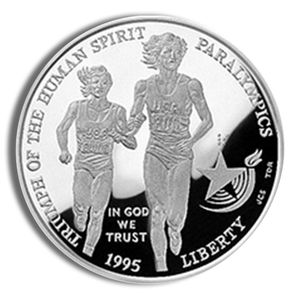
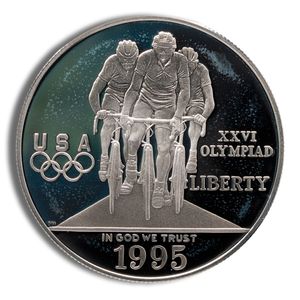
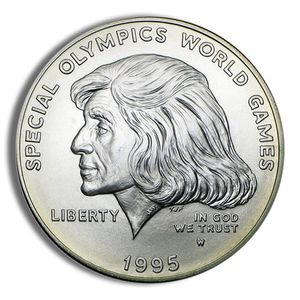
The obverse of the Blind Runner dollar depicts a male athlete running alongside a guide, arms extended forward in motion, conveying both the physical demand and the trust inherent in blind running as a Paralympic discipline. The composition is dynamic and sculptural, with the figures rendered in high relief against a relatively clean field. The inscription "LIBERTY" and the date 1995 appear on the obverse alongside the IN GOD WE TRUST motto.
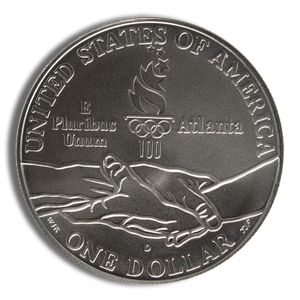
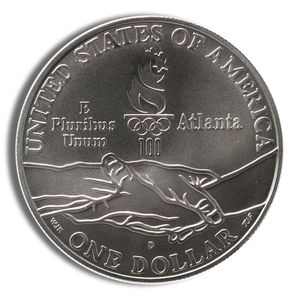
The reverse features the Atlanta 1996 Games logo and the standard commemorative inscriptions, including "UNITED STATES OF AMERICA," "ONE DOLLAR," and "E PLURIBUS UNUM." The overall design is the work of Jim Sharpe, whose rendering of the paired runners gave the coin a sense of movement that stands apart from more static commemorative compositions. The Brilliant Uncirculated finish gives the coin its characteristic cartwheel luster, a product of the die striking process at the Denver Mint.
Fractional Size and Accessibility
At 0.7734 troy ounces, this coin falls just under the one-ounce threshold common to many silver rounds and bullion coins. For buyers focused primarily on silver content by weight, this slightly smaller format represents a modest adjustment in cost relative to a full ounce piece. The difference is marginal, but it is worth noting for those building a position based on precise silver weight accumulation.
For collectors and commemorative buyers, the sub-ounce weight is simply part of the product's standard specification and carries no practical disadvantage. The coin's value in most collecting contexts is driven by its design, mintage, and condition rather than its silver content alone, which makes the fractional weight a secondary consideration rather than a meaningful limitation.
Authenticity and Product Integrity
As a United States Mint product, the 1995-D Blind Runner dollar was produced under strict federal standards governing silver content, coin weight, and die quality. The .900 silver composition and 0.7734-ounce weight are regulated specifications, not manufacturer claims, which provides a high baseline of confidence regarding metal content. The Denver Mint's production processes include internal quality control measures that are part of its mandate as a federal coining facility.
We verify authenticity, weight, and purity on products we handle, and our authorized dealer relationships with both PCGS and NGC allow us to facilitate professional third-party grading for customers who require it. For a government-issued commemorative like this one, the combination of Mint production standards and our own verification practices provides a well-documented chain of product integrity.
Condition and Packaging
Brilliant Uncirculated, often abbreviated BU, describes a coin that has been struck for collector purposes and has not entered general circulation. BU coins exhibit the luster produced during the minting process, though they may show minor handling or contact marks from the packaging, shipping, or counting processes at the Mint level. This is distinct from Proof, which receives a more labor-intensive striking process and polished dies, resulting in mirrored fields and frosted relief.
Individual coins ship in a protective plastic flip to prevent surface contact during transit. Standard packaging for United States Mint commemorative silver dollars of this era typically involves individual capsules or government-issued plastic holders for single-coin sales, with tube packaging used for larger quantities. If you are purchasing a single coin, expect it to arrive protected in a flip suitable for handling and storage without direct contact to the surfaces.
Pricing and Market Factors
Pricing on this coin reflects a combination of its silver melt value and the numismatic premium associated with its status as a United States commemorative issue. The spot price of silver forms the baseline, but commemoratives like the Blind Runner typically carry premiums influenced by original mintage figures, collector demand within the Olympic series, and the condition of the specific piece. The BU designation commands a lower premium than certified or Proof examples, making it an accessible entry point for collectors interested in the design without paying for top-tier certification.
We price this coin in real time against current silver spot, with premiums that reflect current secondary market demand. Buyers familiar with the broader 1995 to 1996 Olympic commemorative series will recognize that individual issues within that program vary considerably in demand and secondary market pricing, and the Blind Runner is among the more thematically compelling pieces in the set.
Selling and Liquidity
United States Mint commemoratives trade actively in the secondary market, particularly within series with established collector followings like the Centennial Olympic program. The Blind Runner's government-issued status, standardized silver content, and recognized design make it straightforward to assess and price when selling. Buyers in the numismatic market are generally familiar with the series and can evaluate condition and value relative to published mintage data.
We operate a two-way market, meaning customers can both purchase and sell this coin within our platform. Liquidity considerations are most relevant when weighing condition-specific premiums against buyback values, and we encourage buyers to evaluate the complete transaction, including what they can expect on the sell side, before committing to a purchase. Our pricing reflects real-time market conditions on both sides of that transaction.
Why Buy the 1995-D Blind Runner Silver Commemorative?
The Blind Runner stands out within the 1995 to 1996 Olympic commemorative series because of its subject matter. Most coins in that program depicted more familiar Olympic sports, which makes the Paralympic blind running design relatively distinctive as a collector piece. For those working through the complete series, it is a necessary acquisition. For buyers focused on individual issues, the human element in Sharpe's design makes it a more compelling choice than many of the standard athletic depictions found elsewhere in the program.
The BU condition strikes a practical balance between collectibility and cost. It carries the Mint's production quality and original luster without the additional expense of a Proof strike or third-party grading. For a buyer building a commemorative collection with an eye toward completeness and design quality, this coin delivers both.
Why Buy from Bullion Standard?
We have built our reputation since 2010 on straightforward pricing, genuine product authentication, and a buying experience that treats customers as informed adults rather than passive recipients of a sales pitch. Our A rating with the Better Business Bureau, membership in the American Numismatic Association, and membership in the National Coin and Bullion Association reflect a long-term commitment to operating with integrity in a market where trust is difficult to earn and easy to lose.
Our authorized dealer relationships with PCGS and NGC are particularly relevant for commemorative buyers who may want professional grading or who value the assurance that comes from a platform capable of facilitating third-party certification. We support the full range of payment options, including credit cards, wire transfer, PayPal, bank-connected payments through Plaid, paper check, and cryptocurrency via BitPay, and every transaction is handled with the security and reliability that a physical precious metals purchase demands. When it is time to sell, our two-way market means you are not starting from scratch with a new counterparty.
Get Near-Spot Pricing with Bullion Standard Pro
Bullion Standard Pro gives members access to live, executable wholesale bid and ask pricing across our catalog, including commemorative silver issues like the Blind Runner. For collectors evaluating premiums across the 1995 to 1996 Olympic series, the ability to view real-time wholesale pricing on individual issues provides a clearer picture of relative value than static retail listings. Portfolio valuation through Pro uses current wholesale bid prices, giving members a realistic view of liquidation value rather than a retail estimate.
Pro also includes proprietary market intelligence tools, historical premium analysis, and spread data that can help collectors understand how demand for specific commemorative issues shifts over time. For a series with as many individual releases as the Centennial Olympic program, having access to product-level pricing data and market comparisons is genuinely useful when making decisions about which issues to prioritize and at what price levels they represent fair value.
Flexible and Secure Payment Options
We accept a wide range of payment methods to make completing your purchase as straightforward as possible. Major credit cards, including Visa, Mastercard, American Express, and Discover, are accepted, as are PayPal, bank-connected payments through Plaid, wire transfer, paper check, and cryptocurrency payments via BitPay. Each method is processed through a secure transaction environment designed to protect your information and ensure reliable order fulfillment from the point of purchase through delivery.
1995-D $1 Blind Runner Silver Commemorative - BU
Product ID: BST-000313F959
Specifications
Year
1995
Precious Metal Type
Silver
Format
Coin
Country of Origin
United States
Brand/Mint
U.S. Mint
Mint Mark
D - Denver
Purity
0.9
Weight
0.7734 oz
Diameter (mm)
38.1
mm
Product Details
Overview of the 1995-D Blind Runner Silver Commemorative
The 1995-D Blind Runner is a United States Mint silver dollar commemorative issued as part of the 1995 to 1996 Atlanta Centennial Olympic Games series. Struck at the Denver Mint, this coin contains 0.7734 troy ounces of .900 fine silver and carries a face value of one dollar, conferring official legal tender status under United States law. It is offered here in Brilliant Uncirculated condition, representing the circulation-quality tier of commemorative production and distinguished from the Proof finish issued alongside it.
The coin honors blind and visually impaired athletes competing at the Paralympic level, making it one of the more distinctive and thematically specific issues in the entire Olympic commemorative program. We carry this piece as part of our broader offering of United States commemorative silver, which spans several decades of Mint-authorized issues.
History and Background
Congress authorized the 1995 to 1996 Centennial Olympic Games commemorative coin program to mark the 100th anniversary of the modern Olympic movement and to celebrate Atlanta as the host city for the 1996 Summer Games. The series became…
Overview of the 1995-D Blind Runner Silver Commemorative
The 1995-D Blind Runner is a United States Mint silver dollar commemorative issued as part of the 1995 to 1996 Atlanta Centennial Olympic Games series. Struck at the Denver Mint, this coin contains 0.7734 troy ounces of .900 fine silver and carries a face value of one dollar, conferring official legal tender status under United States law. It is offered here in Brilliant Uncirculated condition, representing the circulation-quality tier of commemorative production and distinguished from the Proof finish issued alongside it.
The coin honors blind and visually impaired athletes competing at the Paralympic level, making it one of the more distinctive and thematically specific issues in the entire Olympic commemorative program. We carry this piece as part of our broader offering of United States commemorative silver, which spans several decades of Mint-authorized issues.
History and Background
Congress authorized the 1995 to 1996 Centennial Olympic Games commemorative coin program to mark the 100th anniversary of the modern Olympic movement and to celebrate Atlanta as the host city for the 1996 Summer Games. The series became one of the largest and most ambitious commemorative programs in United States Mint history, spanning multiple years and encompassing a wide range of coin designs across different denominations and metals. The Blind Runner dollar was struck in 1995 and issued as part of the Paralympic subset within that broader program.
The Denver Mint, identified by the D mintmark, has operated since 1906 and is one of the primary facilities responsible for producing both circulating coinage and special commemorative issues. Its involvement in the Centennial Olympic series added production credibility to an already significant commemorative program. The Paralympic coins, while sometimes overshadowed by more prominent Olympic designs in the series, carry strong thematic meaning and have developed a dedicated following among collectors focused on the full run of 1995 to 1996 issues.
Design and Aesthetics
The obverse of the Blind Runner dollar depicts a male athlete running alongside a guide, arms extended forward in motion, conveying both the physical demand and the trust inherent in blind running as a Paralympic discipline. The composition is dynamic and sculptural, with the figures rendered in high relief against a relatively clean field. The inscription "LIBERTY" and the date 1995 appear on the obverse alongside the IN GOD WE TRUST motto.
The reverse features the Atlanta 1996 Games logo and the standard commemorative inscriptions, including "UNITED STATES OF AMERICA," "ONE DOLLAR," and "E PLURIBUS UNUM." The overall design is the work of Jim Sharpe, whose rendering of the paired runners gave the coin a sense of movement that stands apart from more static commemorative compositions. The Brilliant Uncirculated finish gives the coin its characteristic cartwheel luster, a product of the die striking process at the Denver Mint.
Fractional Size and Accessibility
At 0.7734 troy ounces, this coin falls just under the one-ounce threshold common to many silver rounds and bullion coins. For buyers focused primarily on silver content by weight, this slightly smaller format represents a modest adjustment in cost relative to a full ounce piece. The difference is marginal, but it is worth noting for those building a position based on precise silver weight accumulation.
For collectors and commemorative buyers, the sub-ounce weight is simply part of the product's standard specification and carries no practical disadvantage. The coin's value in most collecting contexts is driven by its design, mintage, and condition rather than its silver content alone, which makes the fractional weight a secondary consideration rather than a meaningful limitation.
Authenticity and Product Integrity
As a United States Mint product, the 1995-D Blind Runner dollar was produced under strict federal standards governing silver content, coin weight, and die quality. The .900 silver composition and 0.7734-ounce weight are regulated specifications, not manufacturer claims, which provides a high baseline of confidence regarding metal content. The Denver Mint's production processes include internal quality control measures that are part of its mandate as a federal coining facility.
We verify authenticity, weight, and purity on products we handle, and our authorized dealer relationships with both PCGS and NGC allow us to facilitate professional third-party grading for customers who require it. For a government-issued commemorative like this one, the combination of Mint production standards and our own verification practices provides a well-documented chain of product integrity.
Condition and Packaging
Brilliant Uncirculated, often abbreviated BU, describes a coin that has been struck for collector purposes and has not entered general circulation. BU coins exhibit the luster produced during the minting process, though they may show minor handling or contact marks from the packaging, shipping, or counting processes at the Mint level. This is distinct from Proof, which receives a more labor-intensive striking process and polished dies, resulting in mirrored fields and frosted relief.
Individual coins ship in a protective plastic flip to prevent surface contact during transit. Standard packaging for United States Mint commemorative silver dollars of this era typically involves individual capsules or government-issued plastic holders for single-coin sales, with tube packaging used for larger quantities. If you are purchasing a single coin, expect it to arrive protected in a flip suitable for handling and storage without direct contact to the surfaces.
Pricing and Market Factors
Pricing on this coin reflects a combination of its silver melt value and the numismatic premium associated with its status as a United States commemorative issue. The spot price of silver forms the baseline, but commemoratives like the Blind Runner typically carry premiums influenced by original mintage figures, collector demand within the Olympic series, and the condition of the specific piece. The BU designation commands a lower premium than certified or Proof examples, making it an accessible entry point for collectors interested in the design without paying for top-tier certification.
We price this coin in real time against current silver spot, with premiums that reflect current secondary market demand. Buyers familiar with the broader 1995 to 1996 Olympic commemorative series will recognize that individual issues within that program vary considerably in demand and secondary market pricing, and the Blind Runner is among the more thematically compelling pieces in the set.
Selling and Liquidity
United States Mint commemoratives trade actively in the secondary market, particularly within series with established collector followings like the Centennial Olympic program. The Blind Runner's government-issued status, standardized silver content, and recognized design make it straightforward to assess and price when selling. Buyers in the numismatic market are generally familiar with the series and can evaluate condition and value relative to published mintage data.
We operate a two-way market, meaning customers can both purchase and sell this coin within our platform. Liquidity considerations are most relevant when weighing condition-specific premiums against buyback values, and we encourage buyers to evaluate the complete transaction, including what they can expect on the sell side, before committing to a purchase. Our pricing reflects real-time market conditions on both sides of that transaction.
Why Buy the 1995-D Blind Runner Silver Commemorative?
The Blind Runner stands out within the 1995 to 1996 Olympic commemorative series because of its subject matter. Most coins in that program depicted more familiar Olympic sports, which makes the Paralympic blind running design relatively distinctive as a collector piece. For those working through the complete series, it is a necessary acquisition. For buyers focused on individual issues, the human element in Sharpe's design makes it a more compelling choice than many of the standard athletic depictions found elsewhere in the program.
The BU condition strikes a practical balance between collectibility and cost. It carries the Mint's production quality and original luster without the additional expense of a Proof strike or third-party grading. For a buyer building a commemorative collection with an eye toward completeness and design quality, this coin delivers both.
Why Buy from Bullion Standard?
We have built our reputation since 2010 on straightforward pricing, genuine product authentication, and a buying experience that treats customers as informed adults rather than passive recipients of a sales pitch. Our A rating with the Better Business Bureau, membership in the American Numismatic Association, and membership in the National Coin and Bullion Association reflect a long-term commitment to operating with integrity in a market where trust is difficult to earn and easy to lose.
Our authorized dealer relationships with PCGS and NGC are particularly relevant for commemorative buyers who may want professional grading or who value the assurance that comes from a platform capable of facilitating third-party certification. We support the full range of payment options, including credit cards, wire transfer, PayPal, bank-connected payments through Plaid, paper check, and cryptocurrency via BitPay, and every transaction is handled with the security and reliability that a physical precious metals purchase demands. When it is time to sell, our two-way market means you are not starting from scratch with a new counterparty.
Get Near-Spot Pricing with Bullion Standard Pro
Bullion Standard Pro gives members access to live, executable wholesale bid and ask pricing across our catalog, including commemorative silver issues like the Blind Runner. For collectors evaluating premiums across the 1995 to 1996 Olympic series, the ability to view real-time wholesale pricing on individual issues provides a clearer picture of relative value than static retail listings. Portfolio valuation through Pro uses current wholesale bid prices, giving members a realistic view of liquidation value rather than a retail estimate.
Pro also includes proprietary market intelligence tools, historical premium analysis, and spread data that can help collectors understand how demand for specific commemorative issues shifts over time. For a series with as many individual releases as the Centennial Olympic program, having access to product-level pricing data and market comparisons is genuinely useful when making decisions about which issues to prioritize and at what price levels they represent fair value.
Flexible and Secure Payment Options
We accept a wide range of payment methods to make completing your purchase as straightforward as possible. Major credit cards, including Visa, Mastercard, American Express, and Discover, are accepted, as are PayPal, bank-connected payments through Plaid, wire transfer, paper check, and cryptocurrency payments via BitPay. Each method is processed through a secure transaction environment designed to protect your information and ensure reliable order fulfillment from the point of purchase through delivery.
This website uses cookies for analytics and to deliver personalized content. By continuing to
use our site, you acknowledge that you have read and agree to our Privacy Policy and Cookie
Policy.
Current Quantities Available
Unfortunately, we only have 0
of
this item in
stock.
Please call us at (833) 278-4653
or email us at support@bullionstandard.com
if you wish to purchase a larger quantity than what is available on our website.
We can often locate additional quantities.

 (833) 278-4653


.png)