Buy Commemorative Coins Online
Commemorative coins are limited issues struck to honor a person, an event, an anniversary or an institution, and our catalog brings together more than three hundred of them from the U.S. Mint and from government mints around the world. Its core is the modern U.S. program that began in 1982: silver dollars running from the 1983 Los Angeles Olympic issues to the 2019 Apollo 11 and American Legion coins, 1982 George Washington half dollars, and $5 and $10 gold commemoratives.
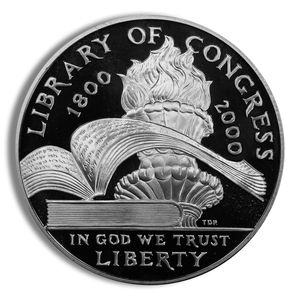
Alongside those standard formats you'll find special gold pieces such as the 2000-W Library of Congress bimetallic $10, the 2014-W 3/4 oz JFK half dollar, the 2016-W gold Mercury dime, Standing Liberty quarter and Walking Liberty half, First Spouse half-ounce coins and the American Arts gold medallions. Anniversary sets of American Silver and Gold Eagles, Morgan and Peace dollars from 2021 onward, and commemoratives from Canada, Mexico, Australia, Great Britain and the former Soviet Union complete the picture.
Most pieces are offered in original government packaging, many are certified by PCGS or NGC in grades up to MS70 and PF70, and a few are sold as random year or random design listings. Each product page shows the live ask next to the current bid, so you can see what a coin costs and what it would bring back before you decide.
What Are Commemorative Coins?
A commemorative coin is legal tender produced for a limited time to mark something specific, rather than to circulate or to serve as an everyday bullion product. In the United States every program needs its own act of Congress, which fixes the subject, the denominations, the metal, the maximum mintage and a surcharge paid to an organization connected with the theme. The Mint sells the coins directly to the public for a set period, and once that window closes the coins aren't struck again.
That model sets them apart from bullion. An American Silver Eagle is minted every year in large quantities and trades mainly on its silver, while a 1997 Jackie Robinson dollar was struck once, in a limited run, and trades mainly on scarcity, condition and interest in its subject. Medals are a related but separate format with no face value, and our catalog includes several, such as the American Arts gold medallions and the 2018 George Washington and John Adams silver presidential medals.
People come to commemoratives for different reasons. Some build collections around a theme like military service, the Olympics, presidents and first ladies or space exploration, others try to complete every modern silver dollar by date, mint and finish, and many simply want one coin that marks a moment, an anniversary or a cause they care about.
History and Background
American commemorative coinage began in 1892 with a half dollar for the World's Columbian Exposition in Chicago. Over the following decades the Mint produced dozens of commemorative half dollars along with a few gold dollars, quarter eagles and other denominations, but many later issues served narrow local or promotional interests, and the program ended in 1954. Those classic coins are background here rather than part of our current selection.
The modern era opened in 1982 with a 90% silver half dollar for the 250th anniversary of George Washington's birth. The Los Angeles Olympic program of 1983 and 1984 brought the first commemorative silver dollars since 1900, and its 1984 $10 gold eagle was the first U.S. gold coin struck since 1933. New programs followed almost every year, and after a crowded stretch in the 1990s a 1996 reform law limited the Mint to two commemorative programs per year.
Other countries built traditions of their own. Mexico issued silver pesos for the centennial of its 1857 Constitution and for the 1968 Mexico City Olympics, Canada struck a $20 gold coin for the 1967 centennial of Confederation followed by decades of $100 gold commemoratives, and the Soviet Union produced 100 rouble gold coins for the 1980 Moscow Games. In recent years the Perth Mint, the Royal Canadian Mint and The Royal Mint have released commemoratives for wartime anniversaries and cultural subjects in .999 and .9999 fine metal.
Purity, Weight, and Specifications
U.S. commemoratives follow a small set of standards. From 1983 through 2018 the silver dollar was struck in .900 fine silver at 26.73 grams, giving 0.7734 troy ounces of silver, and beginning with the 2019 issues the Mint switched to .999 fine silver at the same weight, about 0.859 ounces. The 1982 Washington half dollar is .900 fine as well, with 0.3617 ounces of silver.
Gold is just as standardized. A $5 gold commemorative weighs 8.359 grams at .900 fine and contains 0.2419 troy ounces of gold, and a $10 gold commemorative holds 0.4838 ounces at the same fineness. Newer and special gold pieces often use 24 karat .9999 gold instead, including the 3/4 oz JFK half dollar, the 2016-W centennial coins at 1/10, 1/4 and 1/2 oz and the half-ounce First Spouse coins, while the American Gold Eagles in the anniversary sets are 22 karat at .9167 fine.
World issues cover a wider range. Mexican commemorative pesos are .720 or .900 silver, Canada's $100 gold coins moved from 22 karat with a half ounce of gold to 14 karat with a quarter ounce in 1987, and recent Perth Mint and Royal Canadian Mint pieces are .999 or .9999 fine. U.S. commemorative silver dollars don't state their fineness or weight on the coin the way bullion does, so the specifications box on each product page is the place to confirm metal content.
Available Brands, Mints, and Product Variations
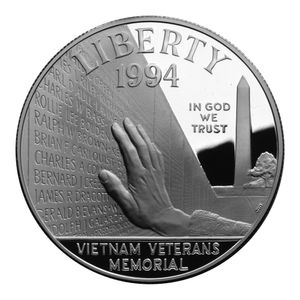
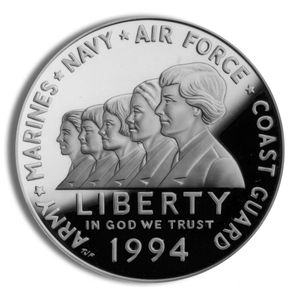
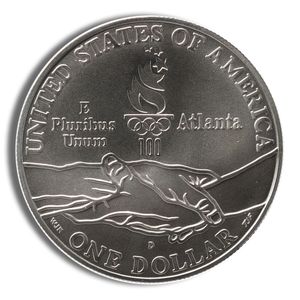
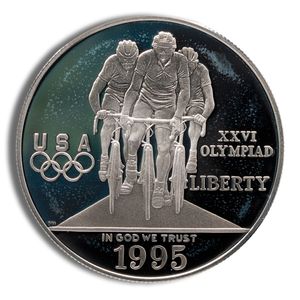
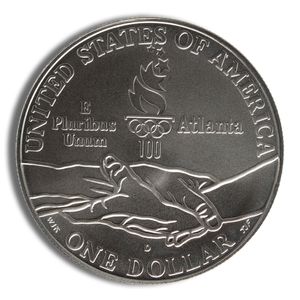
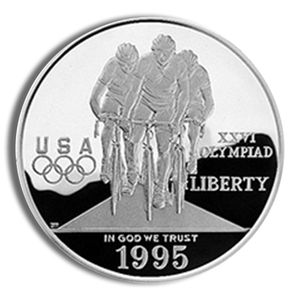
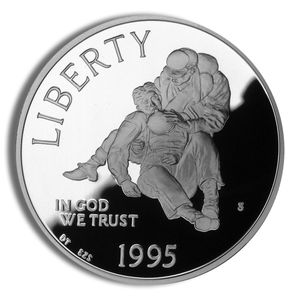
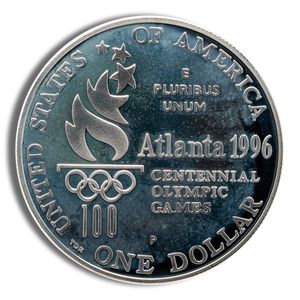
U.S. Mint silver dollars make up most of our catalog, and they group naturally by theme. Military issues include the 1991 Korean War and USO dollars, the 1993 World War II coin, the 1994 Prisoner of War, Vietnam Veterans and Women in Military Service trio, and later programs for the Marine Corps, the U.S. Army, the Medal of Honor and the Five Star Generals. Olympic dollars run from the 1983 and 1984 Los Angeles coins through 1988 and 1992 to the Atlanta designs of 1995 and 1996, including gymnastics, cycling, rowing, tennis and the Paralympic blind runner and wheelchair athlete, and on to the 2002 Salt Lake City Winter Games.
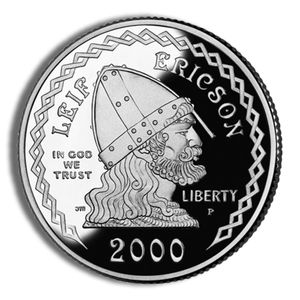
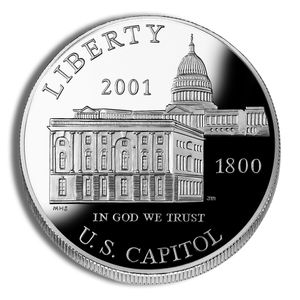
Presidents and public figures form another large group, from the 1990 Eisenhower and 1993 Jefferson and Madison dollars to the 1999 Dolley Madison, 2005 John Marshall, 2006 Benjamin Franklin and 2009 Abraham Lincoln issues. Institutions and culture are well covered too, with the White House, the Capitol, the Smithsonian, the Library of Congress, Jackie Robinson, the Baseball Hall of Fame, Mark Twain and the Boy Scouts and Girl Scouts, while exploration runs from Columbus and Leif Ericson to Lewis and Clark, the Wright brothers' First Flight and the curved 2019 Apollo 11 dollar.
Most U.S. issues come in both proof and uncirculated versions, struck at Philadelphia, Denver, San Francisco or West Point, and many are offered raw in original packaging as well as graded by NGC or PCGS. Random listings include modern silver dollars and $5 and $10 gold coins of our choosing, plus random year First Spouse coins and Arts medallions. World coins come from the Royal Canadian Mint, the Perth Mint, The Royal Mint, the Royal Dutch Mint and Mexico's Casa de Moneda, with subjects ranging from the Devil's Brigade and the Battle of the Coral Sea to 60 years of James Bond.
Pricing, Premiums, and Market Factors
Commemoratives trade at collector premiums, not near spot. Metal content is the baseline that moves with the gold or silver market, and everything above it is numismatic value, which can be a modest add-on for a common silver dollar in its box or most of the price for a low-mintage gold coin or a perfect-grade example.
Mintage is usually the biggest driver. The 1983 Olympic and 1986 Statue of Liberty dollars were struck in large numbers and generally carry smaller premiums, while issues like the uncirculated 1996 Atlanta dollars, the 1997 Jackie Robinson coins and the 2000-W Library of Congress bimetallic $10 had far smaller runs. Grade matters next, since the gap between MS69 and MS70 or PF69 and PF70 can be substantial, and finish counts as well, because in many 1990s programs the uncirculated version sold far fewer coins than the proof and is now the scarcer of the two.
Packaging and subject round it out. A coin with its original U.S. Mint box and certificate of authenticity generally commands more than the same coin loose or in a capsule only, and themes with deep collector followings, such as military service, space and baseball, can support stronger demand. We show the live bid and ask on every product page so you can see how a particular coin is priced on both sides of our two-way market.
Condition, Packaging, and What to Expect
Raw U.S. commemoratives listed with box and COA arrive as issued: the coin in a clear capsule, seated in the Mint's presentation case with its certificate. Proofs show mirrored fields with frosted devices, while uncirculated coins have a softer satin finish. Listings marked no box and COA, or protective capsule only, contain the coin without the original case or paperwork.
Many silver dollars from the 1980s and 1990s have been in their original capsules for decades, and light toning or small spots on some pieces are a normal effect of age rather than damage. Certified coins come sealed in their NGC or PCGS holders at the stated grade, and listings marked random label may arrive in any label style the grading service used for that coin.
For random year and random design listings, we choose the coin from available inventory, so the date, design or finish you receive can differ from the photo. Multi-coin sets such as the 2006 20th Anniversary Gold Eagle set or the 2012-S Silver Eagle San Francisco set come in their original government packaging unless a listing states otherwise.
Authenticity and Verification
Most of our commemoratives were sold by the U.S. Mint or another government mint and come to us through established wholesalers and distributors. Every piece is checked before it ships, with attention to weight, design details, finish and whether the coin, case and certificate match each other and the listing.
Graded coins add an independent layer. NGC and PCGS authenticate each coin before encapsulating it, and the certification number on the label can be looked up on the grading service's website to confirm the date, mint mark, grade and designation. As an authorized dealer for both services, we source certified commemoratives through proper channels.
Counterfeits of modern commemoratives are less common than fakes of bullion or classic coins, but they exist, and fake holders and copied certificates turn up as well. Buying from an established dealer, keeping original packaging together and checking certification numbers are the simplest protections.
Liquidity and Resale Considerations
Commemoratives are less interchangeable than bullion, since each issue trades on its own mintage, finish and demand. Common modern silver dollars in original packaging are easy to sell, but their bids often sit close to metal value plus a modest premium, while scarcer coins and top-grade certified pieces depend more on finding a collector who wants that particular issue.
Recognition helps. U.S. Mint commemoratives, NGC and PCGS holders and well-known world mints give buyers a clear reference point, and complete packaging makes any coin easier to price. Spreads on commemoratives are typically wider than on bullion, so comparing the bid and ask on a product page before buying shows what the round trip looks like for that specific coin.
Storage and Security
Original Mint cases are bulky, but keeping the coin, capsule, box and certificate together preserves full resale value. If you store capsules separately to save space, label them clearly and keep the boxes and certificates in a dry place where they won't be crushed or separated from their coins.
Humidity is the main enemy of older silver commemoratives, so a cool, dry environment with silica gel or another desiccant helps prevent spotting and toning. Never open sealed capsules or holders, never clean a coin, and avoid soft vinyl flips, which can leave residue. Graded coins store best upright in slab boxes.
A fire-rated home safe suits most commemorative collections, while bank safe deposit boxes or a professional depository make sense for larger holdings or high-grade gold. Keep an inventory with photos, certificate details and certification numbers for insurance and for future sales.
Selling and Buyback Options
You can sell commemoratives back to us through the same two-way market you buy from. Product pages show our current bid, and our purchasing team handles each sale from price confirmation through receipt, verification and payment.
Buyback pricing depends on the specific issue, its finish and grade, whether the original box and certificate are present, current demand for that coin, and the spot price of its metal. Bids on common silver dollars track silver closely, while scarce or certified pieces are priced from recent market activity for that coin and grade.
A little preparation helps. Send coins in their original capsules, cases and holders, keep sets complete, and don't try to clean or improve a coin's appearance, since any cleaning reduces what a collector or dealer will pay.
Why Buy Commemorative Coins?
Commemoratives combine government backing with a story. Each U.S. issue is legal tender struck by the U.S. Mint under an act of Congress, in a fixed and finite quantity, honoring a subject that was chosen to be remembered. That pairing of official status and limited production gives every coin a clear identity in the market.
They also hold real precious metal. A modern silver dollar carries about three quarters of an ounce of silver or more, and gold issues range from a tenth of an ounce to a full ounce of gold, so the metal value is tangible even when the premium reflects collector interest.
Collectibility is the third reason. With dozens of programs spanning more than four decades, commemorative coins can be collected by theme, by date, by mint or by grade, and the same structure makes it easy to pick a single coin tied to a birthday, a service record or an anniversary.
Why Buy from Bullion Standard?
We started in San Diego in 2010 and have since become a national online marketplace, guided by the view that you get one chance to earn a customer's trust. With commemoratives, where details like finish, mint mark and packaging change a coin's value, that means listing each one accurately and pricing it openly.
Bullion Standard holds an A+ rating with the Better Business Bureau, is a member of the American Numismatic Association and the National Coin and Bullion Association, and is an authorized PCGS and NGC dealer. Our product research tools let you compare premiums, spreads and liquidity across coins using objective data, which is especially useful when you're choosing between similar issues.
Checkout supports Visa, Mastercard, American Express, Discover, PayPal, Plaid bank-connected payments, wire transfer, paper check and cryptocurrency through BitPay. Orders are verified and packed for secure, reliable delivery, and because we buy back what we sell, the relationship continues after the purchase.
Get Near-Spot Pricing with Bullion Standard Pro
Pro membership opens up live, executable wholesale bid and ask prices across a broad range of precious metals products, with no extra dealer markup or dealer spread added to member pricing. What members see is the price the wholesale market will actually transact at, shaped by real supply and demand.
That doesn't turn commemoratives into spot-priced coins, since their collector premiums exist at wholesale too. What changes is visibility: members can value their holdings at live wholesale bid, study historical premium and spread data, and use liquidity metrics and buy/sell ratio indicators to see how actively a coin trades.
For collectors who buy regularly or keep a close eye on cost, Pro makes it practical to judge each purchase against the market itself. It's the most transparent way we offer to buy and sell commemorative coins.


 (833) 278-4653