Mercury dimes are among the most recognized 90% silver coins in the American junk silver market. Struck by the United States Mint between 1916 and 1945, these coins contain a total silver weight of approximately 0.715 troy ounces per dollar of face value, making a $1 face value lot the standard unit for pricing and trading in the secondary market. Each dime carries a composition of 90% silver and 10% copper, which is consistent across the entire series.
We offer these coins in $1 face value increments, representing ten individual dimes. This format is one of the most familiar and liquid in the junk silver trade, widely recognized by dealers, collectors, and buyers across the country.
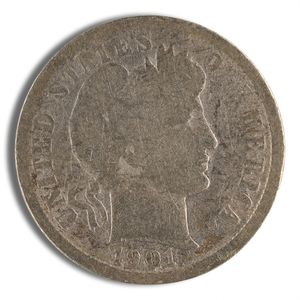
The Mercury dime, formally known as the Winged Liberty Head dime, was designed by sculptor Adolph A. Weinman and entered circulation in 1916, replacing the Barber dime series that had been produced since 1892. Weinman's design was selected through a competition initiated by the United States Mint and was widely praised upon release for its artistic quality. The coin remained in production through 1945, when it was replaced
…Mercury dimes are among the most recognized 90% silver coins in the American junk silver market. Struck by the United States Mint between 1916 and 1945, these coins contain a total silver weight of approximately 0.715 troy ounces per dollar of face value, making a $1 face value lot the standard unit for pricing and trading in the secondary market. Each dime carries a composition of 90% silver and 10% copper, which is consistent across the entire series.
We offer these coins in $1 face value increments, representing ten individual dimes. This format is one of the most familiar and liquid in the junk silver trade, widely recognized by dealers, collectors, and buyers across the country.
The Mercury dime, formally known as the Winged Liberty Head dime, was designed by sculptor Adolph A. Weinman and entered circulation in 1916, replacing the Barber dime series that had been produced since 1892. Weinman's design was selected through a competition initiated by the United States Mint and was widely praised upon release for its artistic quality. The coin remained in production through 1945, when it was replaced by the Roosevelt dime.
The series was struck at three mint facilities: Philadelphia, Denver, and San Francisco. Throughout its run, the Mercury dime circulated as everyday currency and accumulated natural wear consistent with active use. Today, circulated examples are valued primarily for their silver content rather than their numismatic grade, though certain key dates and mint marks carry additional collector premiums beyond the metal value.
The 90% silver standard used in U.S. coinage was in place from the mid-1800s until 1965, when the Coinage Act of 1965 eliminated silver from dimes and quarters and reduced it in half dollars. This change is what established the pre-1965 coinage as a distinct category in the precious metals market.
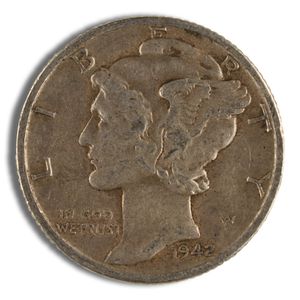
The obverse of the Mercury dime features a portrait of Liberty wearing a winged Phrygian cap, which was commonly mistaken for the Roman god Mercury, giving the coin its popular name. The portrait faces left and is rendered with fine sculptural detail that reads well even on heavily circulated examples. The inscriptions "LIBERTY" and "IN GOD WE TRUST" appear alongside the date and mint mark.
The reverse depicts a Roman fasces, a bundle of rods bound around an axe, symbolizing unity and strength. An olive branch wraps around the fasces, representing peace. The inscription "UNITED STATES OF AMERICA" arcs across the top, with "ONE DIME" at the base and "E PLURIBUS UNUM" completing the design. Weinman's monogram appears on both sides.
Circulated examples will show varying degrees of wear across the high points of the design, including the face, hair, and fasces detail. The depth of remaining detail depends on how long and heavily a given coin circulated, and no two coins will look exactly alike at the average circulated grade.
At roughly 17.9 millimeters in diameter and weighing 2.5 grams each, Mercury dimes are compact and easy to handle in quantity. The small size makes them practical for buyers who want flexibility in how they hold or eventually transact physical silver. Ten coins per dollar of face value also keeps individual unit costs low relative to larger silver formats.
The $1 face value lot is a standard entry point for junk silver buyers and makes it straightforward to scale a purchase up or down based on budget. Buyers looking for modest silver exposure without committing to full rolls or bags will find this format a comfortable starting point.
Every coin we sell is verified for authenticity and silver content before it is listed or shipped. Mercury dimes are well-documented coins with consistent weight and composition standards established by the United States Mint, making counterfeit detection straightforward for experienced hands. The 90% silver composition and 2.5-gram weight per coin are fixed characteristics that have been catalogued for over a century.
Our authorized dealer relationships with both PCGS and NGC reflect a broader commitment to numismatic authenticity standards. While average circulated junk silver is not typically submitted for third-party grading, our familiarity with grading service standards informs how we evaluate and handle all coin inventory we carry.
These coins are graded average circulated, which is the standard condition designation for junk silver Mercury dimes. Average circulated means the coins have seen genuine use as currency and will show visible wear on the high points of the design. The date and major design features will generally remain legible, but surface detail will be reduced. Coins in this lot are not sorted by date, mint mark, or grade beyond the average circulated standard.
Individual $1 face value lots of ten dimes ship in protective plastic flips to keep the coins together and secure during transit. Larger quantity orders may ship in tubes or sealed bags consistent with standard junk silver packaging practices. Because these are circulated coins sourced from the secondary market, minor contact marks, surface toning, and handling signs are expected and do not affect the silver content or market value of the coins.
Mercury dimes in junk silver lots are priced based on the current spot price of silver and the standard 0.715 troy ounce silver content per dollar of face value. This multiplier is the accepted industry standard and is used by dealers and buyers throughout the market. The premium above spot for junk silver tends to be lower than for modern government-minted coins, which reflects the utilitarian nature of the product and the absence of collector-grade presentation.
Premiums on junk silver can shift based on overall silver demand, availability of circulated 90% coins in the secondary market, and broad market conditions. During periods of elevated silver demand, junk silver lots can see tighter supply and higher relative premiums. Our pricing reflects real-time spot conditions and is updated to maintain consistency with current market rates.
Junk silver is one of the most liquid forms of physical silver available. The 90% composition and face value denomination are immediately understood by dealers and buyers nationwide, which removes ambiguity from resale transactions. Mercury dimes specifically are among the most recognized coins in this category and carry no identification uncertainty in the secondary market.
We operate a two-way market that supports both buying and selling within the same platform. Customers who decide to sell can do so using our competitive buyback pricing rather than having to locate a separate buyer. Thinking about liquidity before a purchase is made is a sound practice, and we make that consideration easier by keeping both sides of the transaction visible and accessible.
$1 face value Mercury dime lots offer a straightforward way to hold physical silver in a form that is widely accepted and easily priced. The coins carry a clear, standardized silver content, eliminating the need for assay documentation or refinery certification. Their historical status as circulated U.S. legal tender adds a layer of familiarity that many buyers find reassuring when compared to privately minted rounds or bars.
The Mercury dime series also holds modest collector appeal beyond its silver value, particularly for buyers who appreciate early 20th-century American coinage. While average circulated examples are valued primarily on metal content, they remain historically significant coins that circulated through meaningful decades of American history. For buyers interested in both the metal and the artifact, this format offers something that generic silver products do not.
We have built our reputation on transparent pricing, honest product descriptions, and a purchasing experience that does not rely on pressure or obscured costs. Our pricing is tied directly to real-time market conditions, and the bid/ask spread is displayed on each product page so buyers can evaluate the full transaction rather than just the purchase price. That level of clarity is central to how we operate.
Our credentials reflect long-standing commitments to industry standards. We hold an A rating with the Better Business Bureau, maintain active memberships in the American Numismatic Association and the National Coin and Bullion Association, and are authorized dealers for both PCGS and NGC. Every product we carry is verified before it reaches a customer, and our fulfillment process is built around security and reliability from order placement through delivery.
Our customer service team is knowledgeable about the products we carry and the markets that drive their pricing. Whether you are making a first purchase or adding to an existing position, we are set up to support the transaction from start to finish with straightforward answers and consistent follow-through.
Bullion Standard Pro gives members access to live, executable wholesale bid and ask pricing across our product catalog, including junk silver lots like these Mercury dimes. Because premiums on junk silver can fluctuate based on spot price movement and secondary market supply, having visibility into real-time wholesale pricing provides a meaningful edge when deciding when and how much to buy or sell. Pro members also benefit from real-time portfolio valuation using current wholesale bid prices, giving a more accurate picture of liquidation value than retail-based estimates.
The platform also includes proprietary market intelligence tools that track premiums, bid/ask spreads, and liquidity metrics at the product level. For a category like junk silver, where pricing efficiency matters and premiums can compress or expand quickly, these tools provide objective data that supports more informed decisions rather than guesswork.
We support a broad range of payment methods to make every transaction as straightforward as possible. Customers can pay using major credit cards including Visa, Mastercard, American Express, and Discover, as well as PayPal, bank-connected payments through Plaid, wire transfer, paper check, and cryptocurrency via BitPay. Each payment option is handled through secure processing designed to protect your information and ensure reliable transaction completion.
Choosing the right payment method can also affect your final cost, as different methods carry different processing considerations. Our checkout experience is designed to make these differences clear so you can make an informed choice before completing your purchase.
Volume Discount Pricing Orders paid by debit card, credit card, and PayPal are an item's full list price and receive no discount. Orders paid by cryptocurrency receive a 3% discount from an item's full list price. Orders paid by eCheck (ACH), paper check, and bank wire receive a 4% discount from an item's full list price.
| Quantity | (e)Check/Wire | Crypto | CC/PayPal |
|---|---|---|---|
| 1 - 19 | $42.66 | $43.55 | $44.44 |
| 20 - 99 | $42.45 | $43.34 | $44.22 |
| 100 - 499 | $42.24 | $43.12 | $44.00 |
| 500 - 999 | $42.03 | $42.91 | $43.79 |
| 1000+ | $41.83 | $42.70 | $43.57 |
1+
|
$41.05 | $41.90 | $42.76 |
Product ID: BST-001979FA47
| Random Year Status | Random Year |
|---|---|
| Precious Metal Type | Silver |
| Bullion Coin Type | Mercury Dime |
| Format | Coin |
| Country of Origin | United States |
| Brand/Mint | U.S. Mint |
| Mint Mark | Various |
| Purity | 0.9 |
| Weight | 0.715 oz |
| Thickness (mm) | 1.35 mm |

| Diameter (mm) | 17.91 mm |
| Inner Pack (Quantity) | 10 |
| Grade | Circulated |
Mercury dimes are among the most recognized 90% silver coins in the American junk silver market. Struck by the United States Mint between 1916 and 1945, these coins contain a total silver weight of approximately 0.715 troy ounces per dollar of face value, making a $1 face value lot the standard unit for pricing and trading in the secondary market. Each dime carries a composition of 90% silver and 10% copper, which is consistent across the entire series.
We offer these coins in $1 face value increments, representing ten individual dimes. This format is one of the most familiar and liquid in the junk silver trade, widely recognized by dealers, collectors, and buyers across the country.
The Mercury dime, formally known as the Winged Liberty Head dime, was designed by sculptor Adolph A. Weinman and entered circulation in 1916, replacing the Barber dime series that had been produced since 1892. Weinman's design was selected through a competition initiated by the United States Mint and was widely praised upon release for its artistic quality. The coin remained in production through 1945, when it was replaced
…Mercury dimes are among the most recognized 90% silver coins in the American junk silver market. Struck by the United States Mint between 1916 and 1945, these coins contain a total silver weight of approximately 0.715 troy ounces per dollar of face value, making a $1 face value lot the standard unit for pricing and trading in the secondary market. Each dime carries a composition of 90% silver and 10% copper, which is consistent across the entire series.
We offer these coins in $1 face value increments, representing ten individual dimes. This format is one of the most familiar and liquid in the junk silver trade, widely recognized by dealers, collectors, and buyers across the country.
The Mercury dime, formally known as the Winged Liberty Head dime, was designed by sculptor Adolph A. Weinman and entered circulation in 1916, replacing the Barber dime series that had been produced since 1892. Weinman's design was selected through a competition initiated by the United States Mint and was widely praised upon release for its artistic quality. The coin remained in production through 1945, when it was replaced by the Roosevelt dime.
The series was struck at three mint facilities: Philadelphia, Denver, and San Francisco. Throughout its run, the Mercury dime circulated as everyday currency and accumulated natural wear consistent with active use. Today, circulated examples are valued primarily for their silver content rather than their numismatic grade, though certain key dates and mint marks carry additional collector premiums beyond the metal value.
The 90% silver standard used in U.S. coinage was in place from the mid-1800s until 1965, when the Coinage Act of 1965 eliminated silver from dimes and quarters and reduced it in half dollars. This change is what established the pre-1965 coinage as a distinct category in the precious metals market.
The obverse of the Mercury dime features a portrait of Liberty wearing a winged Phrygian cap, which was commonly mistaken for the Roman god Mercury, giving the coin its popular name. The portrait faces left and is rendered with fine sculptural detail that reads well even on heavily circulated examples. The inscriptions "LIBERTY" and "IN GOD WE TRUST" appear alongside the date and mint mark.
The reverse depicts a Roman fasces, a bundle of rods bound around an axe, symbolizing unity and strength. An olive branch wraps around the fasces, representing peace. The inscription "UNITED STATES OF AMERICA" arcs across the top, with "ONE DIME" at the base and "E PLURIBUS UNUM" completing the design. Weinman's monogram appears on both sides.
Circulated examples will show varying degrees of wear across the high points of the design, including the face, hair, and fasces detail. The depth of remaining detail depends on how long and heavily a given coin circulated, and no two coins will look exactly alike at the average circulated grade.
At roughly 17.9 millimeters in diameter and weighing 2.5 grams each, Mercury dimes are compact and easy to handle in quantity. The small size makes them practical for buyers who want flexibility in how they hold or eventually transact physical silver. Ten coins per dollar of face value also keeps individual unit costs low relative to larger silver formats.
The $1 face value lot is a standard entry point for junk silver buyers and makes it straightforward to scale a purchase up or down based on budget. Buyers looking for modest silver exposure without committing to full rolls or bags will find this format a comfortable starting point.
Every coin we sell is verified for authenticity and silver content before it is listed or shipped. Mercury dimes are well-documented coins with consistent weight and composition standards established by the United States Mint, making counterfeit detection straightforward for experienced hands. The 90% silver composition and 2.5-gram weight per coin are fixed characteristics that have been catalogued for over a century.
Our authorized dealer relationships with both PCGS and NGC reflect a broader commitment to numismatic authenticity standards. While average circulated junk silver is not typically submitted for third-party grading, our familiarity with grading service standards informs how we evaluate and handle all coin inventory we carry.
These coins are graded average circulated, which is the standard condition designation for junk silver Mercury dimes. Average circulated means the coins have seen genuine use as currency and will show visible wear on the high points of the design. The date and major design features will generally remain legible, but surface detail will be reduced. Coins in this lot are not sorted by date, mint mark, or grade beyond the average circulated standard.
Individual $1 face value lots of ten dimes ship in protective plastic flips to keep the coins together and secure during transit. Larger quantity orders may ship in tubes or sealed bags consistent with standard junk silver packaging practices. Because these are circulated coins sourced from the secondary market, minor contact marks, surface toning, and handling signs are expected and do not affect the silver content or market value of the coins.
Mercury dimes in junk silver lots are priced based on the current spot price of silver and the standard 0.715 troy ounce silver content per dollar of face value. This multiplier is the accepted industry standard and is used by dealers and buyers throughout the market. The premium above spot for junk silver tends to be lower than for modern government-minted coins, which reflects the utilitarian nature of the product and the absence of collector-grade presentation.
Premiums on junk silver can shift based on overall silver demand, availability of circulated 90% coins in the secondary market, and broad market conditions. During periods of elevated silver demand, junk silver lots can see tighter supply and higher relative premiums. Our pricing reflects real-time spot conditions and is updated to maintain consistency with current market rates.
Junk silver is one of the most liquid forms of physical silver available. The 90% composition and face value denomination are immediately understood by dealers and buyers nationwide, which removes ambiguity from resale transactions. Mercury dimes specifically are among the most recognized coins in this category and carry no identification uncertainty in the secondary market.
We operate a two-way market that supports both buying and selling within the same platform. Customers who decide to sell can do so using our competitive buyback pricing rather than having to locate a separate buyer. Thinking about liquidity before a purchase is made is a sound practice, and we make that consideration easier by keeping both sides of the transaction visible and accessible.
$1 face value Mercury dime lots offer a straightforward way to hold physical silver in a form that is widely accepted and easily priced. The coins carry a clear, standardized silver content, eliminating the need for assay documentation or refinery certification. Their historical status as circulated U.S. legal tender adds a layer of familiarity that many buyers find reassuring when compared to privately minted rounds or bars.
The Mercury dime series also holds modest collector appeal beyond its silver value, particularly for buyers who appreciate early 20th-century American coinage. While average circulated examples are valued primarily on metal content, they remain historically significant coins that circulated through meaningful decades of American history. For buyers interested in both the metal and the artifact, this format offers something that generic silver products do not.
We have built our reputation on transparent pricing, honest product descriptions, and a purchasing experience that does not rely on pressure or obscured costs. Our pricing is tied directly to real-time market conditions, and the bid/ask spread is displayed on each product page so buyers can evaluate the full transaction rather than just the purchase price. That level of clarity is central to how we operate.
Our credentials reflect long-standing commitments to industry standards. We hold an A rating with the Better Business Bureau, maintain active memberships in the American Numismatic Association and the National Coin and Bullion Association, and are authorized dealers for both PCGS and NGC. Every product we carry is verified before it reaches a customer, and our fulfillment process is built around security and reliability from order placement through delivery.
Our customer service team is knowledgeable about the products we carry and the markets that drive their pricing. Whether you are making a first purchase or adding to an existing position, we are set up to support the transaction from start to finish with straightforward answers and consistent follow-through.
Bullion Standard Pro gives members access to live, executable wholesale bid and ask pricing across our product catalog, including junk silver lots like these Mercury dimes. Because premiums on junk silver can fluctuate based on spot price movement and secondary market supply, having visibility into real-time wholesale pricing provides a meaningful edge when deciding when and how much to buy or sell. Pro members also benefit from real-time portfolio valuation using current wholesale bid prices, giving a more accurate picture of liquidation value than retail-based estimates.
The platform also includes proprietary market intelligence tools that track premiums, bid/ask spreads, and liquidity metrics at the product level. For a category like junk silver, where pricing efficiency matters and premiums can compress or expand quickly, these tools provide objective data that supports more informed decisions rather than guesswork.
We support a broad range of payment methods to make every transaction as straightforward as possible. Customers can pay using major credit cards including Visa, Mastercard, American Express, and Discover, as well as PayPal, bank-connected payments through Plaid, wire transfer, paper check, and cryptocurrency via BitPay. Each payment option is handled through secure processing designed to protect your information and ensure reliable transaction completion.
Choosing the right payment method can also affect your final cost, as different methods carry different processing considerations. Our checkout experience is designed to make these differences clear so you can make an informed choice before completing your purchase.