The $1 Gold Indian Head Type 3 is a United States Mint issue struck in .900 fine gold, weighing 0.0483 troy ounces. It represents the final and longest-running design in the three-type $1 gold series, produced from 1856 through 1889. The coin carries legal tender status as a genuine product of the United States federal coinage system and occupies a distinct position among 19th-century American gold issues.
We offer this coin in PCGS MS65 condition, representing a certified gem example with strong luster, sharp strike, and minimal surface distraction. Because this listing is for a random year, the specific date will vary, but every example carries full PCGS certification with a matching holder and population report reference.
The $1 gold series was authorized under the Coinage Act of 1849, initially introduced alongside the double eagle as the United States expanded its coinage to accommodate gold from the California Gold Rush. The Type 1 and Type 2 designs proved short-lived, with the Type 3 emerging in 1856 under Chief Engraver James Longacre as a refined resolution to the striking difficulties that plagued its predecess
…The $1 Gold Indian Head Type 3 is a United States Mint issue struck in .900 fine gold, weighing 0.0483 troy ounces. It represents the final and longest-running design in the three-type $1 gold series, produced from 1856 through 1889. The coin carries legal tender status as a genuine product of the United States federal coinage system and occupies a distinct position among 19th-century American gold issues.
We offer this coin in PCGS MS65 condition, representing a certified gem example with strong luster, sharp strike, and minimal surface distraction. Because this listing is for a random year, the specific date will vary, but every example carries full PCGS certification with a matching holder and population report reference.
The $1 gold series was authorized under the Coinage Act of 1849, initially introduced alongside the double eagle as the United States expanded its coinage to accommodate gold from the California Gold Rush. The Type 1 and Type 2 designs proved short-lived, with the Type 3 emerging in 1856 under Chief Engraver James Longacre as a refined resolution to the striking difficulties that plagued its predecessors.
The Type 3 design ran for over three decades, produced at multiple United States Mint facilities including Philadelphia, San Francisco, and others depending on the year. Despite its longevity as a denomination, the $1 gold piece was never heavily circulated due to its diminutive size, and many examples entered collections shortly after issuance. Congress abolished the denomination in 1889, making the Type 3 the final chapter of American $1 gold coinage.
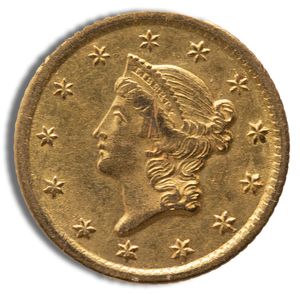
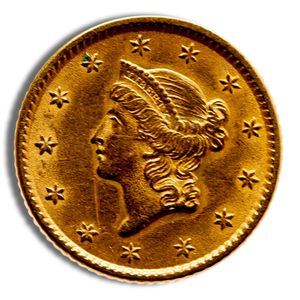
The obverse features a larger Indian princess portrait compared to the earlier Type 2, with a more defined feathered headdress and refined facial detail. The redesign gave the coin a more open field and improved the legibility of LIBERTY inscribed on the tiara. Thirteen stars encircle the portrait, with the date appearing below.
The reverse presents a wreath of agricultural products enclosing the denomination "1 DOLLAR," with UNITED STATES OF AMERICA completing the legend around the periphery. The composition is clean and deliberate, reflecting mid-19th-century American coinage aesthetics without excessive ornamentation. On certified MS65 examples, luster flow across the fields and devices is typically well-preserved, with surface quality consistent with the gem designation.
At 0.0483 troy ounces, the $1 Gold Indian Type 3 is among the smallest gold coins produced by the United States Mint, and its physical size reflects that. The coin measures just 14.3mm in diameter, making it notably compact even by fractional gold standards. This scale makes it a meaningful entry point for collectors and buyers looking to hold genuine 19th-century American gold without committing to larger formats.
The fractional nature of this coin also means individual pieces represent a lower nominal price relative to full-ounce gold products, which tends to make the Type 3 accessible to a broader range of buyers. That accessibility, combined with its historical significance, is a primary reason the series continues to attract consistent attention in the numismatic market.
Each example in this listing has been independently authenticated and graded by the Professional Coin Grading Service (PCGS), one of the most respected third-party grading services in the numismatic industry. PCGS MS65 certification confirms that the coin meets strict standards for luster, strike quality, and surface preservation. The coin is encapsulated in a tamper-evident PCGS holder that protects the grade assignment and provides a permanent record tied to the PCGS population report.
We are an authorized PCGS dealer, which means we have a direct relationship with the grading service and work within the standards and protocols that relationship requires. Every graded coin we carry is verified against its certification before being made available. Buyers can cross-reference the certification number on any piece through the PCGS online verification tool for independent confirmation.
MS65 is a gem mint state designation, indicating a coin with above-average strike, strong luster, and only minor, scattered contact marks that are not immediately noticeable without magnification. At this grade level, eye appeal is generally excellent, and the coin should display vibrant surface quality consistent with a well-preserved 19th-century gold issue. PCGS applies this grade consistently according to the Sheldon 70-point scale, and a certified MS65 from PCGS carries meaningful numismatic weight in both collector and dealer markets.
Because this coin is a graded numismatic product encapsulated by PCGS, it ships in its original PCGS slab. The holder itself provides full protection, and the coin will arrive secured appropriately for transit. No additional handling or repackaging is applied that would compromise the integrity of the holder or its seal.
Pricing for the $1 Gold Indian Type 3 in MS65 reflects both the current spot price of gold and a numismatic premium that accounts for the coin's certified grade, historical scarcity, and collector demand. Because these are 19th-century coins with a finite supply, premiums above spot tend to be substantially higher than those seen on modern bullion coins. The PCGS MS65 grade designation adds further price differentiation compared to lower-grade or raw examples of the same type.
Market pricing for certified Type 3 gold dollars can also be influenced by date-specific scarcity within the random year pool. Some years had relatively low mintages or suffered higher rates of wear in circulation, meaning population data and auction results vary across the date range. Our pricing reflects current market conditions for the grade and type rather than any single date premium, which keeps the listing consistent for random-year purchases.
PCGS-certified 19th-century gold coins trade actively through coin dealers, auction houses, and numismatic marketplaces. The MS65 grade sits in a range where collector demand is genuine and the population is limited enough to support meaningful price support. That combination makes certified Type 3 gold dollars more liquid than many raw or lower-grade examples within the same series.
We operate a two-way market that allows customers to both purchase and sell within the same platform. Understanding the bid side of a transaction before committing to a purchase is central to how we approach the buying and selling experience. Buyers can review our live buyback pricing to understand the spread between acquisition cost and current resale value before completing any transaction.
The Type 3 design represents the most mature and refined version of America's smallest gold denomination, and finding examples at the MS65 level requires selecting from a relatively small certified population. A PCGS MS65 provides a standardized, independently verified grade that removes ambiguity from the transaction and supports consistent valuation across resale environments. For buyers who want genuine 19th-century American gold with documented grade quality, this is a straightforward path to that goal.
The random year format makes this listing accessible at a more consistent price point than chasing specific dates, while still delivering a coin that satisfies both numismatic and gold content criteria. For buyers comfortable with date variation, the value proposition is strong relative to purchasing a specific high-demand year at a significant date premium.
We have been operating as a trusted precious metals dealer since 2010, and our approach has always centered on transparency, honest pricing, and building long-term relationships with customers who expect straightforward answers. As an authorized PCGS dealer, we maintain direct access to certified numismatic products and the standards required to handle and represent them accurately. Our A Better Business Bureau rating, membership in the American Numismatic Association, and membership in the National Coin and Bullion Association reflect the level of professionalism we hold ourselves to across every transaction.
Every graded coin we offer is verified against its certification. We do not apply pressure-based sales tactics or manufacture urgency to push transactions. Our pricing is built to reflect real market conditions, and our two-way market structure ensures that liquidity considerations are visible before a purchase is ever made. Whether you are buying your first certified gold coin or adding to an existing numismatic collection, our goal is to give you the information and the confidence to make a decision that makes sense for you.
Bullion Standard Pro gives members access to live, executable wholesale bid and ask pricing across our catalog, including certified numismatic products like this Type 3 gold dollar. Rather than relying on estimated retail values, Pro members can evaluate products against real-time wholesale pricing that reflects current supply and demand conditions. Portfolio holdings are valued using live executable wholesale bid pricing, which provides a more accurate picture of liquidation value than static or delayed price feeds.
Pro also includes proprietary market intelligence tools that allow members to evaluate premiums, historical premium trends, bid/ask spreads, and liquidity metrics across the broader catalog. For numismatic gold where premiums can shift meaningfully based on collector demand and certified population changes, having access to that kind of transparent, data-driven context makes a measurable difference in how informed a purchase decision can be.
We support a broad range of payment methods to make every transaction simple and secure. Customers can pay using Visa, Mastercard, American Express, Discover, PayPal, or bank-connected payments through Plaid. Wire transfer, paper check, and cryptocurrency payments through BitPay are also accepted for buyers who prefer those channels.
Every payment method is processed through a secure platform designed to protect customer information and transaction integrity. Whether you are completing a single purchase or managing a larger acquisition, the checkout experience is built to be straightforward, with no unnecessary friction between you and the product you are ready to buy.
Product ID: BST-0005409F2E
| Random Year Status | Random Year |
|---|---|
| Precious Metal Type | Gold |
| Bullion Coin Type | Princess Head Dollar |
| Format | Coin |
| Country of Origin | United States |
| Brand/Mint | U.S. Mint |
| Mint Mark | Various |
| Purity | 0.9 |
| Weight | 0.0483 oz |
| Diameter (mm) | 14.3 mm |

| Grade | MS65 |
| Grading Service | PCGS |
The $1 Gold Indian Head Type 3 is a United States Mint issue struck in .900 fine gold, weighing 0.0483 troy ounces. It represents the final and longest-running design in the three-type $1 gold series, produced from 1856 through 1889. The coin carries legal tender status as a genuine product of the United States federal coinage system and occupies a distinct position among 19th-century American gold issues.
We offer this coin in PCGS MS65 condition, representing a certified gem example with strong luster, sharp strike, and minimal surface distraction. Because this listing is for a random year, the specific date will vary, but every example carries full PCGS certification with a matching holder and population report reference.
The $1 gold series was authorized under the Coinage Act of 1849, initially introduced alongside the double eagle as the United States expanded its coinage to accommodate gold from the California Gold Rush. The Type 1 and Type 2 designs proved short-lived, with the Type 3 emerging in 1856 under Chief Engraver James Longacre as a refined resolution to the striking difficulties that plagued its predecess
…The $1 Gold Indian Head Type 3 is a United States Mint issue struck in .900 fine gold, weighing 0.0483 troy ounces. It represents the final and longest-running design in the three-type $1 gold series, produced from 1856 through 1889. The coin carries legal tender status as a genuine product of the United States federal coinage system and occupies a distinct position among 19th-century American gold issues.
We offer this coin in PCGS MS65 condition, representing a certified gem example with strong luster, sharp strike, and minimal surface distraction. Because this listing is for a random year, the specific date will vary, but every example carries full PCGS certification with a matching holder and population report reference.
The $1 gold series was authorized under the Coinage Act of 1849, initially introduced alongside the double eagle as the United States expanded its coinage to accommodate gold from the California Gold Rush. The Type 1 and Type 2 designs proved short-lived, with the Type 3 emerging in 1856 under Chief Engraver James Longacre as a refined resolution to the striking difficulties that plagued its predecessors.
The Type 3 design ran for over three decades, produced at multiple United States Mint facilities including Philadelphia, San Francisco, and others depending on the year. Despite its longevity as a denomination, the $1 gold piece was never heavily circulated due to its diminutive size, and many examples entered collections shortly after issuance. Congress abolished the denomination in 1889, making the Type 3 the final chapter of American $1 gold coinage.
The obverse features a larger Indian princess portrait compared to the earlier Type 2, with a more defined feathered headdress and refined facial detail. The redesign gave the coin a more open field and improved the legibility of LIBERTY inscribed on the tiara. Thirteen stars encircle the portrait, with the date appearing below.
The reverse presents a wreath of agricultural products enclosing the denomination "1 DOLLAR," with UNITED STATES OF AMERICA completing the legend around the periphery. The composition is clean and deliberate, reflecting mid-19th-century American coinage aesthetics without excessive ornamentation. On certified MS65 examples, luster flow across the fields and devices is typically well-preserved, with surface quality consistent with the gem designation.
At 0.0483 troy ounces, the $1 Gold Indian Type 3 is among the smallest gold coins produced by the United States Mint, and its physical size reflects that. The coin measures just 14.3mm in diameter, making it notably compact even by fractional gold standards. This scale makes it a meaningful entry point for collectors and buyers looking to hold genuine 19th-century American gold without committing to larger formats.
The fractional nature of this coin also means individual pieces represent a lower nominal price relative to full-ounce gold products, which tends to make the Type 3 accessible to a broader range of buyers. That accessibility, combined with its historical significance, is a primary reason the series continues to attract consistent attention in the numismatic market.
Each example in this listing has been independently authenticated and graded by the Professional Coin Grading Service (PCGS), one of the most respected third-party grading services in the numismatic industry. PCGS MS65 certification confirms that the coin meets strict standards for luster, strike quality, and surface preservation. The coin is encapsulated in a tamper-evident PCGS holder that protects the grade assignment and provides a permanent record tied to the PCGS population report.
We are an authorized PCGS dealer, which means we have a direct relationship with the grading service and work within the standards and protocols that relationship requires. Every graded coin we carry is verified against its certification before being made available. Buyers can cross-reference the certification number on any piece through the PCGS online verification tool for independent confirmation.
MS65 is a gem mint state designation, indicating a coin with above-average strike, strong luster, and only minor, scattered contact marks that are not immediately noticeable without magnification. At this grade level, eye appeal is generally excellent, and the coin should display vibrant surface quality consistent with a well-preserved 19th-century gold issue. PCGS applies this grade consistently according to the Sheldon 70-point scale, and a certified MS65 from PCGS carries meaningful numismatic weight in both collector and dealer markets.
Because this coin is a graded numismatic product encapsulated by PCGS, it ships in its original PCGS slab. The holder itself provides full protection, and the coin will arrive secured appropriately for transit. No additional handling or repackaging is applied that would compromise the integrity of the holder or its seal.
Pricing for the $1 Gold Indian Type 3 in MS65 reflects both the current spot price of gold and a numismatic premium that accounts for the coin's certified grade, historical scarcity, and collector demand. Because these are 19th-century coins with a finite supply, premiums above spot tend to be substantially higher than those seen on modern bullion coins. The PCGS MS65 grade designation adds further price differentiation compared to lower-grade or raw examples of the same type.
Market pricing for certified Type 3 gold dollars can also be influenced by date-specific scarcity within the random year pool. Some years had relatively low mintages or suffered higher rates of wear in circulation, meaning population data and auction results vary across the date range. Our pricing reflects current market conditions for the grade and type rather than any single date premium, which keeps the listing consistent for random-year purchases.
PCGS-certified 19th-century gold coins trade actively through coin dealers, auction houses, and numismatic marketplaces. The MS65 grade sits in a range where collector demand is genuine and the population is limited enough to support meaningful price support. That combination makes certified Type 3 gold dollars more liquid than many raw or lower-grade examples within the same series.
We operate a two-way market that allows customers to both purchase and sell within the same platform. Understanding the bid side of a transaction before committing to a purchase is central to how we approach the buying and selling experience. Buyers can review our live buyback pricing to understand the spread between acquisition cost and current resale value before completing any transaction.
The Type 3 design represents the most mature and refined version of America's smallest gold denomination, and finding examples at the MS65 level requires selecting from a relatively small certified population. A PCGS MS65 provides a standardized, independently verified grade that removes ambiguity from the transaction and supports consistent valuation across resale environments. For buyers who want genuine 19th-century American gold with documented grade quality, this is a straightforward path to that goal.
The random year format makes this listing accessible at a more consistent price point than chasing specific dates, while still delivering a coin that satisfies both numismatic and gold content criteria. For buyers comfortable with date variation, the value proposition is strong relative to purchasing a specific high-demand year at a significant date premium.
We have been operating as a trusted precious metals dealer since 2010, and our approach has always centered on transparency, honest pricing, and building long-term relationships with customers who expect straightforward answers. As an authorized PCGS dealer, we maintain direct access to certified numismatic products and the standards required to handle and represent them accurately. Our A Better Business Bureau rating, membership in the American Numismatic Association, and membership in the National Coin and Bullion Association reflect the level of professionalism we hold ourselves to across every transaction.
Every graded coin we offer is verified against its certification. We do not apply pressure-based sales tactics or manufacture urgency to push transactions. Our pricing is built to reflect real market conditions, and our two-way market structure ensures that liquidity considerations are visible before a purchase is ever made. Whether you are buying your first certified gold coin or adding to an existing numismatic collection, our goal is to give you the information and the confidence to make a decision that makes sense for you.
Bullion Standard Pro gives members access to live, executable wholesale bid and ask pricing across our catalog, including certified numismatic products like this Type 3 gold dollar. Rather than relying on estimated retail values, Pro members can evaluate products against real-time wholesale pricing that reflects current supply and demand conditions. Portfolio holdings are valued using live executable wholesale bid pricing, which provides a more accurate picture of liquidation value than static or delayed price feeds.
Pro also includes proprietary market intelligence tools that allow members to evaluate premiums, historical premium trends, bid/ask spreads, and liquidity metrics across the broader catalog. For numismatic gold where premiums can shift meaningfully based on collector demand and certified population changes, having access to that kind of transparent, data-driven context makes a measurable difference in how informed a purchase decision can be.
We support a broad range of payment methods to make every transaction simple and secure. Customers can pay using Visa, Mastercard, American Express, Discover, PayPal, or bank-connected payments through Plaid. Wire transfer, paper check, and cryptocurrency payments through BitPay are also accepted for buyers who prefer those channels.
Every payment method is processed through a secure platform designed to protect customer information and transaction integrity. Whether you are completing a single purchase or managing a larger acquisition, the checkout experience is built to be straightforward, with no unnecessary friction between you and the product you are ready to buy.