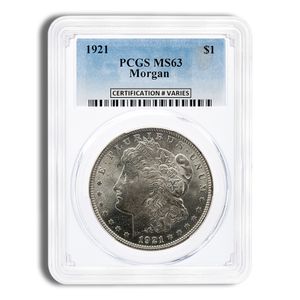
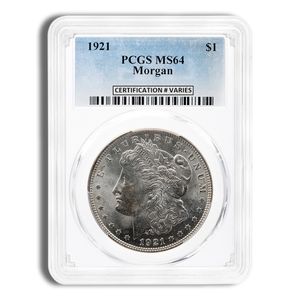
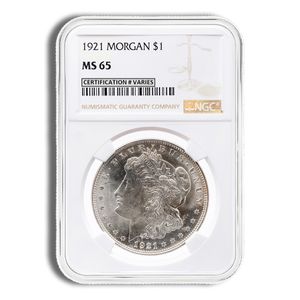
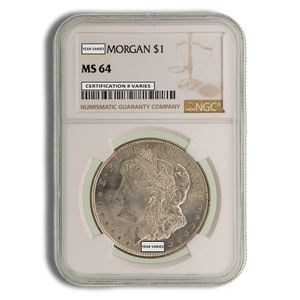
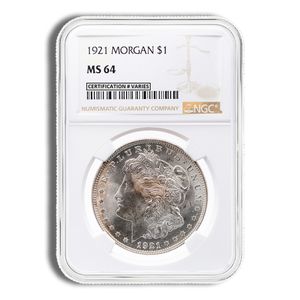
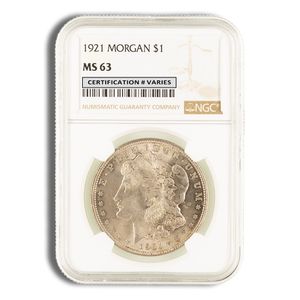
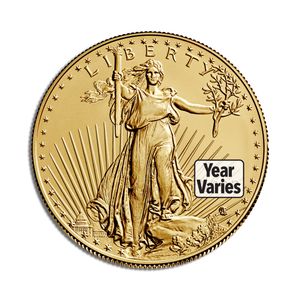
The 1921 Morgan Silver Dollar is one of the most recognized coins in American numismatic history, and the PCGS MS66 example we carry represents that legacy at a level of preservation rarely encountered in the market. Struck in .900 fine silver with a total weight of 0.7734 troy ounces, this coin carries the full weight of its era and the unmistakable character of United States Mint production. As a PCGS-graded specimen, every aspect of its condition has been professionally evaluated and encapsulated by the most respected third-party grading service in the industry.
At MS66, this coin sits well above the threshold of what most collectors consider a high-grade example of the 1921 issue. PCGS grades coins on a 70-point Sheldon scale, and an MS66 designation indicates a coin with above-average strike quality, exceptional luster, and only minimal, scattered contact marks that require magnification to identify. For a coin of this age and historical significance, that level of preservation is genuinely impressive.
The Morgan dollar series ran from 1878 through 1904, then experienced a brief but historically s
…The 1921 Morgan Silver Dollar is one of the most recognized coins in American numismatic history, and the PCGS MS66 example we carry represents that legacy at a level of preservation rarely encountered in the market. Struck in .900 fine silver with a total weight of 0.7734 troy ounces, this coin carries the full weight of its era and the unmistakable character of United States Mint production. As a PCGS-graded specimen, every aspect of its condition has been professionally evaluated and encapsulated by the most respected third-party grading service in the industry.
At MS66, this coin sits well above the threshold of what most collectors consider a high-grade example of the 1921 issue. PCGS grades coins on a 70-point Sheldon scale, and an MS66 designation indicates a coin with above-average strike quality, exceptional luster, and only minimal, scattered contact marks that require magnification to identify. For a coin of this age and historical significance, that level of preservation is genuinely impressive.
The Morgan dollar series ran from 1878 through 1904, then experienced a brief but historically significant revival in 1921 before the design was retired in favor of the Peace dollar. The 1921 Morgan was produced at multiple United States Mint facilities and stands as the final year of the series, giving it a particular resonance for collectors who follow the arc of American coinage history. It was the first full year of production under the Pittman Act of 1918, which mandated the melting and recoinage of millions of silver dollars.
The Morgan dollar itself was designed by George T. Morgan, an English-born engraver who joined the United States Mint in 1876. His design replaced the earlier Seated Liberty motif and quickly became one of the defining images of the American West and the late industrial era. The 1921 issue holds a distinct place within the series because it was minted with a slightly modified hub compared to earlier dates, a detail that numismatists have documented and debated for decades.
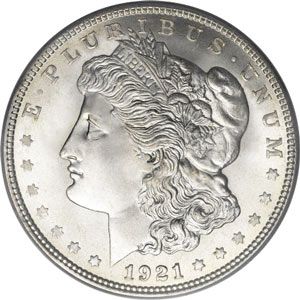
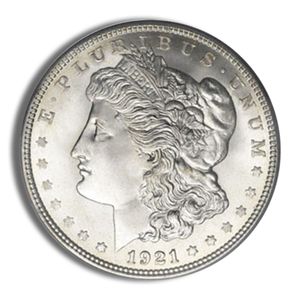
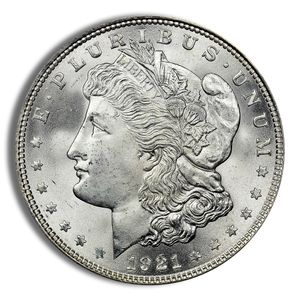
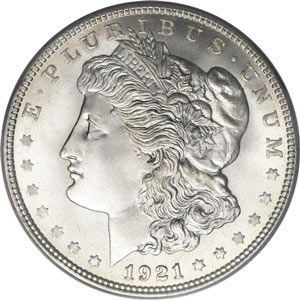
The obverse features a left-facing portrait of Lady Liberty wearing a crown inscribed with the word LIBERTY, surrounded by stars and flanked by the date at the bottom. Morgan modeled Liberty after Anna Willess Williams, a Philadelphia schoolteacher, giving the portrait an unusual degree of refinement and naturalism for its time. The inscription E PLURIBUS UNUM and the phrase IN GOD WE TRUST appear in their designated positions around the central portrait.
The reverse presents a heraldic eagle with outstretched wings, clutching arrows and an olive branch, with a shield at its breast. The eagle is framed by UNITED STATES OF AMERICA above and ONE DOLLAR below, with a ribbon connecting the arrows and olive branch at the bottom. The coin's high-relief design catches light dramatically across both sides, and on an MS66 example, the luster flows across the surfaces in the unbroken, cartwheel pattern that high-grade Morgan collectors specifically seek.
PCGS certification provides the most authoritative form of authentication available in the numismatic market. Each graded coin is examined by multiple expert numismatists before receiving a grade, then sealed in a tamper-evident holder with a unique certification number that can be verified through the PCGS registry. The holder itself is designed to protect the coin from environmental exposure and physical handling without interfering with visual inspection.
We are an authorized dealer for both PCGS and NGC, which means the graded coins we carry have been authenticated and graded under the same standards that the broader numismatic market relies upon. When you purchase a PCGS MS66 1921 Morgan dollar from us, you are receiving a coin whose grade and authenticity have been independently confirmed, not simply represented by the seller. That distinction matters significantly in a market where ungraded coins can be subject to disagreement over condition and value.
An MS66 grade on the Sheldon scale places this coin firmly in the category of a premium uncirculated example. At this level, a coin displays strong, original mint luster across both surfaces, a well-defined strike that captures most of the fine detail in Morgan's design, and only a small number of light contact marks that are not immediately visible without close examination. For the 1921 Morgan specifically, locating an MS66 example with consistent luster and a sharp strike on Liberty's hair above the ear is a meaningful achievement, as that area is among the most difficult to find well-struck on the issue.
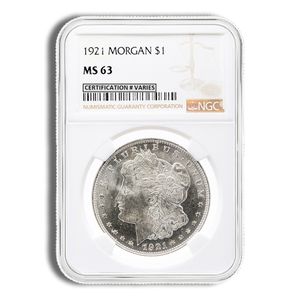
This coin ships in its original PCGS holder, which protects the surfaces from handling and preserves the grade integrity of the coin. No additional packaging modifications are made. The holder is sonically sealed and includes printed certification details alongside the numeric grade. Keeping the coin in its original PCGS slab is both the standard practice and the best way to preserve its graded value for future resale or transfer.
Pricing for a graded 1921 Morgan dollar at MS66 reflects several intersecting factors. The base silver value, derived from the spot price of silver applied to the coin's 0.7734 troy ounce content, establishes a floor, but the numismatic premium at this grade level is substantial and often dominates the price. That premium is shaped by collector demand, population report data from PCGS showing how many examples exist at this grade, and the general market activity for high-grade Morgan dollars at any given time.
Our pricing reflects current market conditions and is updated to remain consistent with the broader graded coin market. Because numismatic premiums can fluctuate independently of silver spot prices, understanding what drives the premium on a graded coin like this requires attention to population data, recent auction results, and overall collector demand rather than spot movement alone. We structure our pricing to reflect those dynamics with clarity rather than obscure the factors at play.
The Morgan dollar is among the most actively traded series in American numismatics, and the 1921 date with a PCGS MS66 grade occupies a recognizable position within that market. Graded coins in PCGS holders benefit from the universal recognition of the certification, which reduces friction in resale by eliminating most disputes over condition and authenticity. Dealers, auction houses, and private collectors regularly transact in PCGS-certified Morgan dollars, and the 1921 issue in particular enjoys broad familiarity.
We operate a two-way market that supports both purchases and buybacks, allowing customers to sell back into the same ecosystem where they bought. Liquidity for this specific coin is meaningfully influenced by its grade tier and population, and understanding current wholesale bid pricing for graded Morgans is relevant to any decision made at either end of the transaction. Our platform is structured to keep that information accessible rather than opaque.
The 1921 Morgan dollar at MS66 occupies a specific and well-defined position in the numismatic market. It is the final year of one of America's most collected coin series, which gives it historical weight that most bullion-grade coins simply do not carry. At MS66, the coin also clears the threshold where collector demand begins to intensify relative to lower-grade examples, making it a meaningful step up from coins that are technically uncirculated but show more surface disturbance.
The PCGS holder removes the most common friction points in buying a graded coin: authenticity concerns and disagreements over condition. What you receive is exactly what the certification says it is, evaluated by a team of professional numismatists and confirmed by one of the two most trusted grading services in the world. For collectors building a set or adding a significant date to a Morgan dollar collection, this combination of grade, history, and third-party certification creates a coherent case for the coin on its own terms.
We have been operating as a national precious metals dealer since 2010, and our approach has consistently prioritized transparency over pressure. As an authorized PCGS and NGC dealer, we handle graded coins with a level of familiarity that comes from years of working directly within those authentication ecosystems. Our A rating with the Better Business Bureau and active memberships in both the American Numismatic Association and the National Coin and Bullion Association reflect a long-standing commitment to operating with integrity at every level of the business.
Our pricing is structured to reflect real market conditions rather than obscure the premium you are paying. We believe you should be able to evaluate what you are buying, understand what you paid relative to the broader market, and know what selling back looks like before you ever complete a purchase. That is the philosophy behind our two-way marketplace model, and it applies to graded numismatic coins just as it does to standard bullion products. Our customer support team is knowledgeable, our fulfillment is reliable, and our platform is built around the expectation that an informed buyer is a better long-term customer.
Bullion Standard Pro gives members access to live, executable wholesale bid and ask pricing across our product catalog, including graded numismatic coins. For a coin like the PCGS MS66 1921 Morgan dollar, where numismatic premiums move independently of silver spot prices, having visibility into current wholesale bid levels provides a more complete picture of what the coin is actually worth in a live market context. Pro members can track portfolio valuation using real-time wholesale bid pricing rather than estimated retail values, which is particularly relevant when managing holdings that include graded coins with fluctuating collector premiums.
Beyond pricing, Pro includes proprietary market intelligence tools and product research capabilities that allow members to evaluate premiums, spread tightness, and historical pricing trends across products. For numismatic buyers who want to understand whether a premium is historically elevated or compressed relative to past market conditions, these tools provide objective data rather than requiring reliance on marketing assumptions alone.
We support a broad range of payment methods to make the transaction straightforward regardless of how you prefer to pay. Accepted options include Visa, Mastercard, American Express, and Discover, as well as PayPal, bank-connected payments through Plaid, wire transfer, paper check, and cryptocurrency payments via BitPay. Each method is integrated into a secure checkout process designed to protect your transaction from start to finish.
Whether you are purchasing a single graded coin or building a broader position across multiple products, our payment infrastructure is designed to accommodate different preferences without adding unnecessary friction to the process. Security and convenience are built into every step of the transaction.
Product ID: BST-0021551D1D
| Year | 1921 |
|---|---|
| Precious Metal Type | Silver |
| Bullion Coin Type | Morgan Dollar |
| Format | Coin |
| Country of Origin | United States |
| Brand/Mint | U.S. Mint |
| Mint Mark | Various |
| Purity | 0.9 |
| Weight | 0.7734 oz |
| Thickness (mm) | 2.4 mm |

| Diameter (mm) | 38.1 mm |
| Inner Pack (Quantity) | 20 |
| Grade | MS66 |
| Grading Service | PCGS |
The 1921 Morgan Silver Dollar is one of the most recognized coins in American numismatic history, and the PCGS MS66 example we carry represents that legacy at a level of preservation rarely encountered in the market. Struck in .900 fine silver with a total weight of 0.7734 troy ounces, this coin carries the full weight of its era and the unmistakable character of United States Mint production. As a PCGS-graded specimen, every aspect of its condition has been professionally evaluated and encapsulated by the most respected third-party grading service in the industry.
At MS66, this coin sits well above the threshold of what most collectors consider a high-grade example of the 1921 issue. PCGS grades coins on a 70-point Sheldon scale, and an MS66 designation indicates a coin with above-average strike quality, exceptional luster, and only minimal, scattered contact marks that require magnification to identify. For a coin of this age and historical significance, that level of preservation is genuinely impressive.
The Morgan dollar series ran from 1878 through 1904, then experienced a brief but historically s
…The 1921 Morgan Silver Dollar is one of the most recognized coins in American numismatic history, and the PCGS MS66 example we carry represents that legacy at a level of preservation rarely encountered in the market. Struck in .900 fine silver with a total weight of 0.7734 troy ounces, this coin carries the full weight of its era and the unmistakable character of United States Mint production. As a PCGS-graded specimen, every aspect of its condition has been professionally evaluated and encapsulated by the most respected third-party grading service in the industry.
At MS66, this coin sits well above the threshold of what most collectors consider a high-grade example of the 1921 issue. PCGS grades coins on a 70-point Sheldon scale, and an MS66 designation indicates a coin with above-average strike quality, exceptional luster, and only minimal, scattered contact marks that require magnification to identify. For a coin of this age and historical significance, that level of preservation is genuinely impressive.
The Morgan dollar series ran from 1878 through 1904, then experienced a brief but historically significant revival in 1921 before the design was retired in favor of the Peace dollar. The 1921 Morgan was produced at multiple United States Mint facilities and stands as the final year of the series, giving it a particular resonance for collectors who follow the arc of American coinage history. It was the first full year of production under the Pittman Act of 1918, which mandated the melting and recoinage of millions of silver dollars.
The Morgan dollar itself was designed by George T. Morgan, an English-born engraver who joined the United States Mint in 1876. His design replaced the earlier Seated Liberty motif and quickly became one of the defining images of the American West and the late industrial era. The 1921 issue holds a distinct place within the series because it was minted with a slightly modified hub compared to earlier dates, a detail that numismatists have documented and debated for decades.
The obverse features a left-facing portrait of Lady Liberty wearing a crown inscribed with the word LIBERTY, surrounded by stars and flanked by the date at the bottom. Morgan modeled Liberty after Anna Willess Williams, a Philadelphia schoolteacher, giving the portrait an unusual degree of refinement and naturalism for its time. The inscription E PLURIBUS UNUM and the phrase IN GOD WE TRUST appear in their designated positions around the central portrait.
The reverse presents a heraldic eagle with outstretched wings, clutching arrows and an olive branch, with a shield at its breast. The eagle is framed by UNITED STATES OF AMERICA above and ONE DOLLAR below, with a ribbon connecting the arrows and olive branch at the bottom. The coin's high-relief design catches light dramatically across both sides, and on an MS66 example, the luster flows across the surfaces in the unbroken, cartwheel pattern that high-grade Morgan collectors specifically seek.
PCGS certification provides the most authoritative form of authentication available in the numismatic market. Each graded coin is examined by multiple expert numismatists before receiving a grade, then sealed in a tamper-evident holder with a unique certification number that can be verified through the PCGS registry. The holder itself is designed to protect the coin from environmental exposure and physical handling without interfering with visual inspection.
We are an authorized dealer for both PCGS and NGC, which means the graded coins we carry have been authenticated and graded under the same standards that the broader numismatic market relies upon. When you purchase a PCGS MS66 1921 Morgan dollar from us, you are receiving a coin whose grade and authenticity have been independently confirmed, not simply represented by the seller. That distinction matters significantly in a market where ungraded coins can be subject to disagreement over condition and value.
An MS66 grade on the Sheldon scale places this coin firmly in the category of a premium uncirculated example. At this level, a coin displays strong, original mint luster across both surfaces, a well-defined strike that captures most of the fine detail in Morgan's design, and only a small number of light contact marks that are not immediately visible without close examination. For the 1921 Morgan specifically, locating an MS66 example with consistent luster and a sharp strike on Liberty's hair above the ear is a meaningful achievement, as that area is among the most difficult to find well-struck on the issue.
This coin ships in its original PCGS holder, which protects the surfaces from handling and preserves the grade integrity of the coin. No additional packaging modifications are made. The holder is sonically sealed and includes printed certification details alongside the numeric grade. Keeping the coin in its original PCGS slab is both the standard practice and the best way to preserve its graded value for future resale or transfer.
Pricing for a graded 1921 Morgan dollar at MS66 reflects several intersecting factors. The base silver value, derived from the spot price of silver applied to the coin's 0.7734 troy ounce content, establishes a floor, but the numismatic premium at this grade level is substantial and often dominates the price. That premium is shaped by collector demand, population report data from PCGS showing how many examples exist at this grade, and the general market activity for high-grade Morgan dollars at any given time.
Our pricing reflects current market conditions and is updated to remain consistent with the broader graded coin market. Because numismatic premiums can fluctuate independently of silver spot prices, understanding what drives the premium on a graded coin like this requires attention to population data, recent auction results, and overall collector demand rather than spot movement alone. We structure our pricing to reflect those dynamics with clarity rather than obscure the factors at play.
The Morgan dollar is among the most actively traded series in American numismatics, and the 1921 date with a PCGS MS66 grade occupies a recognizable position within that market. Graded coins in PCGS holders benefit from the universal recognition of the certification, which reduces friction in resale by eliminating most disputes over condition and authenticity. Dealers, auction houses, and private collectors regularly transact in PCGS-certified Morgan dollars, and the 1921 issue in particular enjoys broad familiarity.
We operate a two-way market that supports both purchases and buybacks, allowing customers to sell back into the same ecosystem where they bought. Liquidity for this specific coin is meaningfully influenced by its grade tier and population, and understanding current wholesale bid pricing for graded Morgans is relevant to any decision made at either end of the transaction. Our platform is structured to keep that information accessible rather than opaque.
The 1921 Morgan dollar at MS66 occupies a specific and well-defined position in the numismatic market. It is the final year of one of America's most collected coin series, which gives it historical weight that most bullion-grade coins simply do not carry. At MS66, the coin also clears the threshold where collector demand begins to intensify relative to lower-grade examples, making it a meaningful step up from coins that are technically uncirculated but show more surface disturbance.
The PCGS holder removes the most common friction points in buying a graded coin: authenticity concerns and disagreements over condition. What you receive is exactly what the certification says it is, evaluated by a team of professional numismatists and confirmed by one of the two most trusted grading services in the world. For collectors building a set or adding a significant date to a Morgan dollar collection, this combination of grade, history, and third-party certification creates a coherent case for the coin on its own terms.
We have been operating as a national precious metals dealer since 2010, and our approach has consistently prioritized transparency over pressure. As an authorized PCGS and NGC dealer, we handle graded coins with a level of familiarity that comes from years of working directly within those authentication ecosystems. Our A rating with the Better Business Bureau and active memberships in both the American Numismatic Association and the National Coin and Bullion Association reflect a long-standing commitment to operating with integrity at every level of the business.
Our pricing is structured to reflect real market conditions rather than obscure the premium you are paying. We believe you should be able to evaluate what you are buying, understand what you paid relative to the broader market, and know what selling back looks like before you ever complete a purchase. That is the philosophy behind our two-way marketplace model, and it applies to graded numismatic coins just as it does to standard bullion products. Our customer support team is knowledgeable, our fulfillment is reliable, and our platform is built around the expectation that an informed buyer is a better long-term customer.
Bullion Standard Pro gives members access to live, executable wholesale bid and ask pricing across our product catalog, including graded numismatic coins. For a coin like the PCGS MS66 1921 Morgan dollar, where numismatic premiums move independently of silver spot prices, having visibility into current wholesale bid levels provides a more complete picture of what the coin is actually worth in a live market context. Pro members can track portfolio valuation using real-time wholesale bid pricing rather than estimated retail values, which is particularly relevant when managing holdings that include graded coins with fluctuating collector premiums.
Beyond pricing, Pro includes proprietary market intelligence tools and product research capabilities that allow members to evaluate premiums, spread tightness, and historical pricing trends across products. For numismatic buyers who want to understand whether a premium is historically elevated or compressed relative to past market conditions, these tools provide objective data rather than requiring reliance on marketing assumptions alone.
We support a broad range of payment methods to make the transaction straightforward regardless of how you prefer to pay. Accepted options include Visa, Mastercard, American Express, and Discover, as well as PayPal, bank-connected payments through Plaid, wire transfer, paper check, and cryptocurrency payments via BitPay. Each method is integrated into a secure checkout process designed to protect your transaction from start to finish.
Whether you are purchasing a single graded coin or building a broader position across multiple products, our payment infrastructure is designed to accommodate different preferences without adding unnecessary friction to the process. Security and convenience are built into every step of the transaction.