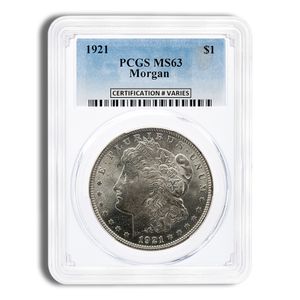
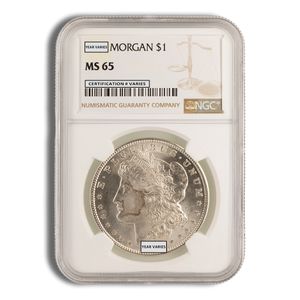
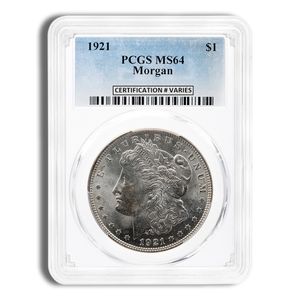
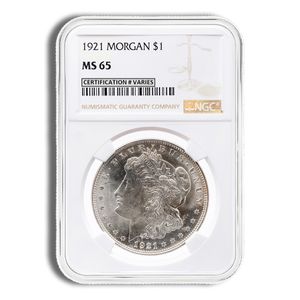
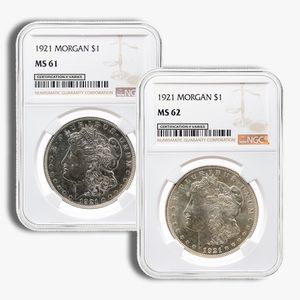
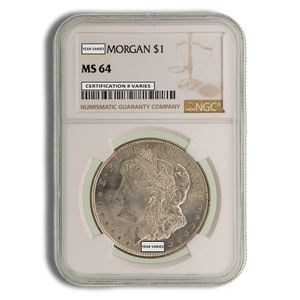
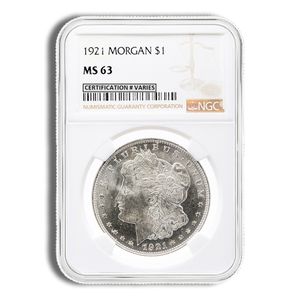
Overview of the 1921 Morgan Silver Dollar (PCGS MS66 Toned)
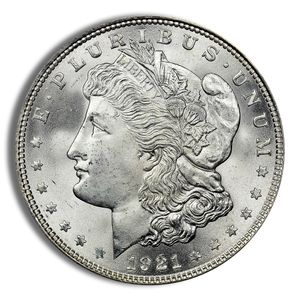
The 1921 Morgan Silver Dollar is one of the most widely recognized coins in American numismatic history, and this example has been graded MS66 by the Professional Coin Grading Service with a designation noting attractive toning. Struck in .900 fine silver with a total weight of 0.7734 troy ounces, the Morgan dollar carries a legal tender face value of one dollar and was produced at multiple United States Mint facilities during its final year of issue. At the MS66 grade level, this coin sits well above the average uncirculated survivor and represents a particularly sharp example of the 1921 production run.
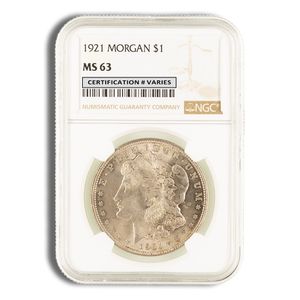
We offer this coin encapsulated in its original PCGS holder, which locks in the assigned grade and provides immediate authentication for buyers at any level of numismatic experience. As authorized PCGS dealers, we are positioned to offer graded coins with full confidence in the certification that accompanies each piece.
History and Background
The Morgan dollar series was designed by United States Mint engraver George T. Morgan and first issued in 1878 following the Bland-Allison Act, which mandated the federal government purchase silver and strike it into coin. The series ran through 1904 before being discontinued as silver stockpiles accumulated and political pressure shifted. When silver was again required under the Pittman Act of 1918, which had authorized the melting of millions of Morgan dollars to support World War I silver sales to Britain, Congress directed the mint to resume production using new silver purchases.
The 1921 issue is notable for being the final year of the Morgan dollar series and the only year in which all three active mint facilities produced the design simultaneously. Philadelphia, Denver, and San Francisco each struck 1921 Morgans, though in exceptionally high combined quantities relative to most other Morgan dates. That same year, the mint transitioned to the new Peace dollar design, making 1921 the last chapter of a series that had defined American coinage for a generation.
Because 1921 Morgans were struck in massive numbers as a matter of urgency following years of inactivity, many exhibit shallower die detail compared to earlier production years. High-grade examples with strong luster and appealing surfaces like this MS66 represent a meaningful exception to the typical 1921 survival profile.
Design and Aesthetics
The obverse presents a left-facing portrait of Liberty wearing a crown inscribed with the word LIBERTY, surrounded by stars and the date at the base. Morgan modeled the portrait after Anna Willess Williams, a Philadelphia schoolteacher, producing a design that was considered both dignified and distinctly American for its era. The reverse features a heraldic eagle with outstretched wings, clutching arrows and an olive branch, with a wreath above and the inscriptions UNITED STATES OF AMERICA and E PLURIBUS UNUM completing the composition.
The toning noted on this example is a significant aesthetic factor for many collectors. Natural toning on a Morgan dollar develops over decades as the silver surface reacts with sulfur compounds and other environmental elements, producing color gradients that range from pale gold and rose to deeper blues, purples, and russets depending on the conditions under which the coin was stored. Coins with original, naturally acquired toning are broadly preferred by the numismatic community over cleaned or artificially toned examples, and PCGS does not assign the toned designation lightly. The colors present on a toned MS66 specimen typically enhance rather than obscure the underlying luster, adding visual complexity that many collectors find more appealing than a blast white surface.
Authenticity and Product Integrity
Every Morgan dollar in this grade has been individually examined and encapsulated by PCGS, whose grading standards are among the most rigorous in the numismatic industry. The coin is sealed in a tamper-evident plastic holder that preserves the coin's surface while permanently associating it with its assigned grade and certification number. That number can be verified directly through the PCGS registry, providing independent confirmation of the coin's attributed condition.
We are authorized dealers for both PCGS and NGC, which means we operate within the professional standards those services require of their dealer network. Graded coins like this one carry built-in authentication that eliminates the uncertainty associated with raw silver dollars, making them straightforward to evaluate and transfer within collector and dealer markets alike.
Condition and Packaging
MS66 is a high uncirculated grade indicating a coin with full mint luster, sharp strike, and only a small number of minor contact marks that are not immediately obvious without close examination. At this grade level, the coin's surfaces should show no evidence of circulation and only the most minimal handling-related imperfections. The toned designation is applied alongside the numeric grade and reflects PCGS's assessment that the toning is original and does not conceal damage or cleaning.
This coin ships encapsulated in its original PCGS holder. Graded coins are not repackaged, rehoused, or removed from their slabs at any point in our fulfillment process. The holder itself serves as both protective packaging and a permanent record of the coin's certification. For buyers purchasing a single example, the slab arrives within secure outer packaging designed to prevent damage during transit.
Pricing and Market Factors
The price of this coin reflects both the underlying silver value and the substantial numismatic premium associated with the grade, toning quality, and collector demand. While the .7734 troy ounces of .900 fine silver in a Morgan dollar do contribute to its base value, an MS66 toned example trades almost entirely on its numismatic characteristics rather than its melt value. Spot price movements in silver have a proportionally smaller impact on the price of this coin than they do on bullion-grade silver products.
Pricing for graded Morgan dollars in the MS66 tier is driven by factors including PCGS population data, the relative attractiveness of the toning, recent auction records, and dealer-to-dealer wholesale activity. High-grade 1921 Morgans with desirable toning occupy a distinct segment of the collector market, and premiums in that segment tend to be more stable across spot price fluctuations than those of purely bullion-focused silver products. We price graded numismatic items to reflect current market conditions and the specific characteristics of each coin.
Selling and Liquidity
PCGS-graded Morgan dollars are among the more liquid certified coins in the numismatic market, owing to the series' broad collector base and the global recognition of the PCGS holder. When it comes time to sell, the encapsulated grade functions as a universally understood shorthand that streamlines negotiations with dealers, auction houses, and other collectors. An MS66 toned 1921 Morgan carries enough numismatic weight to appeal to both dedicated Morgan collectors and buyers who focus more broadly on high-grade certified American coinage.
We operate a two-way market that allows customers to sell coins back within the same platform where they purchased them. For graded numismatic coins, resale pricing reflects current market conditions, PCGS population data, and the specific attributes of the individual piece. Understanding both the buy and sell side of any numismatic purchase before committing is a practice we strongly encourage, and our platform is structured to support that kind of informed decision-making.
Why Buy the 1921 Morgan Silver Dollar (PCGS MS66 Toned)?
The 1921 Morgan dollar carries the distinction of being the final-year issue of a series that defined American silver coinage for decades. At the MS66 grade, it represents a coin that has survived more than a century in exceptional condition, well above what the typical 1921 example offers. The combination of the year's historical significance, the high uncirculated grade, and the added visual appeal of natural toning makes this a particularly well-rounded numismatic piece for collectors who want more than a common circulated example or a low-grade slider.
Toned Morgan dollars at this grade level attract buyers across several overlapping collector markets, from registry-set builders focused on the series to collectors who specialize in toned United States coinage as a category unto itself. The PCGS holder removes any ambiguity about the coin's authenticity and condition, making it easy to buy, hold, and sell with a clearly defined set of attributes already established by a trusted third party.
Why Buy from Bullion Standard?
We have been operating in the precious metals and numismatic space since 2010, and our approach has always centered on transparency over pressure. As authorized dealers for both PCGS and NGC, we have direct access to certified coins and the professional standards that come with those relationships. Our A rating with the Better Business Bureau and memberships in the American Numismatic Association and the National Coin and Bullion Association reflect a long-standing commitment to professional conduct and customer trust.
Every graded coin we offer is presented as-is within its original certified holder, and we do not alter, repackage, or misrepresent the items we sell. Our pricing reflects current market conditions, and our two-way market structure means you can evaluate the resale side of any purchase before you commit. We believe that transparency on both the buy and sell side is what separates a trustworthy dealer from one that only looks good at the point of sale.
Get Near-Spot Pricing with Bullion Standard Pro
Bullion Standard Pro gives members access to live, executable wholesale bid and ask pricing across our catalog, along with real-time portfolio valuation based on current wholesale bid prices rather than estimated retail figures. For collectors holding graded numismatic coins alongside bullion, this provides a more complete and accurate picture of what a portfolio is actually worth at any given moment based on observable market activity rather than assumptions.
Pro members also gain access to proprietary research tools that allow products to be compared across premiums, bid/ask spreads, liquidity, and historical pricing data. For buyers active in the certified coin market, understanding how premium levels have moved over time and how spreads compare across products is the kind of objective market intelligence that leads to more deliberate and better-informed decisions.
Flexible and Secure Payment Options
We support a broad range of payment methods to make every transaction as straightforward as possible. Buyers can pay using Visa, Mastercard, American Express, or Discover, as well as PayPal, bank-connected payments through Plaid, wire transfer, paper check, or cryptocurrency through BitPay. Each option is supported by a secure checkout process designed to protect your information and confirm your order reliably.
Whether you are completing a single numismatic purchase or managing a larger transaction, our payment infrastructure is built to handle both with the same level of security and efficiency. If you have questions about payment methods or need guidance before completing a purchase, our customer support team is available to assist.

 (833) 278-4653

.png)