Buy Silver Commemorative Coins Online
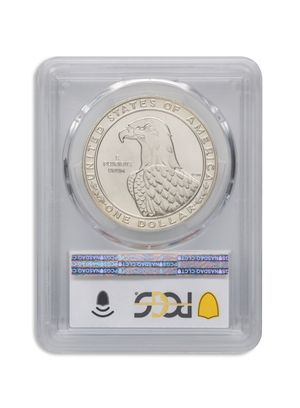
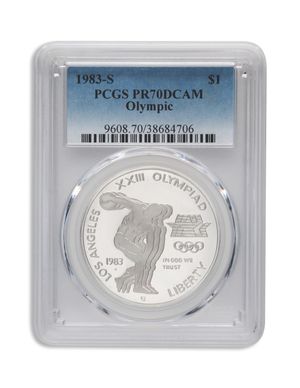
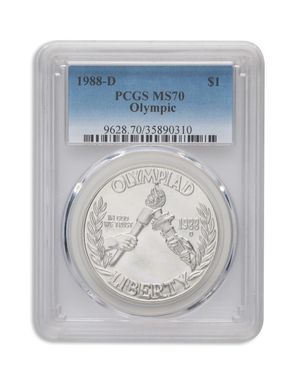
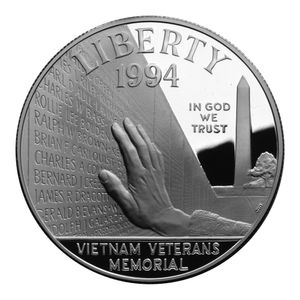
Our silver commemorative coins span more than four decades of special issues, and the largest share is the U.S. Mint's modern commemorative silver dollar. Nearly every program from the 1983 Los Angeles Olympic dollar to the 2019 Apollo 11 and American Legion coins is represented, usually in both proof and uncirculated versions and often in NGC or PCGS holders as well.
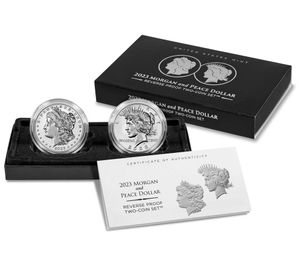
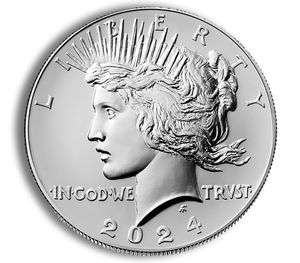
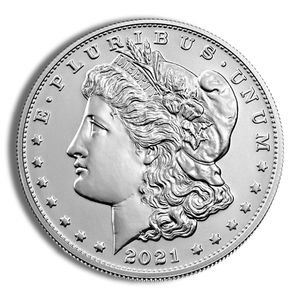
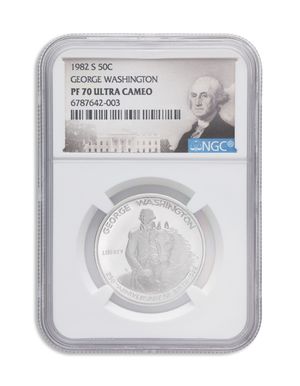
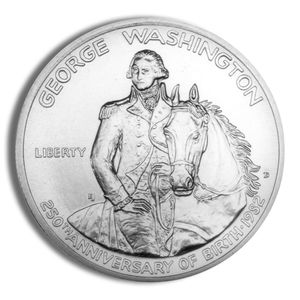
The rest of the silver selection is just as varied. You'll find 1982 George Washington half dollars, 40% silver Bicentennial quarters, anniversary sets of American Silver Eagles from 2006, 2011 and 2012, the 2016-W 30th Anniversary and 2020-W V75 proof Eagles, and the .999 fine Morgan and Peace dollars the Mint has struck since 2021. Older Mexican commemorative pesos and newer pieces from the Royal Canadian Mint and the Perth Mint add a world dimension.
Formats range from single coins in original Mint packaging to certified MS70 and PF70 examples, multi-coin sets and random year or random design silver dollars. Every listing shows the live ask and our current bid, which makes it easy to compare one silver commemorative against another.
What Are Silver Commemorative Coins?
A silver commemorative is a limited-issue coin struck in silver to honor a specific subject, usually with a face value and legal tender status but sold to collectors rather than released into circulation. In the U.S., the dollar is the standard silver denomination for commemoratives, and nearly every modern program since 1983 has included one, often alongside a clad half dollar, a gold coin or both.
Silver commemoratives sit between bullion and pure numismatics. A Silver Eagle holds a full ounce of .999 silver and trades close to its metal value, while a silver commemorative dollar holds about three quarters of an ounce and trades on its mintage, finish, grade and subject as well. Compared with gold commemoratives, silver issues cost far less per coin, which is why many collectors build complete date and mint sets in silver.
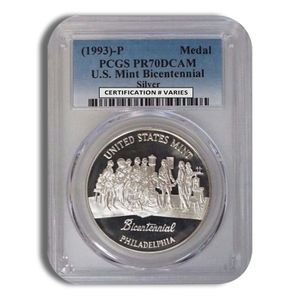
Our catalog also includes a few related formats. The 2018 George Washington and John Adams presidential medals and the 1993 Bicentennial proof medals are silver pieces from the U.S. Mint without a face value, and the reissued Morgan and Peace dollars are legal tender silver dollars honoring classic designs rather than an event or person in the traditional commemorative sense.
History and Background
Silver was the backbone of American coinage until the Coinage Act of 1965 removed it from dimes and quarters and cut the half dollar to 40% silver, which ended entirely after 1970. When Congress revived commemoratives in 1982, the George Washington half dollar was struck in 90% silver, the first coin of that composition the Mint had made since 1964.
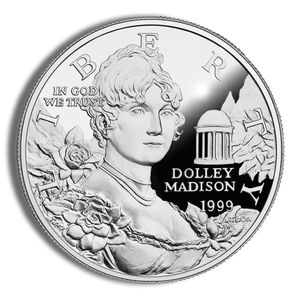
The 1983 Los Angeles Olympic dollar was the first commemorative silver dollar since the 1900 Lafayette dollar, and it set the standard that lasted for decades: .900 fine silver, sold in proof and uncirculated versions with a surcharge supporting a related cause. Over the next 36 years the Mint issued dozens of these dollars before moving to .999 fine silver with the 2019 programs.
The Bicentennial quarter belongs to the same story. For 1976 the Mint struck special 40% silver versions of the dual-dated 1776-1976 quarter, half dollar and dollar for collectors at San Francisco, which is why our catalog includes the quarter in both uncirculated and proof. Mexico's silver commemorative pesos from 1957, 1960, 1968 and 1972 reflect a parallel tradition from a country with one of the world's longest histories of silver mining.
Purity, Weight, and Specifications
Every U.S. commemorative silver dollar from 1983 through 2018 shares one specification: 26.73 grams of .900 fine silver, with the remaining 10% copper, for 0.7734 troy ounces of silver. Starting with the 2019 Apollo 11 and American Legion programs, the Mint kept the 26.73 gram weight but switched to .999 fine silver, raising the silver content to about 0.859 ounces. The 1982 Washington half dollar uses the older 90% standard and contains 0.3617 ounces.
The bullion-based pieces follow their own standards. American Silver Eagles are one troy ounce of .999 fine silver, the 2021 and later Morgan and Peace dollars are .999 fine at about 0.858 ounces, and the 2018 presidential silver medals are one ounce of .999 silver. The 40% silver Bicentennial quarter holds a little under a tenth of an ounce.
World issues vary by country. Mexico's 1957 5 pesos and its 1968 Olympic and 1972 Juarez 25 pesos are .720 fine, while the 1960 10 pesos is .900 fine with about 0.836 ounces of silver. Royal Canadian Mint pieces such as the 3/4 oz War of 1812 and Devil's Brigade coins are .9999 fine, and Perth Mint issues are generally .999 or .9999 fine, with the weight and purity often struck on the coin itself.
Available Brands, Mints, and Product Variations
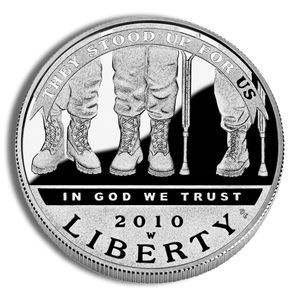
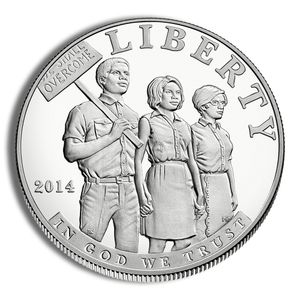
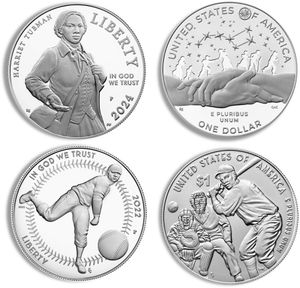
The U.S. Mint accounts for most of what we carry, and its silver dollars cover a wide sweep of subjects: the 1986 Statue of Liberty centennial, the 1987 Constitution and 1989 Congressional bicentennials, the 1991 Mount Rushmore and USO dollars, the 1992 White House and Columbus coins, the 1996 Smithsonian, 1997 Botanic Garden and Law Enforcement issues, the 2001 Buffalo, the 2004 Lewis and Clark and Thomas Edison dollars and many more. More recent programs include the 2009 Louis Braille, 2010 Boy Scouts, 2013 Girl Scouts, 2014 Baseball Hall of Fame and Civil Rights Act, 2016 Mark Twain and National Park Service, 2017 Boys Town and Lions Clubs, and 2018 Breast Cancer Awareness and World War I dollars.
Mint marks matter in this series because the same program was often struck at more than one facility. The 1983 Olympic dollar exists with P, D and S mint marks, the 1990 Eisenhower dollar was struck in uncirculated at West Point and in proof at Philadelphia, and the 2001 Buffalo dollar appears as a 2001-D uncirculated and 2001-P proof. Certified options include the 2001 Buffalo in NGC black slabs and PCGS holders, the 1994 World Cup in PF70, and the 2014 Baseball Hall of Fame dollar in MS70 and PF70.
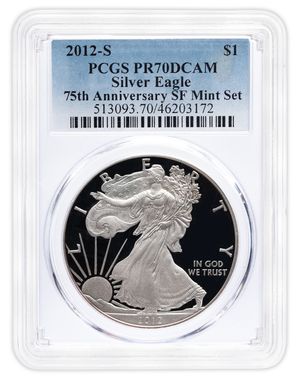
Anniversary sets form a separate group, including the 2006 20th Anniversary three-coin set, the 2011 25th Anniversary five-coin set, the 2012-S two-coin San Francisco set and the 2023-S Morgan and Peace reverse proof pair. From world mints you'll find the Perth Mint's Coral Sea and World War II half-ounce coins and its 2024 anniversary coin, Tuvalu's 60 Years of Bond issues including a gilded 2 oz proof, a 2021 St. Helena Queen's Virtues coin and Canada's Devil's Brigade coins, while random listings let us select a modern silver dollar for you, raw or certified.
Pricing, Premiums, and Market Factors
Silver commemoratives are priced as collectibles, with the silver content as the starting point rather than the whole story. A common .900 silver dollar in its original box may sell for a moderate premium over its 0.7734 ounces of silver, while scarce issues or top-grade examples can trade for several times their metal value.
Mintage drives most of that difference. The 1983 and 1984 Olympic and 1986 Statue of Liberty dollars were struck in large numbers, while uncirculated issues such as the 1996 Atlanta Olympic coins, the 1997-S Jackie Robinson and several 1990s military dollars had much smaller runs. Grade comes next, with MS70 and PF70 coins priced well above raw examples, and finish matters because in many programs the uncirculated version sold fewer coins than the proof. Coins with the original box and certificate of authenticity also carry more than loose coins, and popular subjects such as baseball, space and military service draw broader demand.
Silver's spot price still moves the baseline. Silver is used heavily in electronics, solar panels, medical products and industrial chemistry, and much of the world's supply is mined as a byproduct of copper, lead, zinc and gold production, so industrial conditions shape the metal value inside every coin. Our product pages show the live ask next to our bid, which helps separate the metal component from the collector premium on each listing.
Condition, Packaging, and What to Expect
Raw U.S. silver commemoratives sold with box and COA arrive in a hard plastic capsule inside the Mint's presentation case, with the certificate included. Proofs carry mirror-like fields and frosted designs, while uncirculated coins have a brighter satin finish.
Silver reacts with its environment, so many dollars from the 1980s and 1990s show light toning, haze or small white spots after decades in their capsules. That's typical of the series and isn't a sign of mishandling, though fully brilliant examples are more common in certified MS69 and MS70 holders. Graded coins come sealed in their NGC or PCGS slabs, including the NGC black slabs on certain 2001 Buffalo listings.
Random listings work a little differently. The modern silver dollar listing with protective capsule only contains a coin of our choosing in its capsule without a box or certificate, the no box and COA listing is a brilliant uncirculated coin without packaging, and the NGC or PCGS random year listing is a certified dollar whose date and design we select.
Authenticity and Verification
Every silver commemorative we sell is a genuine government issue, sourced through established wholesale and distributor channels. Before shipping, each coin is checked against its listing for date, mint mark, finish and packaging, and certified coins are matched to their holder labels.
Silver commemoratives have known specifications, which makes verification straightforward. A .900 silver dollar should weigh 26.73 grams, and a 2019 or later .999 dollar should weigh the same, so a scale accurate to a hundredth of a gram is a useful first check, along with a close look at lettering and design sharpness. For graded coins, the certification number can be entered on the NGC or PCGS website to confirm the coin and grade.
We're an authorized dealer for both NGC and PCGS and a member of the American Numismatic Association, and every coin is verified before it reaches you. That applies equally to a raw 1980s Olympic dollar and to a PF70 Baseball Hall of Fame coin.
Liquidity and Resale Considerations
Common modern silver dollars are among the most widely held U.S. commemoratives, and dealers buy them every day. Their bids, though, tend to sit near silver value plus a modest premium, especially for raw coins without packaging, so their resale behaves partly like silver bullion.
Scarcer and certified pieces trade differently. A low-mintage uncirculated dollar or an MS70 example depends on collector demand for that specific coin, and its bid can take longer to find the right buyer at a given price. Silver Eagle anniversary sets are easiest to resell complete and in their original packaging, since a broken set is usually valued coin by coin.
Storage and Security
Because silver tones and spots, environment is the first storage concern. Keep silver commemoratives in a cool, dry place, use silica gel or another desiccant in safes and boxes, and keep them away from rubber, wool, paper with sulfur content and anything that off-gasses.
Leave coins in their original capsules or holders, handle cases rather than coins, and never polish or dip silver, since cleaning permanently damages the surface and its value to collectors. If you store capsules apart from their Mint cases to save room, keep the cases and certificates together and clearly labeled.
Silver commemoratives take up more space than their weight suggests, especially in original packaging. A home safe works well for most collections, while a bank safe deposit box or a professional depository suits larger holdings, and a dated inventory with photos and certification numbers simplifies insurance.
Selling and Buyback Options
Silver commemoratives can be sold back to us on the same platform you buy them from. The bid on each product page reflects what we'll pay today, and our purchasing team guides the sale from price confirmation through shipment, verification and payment.
For common raw dollars, our bid follows the silver price closely with a premium for the original box and certificate. For scarce issues, certified coins and anniversary sets, pricing reflects recent trading for that specific coin, grade and packaging. Keeping coins in their capsules, cases and holders, and keeping sets intact, gives you the strongest bid.
Why Buy Silver Commemorative Coins?
Silver makes commemoratives accessible. A single coin costs a fraction of a gold commemorative, so you can build a complete set, follow a theme across dozens of programs or collect both proof and uncirculated versions without the outlay that gold requires.
Each coin also carries a defined amount of silver from a recognized government mint, from 0.7734 ounces in a .900 dollar to a full ounce in a Silver Eagle, so the metal underneath has a value you can measure independent of collector interest. The 2019 and later .999 dollars and the modern Morgan and Peace dollars hold more silver than the .900 issues, at about 0.86 ounces each.
The breadth of subjects is the other draw. Silver commemorative coins cover the Olympics, the armed forces, presidents, American institutions, sports, science and exploration, which gives almost every collector a coin that connects to something personal.
Why Buy from Bullion Standard?
Founded in San Diego in 2010, Bullion Standard grew into a national precious metals marketplace on a straightforward principle: you only get one chance to earn someone's trust. For silver commemoratives that means describing each coin's finish, mint mark and packaging exactly and showing you our buyback price next to our sale price.
Our credentials include an A+ rating from the Better Business Bureau, membership in the ANA and the National Coin and Bullion Association, and authorized dealer status with PCGS and NGC. We pay by the same standards we sell by, verifying every coin and backing each sale with a real two-way market.
You can check out with Visa, Mastercard, American Express, Discover, PayPal, Plaid bank payments, wire transfer, paper check or BitPay cryptocurrency. Our research tools also let you sort and compare products by premium, spread and liquidity, which is useful when deciding between similar silver dollars.
Get Near-Spot Pricing with Bullion Standard Pro
For members, Bullion Standard Pro replaces fixed retail pricing with live, executable wholesale bids and asks, without an added dealer markup or dealer spread. Prices move as wholesale supply and demand move, and members can transact at the level the market is actually trading.
Silver commemoratives keep their collector premiums at wholesale, so Pro doesn't make a 1997 Jackie Robinson dollar a spot-priced coin. It does show where that premium really sits. Members see holdings valued at live wholesale bid, and tools such as historical premium analysis, spread tightness and liquidity metrics show how a given coin has traded over time.
That's most useful for collectors who buy often, fill sets one coin at a time or simply want to know they're paying a market price for each silver commemorative they add. Membership details are available on the Bullion Standard Pro page.


 (833) 278-4653