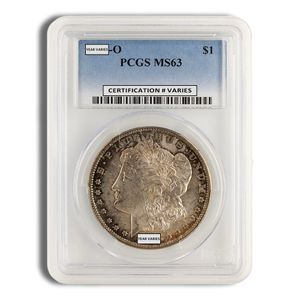
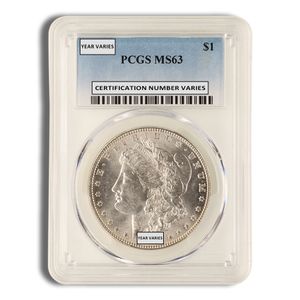
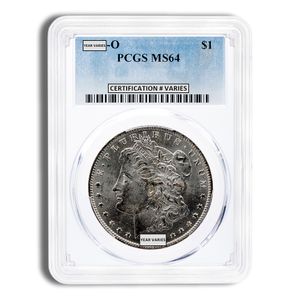
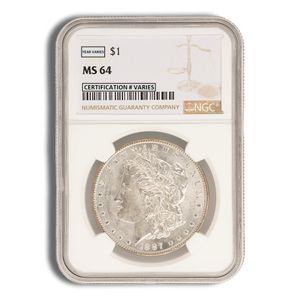
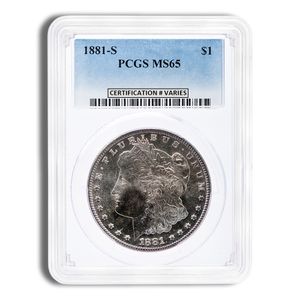
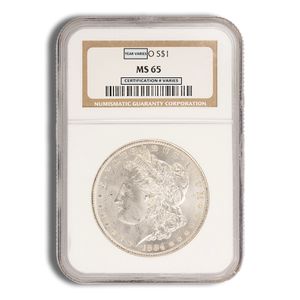
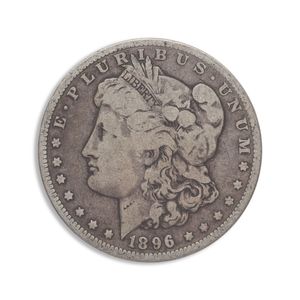
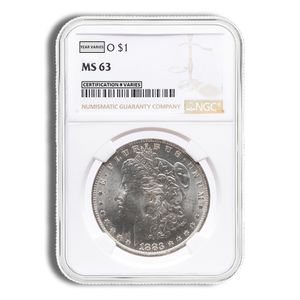
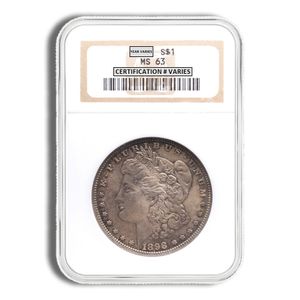
The Morgan silver dollar is one of the most widely recognized and actively traded coins in American numismatics. Struck at various United States Mint facilities between 1878 and 1904, each coin contains 0.7734 troy ounces of .900 fine silver and carries a face value of one dollar as legal tender of the United States. The specific example offered here has been graded MS65 by the Professional Coin Grading Service and exhibits natural toning, placing it firmly in the category of premium collectible silver with strong crossover appeal to both numismatists and bullion-oriented buyers.
We carry this coin as part of our broader offering of certified American numismatic silver. An MS65 designation from PCGS represents a gem-quality example with sharply struck design elements, exceptional luster, and only minor contact marks acceptable at that grade level. The toning present on this coin developed naturally over decades of storage and is recognized within the hobby as an aesthetic quality that can significantly influence collector demand.
The Morgan dollar takes its name from George T. Morgan, the as
…The Morgan silver dollar is one of the most widely recognized and actively traded coins in American numismatics. Struck at various United States Mint facilities between 1878 and 1904, each coin contains 0.7734 troy ounces of .900 fine silver and carries a face value of one dollar as legal tender of the United States. The specific example offered here has been graded MS65 by the Professional Coin Grading Service and exhibits natural toning, placing it firmly in the category of premium collectible silver with strong crossover appeal to both numismatists and bullion-oriented buyers.
We carry this coin as part of our broader offering of certified American numismatic silver. An MS65 designation from PCGS represents a gem-quality example with sharply struck design elements, exceptional luster, and only minor contact marks acceptable at that grade level. The toning present on this coin developed naturally over decades of storage and is recognized within the hobby as an aesthetic quality that can significantly influence collector demand.
The Morgan dollar takes its name from George T. Morgan, the assistant engraver at the Philadelphia Mint who designed the coin. Congress authorized the series through the Bland-Allison Act of 1878, which required the federal government to purchase and coin large quantities of domestic silver as a concession to Western mining interests. Production continued at multiple facilities, including Philadelphia, New Orleans, San Francisco, and Carson City, until 1904, when the series was temporarily suspended due to depleted silver reserves.
The 1878-1904 span covers the original run of the Morgan dollar before its brief revival in 1921. Coins from this era were produced during a period of significant monetary debate in the United States, when the role of silver in the monetary system was a central political issue. The mint facilities involved in production each brought their own striking characteristics, and coins can often be attributed to a specific facility through the mint mark located on the reverse.
Today, the Morgan dollar occupies a unique position as both a circulated and collectible series. Original mintages were substantial, but attrition through circulation, melting under the Pittman Act, and decades of use means that truly gem-quality survivors in MS65 and above represent a small fraction of the original population. PCGS population reports provide documented census data that can be referenced when evaluating relative scarcity at this grade level.
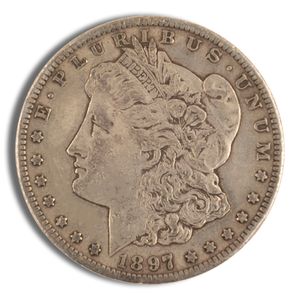
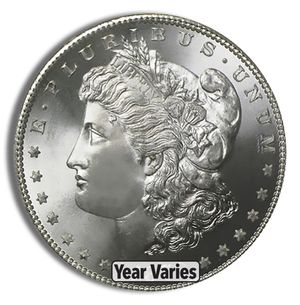
The obverse features a left-facing portrait of Lady Liberty wearing a Phrygian cap adorned with wheat and cotton, the latter symbolizing American agricultural abundance. The design was modeled after Anna Willess Williams, a Philadelphia schoolteacher whom Morgan used as a reference for the portrait. The word "LIBERTY" appears on the headband, and thirteen stars encircle the portrait along with the date and the motto "E PLURIBUS UNUM."
The reverse presents a heraldic eagle with outstretched wings, clutching an olive branch and arrows, with a union shield at its chest. The denomination "ONE DOLLAR" appears at the base, flanked by the inscriptions "UNITED STATES OF AMERICA" and "IN GOD WE TRUST." The overall composition is bold and well-defined, and in MS65 condition the devices and fields retain the full cartographic sharpness that makes high-grade Morgans visually compelling.
The toned designation on this coin reflects naturally occurring color development across the coin's surface, which can range from golden and amber hues to more complex blues, purples, and greens depending on the coin's storage history and chemical environment. Eye-appealing original toning is widely sought in the collector market and is considered by PCGS graders when assigning grade. The specific toning characteristics of each coin will vary, making every toned example unique.
Every coin we offer in this listing has been independently authenticated and graded by PCGS, one of the two most widely respected third-party grading services in the numismatic industry. The PCGS slab encapsulates the coin in a tamper-evident holder that displays the grade, certification number, and designation, all of which can be verified through the PCGS online registry. We are an authorized PCGS dealer, which gives us direct access to certified inventory and the ability to stand behind the authenticity of every graded coin we sell.
The .900 fine silver content and 0.7734 troy ounce weight of the Morgan dollar are fixed by the Coinage Act of 1873 and were maintained consistently across all mint facilities and production years within the 1878-1904 span. The PCGS certification process independently confirms the coin's authenticity, which includes its metal composition and die characteristics. Buyers can reference the certification number on the holder to pull the coin's full grading history and population data directly from PCGS.
MS65 is a gem-uncirculated grade that indicates the coin has never seen circulation and retains full original mint luster across both obverse and reverse. At this level, PCGS permits only a small number of scattered contact marks or minor blemishes that are not distracting to the naked eye. The strike is expected to be sharp, and the surfaces should be free of significant abrasions, hairlines, or environmental damage. Toned examples graded MS65 have passed PCGS review confirming that the toning is natural and did not mask underlying surface problems.
Each coin arrives in its original PCGS hard plastic slab, which serves as both protective packaging and a sealed certificate of grade and authenticity. The holder is designed to prevent handling damage and maintain the coin's condition as graded. No additional packaging beyond the slab is required for standard storage, and the format is universally compatible with PCGS-specific coin storage products used by collectors and dealers alike.
Pricing for this coin reflects both its silver content and its numismatic premium above the intrinsic metal value. The spot price of silver establishes a floor, but the MS65 grade and the toned designation introduce additional pricing variables that are driven by collector demand, population data from PCGS, and the specific visual appeal of the toning on each individual coin. Unlike generic bullion, where premiums are relatively predictable, certified numismatic coins trade across a wider range based on these grade-specific and aesthetic factors.
Our pricing reflects real-time market conditions and is updated to remain consistent with current wholesale and secondary market activity for PCGS-graded Morgan dollars at this grade level. The bid/ask spread displayed on our product page gives buyers direct visibility into both acquisition cost and current resale pricing, allowing for a more complete picture of the total cost of ownership rather than just the purchase price in isolation.
PCGS-certified Morgan silver dollars in MS65 are among the more actively traded items in the certified U.S. coin market. The combination of widely recognized design, standardized silver content, trusted third-party certification, and a well-documented population report makes this coin straightforward to price and transact in secondary market environments. Dealers, auction platforms, and private collectors all actively trade certified Morgans, and the PCGS certification substantially reduces the friction typically associated with authenticating older U.S. silver coinage.
We operate a two-way market that supports both purchases and buybacks, meaning customers can sell certified coins back to us using the same transparent pricing structure they used to buy. Liquidity for toned MS65 examples can vary depending on the visual quality of the toning, and coins with more aesthetically desirable color patterns tend to command stronger secondary market pricing. Our platform displays live bid pricing that reflects current wholesale market conditions, giving sellers a realistic picture of what their coins are worth at any given time.
The Morgan dollar at the MS65 grade level occupies a segment of the market where numismatic interest and silver bullion ownership genuinely converge. The silver content provides a measurable intrinsic value that moves with the spot market, while the PCGS certification and gem-quality grade add a layer of collector premiums that reflect scarcity at that population level. For buyers who want certified American silver with a historical identity rather than a generic round or bar, the MS65 Morgan is one of the most logical entry points in the series.
The toning designation adds a further dimension that differentiates this coin from standard certified Morgans. Coins with attractive natural toning are actively sought by advanced collectors, and eye-appealing examples with desirable color can trade at meaningful premiums relative to untoned coins at the same numeric grade. The PCGS certification confirms that the toning passed grading scrutiny, which removes one of the primary uncertainties buyers encounter when evaluating toned coins in unslabbed condition.
We are an authorized dealer for both PCGS and NGC, which gives us legitimate access to certified inventory and the ability to verify every coin we sell through the grading service's own registry. Our A rating with the Better Business Bureau and membership in the American Numismatic Association and National Coin and Bullion Association reflect a long-standing commitment to professional standards in both the bullion and numismatic segments of the market. We do not treat graded coins as an afterthought to our bullion inventory; they are a deliberate part of what we offer.
Transparent pricing is central to how we operate. Every product page displays both the ask and the bid, so you can evaluate a purchase with full awareness of the current market spread before committing. Our two-way market model means liquidity is factored into the transaction from the start, not something you have to figure out independently after the purchase has already been made. We prioritize the kind of pricing clarity and post-purchase support that makes buying certified numismatic silver a straightforward experience rather than an opaque one.
Bullion Standard Pro gives members access to live, executable wholesale bid and ask pricing across a wide range of certified and bullion products, including PCGS-graded coins like this Morgan dollar. For numismatic silver in particular, understanding where a product trades at the wholesale level relative to retail listings can make a meaningful difference in how you evaluate premiums and bid/ask spreads. Pro members can also access historical premium data and population-adjusted analytics that help contextualize whether current pricing reflects strong or soft demand within the certified coin market.
Portfolio valuation through Pro uses live wholesale bid pricing rather than estimated retail values, which provides a more accurate picture of what your certified holdings are actually worth in the current market. For toned coins, where premiums can shift based on changing collector preferences, having access to objective pricing data rather than static estimates is particularly useful when making informed buying or selling decisions.
We support a broad range of payment methods to make purchasing as straightforward as possible. Buyers can complete transactions using Visa, Mastercard, American Express, or Discover, as well as PayPal, bank-connected payments through Plaid, wire transfer, and paper check. Cryptocurrency payments are also accepted through BitPay for buyers who prefer that option.
Every transaction on our platform is handled with security and reliability as the baseline expectation. Whether you are completing a single certified coin purchase or building out a larger position in graded numismatic silver, the checkout process is designed to be clear, efficient, and protected from start to finish.
Product ID: BST-0021331204
| Random Year Status | Random Year |
|---|---|
| Precious Metal Type | Silver |
| Bullion Coin Type | Morgan Dollar |
| Format | Coin |
| Country of Origin | United States |
| Brand/Mint | U.S. Mint |
| Mint Mark | Various |
| Purity | 0.9 |
| Weight | 0.7734 oz |
| Thickness (mm) | 2.4 mm |

| Diameter (mm) | 38.1 mm |
| Inner Pack (Quantity) | 20 |
| Grade | MS65 |
| Grading Service | PCGS |
The Morgan silver dollar is one of the most widely recognized and actively traded coins in American numismatics. Struck at various United States Mint facilities between 1878 and 1904, each coin contains 0.7734 troy ounces of .900 fine silver and carries a face value of one dollar as legal tender of the United States. The specific example offered here has been graded MS65 by the Professional Coin Grading Service and exhibits natural toning, placing it firmly in the category of premium collectible silver with strong crossover appeal to both numismatists and bullion-oriented buyers.
We carry this coin as part of our broader offering of certified American numismatic silver. An MS65 designation from PCGS represents a gem-quality example with sharply struck design elements, exceptional luster, and only minor contact marks acceptable at that grade level. The toning present on this coin developed naturally over decades of storage and is recognized within the hobby as an aesthetic quality that can significantly influence collector demand.
The Morgan dollar takes its name from George T. Morgan, the as
…The Morgan silver dollar is one of the most widely recognized and actively traded coins in American numismatics. Struck at various United States Mint facilities between 1878 and 1904, each coin contains 0.7734 troy ounces of .900 fine silver and carries a face value of one dollar as legal tender of the United States. The specific example offered here has been graded MS65 by the Professional Coin Grading Service and exhibits natural toning, placing it firmly in the category of premium collectible silver with strong crossover appeal to both numismatists and bullion-oriented buyers.
We carry this coin as part of our broader offering of certified American numismatic silver. An MS65 designation from PCGS represents a gem-quality example with sharply struck design elements, exceptional luster, and only minor contact marks acceptable at that grade level. The toning present on this coin developed naturally over decades of storage and is recognized within the hobby as an aesthetic quality that can significantly influence collector demand.
The Morgan dollar takes its name from George T. Morgan, the assistant engraver at the Philadelphia Mint who designed the coin. Congress authorized the series through the Bland-Allison Act of 1878, which required the federal government to purchase and coin large quantities of domestic silver as a concession to Western mining interests. Production continued at multiple facilities, including Philadelphia, New Orleans, San Francisco, and Carson City, until 1904, when the series was temporarily suspended due to depleted silver reserves.
The 1878-1904 span covers the original run of the Morgan dollar before its brief revival in 1921. Coins from this era were produced during a period of significant monetary debate in the United States, when the role of silver in the monetary system was a central political issue. The mint facilities involved in production each brought their own striking characteristics, and coins can often be attributed to a specific facility through the mint mark located on the reverse.
Today, the Morgan dollar occupies a unique position as both a circulated and collectible series. Original mintages were substantial, but attrition through circulation, melting under the Pittman Act, and decades of use means that truly gem-quality survivors in MS65 and above represent a small fraction of the original population. PCGS population reports provide documented census data that can be referenced when evaluating relative scarcity at this grade level.
The obverse features a left-facing portrait of Lady Liberty wearing a Phrygian cap adorned with wheat and cotton, the latter symbolizing American agricultural abundance. The design was modeled after Anna Willess Williams, a Philadelphia schoolteacher whom Morgan used as a reference for the portrait. The word "LIBERTY" appears on the headband, and thirteen stars encircle the portrait along with the date and the motto "E PLURIBUS UNUM."
The reverse presents a heraldic eagle with outstretched wings, clutching an olive branch and arrows, with a union shield at its chest. The denomination "ONE DOLLAR" appears at the base, flanked by the inscriptions "UNITED STATES OF AMERICA" and "IN GOD WE TRUST." The overall composition is bold and well-defined, and in MS65 condition the devices and fields retain the full cartographic sharpness that makes high-grade Morgans visually compelling.
The toned designation on this coin reflects naturally occurring color development across the coin's surface, which can range from golden and amber hues to more complex blues, purples, and greens depending on the coin's storage history and chemical environment. Eye-appealing original toning is widely sought in the collector market and is considered by PCGS graders when assigning grade. The specific toning characteristics of each coin will vary, making every toned example unique.
Every coin we offer in this listing has been independently authenticated and graded by PCGS, one of the two most widely respected third-party grading services in the numismatic industry. The PCGS slab encapsulates the coin in a tamper-evident holder that displays the grade, certification number, and designation, all of which can be verified through the PCGS online registry. We are an authorized PCGS dealer, which gives us direct access to certified inventory and the ability to stand behind the authenticity of every graded coin we sell.
The .900 fine silver content and 0.7734 troy ounce weight of the Morgan dollar are fixed by the Coinage Act of 1873 and were maintained consistently across all mint facilities and production years within the 1878-1904 span. The PCGS certification process independently confirms the coin's authenticity, which includes its metal composition and die characteristics. Buyers can reference the certification number on the holder to pull the coin's full grading history and population data directly from PCGS.
MS65 is a gem-uncirculated grade that indicates the coin has never seen circulation and retains full original mint luster across both obverse and reverse. At this level, PCGS permits only a small number of scattered contact marks or minor blemishes that are not distracting to the naked eye. The strike is expected to be sharp, and the surfaces should be free of significant abrasions, hairlines, or environmental damage. Toned examples graded MS65 have passed PCGS review confirming that the toning is natural and did not mask underlying surface problems.
Each coin arrives in its original PCGS hard plastic slab, which serves as both protective packaging and a sealed certificate of grade and authenticity. The holder is designed to prevent handling damage and maintain the coin's condition as graded. No additional packaging beyond the slab is required for standard storage, and the format is universally compatible with PCGS-specific coin storage products used by collectors and dealers alike.
Pricing for this coin reflects both its silver content and its numismatic premium above the intrinsic metal value. The spot price of silver establishes a floor, but the MS65 grade and the toned designation introduce additional pricing variables that are driven by collector demand, population data from PCGS, and the specific visual appeal of the toning on each individual coin. Unlike generic bullion, where premiums are relatively predictable, certified numismatic coins trade across a wider range based on these grade-specific and aesthetic factors.
Our pricing reflects real-time market conditions and is updated to remain consistent with current wholesale and secondary market activity for PCGS-graded Morgan dollars at this grade level. The bid/ask spread displayed on our product page gives buyers direct visibility into both acquisition cost and current resale pricing, allowing for a more complete picture of the total cost of ownership rather than just the purchase price in isolation.
PCGS-certified Morgan silver dollars in MS65 are among the more actively traded items in the certified U.S. coin market. The combination of widely recognized design, standardized silver content, trusted third-party certification, and a well-documented population report makes this coin straightforward to price and transact in secondary market environments. Dealers, auction platforms, and private collectors all actively trade certified Morgans, and the PCGS certification substantially reduces the friction typically associated with authenticating older U.S. silver coinage.
We operate a two-way market that supports both purchases and buybacks, meaning customers can sell certified coins back to us using the same transparent pricing structure they used to buy. Liquidity for toned MS65 examples can vary depending on the visual quality of the toning, and coins with more aesthetically desirable color patterns tend to command stronger secondary market pricing. Our platform displays live bid pricing that reflects current wholesale market conditions, giving sellers a realistic picture of what their coins are worth at any given time.
The Morgan dollar at the MS65 grade level occupies a segment of the market where numismatic interest and silver bullion ownership genuinely converge. The silver content provides a measurable intrinsic value that moves with the spot market, while the PCGS certification and gem-quality grade add a layer of collector premiums that reflect scarcity at that population level. For buyers who want certified American silver with a historical identity rather than a generic round or bar, the MS65 Morgan is one of the most logical entry points in the series.
The toning designation adds a further dimension that differentiates this coin from standard certified Morgans. Coins with attractive natural toning are actively sought by advanced collectors, and eye-appealing examples with desirable color can trade at meaningful premiums relative to untoned coins at the same numeric grade. The PCGS certification confirms that the toning passed grading scrutiny, which removes one of the primary uncertainties buyers encounter when evaluating toned coins in unslabbed condition.
We are an authorized dealer for both PCGS and NGC, which gives us legitimate access to certified inventory and the ability to verify every coin we sell through the grading service's own registry. Our A rating with the Better Business Bureau and membership in the American Numismatic Association and National Coin and Bullion Association reflect a long-standing commitment to professional standards in both the bullion and numismatic segments of the market. We do not treat graded coins as an afterthought to our bullion inventory; they are a deliberate part of what we offer.
Transparent pricing is central to how we operate. Every product page displays both the ask and the bid, so you can evaluate a purchase with full awareness of the current market spread before committing. Our two-way market model means liquidity is factored into the transaction from the start, not something you have to figure out independently after the purchase has already been made. We prioritize the kind of pricing clarity and post-purchase support that makes buying certified numismatic silver a straightforward experience rather than an opaque one.
Bullion Standard Pro gives members access to live, executable wholesale bid and ask pricing across a wide range of certified and bullion products, including PCGS-graded coins like this Morgan dollar. For numismatic silver in particular, understanding where a product trades at the wholesale level relative to retail listings can make a meaningful difference in how you evaluate premiums and bid/ask spreads. Pro members can also access historical premium data and population-adjusted analytics that help contextualize whether current pricing reflects strong or soft demand within the certified coin market.
Portfolio valuation through Pro uses live wholesale bid pricing rather than estimated retail values, which provides a more accurate picture of what your certified holdings are actually worth in the current market. For toned coins, where premiums can shift based on changing collector preferences, having access to objective pricing data rather than static estimates is particularly useful when making informed buying or selling decisions.
We support a broad range of payment methods to make purchasing as straightforward as possible. Buyers can complete transactions using Visa, Mastercard, American Express, or Discover, as well as PayPal, bank-connected payments through Plaid, wire transfer, and paper check. Cryptocurrency payments are also accepted through BitPay for buyers who prefer that option.
Every transaction on our platform is handled with security and reliability as the baseline expectation. Whether you are completing a single certified coin purchase or building out a larger position in graded numismatic silver, the checkout process is designed to be clear, efficient, and protected from start to finish.